












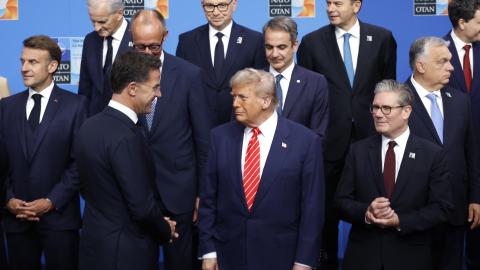
Many on the right have joined President Donald Trump’s heated ridicule of the behavior of our European allies during Operation Epic Fury: their risk aversion, penchant for process over decision and action, and overall lack of preparedness and capability to confront the Iranian terror threat, while simultaneously criticizing the one ally with the will and capability to do so. The transatlantic alliance has in fact been unhealthy for some time, dating back to before the Obama administration conspired with German Chancellor Angela Merkel to reset relations with Russia and pursued policies, including the Paris Climate Accords, that weakened the West to the advantage of China. But there is much more to the story, and today both sides of the Atlantic should grapple with some hard truths and work to end the feuding. The United States needs NATO allies and is the indispensable leader of the alliance for the foreseeable future.
“I am not currently recommending any additional changes to our posture in Europe.” That was the congressional testimony of General Alexus Grynkewich, commander of the U.S. European Command and the NATO Supreme Allied Commander Europe, on March 18. Roughly six weeks later, the Department of Defense announced that it would withdraw 5,000 American troops from Germany. The announcement followed President Trump’s Truth Social post suggesting that he was considering withdrawing troops after German Chancellor Friedrich Merz claimed that Iran was “humiliating” the United States.
The Department of Defense then sent a notice to Congress specifying that the planned deployment of a Long-Range Fires Battalion (LRFB) to Germany was also canceled. That deployment was possible only because Trump rightly withdrew the United States from the Intermediate Nuclear Forces (INF) Treaty during his first term, after Russia deployed prohibited systems in violation of it. He did so over intense opposition from Democrats. The Biden administration was later forced to grapple with the same acute Russian threat to Europe and, remarkably, initiated the deployment of the LRFB to strengthen deterrence and prevent Russia from expanding its war beyond Ukraine. The LRFB deployment could have been a masterly strategic accomplishment of Trump’s second term. But it is now poised to be undone by his own war department — if Congress permits it. There is already bipartisan objection to the announcement.
In early March, Merz said that he and Trump were “on the same page in terms of getting this terrible regime in Tehran away.” He was right. The Islamic Republic’s terrorism exports and missile force have posed as great a threat to European security as they have to American and Israeli security. But the war is unpopular in Germany, and Merz’s claim that the Iranians were “humiliating” the United States was aimed at a domestic audience. As bad as the comment was, removing U.S. troops from Germany isn’t a reasonable punishment in part because, despite Merz’s public kvetching, Germany has been quietly and steadily enabling Trump’s ongoing war against Iran. General Grynkewich explained during those recent congressional hearings that, despite the initial and highly publicized British refusal to permit the United States to initiate bomber strikes against Iran from the joint base at Diego Garcia, and despite complaints from some European politicians, the reality is that European countries are helping, and more than passively so.
Merz’s public insistence that “Germany is not a party to this war, and we do not want to become one” does not change the fact that Germany has been key to Operation Epic Fury. Ramstein Air Base is a central command-and-logistics hub for the military campaign, and there are no flight restrictions at German bases. Germany under Merz has also been receptive to the United States’ urging that Europeans share more of the defense burden across NATO and shoulder more of the help for Ukraine. Germany is the largest European buyer of American weapons and the largest supplier of weapons to Ukraine. Under Merz, Germany has agreed with Trump’s criticisms of previous German policies to dismantle nuclear power plants in favor of dependence on Russian gas. Friedrich Merz is no Angela Merkel.
In London, Prime Minister Keir Starmer’s ghastly decision to prevent the United States from operating freely from Diego Garcia was reversed within days. The United States has since operated freely out of the joint base, as well as out of RAF Fairford in Gloucestershire and a network of other U.K. bases, including RAF Menwith Hill, RAF Molesworth, RAF Croughton, and RAF Digby. And, despite Starmer’s condemnations of the United States’ war against the Iranian regime, the U.K. military is working closely with the Americans on providing intelligence. British politicians may have pandered to domestic audiences who oppose the war, but British air defenders have been busy intercepting hundreds of Iranian drones heading toward Gulf states where American forces are deployed, and the Royal Air Force is flying sorties in the Middle East to help counter Iranian attacks.
France’s Emmanuel Macron has also aggravated Trump. At a dinner, Trump said Macron was willing to help with the Strait of Hormuz, but only after the war ended. Trump mocked the French president and derided NATO as a “paper tiger.” But France is also playing an important role in support of Operation Epic Fury. The French are giving the United States access to sovereign French bases and granting overflight access to hundreds of sorties. They sent air-defense systems, including a SAMP/T and multiple helicopters, to the United Arab Emirates, Qatar, and Kuwait. This is in addition to the dozens of Rafale fighters they have deployed to the UAE for air-to-air defense. The French armed forces have moved their sole aircraft carrier from the Baltic Sea to the Eastern Mediterranean, positioned eight frigates in the wider Northern Indian Ocean, and are currently routing two minesweepers to the region.
Among NATO’s smaller members, public support from their governments has been clearer. Belgium’s defense minister called the U.S. war “a righteous cause to try to decapitate the Ayatollah regime.” All three Baltic states have expressed support for the United States. Foreign Minister Margus Tsahkna of Estonia stated that Estonia backs the United States and Israel in “every action that curbs the Iranian regime’s capabilities,” and dozens of Estonian parliamentarians signed a statement of support. Lithuania’s president put the matter bluntly: “We cannot say with one hand that the presence of U.S. troops on the territory of Lithuania is a matter of course and we simply accept it as a given, but when we are asked to contribute to international missions, we say that this is none of our business.” No doubt if they weren’t rightly prioritizing the acute threat from Russia, they would send whatever military forces they had.
A sign of the strange times is that some commentators, taking cues from President Trump’s public haranguing of European allies, now suggest that the Gulf states are more helpful allies than old Europe. Sure, Saudi Arabia, Qatar, and the UAE are cooperating with the United States and Israel by sharing intelligence and allowing logistical access. It represents a welcome change in the region. Still, this new and bolder support does not come close to the contributions the United States receives from European allies, whose integration with the U.S. military reflects decades of joint planning, earned trust, and military competencies forged through combat in the Middle East and coordinated war-gaming exercises as part of active deterrence against Russia.
Even so, Trump has threatened to punish Europeans for not doing enough or for their political leaders’ public criticisms. Beyond removing troops from Germany, ideas have ranged from withdrawing troops from Spain — despite the indispensability of Naval Station Rota — to no longer recognizing the Falklands as British territory, a report mercifully dismissed by Secretary of State Marco Rubio. Redeploying U.S. forces may sometimes be necessary as threats change, but removing troops as punishment from host nations that enable U.S. power projection amounts to cutting off America’s nose to spite our face.
This does not mean that American frustrations with European allies aren’t legitimate. Starmer’s public criticisms of the war, antagonistic remarks about Israel, and initial refusal to grant full access to Diego Garcia earned anger not only from President Trump. Republican members of Congress who value NATO and the special relationship were dismayed by London. Spain was — and remains — the European ally most defiant of Trump and opposed to seeing the United States win Epic Fury. Prime Minister Pedro Sánchez not only condemned the war; the socialist leader also lambasted Trump and has refused to permit United States strikes from Spanish bases. Spain has long been an obstinate NATO member and was the only ally to refuse Trump’s call for defense spending at 5 percent of GDP, the alliance’s stated standard.
The fact is, though, that while NATO’s members share a national security interest in an American victory, Operation Epic Fury is not a NATO mission. The United States neither informed nor consulted allies, nor did it ask for assistance, before it and Israel went to war. There were sound reasons for acting this way, but it nonetheless makes it politically difficult for European leaders to express enthusiasm at the start of the war. Compounding matters, Trump initiated Epic Fury mere weeks after threatening to forcibly take control of Denmark’s territory of Greenland and publicly humiliating ally leaders who opposed those threats.
Trump’s focus on Greenland has shone a spotlight on the United States’ profound national security interest in preventing Russia or China from taking control of the Arctic. But the threat to forcibly seize Greenland — even if one believes it was a Trumpian maximalist bluff — created a serious rupture of trust among allies who had been willing to bear with tariffs and public rebukes, and it collapsed goodwill among the most pro-American factions in European capitals, where favorable views of the U.S. dropped to an all-time low.
European conservatives from the U.K. to Germany to Poland who otherwise expressed solidarity with Trump and the American right on border security and immigration also condemned the Greenland gambit and did so forcefully. And there is no political support in the United States for seizing Greenland, which likely explains why the president dropped the issue and left it to Rubio and NATO Secretary General Mark Rutte to pursue a diplomatic resolution with Denmark.
What made the episode especially breathtaking was its timing. Just months earlier, Trump had been praising Europe’s willingness to invest more in conventional defense and shoulder a greater share of NATO’s burden. The Greenland crisis also followed immediately after the highly successful U.S. raid to capture Venezuelan dictator Nicolás Maduro. That achievement should have dominated the news cycle, allowing the administration to highlight its military competence and deter adversaries. Instead, Trump’s Greenland threats had a serious negative impact on U.S. influence and worked directly against his broader objectives, including rallying allies to help open up the Strait of Hormuz.
It is one thing to demand that allies rebuild and invest in their militaries and carry a greater share of the collective defense burden; it’s quite another to castigate them, let alone threaten their sovereignty. It should surprise no one that European democratic leaders now lack domestic political mandates to openly join the war. And yet, because of abiding shared interests, Europeans have been working with the United States to execute Epic Fury, if only quietly.
So what now? Europeans are at least a decade or more from having the military capabilities to replace what the United States provides. They need the United States to remain the backbone of NATO for the foreseeable future. And the United States needs the collaboration of its European allies not only to help provide security against Russia but to project power into Africa and the Middle East from European bases. Again, Grynkewich explained this to Congress. He said, “To fly bombers from the United States, or even from locations in the theater, and project power into the Middle East requires a tanker bridge. That tanker bridge is projected from USEUCOM bases.” In plain English: we refuel, safely, from supportive and trustworthy European allies. To remove the infrastructure in Europe that gives U.S. forces communications, weapons-detection abilities, intelligence, and logistics would cost the United States dearly.
It’s time for the U.S. and Europe to cease the feuding.
The United States is winning against the Islamic Republic, but to turn military success in the campaign into a geopolitical masterstroke, Trump will need an international armada to escort ships through the Strait of Hormuz. And to get that, he will have to adjust his diplomatic approach — not toward our enemies but toward our allies. Rather than publicly berating allies, he should move the disagreements to private channels. It should go without saying, but there should be some formal acknowledgment on the U.S. side that there will be no more threats over Denmark’s territory. And on the other side of the Atlantic, European leaders should explain to their skeptical publics that the American campaign against the Iranian regime has served their interests, has made them safer, and merits support.
Security conditions in the Strait of Hormuz are sufficient for the mission to be underway, which is why the United States is more forcefully transiting the strait with U.S. Navy destroyers. Operation Epic Fury has eliminated most of Iran’s defense-industrial base, including its ballistic missile arsenal, launchers, and long-range drones. Iran’s navy has been largely neutralized after losing 150 warships and the bulk of its naval mine inventory. More than 250 senior Iranian officials have been killed and some 2,000 command-and-control structures struck.
Even so, the rump Iranian regime continues to try to attack U.S. ships, and it appears that Trump is prepared to resume military operations against Iran to further degrade the Islamic Revolutionary Guard Corps’ ability to terrorize the strait. European leaders should support the resumption of U.S. strikes and stand ready with a multinational armada as soon as the last wave of operations concludes. The more the United States can internationalize its efforts to restore and maintain a free and open maritime corridor through the strait, the faster — and more permanently — it can reopen a choke point that carries roughly 25 percent of global seaborne energy. The official position of the U.K. is that it is willing to help keep the strait open, and the French defense minister has said that the French, Belgians, and Dutch have a joint mine-clearing program that they could contribute. They’re not the only potential partners. Bringing more allies into the campaign would help overwhelm whatever IRGC elements remain willing to harass shipping along the coast.
Although U.S. energy dominance enables the United States to absorb disruptions caused by Iranians terrorizing the strait, it remains politically desirable for Washington to end the war decisively — and as soon as possible — and to bring gasoline prices below $3 per gallon. For U.S. allies and partners, reopening the strait is not merely desirable but imperative.
India, for example, sources nearly half of its crude oil through the strait, and the conflict is already inflicting costs on the population of this crucial U.S. partner. While only about 4 percent of European crude oil imports pass directly through Hormuz, Europe has reduced its dependence on Russian energy by sourcing roughly 8 percent of its liquefied natural gas import requirements from Qatar, shipments that must also pass through the strait. That shift followed pressure that began during the first Trump administration to end reliance on Russian energy, including sanctions implemented on the Nord Stream 2 natural gas pipeline. To complete the picture, 75 percent of Europe’s jet-fuel imports come from the Gulf region. For Japan, around 95 percent of oil imports pass through the strait; for South Korea, roughly 70 percent of crude imports do so.
It is intolerable for the United States or any of its allies to permit Iran to run an extortion racket by charging fees for safe passage. Doing so would concede unacceptable leverage to Tehran — and by extension, to China, Iran’s most powerful backer — and set a dangerous precedent for Chinese ambitions in the South China Sea. Whether or not Trump says he needs allies and whether or not allies want this war to be their war, shared interests remain clear: The Islamic Republic must lose and the United States and Israel win.
Trump is at his best when he urges Europeans to be strong and to work with the United States. As Secretary Rubio said in his Munich speech, “We believe that Europe must survive, because the two great wars of the last century serve for us as history’s constant reminder that ultimately, our destiny is and will always be intertwined with yours. . . . We should be proud of what we achieved together in the last century, but now we must confront and embrace the opportunities of a new one — because yesterday is over, the future is inevitable, and our destiny together awaits.”
King Charles III recently concluded a warm state visit to the United States, which could not have been timelier. Trump and Charles got along very well, and Trump even lifted sanctions on Scottish whiskey as a favor to Charles — even after Charles delivered a speech to a joint session of Congress extolling Ukrainian bravery and underscoring the need to support NATO. The address elicited a bipartisan standing ovation and compliments from Trump. The visit gives Europeans something to build on. Repairing transatlantic relations is necessary, and Trump has shown he is willing to change course if it serves his interests. Trump’s direction to remove 5,000 American troops from Germany may be redeemed, if, for example, the president shifts them to NATO’s eastern front — Poland or Romania — and he can easily reverse the decision not to deploy the LRFB missile battalion. Poland has already publicly signaled it would be happy to host additional U.S. forces. The threat from Russia against Europe remains acute, and this move would go a long way to assure allies and Putin that the United States is committed to NATO.
We have heard often that “America First” does not mean America alone. But if the United States behaves like a bully toward its allies, we may find ourselves feeling increasingly lonelier than we’d like. Trump has initiated a war that American and Israeli forces have executed with the help of allies — privately — to the benefit of the entire world. Allies will be needed in a much more public way to help win the peace.