















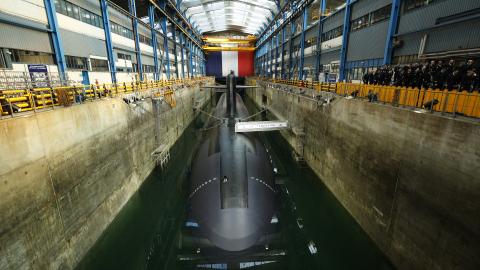
“What you see before you is a precious legacy of which we are the custodians, and which we will continue to sustain with determination,” declared President Emmanuel Macron on March 2, 2026, standing before the massive dry-docked hull of a Triomphant-class submarine in Île Longue.[1] The formulation deliberately anchored French nuclear policy in continuity—a shared strategic matrix that transcends partisan divides and that the country has tasked every president since 1959 with preserving and strengthening. Macron’s speech underscored France’s distinct nuclear history and reflected a doctrine remarkably stable in its core principles thanks to decades of strategic experience.
Yet far from being a routine reaffirmation, this moment marks a turning point in posture and expression. Without overturning the Gaullist foundations of deterrence, Macron introduced adjustments in scale, signaling, and scope that collectively amount to a qualitative shift in how the French conceive and communicate deterrence.
In that sense, the Île Longue address stands as a landmark moment in the history of French nuclear doctrine—not because it broke with the past but because it reinterpreted the doctrine’s legacy under new strategic conditions.
Macron is decisively anchoring his nuclear doctrine in what Admiral Pierre Vandier has described as the “third nuclear age.”[2] It is a world that increasingly blurs the boundaries between war and peace and between external and internal threats; a world defined by systemic competition and the return of great-power ambitions; a world in which, after nonproliferation efforts dominated for decades, nuclear weapons are again becoming a structuring factor of power and, with a more dangerous and unstable multipolar character, are returning to the very center of strategic balance.
To fully grasp the significance of this shift, one should first return to the origins of French nuclear doctrine.
The Birth of the French Nuclear Doctrine
General Charles de Gaulle, president of the French Republic from 1959 to 1969, laid the intellectual and strategic foundations of the nation’s nuclear doctrine. Scholars widely regard his speech on French defense at the École Militaire on November 3, 1959, as the defining political moment when he articulated France’s strategic vision at the dawn of the Fifth Republic. De Gaulle argued that the emergence of nuclear parity between the United States and the Soviet Union had fundamentally altered the credibility of the American nuclear guarantee. In such a context, he believed France needed its own finite nuclear force capable of deterring any attack against its territory while preserving full strategic autonomy in its potential use.
If de Gaulle’s vision of France’s military independence rested on the existence of “a strike force that could be deployed at any time and anywhere,”[3] analysts should understand him more as the political champion of French nuclear strategy than as its sole intellectual architect. The deeper doctrinal thinking emerged from a group of military strategists who became known as the “four generals of the apocalypse”[4]—Generals André Beaufre, Pierre Gallois, Lucien Poirier, and Charles Ailleret. Their writings and strategic concepts shaped the conceptual framework of French nuclear deterrence in ways that strategists continue to underappreciate, particularly in Anglo-American strategic literature.
Beaufre focused on the question of the stability of nuclear deterrence and, following American research—notably that of Herman Kahn[5]—on the problems of escalation to which the Cuban Missile Crisis had drawn attention. Beaufre situated himself within a general strategic framework of bilateral deterrence between adversaries possessing equivalent capabilities.
Gallois, perhaps the most prolific of the four, developed the theory of indirect strategy and the notion of a strategy of dissuasion du faible au fort—deterrence of the strong by the weak—which gave intellectual legitimacy to a small but independent nuclear force.
Poirier contributed a rigorous philosophical and strategic architecture to the doctrine, theorizing the conditions and graduated logic of nuclear engagement. Ailleret, as chief of staff of the Armed Forces, operationalized these concepts and notably introduced the doctrine of deterrence tous azimuts—in all directions—signaling France’s refusal to subordinate its nuclear posture to any alliance framework.
At that time, de Gaulle’s speech announced the creation of what he called the force de frappe (strike force). France had not yet conducted its first nuclear test, yet it had already clearly established the doctrinal framework. The strategic concept underpinning the force de frappe is countervalue deterrence—the capacity to inflict such severe damage on an adversary’s population and economic centers that it would deter even a more powerful opponent from launching an attack, regardless of its own destructive capabilities.
In 1963, de Gaulle reaffirmed this logic, stating that “deterrence is proportional to the stake.”[6] In other words, deterrence exists as soon as a nuclear capability convinces a potential adversary that aggression would bring consequences so severe that it simply would not be worth the risk.
Deterrence Is the Core
Embedded within the framework of international law, French nuclear deterrence is at the core of French sovereignty and national defense.
France supports the Nuclear Non-Proliferation Treaty, the cornerstone of the global security architecture. It was also one of the first nuclear-armed states, alongside the United Kingdom, to sign and ratify the Comprehensive Nuclear-Test-Ban Treaty, and it has permanently dismantled its testing sites. Since then, the design and reliability of weapons rest exclusively on scientific simulation, which high-level computing capabilities and experimental facilities have made possible. Through these irreversible measures and its active engagement in arms control regimes, France anchors its deterrence within a logic of strategic stability and progressive disarmament.
Because it concentrates unparalleled destructive power, France has made clear that nuclear force imposes requirements of transparency, legality, and ethics.
Following de Gaulle’s vision and a principle of strategic autonomy, French deterrence is independent. It guarantees that the protection of the nation’s vital interests depends on no foreign power. Since it aims to protect the nation against the gravest threats, France can neither share nor delegate its design and implementation.
The Commissariat à l’Énergie Atomique et aux Énergies Alternatives (Alternative Energies and Atomic Energy Commission) develops nuclear warheads in France. Fissile materials come from the recycling of the existing national stockpile, with no external dependency. The missiles, submarines, and carrier aircraft—including the Rafale—are also designed under full French control. The Delegation générale de l’Armement (DGA, French defense procurement) oversees all these programs to guarantee total technological sovereignty.
Two Complementary Components
French deterrence rests on two complementary components: oceanic and airborne.
The oceanic component, permanent and invisible, forms the heart of the system. Nuclear-armed ballistic missile submarines (SSBNs) patrol the ocean depths continuously. Undetectable, they guarantee the second-strike capability even in the event of a surprise attack on national territory.
The airborne component, more visible and flexible, makes it possible to send a clear strategic signal and to offer a graduated response. The airborne component has two essential characteristics:
- It is visible. The Strategic Air Forces and the Nuclear Naval Air Force regularly place their Rafale aircraft on operational readiness. Crews train under realistic conditions without carrying nuclear payloads, and other countries can observe their activities. This visibility helps to send a strategic signal to any potential adversary.
- It is gradual. In the event of a major crisis, raising the airborne component to alert status can send graduated signals of resolve. Even before a strike package takes off, these measures bear witness to the gravity of the situation. The air forces can still recall an aircraft after it is airborne and until it has received the nuclear engagement order. This recall capability gives the airborne component a unique function in escalation management.
This two-legged model ensures flexibility and survivability as well as uncertainty for any potential adversary: France will answer every attack against its vital interests.
If the oceanic and airborne components give substance to the operational credibility of deterrence, this credibility is also scientific, technological, and industrial. Through simulation programs, France maintains a unique expertise guaranteeing the reliability of weapons designed to penetrate the most advanced defense systems.
The coherence between political decision, operational forces, and industrial means underpins the overall credibility of French deterrence.
Five Key Characteristics
The French deterrence model is built on five inseparable characteristics.
1. Strict sufficiency. France is not engaged in any arms race. It seeks neither parity nor quantitative superiority over other nuclear powers. Its arsenal evolves solely to ensure the effectiveness of deterrence against adversarial threats and defense systems, in accordance with the president’s directions. France has tailored its nuclear forces to inflict damage that any potential aggressor would deem unacceptable—nothing more, nothing less.
2. Independence of decision. In France, a single authority bears responsibility for deciding when to employ a nuclear weapon: the president of the republic. According to the Constitution of the Fifth Republic, only the president can order the use of nuclear weapons. Elected by direct universal suffrage every five years and a guardian of national sovereignty, they hold the ultimate legitimacy for a decision that engages the survival of the country.[7] Unlike North Atlantic Treaty Organization nuclear sharing, France has not embedded its force in an alliance command structure. Its credibility rests precisely on its independence: An adversary must assume that France would act even if allies hesitated.
3. Operational credibility. Nuclear forces must always be capable of responding to an authenticated presidential order, regardless of the circumstances. This requires weapons systems that are reliable and constantly updated to address changes in the operational environment.
4. Permanent presence at sea. Since the 1970s, at least one SSBN has been on permanent patrol. Invisible and undetectable, it forms the heart of the second-strike capability.
5. A strictly defensive purpose. French doctrine excludes any logic of conquest. The country aims nuclear weapons exclusively at preventing major aggression against its vital interests. They have an exclusively defensive vocation.
But France’s purpose is not to eliminate all conflict. Below the nuclear threshold, tensions and conflicts persist. Adversaries may seek to test the limits of deterrence or to act in gray zones. This is why French doctrine deliberately maintains ambiguity regarding the exact perimeter of vital interests. The strategic uncertainty makes any attempt at circumvention “from below” more difficult.
Facing an adversary who crosses a threshold France has deemed critical while gambling on its misjudgment, the president of the republic can order the possibility of a unique, nonrenewable nuclear warning. The intention is for this ultimate signal to convey that the conflict has radically changed in nature and has entered the domain of deterrence.
A Doctrine Faithful to Its Gaullist Foundations
Despite a broad consensus in support of military nuclear deterrence, the evolution of both doctrine and posture has periodically been the subject of debate. After the September 11 attacks, counterterrorism became the overriding strategic priority. Along with a renewed interest in missile defense, it raised questions about the continued relevance of maintaining a costly nuclear arsenal that appeared ill-suited to emerging threats and vulnerable to new strategic blind spots.
The debates were, however, limited—despite the global movement to denuclearize the world[8] or because of its failure. And continuity remains the most accurate lens through which to understand how successive French presidents have approached nuclear deterrence. Since its formulation under President de Gaulle, French leaders have steadily adapted the doctrine to cope with major strategic shifts—from the bipolar balance of the Cold War to the rise of nuclear proliferation, and more recently the return of high-intensity conflict in Europe. They have done so without ever straying from its core principles.
These foundational pillars have remained unchanged since the late 1960s: strict sufficiency, the president’s sole authority over nuclear use, operational credibility, deliberate ambiguity regarding vital interests, and the maintenance of a force with two permanent components. What analysts have often described as “adaptations” by successive presidents are, in most cases, adjustments in expression rather than in structure. Whether in Jacques Chirac’s 2006 speech, which paved the way to deterrence of state-sponsored terrorism,[9] or in Emmanuel Macron’s 2020 address emphasizing a European dimension,[10] the underlying architecture has remained intact. Doctrine endures; its language evolves.
That said, limited but meaningful shifts have occurred at the margins:
- French leaders have progressively asserted the European dimension of vital interests (such as in Macron’s 2020 speech). But France has stopped well short of any form of nuclear sharing or extended deterrence commitment.
- The elimination of the land-based component, with the retirement of the missiles on the Plateau d’Albion in 1996, constituted a genuine structural change—albeit one now three decades old.
- A renewed emphasis on the airborne component reflects a more explicit role in escalation management and signaling without altering the fundamental logic of deterrence.
The United Kingdom and France signed the Northwood Declaration, a bilateral agreement to coordinate their nuclear deterrence strategies, on July 10, 2025. It marked a significant step toward nuclear cooperation between the two countries in which they committed to coordinating nuclear policies and operations in joint planning.[11] Russia clearly took notice.[12] This landmark moment announced the shift to come in 2026.
From 2020 to 2026: Toward Forward Deterrence
Traditionally, a French president delivers a single major speech on nuclear deterrence during their term, making such moments particularly significant. In this regard, the evolution between Macron’s 2020 speech and his address on March 2, 2026, at Île Longue is notable.
The concept of forward deterrence represents a shift that a single formula can summarize: extending the strategic depth of French deterrence to the European strategic space without sharing decision-making authority, but complexifying an adversary’s understanding of the situation. In this perspective, France reaffirms that it does not confine its “vital interests” strictly to its national territory while maintaining full sovereignty over nuclear use.
What distinguishes the 2026 articulation is the effort to align rhetorical evolution with posture. The European dimension is no longer only a matter of political signaling or dialogue; it is increasingly embedded in how France communicates and positions deterrence.
Through forward deterrence, Macron has clearly moved from suggesting that France’s deterrent has a “European dimension” (2020) to signaling that it should function as a central pillar of European security in practice. The purpose is political and strategic: to reinforce deterrence credibility by demonstrating that aggression against Europe would implicate France’s vital interests.
Three concrete developments distinguish the 2026 posture.
1. Quantitative Arsenal Expansion—A Structural Inflection
By announcing the first increase in France’s nuclear warhead stockpile since 1992, President Emmanuel Macron departed from more than three decades of gradual, unilateral reductions. This was not a rhetorical adjustment but a material capability decision with long-term implications. It signaled a possible reinterpretation—if not a quiet erosion—of the traditional principle of strict sufficiency, whereby France maintained the smallest arsenal compatible with credible deterrence and avoided counterforce-oriented postures. Notably, the term itself was absent from official language.
Moreover, Macron announced an end to transparency regarding the number of nuclear warheads.
Major modernization decisions accompany this shift: the launch of a third generation of SSBNs, the development of the fourth iteration of the M51 submarine-launched ballistic missile, and the initiation of the ASN4G program—a hypersonic missile intended to equip the future airborne nuclear component, including next-generation Dassault Rafale standards. France has scheduled the ASN4G for delivery at the same time as the Rafale F5.
2. A Structured European Opening—Calibrated but Tangible
The March 2026 speech at Île Longue follows months of discreet consultations that have translated into a more concrete strategic rapprochement with selected European partners. The shift remains under careful control: France is neither extending a formal nuclear guarantee nor diluting its decision-making autonomy. Instead, it is proposing a graduated framework of integration—including structured strategic dialogue, participation in nuclear-related exercises, enhanced transparency, and cooperation on early warning as well as air and missile defense.
Macron explicitly identified a core group of partners—the United Kingdom, Germany, Poland, the Netherlands, Belgium, Greece, Sweden, and Denmark—in which Germany occupies a central role. The creation of a Franco-German Nuclear Steering Group, which Macron and Chancellor Friedrich Merz announced immediately after the speech, marked a significant step. Merz also indicated that Germany would provide conventional support to French nuclear exercises before the end of the year.
3. Forward Deployment—An Evolution in Posture
France is now opening the possibility of forward deployment of nuclear-capable assets beyond its national territory. This represents a notable departure from its traditionally strict territorial posture. In practical terms, it could station nuclear-capable Rafale aircraft on allied soil, introducing a new dimension of visibility and signaling into French deterrence.
A Shift in Posture or a Doctrinal Revolution?
Taken together, these developments do not amount to a doctrinal rupture. However, they do reflect a clear evolution in posture, scale, and European articulation, marking a shift from restrained continuity toward a more assertive and outward-facing deterrence framework.
The 2026 speech represents a genuine doctrinal evolution—but one that stops well short of a revolution. To appreciate its true scope, it is worth following Bruno Tertrais’s method of reading not only what was said but what was deliberately left unsaid.[13] In official rhetoric, silences can be as revealing as declarations.
As Tertrais notes, Macron introduced a studied ambiguity into several traditionally well-defined concepts. He did not specify the scope of France’s vital interests, whereas other official statements have anchored them firmly to French territory, population, and sovereignty. The phrase extreme circumstances of self-defense, a standard fixture of French nuclear language, was notably absent. So too were two foundational doctrinal benchmarks: the concept of inflicting “unacceptable damage” on an adversary and its more recent refinement—the targeting of “centers of power.” In their place, Macron spoke of strikes that would ensure any state that France targeted would “not recover,” a formulation that is at once more absolute and more open-ended.
Macron also did not resolve further ambiguities. He did not clarify whether the “strategic” assets France intends to deploy in Europe could include nuclear weapons, nor whether allied nations might one day participate directly in a French nuclear strike—for instance, with air-defense aircraft. He also refrained from explicitly restating two red lines he had articulated in May 2025: that France would not finance the security of others and that any arrangements with allies would not come at the expense of France’s own defense requirements.
Yet for all this deliberate openness, France’s foundational nuclear principles remain firmly intact. Strict national control, sole presidential authority over the trigger, operational credibility, an exclusively defensive purpose, and the protection of vital interests—Macron’s shift does not touch these pillars of de Gaulle’s framework. Paris is not proposing NATO-style nuclear sharing, nor is it departing from the tradition that de Gaulle established and every successor has upheld.
In this respect, the 2026 speech also performed an important corrective function: It neutralized the misreading trap that the Stockholm speech had fallen into.[14] Macron was unambiguous on the essentials—France will always decide alone on the use of its nuclear weapons. There will be no dual-key arrangement, no multinational command structure, and no transfer of weapons to allied forces. He explicitly ruled out shared planning, joint decision-making on nuclear use, and any collective definition of France’s vital interests.
What the speech offers, therefore, is a carefully calibrated expansion of France’s strategic posture—broader in geographic imagination, more deliberately opaque in its thresholds, but entirely orthodox in its command philosophy. The perimeter has shifted; the sovereign core has not.
Unresolved Tensions in the Doctrine’s Renewal and Implementation
France’s doctrinal evolution raises as many questions as it answers. It declines to resolve several structural tensions. And they are not merely academic; they bear directly on the credibility and practical reach of the renewed posture.
The first structural tension is what one might call the credibility paradox. France insists that its deterrence can protect Europe while simultaneously refusing any binding commitment to do so. This ambiguity is a deliberate feature, not a flaw—it preserves presidential freedom of decision and strategic flexibility. But it comes at a cost: it offers partners, particularly Poland and the Baltic states, no more tangible guarantee today than they had before the Île Longue speech. For those facing the most direct Russian threat, reassurance value requires more than calculated opacity.
Closely related is the sovereignty-solidarity contradiction. The more France integrates European partners into exercises, consultations, and strategic dialogue, the more it raises expectations it is structurally unwilling to meet. Allies may come to believe they have a seat at the table when the table has only one chair. This tension points to a deeper logical problem: the more France insists on the European dimension of its deterrence, the more it strains the logic of sole presidential authority since extended deterrence inherently implies some form of shared commitment, even if not shared decision-making.
Héloïse Fayet’s analysis at the French Institute of International Relations sharpens this further.[15] She makes clear that the doctrine of employment is substantively unchanged: no tactical nuclear battle, no lowering of the threshold, and preservation of the unique and nonrenewable nuclear warning option. This raises an uncomfortable question—does making an implicit posture explicit constitute genuine doctrinal evolution, or is it primarily political signaling? If no change to the underlying employment logic occurs, the innovation may lie less in strategy than in communication.
The third and perhaps most fundamental tension is the doctrine’s ill-adaptation to the gray zone. Forward deterrence, like its predecessor, is designed to address existential threats. It offers no credible answer to sub-threshold coercion, hybrid warfare, or the kind of graduated pressure Russia has systematically applied since 2014, through sabotage, cyberattacks, manipulation of information, and manipulation of elections. The deliberate ambiguity that deters a peer adversary from an existential strike becomes a structural weakness precisely where adversaries are most active: in the space below the threshold. Adversaries engineer their salami-slicing tactics to exploit that refusal. A doctrine built around the ultimate weapon has little to say about the penultimate pressure.
Taken together, these tensions suggest it is most accurate to understand France’s doctrinal renewal as a significant political reframing rather than a strategic transformation. The perimeter of ambition has expanded, but the underlying architecture has not. The posture is slightly more forward-leaning, but the fundamental questions about Europe’s nuclear future—burden-sharing, threshold definition, democratic legitimacy—remain conspicuously unanswered. What has changed is the strategic framing.
Implications for NATO
NATO established its nuclear sharing arrangements during the Cold War to address a dual imperative: deterring the Soviet Union while preventing independent nuclear proliferation among European allies.
Today, US B61 gravity bombs remain forward-deployed in several European countries (Belgium, Germany, Italy, the Netherlands, and Turkey). Allied air forces operate dual-capable aircraft, train for nuclear delivery missions, and participate in consultations through NATO’s Nuclear Planning Group. While any use would require both US authorization and host-nation involvement, ultimate control remains firmly in American hands.
This system produces three core strategic effects:
- Credibility of extended deterrence, which the physical presence of US nuclear weapons in Europe ensures
- Political integration, embedding allies in nuclear planning and signaling shared responsibility
- Nonproliferation through reassurance, reducing incentives for national nuclear programs
Nuclear sharing is therefore not simply a military arrangement but a central mechanism of alliance cohesion, directly linking European security to US strategic guarantees. The independent nuclear forces of France and the United Kingdom complement this architecture by introducing additional centers of decision-making, thereby complicating adversary calculations.
France has rooted its nuclear posture in a fundamentally different logic. From its inception, the doctrine has conceived of deterrence as the ultimate guarantee of national sovereignty and freedom of action. Building on this foundation, the emerging concept of forward deterrence reflects an effort to adapt this posture to a European context. It includes the following features:
- Explicit consideration of allies’ security in defining France’s vital interests
- Structured strategic dialogue with European partners
- Participation of allied forces in nuclear-related exercises
- Potential deployment of French strategic assets to allied territory in times of crisis
- Increased visibility of France’s nuclear role in European defense
- Enlargement of the épaulement (shouldering, or mutual support)[16] to European partners—mutual strategic épaulement
Crucially, France offers protection without sharing control. Unlike NATO nuclear sharing—in which the US deploys weapons abroad and works with allies to train their pilots for delivery—French forces would remain under exclusive national authority even during temporary forward-deployment. They would not transfer their delivery systems, and allies would not participate in targeting or employment decisions.
It is not reasonable to separate the emergence of the forward deterrence concept from evolving perceptions of US reliability. While NATO remains the cornerstone of European defense, political debates in Washington and shifting strategic priorities toward the Indo-Pacific have introduced uncertainty regarding the long-term durability of extended deterrence.
France’s initiative does not assume American withdrawal. Rather, it prepares for scenarios in which circumstances might constrain, delay, or politically hamper US engagement. In this sense, forward deterrence functions as a complementary layer: strengthening European resilience while remaining fully compatible with NATO.
For the alliance, the implications are stabilizing rather than disruptive. A more visible French role adds a credible additional center of nuclear decision-making, reinforcing overall deterrence—while the US nuclear umbrella remains indispensable. From a European standpoint, it provides reassurance without necessitating new national nuclear programs or politically sensitive hosting arrangements. Ultimately, a strengthened French contribution helps consolidate a more robust European pillar within NATO while further complicating the strategic calculus of potential adversaries.
European Reactions to Forward Deterrence
Six years ago, at the École de Guerre, Macron introduced the idea of a “European dimension” to French nuclear deterrence.[17] At the time, the speech was primarily an invitation to dialogue—but it generated limited engagement. Many European capitals, particularly those with strong Atlanticist orientations, were wary that opening European discussion of nuclear deterrence might encourage the United States to scale back its extended deterrence commitments to Europe.
Since then, however, the strategic environment has changed profoundly. The war in Ukraine, the expansion of Russian and Chinese nuclear capabilities, and growing uncertainty about the long-term reliability of US security guarantees have altered European threat perceptions. As a result, attitudes across European capitals have shifted, and they now broadly welcome France’s initiative, reflecting a more receptive and constructive climate.
A central factor behind this evolution is how France has framed its proposal. By explicitly presenting forward deterrence as complementary to NATO rather than as an alternative, Paris has mitigated one of the key concerns of its allies. This positioning reassures states that remain deeply attached to the transatlantic framework and helps explain the more positive reception of the French approach today.
In this context, the positions of Belgium, Italy, and the Netherlands are particularly significant as host countries for US B61 nuclear gravity bombs in NATO’s nuclear-sharing arrangements. Their stance illustrates that engagement with France’s strategic dialogue is compatible with their existing obligations within the alliance. Their willingness to participate indicates that they view the French initiative not as an alternative framework but as an additional layer of reassurance—one that can reinforce European security without calling into question established commitments.
This alignment suggests that France has, at least for now, avoided the political risk of appearing to fragment Western deterrence. The readiness of NATO nuclear-sharing partners to engage lends weight to the French argument that a stronger European component and the transatlantic bond are not in competition but instead can reinforce one another.
Notably absent from the list of partners, however, are the Baltic states as well as Norway[18] and Finland—countries that directly border Russia. Their absence underscores the enduring limitations of France’s nuclear posture as an extended deterrent. Washington has noticed this gap; strategists question whether a French deterrent that does not explicitly cover NATO’s most exposed eastern flank can truly substitute for American guarantees.
Forward Deterrence and the Future of European Security
For more than 60 years, nuclear deterrence has been the silent architecture of French security—rarely politicized yet always present. That silence is now ending. By describing deterrence as the life insurance of the nation and emphasizing adaptation, reinforcement, and forward posture, Macron has effectively reinserted the nuclear variable into the political grammar of an ongoing war on European soil. This is a shift not toward use but toward preparedness, a recognition that high-intensity scenarios, long implicit, now have to undergo explicit integration into strategic thinking.
In this light, dissuasion avancée is more than a doctrinal evolution—it is a strategic diagnosis. It reflects the closure of the post–Cold War parenthesis, the erosion of the rules-based order, and the return of existential risk to the European continent. The Île Longue speech thus marks a threshold: the moment France publicly acknowledged this new reality and began to operationalize its implications.
For European partners, the message is stark. Nuclear deterrence has returned not as Cold War nostalgia but as the ultimate guarantor of peace on a continent where conventional means alone have proven insufficient to prevent aggression. The question Europe should now confront is not whether to engage with this reality but on what terms. France is offering a framework that is generous in its strategic ambition and uncompromising in its operational sovereignty. Far from being a unique assistance, it is a dynamic partnership in which partners who wish to enjoy its shelter will have to provide the conventional épaulement.
The deepest insight of the 2026 speech may ultimately be this: France is not Europeanizing its nuclear force. It is Europeanizing the strategic meaning of that force—widening the conceptual perimeter of what its allies and adversaries understand French deterrence to protect while leaving intact every mechanism of sole national control. The weapons remain French. But the stakes, France is now saying, are European.
Whether this reframing proves durable will depend on factors beyond any single speech: the trajectory of the war in Ukraine, the posture of the next American administration, the willingness of European partners to build the conventional architecture that gives épaulement operational content, and—not least—the outcome of France’s own 2027 presidential election. A doctrine that one president has announced can be quietly shelved by the next.
What a new president cannot shelve, however, is the underlying reality that the speech was designed to address. The return of great-power competition to European soil, the demonstrated willingness of a nuclear state to wage aggressive war against its neighbors, and the structural uncertainty surrounding the American commitment are not conjunctural. They are the new permanent condition of European security. France has chosen to meet that condition with its most consequential asset. The question now is whether Europe will build something worthy of that wager.
Washington’s Reception of Forward Deterrence
The Trump administration’s public reaction has been notably measured rather than hostile—but far from enthusiastic. Washington has reiterated that it intends to continue extending its nuclear deterrent to Europe even as it invests heavily in modernizing its own arsenal. This reaffirmation is important: it signals that Washington does not view France’s move as a hostile act, but the reassurance is largely formulated.
Indeed, forward deterrence came amid a larger debate about greater European strategic autonomy and meaningful burden-shifting in NATO’s deterrence mission. This policy reorientation reflects deep and growing unease among some US allies in Europe following the release of the 2025 US National Security Strategy and the 2026 US National Defense Strategy. Both documents signal a clear US preference for offloading regional security responsibilities onto allies.
This creates an awkward paradox for Washington: the Trump administration has simultaneously demanded that Europeans take more responsibility for their own defense and shown discomfort when they do so autonomously.
For Washington, the message carries both reassurance and an implicit challenge. Europe is beginning—slowly, unevenly, and without unanimity—to assume greater responsibility for its own strategic survival. France is not waiting for American permission to lead on nuclear questions. The Northwood Declaration with the United Kingdom, the Franco-German nuclear dialogue, and the épaulement framework together constitute the outline of a European strategic architecture that neither depends on Washington to function nor excludes it. That is precisely its value.
Crucially, Macron said that France had consulted with the United States and NATO and that its moves are compatible with the existing systems. This prior consultation was deliberate—Paris sought to preempt any Washington backlash by framing forward deterrence as complementary, not competitive.
Recommendations to Washington
Engage, don’t dismiss. France is doing what Washington has long demanded: assuming greater strategic responsibility. The Trump administration should publicly welcome dissuasion avancée as consistent with burden-sharing objectives. Endorsement costs nothing materially and significantly reinforces the initiative’s credibility.
Leverage the Franco-German dialogue. Washington should view the Franco-German nuclear steering group not as a rival structure but as an opportunity. A more strategically self-aware Germany is a more reliable NATO ally. Quiet US support, conditional on the dialogue remaining anchored within NATO, costs little and yields much.
Close the eastern flank gap. The absence of the Baltic states, Finland, and Norway from France’s partner list is a visible vulnerability. Washington should press Paris to extend its dialogue to frontline states—or reaffirm US extended deterrence commitments specifically for them—to prevent a two-tiered security architecture from taking hold.
Resist the disengagement temptation. The greatest risk is that Washington reads France’s nuclear assertiveness as a license to reduce US commitments. It is not. French forward deterrence is a complement to American extended deterrence, not a substitute. Using the French initiative as a pretext for strategic retrenchment would hollow out the NATO cohesion that deters Russian adventurism—precisely the outcome Moscow would welcome most.
Herman Kahn and the French Nuclear Debate
Herman Kahn’s landmark works, On Thermonuclear War (1960) and Thinking About the Unthinkable (1962), arrived in French strategic circles at precisely the moment when the intellectual foundations of the force de frappe were being debated and consolidated. His concept of the “escalation ladder”—the graduated steps from conventional skirmishing to full thermonuclear exchange—proved particularly stimulating for French thinkers. It raised a question that was acutely uncomfortable for their doctrine: If countries could manage and calibrate conflict across multiple thresholds, did this not undermine the very logic of massive retaliation on which small nuclear powers depended?
General Beaufre engaged with Kahn’s framework directly through the Institut Français d’Études Stratégiques (French Institute for Strategic Studies), concluding that for a middle power, deterrence had to function at the level of uncertainty rather than calculated response. France did not need to match the Soviet Union for every level of escalation on Kahn’s ladder; it needed only to ensure that any aggressor faced an unacceptable and incalculable risk. This is the conceptual core of what Beaufre called “deterrence of the strong by the weak.” Gallois drew a complementary lesson: the very complexity and danger of escalation reinforced the case for an independent national deterrent. If France could not trust the United States to risk New York for Paris—a question Kahn’s own analysis implicitly raised—it had no choice but to hold its own nuclear sword.
The Cuban Missile Crisis of 1962 served as the crucial empirical test case for these debates. It confirmed that nuclear powers did manage confrontation through graduated signals and implicit thresholds, as Kahn had theorized. However, it also revealed that crisis management remained the exclusive prerogative of the two superpowers, keeping European allies largely in the dark—a reality that only deepened the French conviction that strategic autonomy was not a luxury but a necessity.
Endnotes
- Emmanuel Macron, “Discours Du Président de La République Sur La Dissuasion Nucléaire de La France” [Speech by the president of the republic on France’s nuclear deterrent], La France au Royaume-Uni, March 2, 2026, https://uk.diplomatie.gouv.fr/fr/discours-du-president-sur-la-dissuasion-nucleaire. ↑
- Pierre Vandier, La Dissuasion Au Troisième Âge Nucléaire [Deterrence in the third nuclear age], 2nd ed. (Éditions du Rocher, 2024). ↑
- Charles de Gaulle, “Vision de la Défense de la France” [Vision for the defense of France], L'Institut national de l'audiovisuel, November 3, 1959, accessed May 5, 2026, https://fresques.ina.fr/de-gaulle/fiche-media/Gaulle00335/vision-de-la-defense-de-la-france.html. ↑
- François Géré, “Quatre généraux et l’apocalypse” [Four generals and the apocalypse], in Stratégique no53, 1992/1 – La stratégie française [Strategic no. 53, 1992/1 – The French strategy], https://www.institut-strategie.fr/strategique-n53-1992-1-la-strategie-francaise. ↑
- Herman Kahn, founder of the Hudson Institute. See “Herman Kahn and the French Nuclear Debate” at the end of this article. ↑
- Bruno Tertrais, “‘Destruction Assurée’: The Origins and Development of French Nuclear Strategy, 1945–1981,” in Getting MAD: Nuclear Mutual Assured Destruction, Its Origins and Practice, ed. Henry D. Sokolski (US Army War College Press, 2004), 65, https://press.armywarcollege.edu/cgi/viewcontent.cgi?article=1031&context=monographs. ↑
- Charles de Gaulle’s decision to institute direct universal suffrage for electing the president of the republic had a close link to the logic of nuclear deterrence. As the sole authority with the power to order the use of France’s nuclear forces, the president had to possess an unquestionable democratic legitimacy commensurate with the gravity of that responsibility. In de Gaulle’s conception, only a head of state that the nation elected directly could embody the sovereignty necessary to decide, alone and in extremis, on the employment of the force de frappe. ↑
- One example of this effort is Global Zero, an initiative that Barack Obama launched in 2008. ↑
- “Chirac Threatens Nuclear Response to Terrorists,” NBC News, January 19, 2006, https://www.nbcnews.com/id/wbna10929636. ↑
- “Speech of the President of the Republic on the Defense and Deterrence Strategy,” Élysée, February 7, 2020, transcript, https://www.elysee.fr/en/emmanuel-macron/2020/02/07/speech-of-the-president-of-the-republic-on-the-defense-and-deterrence-strategy. ↑
- Timothée Albessard, “The Franco-British Northwood Declaration: A New Model of Nuclear Partnership and Deterrence?,” Japan Institute of International Affairs, July 24, 2025, https://www.jiia.or.jp/eng/report/2025/07/column/2025/07/security-fy2025-01.html. ↑
- “Russia to Consider UK-France Nuclear Partnership in Military Planning – Senior Diplomat,” TASS, July 10, 2025, https://tass.com/politics/1988021. ↑
- Bruno Tetrais, “The French Nuclear Deterrent Expands Eastward,” Strategic Comments 32, no. 6 (March 2026), https://www.iiss.org/publications/strategic-comments/2026/03/the-french-nuclear-deterrent-expands-eastward. ↑
- In a January 2024 speech at the Swedish Defence University in Stockholm, Macron stated that “French vital interests have a European dimension.” The formulation was consistent with the Gaullist tradition as Mitterrand and his successors applied it—yet it triggered a political controversy in France and a wave of misinterpretation among allies. ↑
- Héloïse Fayet, “France Has a New Nuclear Doctrine of ‘Forward Deterrence’ for Europe. What Does It Mean?,” Bulletin of the Atomic Scientists, March 5, 2026, https://thebulletin.org/2026/03/france-has-a-new-nuclear-doctrine-of-forward-deterrence-for-europe-what-does-it-mean. ↑
- The central idea is that nuclear deterrence can be credible only if it is flanked by robust conventional capabilities, allowing management of escalation before it crosses the nuclear threshold. It rests on three concrete pillars: early warning—detecting and tracking incoming missiles (via satellites and radars, the JEWEL program), extended air defense—protecting airspace against missiles and drones (SAMP/T NG system), and deep strike—long-range conventional offensive capability (the ELSA initiative with Germany and the United Kingdom). Lack of épaulement might tempt an adversary to push escalation, betting on the fact that France would have only the nuclear option at its disposal—an option too radical to activate in intermediate situations. ↑
- “Speech of the President of the Republic on the Defense and Deterrence Strategy.” ↑
- Norway expressed interest in joining days after the speech. ↑