08
August 2018
Past Event
2018 Nicaraguan Protests: President Ortega's Violent Crackdown

2018 Nicaraguan Protests: President Ortega's Violent Crackdown

Past Event
Hudson Institute, Washington, D.C. Headquarters
August 08, 2018
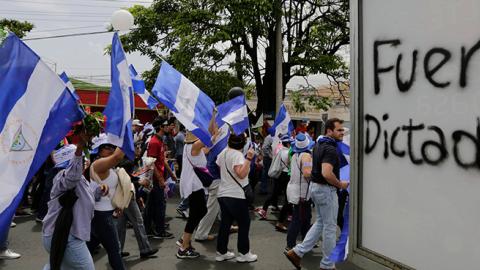
People attend the 'Marcha de las Flores' -in honor of the children killed during protests- in Managua on June 30, 2018
Caption
People attend the 'Marcha de las Flores' -in honor of the children killed during protests- in Managua on June 30, 2018
08
August 2018
Past Event

1201 Pennsylvania Avenue, N.W., Suite 400
Washington, DC 20004

Speakers:
Dr. John Polga-Hecimovich

Assistant Professor, Political Science Department, U.S. Naval Academy

Eduardo Ulibarri

Former Ambassador and Permanent Representative of Costa Rica to the United Nations

Víctor Agustín Cuadras Andino

Nicaraguan youth leader and activist.

Ambassador Jaime Daremblum

Senior Fellow and Director, Center for Latin American Studies, Hudson Institute

In recent months, Nicaragua has become a new and acute source of instability in the Western hemisphere. On April 18, a peaceful demonstration against proposed reforms to the country’s social security system quickly ignited much wider civilian protests against the government of President Daniel Ortega. Violent repression of these protests resulted in 30 people being killed in the first 5 days, and the death toll has since climbed into the hundreds, with many of the casualties being students attacked by Ortega-aligned paramilitary groups. These protests are the largest of President Ortega’s tenure, and the deadliest since the Nicaragua revolution, which ended in 1990.

Meanwhile, the economy is paralyzed and an increasing number citizen are now seeking asylum in neighboring countries. The Inter-American Commission of Human Rights, the Organization of American States (OAS), the U.S. Government and the European Union have condemned Nicaraguan repression and called for an orderly transition to democracy. But Ortega refuses to hold early elections as a way out of the crisis and has claimed “victory” and “normality” after removing barricades through the country.

On August 8, Hudson Institute hosted a panel to discuss the recent unrest in Nicaragua. Panelists will include Dr. John Polga-Hecimovich, assistant professor of comparative politics in the Political Science Department at the U.S. Naval Academy; Eduardo Ulibarri, the former Costa Rican Ambassador to the United Nations; and Víctor Agustín Cuadras Andino, a Nicaraguan youth leader and activist. The discussion was moderated by Ambassador Jaime Daremblum, a Hudson senior fellow and director of the Center for Latin American Studies.

Related Events
19
May 2026
In-Person Event | Invite Only
Environmental Agendas, Geopolitical Ends: Climate Policy and Great Power Competition
Featured Speakers:
Michael Doran
Zineb Riboua
Brenda Shaffer
Sam Cooper
Getty Images
19
May 2026
In-Person Event | Invite Only
Environmental Agendas, Geopolitical Ends: Climate Policy and Great Power Competition

To examine this emerging challenge, Senior Fellow Dr. Michael Doran will convene a conversation with Research Fellow Zineb Riboua, Professor Brenda Shaffer—Research Faculty Member at the US Naval Postgraduate School and Senior Fellow at the Atlantic Council—and Sam Cooper, an award-winning investigative journalist focusing on China-Canada relations.

Getty Images
Featured Speakers:
Michael Doran
Zineb Riboua
Brenda Shaffer
Sam Cooper
20
May 2026
In-Person Event | Invite Only
A Conversation with Under Secretary of State for Public Diplomacy of the United States Sarah B. Rogers
Featured Speakers:
Sarah B. Rogers
Zineb Riboua
Eric Schmitt
Michael Doran
Getty Images
20
May 2026
In-Person Event | Invite Only
A Conversation with Under Secretary of State for Public Diplomacy of the United States Sarah B. Rogers

Please join the Hudson Institute for a conversation with Under Secretary of State for Public Diplomacy Sarah B. Rogers and Hudson Research Fellow Zineb Riboua on how the United States is adapting its public diplomacy tools to advance its interests abroad, counter censorship, promote free speech, and leverage artificial intelligence to deliver more effective, targeted messaging.

Getty Images
Featured Speakers:
Sarah B. Rogers
Zineb Riboua
Eric Schmitt
Michael Doran
21
May 2026
In-Person Event | Hudson Institute
Georgia at a Geopolitical Crossroads: Iranian Influence and Strategic Competition
Featured Speakers:
Luke Coffey
Giorgi Kandelaki
John P. Walters
Congressman Joe Wilson
Ian McGinnity
Moderator:
Matthew Boyse
Tbilisi residents protest after the Georgian Dream government announced a suspension of negotiations on EU candidate status until 2028, as police detain demonstrators during a crackdown in the capital on November 28, 2025. (Photo by Sebastien Canaud/NurPhoto via Getty Images)
21
May 2026
In-Person Event | Hudson Institute
Georgia at a Geopolitical Crossroads: Iranian Influence and Strategic Competition
Tbilisi residents protest after the Georgian Dream government announced a suspension of negotiations on EU candidate status until 2028, as police detain demonstrators during a crackdown in the capital on November 28, 2025. (Photo by Sebastien Canaud/NurPhoto via Getty Images)
Featured Speakers:
Luke Coffey
Giorgi Kandelaki
John P. Walters
Congressman Joe Wilson
Ian McGinnity
Moderator:
Matthew Boyse
22
May 2026
Virtual Event | Online Only
The Western Hemisphere’s Energy Moment
Featured Speakers:
Daniel Batlle
Francisco Monaldi
Getty Images
22
May 2026
Virtual Event | Online Only
The Western Hemisphere’s Energy Moment

Join Hudson Institute as Adjunct Fellow Daniel Batlle interviews Francisco Monaldi, director of the Latin American Energy Program at Rice University’s Baker Institute for Public Policy and one of the foremost authorities on energy and political economy in the region, for a wide-ranging conversation on Latin America's energy future and what it means for the hemisphere and for US interests.

Getty Images
Featured Speakers:
Daniel Batlle
Francisco Monaldi