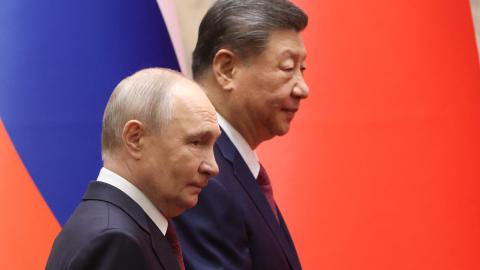












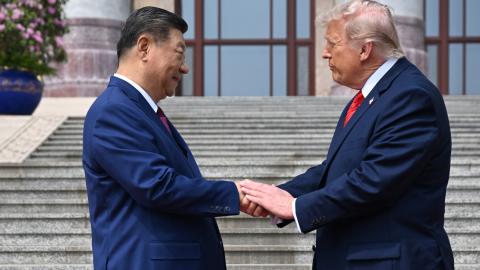
President Trump and Chinese leader Xi Jinping are meeting in Beijing. It is Trump’s first visit to Beijing this term, and their first encounter since they met in South Korea in October.
When the two men look across the table at each other, their advisers silently arrayed by their sides, each will almost certainly think that he is holding all the cards. But Xi holds a losing hand.
Xi is likely to walk into his meeting with Trump buoyed by the belief that America has come to him, showing itself to be a weakened and declining power, facing a stalemate in Iran and Ukraine and deteriorating relations with Europe and Africa. His advisors — who serve to implement his vision and reinforce his thinking — will fortify his perception that time is on China’s side.
In Beijing’s view, the Global Financial Crisis, the polarization of American politics and accompanying political violence, wars in Iraq and Afghanistan, are proof of the failure of the U.S. and the Western democratic system.
Xi also enters the summit convinced that China is on the rise — a fact reflected in global polls that show China and the U.S. now running neck and neck in favorability compared to a few years ago. In Beijing, advisors have likely calculated that Xi’s best bet is to play up to Trump’s appreciation of pomp and flattery, including offers to reduce the trade deficit through agriculture purchases, Boeing Jets and energy.
Xi has reasons to extend China’s strategic pause in rhetoric and escalatory actions — especially on trade, Taiwan, and the South China Sea — that started in Busan. He may well seek to keep Trump distracted through a series of dialogue proposals that lead nowhere, as China has successfully done through the decades on narcotics, human rights, arms control and, more recently, artificial intelligence. Look for Xi to suggest renewed talks on all or some of these subjects, a strategy that amounts to Lilliputian threads to tie down the Gulliver of the U.S.
Trump and his advisors, for their part, enter the Summit with a very different perspective on themselves and the world. American actions in Venezuela, Cuba and across Latin America — including blocking Chinese control of the Panama Canal and edging Huawei out of deals in Paraguay and Chile — have begun to curb Chinese and Russian influence in the Western hemisphere. They have ended sweetheart business deals, exposed corrupt officials and cut off Chinese intelligence operations against the U.S.
Meanwhile, Trump’s actions in Iran and Syria, and across the Middle East, have shown that the U.S. is serious again about the use of lethal force. China’s absence from the crisis in the Strait of Hormuz has also revealed to Gulf allies the depth of China’s unreliability. When Bahrain made a motion in the United Nations to censure Iran over its closure of the Strait, China (along with Russia) vetoed the resolution despite extensive lobbying.
It was a moment that wasn’t closely watched in public. But, behind closed doors, Gulf countries have made clear that they noticed and will not forget it. For Xi, putting all his money on Iran and against the U.S. military, as well as international freedom of navigation principles, will prove very costly.
Xi believes that time is on China’s side. But an objective appraisal casts doubt on that confidence. China’s population is aging. Although it sits on vast dollar (and oil) reserves, its economy is on track to stagnate and decline. Its real estate markets are massively over-leveraged, presenting a real risk for a flash crisis. It has a dangerous dependency on overseas energy. Its youth unemployment rate, which the government openly started manipulating after it topped 20 percent in 2023, was officially 16.9 percent in March. It likely tops 20 percent if students seeking jobs are included again, like they used to be.
China is also still beholden to American technology developments. It must continually buy overseas talent, through shiny new labs and generous salaries, as well as intellectual property through the purchase of American companies, to keep at pace with U.S. frontier technologies.
Although Huawei dominates in developing markets for 5G, American and allied companies are poised to own the next generations of technology that follows. Think quantum, high end semiconductors, aerospace, biosciences, and — despite the hype — AI.
Overall, although Americans would like greater access to Chinese markets, China is inexorably reliant on U.S. markets — to sell the goods from its export driven economic model, to promote its technology, and to keep America reliant on cheap imports from China.
Xi would also be very mistaken to perceive a strategic pause in our competition as a sign of acquiescence. On the contrary, it was a galvanizing acknowledgement that we won’t let ourselves become dependent on another country for crucial supply-chain components again.
It may take a moment to turn around our vast aircraft carrier of a country, with all of its regulations and special-interest groups. But we are already seeing this on critical minerals, where the U.S. is reorienting critical minerals supply-chains toward domestic production through massive investments in processing, reprocessing mine waste, and strategic stockpiling supported by government initiatives. The U.S. has deep reserves of national will to reorient our economy.
So what will the much-heralded summit and its attendant fanfare bring, other than some sense of stability in US-China relations? Probably, first and foremost an announcement that the two leaders will meet again in America sometime in the coming months — aside from at the G20 in Miami.
In addition, it’s likely that the Chinese will announce large purchases of agriculture products like soy and beef, as well as Boeing airplanes to balance the trade deficit somewhat. Also likely is the announcement of a “Board of Trade” and a “Board of Investment” to provide reassurance, without details, to the global economic community that there is a path toward settling disputes.
Just as when the World Series of poker’s final hand is televised and we can see what each player holds, it is easier to make the right call from the comfort of the couch. It looks like this: Xi thinks he can bluff with two pair, but Trump is holding a full house.