











China does not do military alliances. Its declared posture is one of non-interference in other nations’ internal affairs. Yet Beijing has long understood that commercial ties alone cannot anchor strategic relationships; only security partnerships can.
China’s recent experiments with 2+2 security dialogues – bringing together foreign and defense ministers – signal that it is seeking to move beyond an economics-first approach. The most likely next candidates for this format are Kazakhstan, Kyrgyzstan and Tajikistan, all of which share borders with China.
For Central Asian governments, a 2+2 with China may hold appeal, particularly as they seek to manage instability spilling over from Afghanistan at a time when Russia’s security role is being strained by its war in Ukraine. After years of hoping that engagement could stabilize Afghanistan, Central Asian states have largely shifted to a policy of containment – seeking to insulate themselves from cross-border militant threats, narcotics flows and refugee movements rather than attempting to reshape Afghanistan’s internal trajectory.
For Beijing, the objective would be to consolidate partnerships across the Eurasian heartland – an outcome Washington would prefer to counter. China shares Central Asia’s risk-management approach toward Afghanistan. Like its neighbors, Beijing has little appetite for deep involvement inside the country itself, focusing instead on preventing instability from spilling northward toward Xinjiang or disrupting Belt and Road corridors that run through the region. A 2+2 format offers China a way to institutionalize security coordination without violating its long-standing aversion to formal alliances.
Earlier this week, Chinese Foreign Minister Wang Yi and Defense Minister Dong Jun traveled to Phnom Penh to hold China’s first-ever 2+2 dialogue with Cambodia.
Wang told reporters that China is willing to develop the mechanism into a “strategic platform” for enhancing political and defense security cooperation. He described it as a key instrument for cementing mutual assistance and solidarity, and for advancing the construction of a China-Cambodia “community with a shared future.”
Wang also said China was prepared to work with Cambodia to build an “Asian security model” based on shared security and on seeking common ground while reserving differences.
China’s deepening security engagement with Cambodia comes as the Southeast Asian nation remains locked in a border dispute with Thailand. Although Wang’s itinerary took him next to Bangkok, Beijing chose to hold a 2+2 only with Cambodia – notably the non-U.S. ally in this pairing.
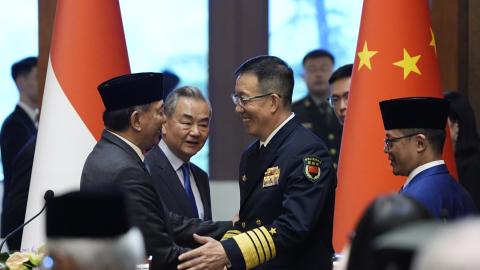
China is new to the 2+2 format. Last April, Beijing hosted its first ever 2+2 with a foreign country – with Indonesia.
The trajectory suggests further 2+2 engagements ahead, including Kazakhstan, Kyrgyzstan and Tajikistan – the three Central Asian states that border China. In several aspects, Central Asia may be a more conducive environment for this diplomacy than Southeast Asia: there are no maritime disputes, and the countries are not embedded in U.S. alliance structures. Instead, there is a convergence around defensive security priorities – particularly border control and crisis management linked to Afghanistan – making the 2+2 format a natural fit.
China under President Xi Jinping has always had an eye on deepening security ties with its western neighbors.
One of the most significant foreign-policy shifts Xi made after becoming top leader in 2012 was to elevate relations with neighboring countries to China’s top diplomatic priority. Previously, “major-country diplomacy” had dominated, under which Beijing focused on learning from advanced powers while biding its time and building national strength.
The first phase of Xi’s neighborhood policy was to build what Beijing calls “a community of shared interests and mutual benefit.” The idea was to link surrounding countries through railroads, pipelines and trade corridors so that China’s economic rise would also lift its neighbors. This was the logic behind the Belt and Road Initiative.
A second, less openly discussed phase was China’s ambition to eventually provide security assurances to neighboring states. Chinese strategists have long argued that economic interdependence alone cannot sustain strategic alignment. Beijing has viewed the roughly 70 treaty and non-treaty alliances the United States enjoyed as one of the main pillars of American power.
China has had only North Korea as a near-equivalent partner. A true great power must have partners that depend on it for protection, the thinking goes.
Scholars have pointed to China’s Central Asian neighbors – Kazakhstan, Kyrgyzstan and Tajikistan – as well as Southeast Asian partners such as Myanmar, Cambodia, Laos, and South Asian countries including Pakistan, Sri Lanka, Bangladesh and Nepal.
China may offer to help Central Asia stabilize its southern frontier – a move that would anchor its influence across Eurasia.
For many years, this security dimension remained largely aspirational. Now, shifting regional realities – including the failure to stabilize Afghanistan and Russia’s reduced capacity to act as Central Asia’s sole security guarantor – are creating space for new external players. And the appearance of the 2+2 format now suggests that Beijing may be moving into the second stage of its Eurasian neighborhood strategy.
The 2+2 dialogue is a format the United States has long used to signal strategic alignment with allies and partners. Washington holds ministerial-level 2+2 meetings with Japan, South Korea, Australia, the Philippines and India, as well as lower-level dialogues with Indonesia and Thailand, among others.
The talks are extensive. The U.S.-Japan 2+2 held in the summer of 2024, during the Biden administration, produced a 10-page joint statement reaffirming both sides’ commitment to uphold a free and open international order based on the rule of law.
Discussions included establishing joint command and control functions, strengthening Japan’s missile capabilities, expanding joint operations in Japan’s Southwest Islands – a stone’s throw from Taiwan – and co-production of defense equipment.