

















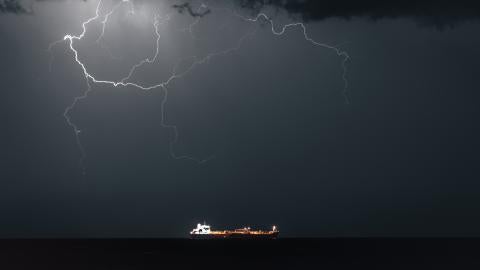
Three weeks into the campaign of US and Israeli airstrikes against Iran and attention has shifted to the Strait of Hormuz and the closure of this vital waterway.
The Strait of Hormuz is 39 km wide at its narrowest point, but this does not fully capture how constrained transit is. The designated shipping lanes are only about 3.7 km wide in each direction. Through these waters pass about 20 percent of global oil consumption and roughly one-third of all seaborne oil trade, much of it destined for Asian markets, particularly China, Japan and South Korea.
Given the strait’s proximity to Iran, shipping is especially vulnerable to disruption. Even before the current fighting, Tehran repeatedly demonstrated its willingness to target international shipping, including through harassment, seizure and attacks on vessels in the strait when it suited its agenda. Although the White House has suggested it was surprised by Iran’s current closure of the strait, such a development has long been considered a plausible contingency by the policy community.
The US administration’s response to the crisis has been inconsistent. At various points, it has stated that Iran could not close the strait, expressed surprise that it had done so, called on European allies and other nations to assist in reopening it, and later suggested that such assistance was unnecessary. This lack of coherence in messaging has only added to the uncertainty in an already volatile situation.
What cannot be disputed, however, is that even a partial closure of the Strait of Hormuz will have significant consequences for the global economy. The US has long recognized the risk of disruption in the Gulf. This concern was a driving force behind the establishment of the Combined Maritime Forces, headquartered in Bahrain. Created in 2002, it was designed to promote maritime security across the Gulf and surrounding waters through a coalition of willing partners.
The Combined Maritime Forces operates several task forces with distinct missions. For example, Combined Task Force 150 focuses on counterterrorism, Combined Task Force 151 on counterpiracy and Combined Task Force 152 on security and cooperation in the Arabian Gulf. Importantly, local countries such as Saudi Arabia, Bahrain, the UAE, Kuwait, and Qatar have participated in these missions and, in some cases, even commanded task forces.
There is little doubt that the Combined Maritime Forces has planned and exercised for scenarios involving Iranian attempts to disrupt or close the strait. However, there are three reasons that help to explain the perilous situation faced today.
First, it was likely believed by US military commanders that the multinational nature of the Combined Maritime Forces — and the broader network of partnerships built over years of joint training and operations — would provide a ready-made coalition capable of responding quickly in a crisis. European and Gulf navies regularly participated in Combined Maritime Forces missions, reinforcing the expectation that, in the event of conflict, a coalition would coalesce to keep the strait open.
That assumption now appears to have been overly optimistic. The US did not do sufficient preparatory work to ensure that such a coalition would be politically and operationally ready to act. Without this groundwork, expectations of rapid allied support were unrealistic.
Second, many in Washington believed that US naval superiority would be sufficient to deter or defeat any Iranian attempt to close the strait. Historically, this confidence was not unfounded. The US military has demonstrated its ability to neutralize Iranian maritime threats and, in the current campaign, American officials say their forces have damaged or destroyed more than 120 Iranian naval vessels.
However, the strategic environment has evolved. Iran now possesses a far more capable and battle-tested arsenal of unmanned aerial vehicles and other asymmetric tools that did not exist at scale 15 or 20 years ago. These systems complicate traditional naval operations and raise questions about whether existing contingency plans have been adequately updated.
Finally, this challenge in the strait is further exacerbated by the fact that, in recent years, both the US and the UK have drawn down their dedicated mine countermeasure vessels in the Gulf. These were replaced with unmanned capabilities that have yet to be fielded at scale and risk leaving real capability gaps in a high-intensity environment such as the one currently faced.
Trump is correct in one respect: action is required. But the available options are limited. Effective coalition building cannot be improvised amid a crisis. It requires deliberate planning and buy-in from partners who understand both the risks and the strategic importance of the mission. Expecting European countries to deploy high-value naval assets on short notice, without prior involvement in shaping the mission, was always unlikely to succeed. Unsurprisingly, few have stepped forward — at least so far.
While the US may not rely heavily on Middle Eastern oil and gas, the global economy and many American allies in East Asia do. Disruptions in supply will drive up prices, strain supply chains and create economic instability that inevitably affects the US.
The consequences of sustained disruption would therefore be global in scope. Economic shocks abroad would quickly translate into higher costs and political pressure at home for the president. As the US approaches midterm elections and enters the summer travel season, what may appear to be a distant geopolitical crisis could rapidly become a domestic political issue.
The closure of the Strait of Hormuz is not just a regional challenge — it is a test of American leadership, international coordination, strategic foresight and political will. The failure to prepare a credible coalition response ahead of time has left the US reacting to events rather than shaping them. Admittedly, this is not a good position to be in during a war.