






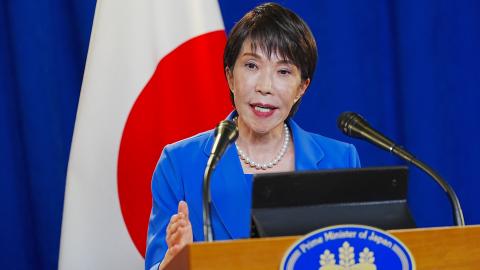






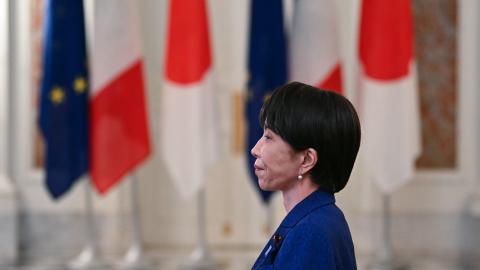
On April 24, William Chou joined Nicole Wiley on an episode of War on the Rocks to discuss Japan’s diplomatic agenda and recent changes in its defense and economic sectors.
Transcript
This transcription is automatically generated and edited lightly for accuracy. Please excuse any errors.
Nicole Wiley:
Hello, I’m Nicole Wiley, membership editor for War on the Rocks, and you’re listening to The Warcast, the Members Only podcast for what you need to know now. We’re talking about Japan again today, which I think we’ve done more frequently than perhaps ever after Sanae Takaichi was elected Prime Minister. She’s a really interesting person with a calculated and strategic diplomatic agenda, and this episode is going to explore the next iteration of that fact. Japan’s notorious lethal weapons export ban has been lifted. And joining me for a conversation about this today is William Chou. William is a senior fellow and deputy director of the Hudson Institute’s Japan Chair, and his work at Hudson focuses on the United States relationship with Japan and other Indo-Pacific issues, specifically economic security, trade and investment, and regional partnerships. William, thank you so much for being here.
William Chou:
Great to be here. Thanks, Nicole.
Nicole Wiley:
Of course. So, from my understanding, this is a pretty major change from Japan’s post-World War II pacifist constitution that prohibited the export of lethal weaponry. Can you first explain to our listeners how this pacifist constitution influenced Japan’s defense export policies before this recent change?
William Chou:
It’s pretty long and convoluted, but I think what I would really describe it as is there are a number of key dates. So, I think the first key date is 1967 when the then Prime Minister Sato introduced the three principles on arms exports, which ban arms exports to, (1) communist countries, (2)countries subject to UN resolutions against arms exports, and then (3) countries that are involved in conflicts or very, very likely at risk to be involved. So, this actually had a lot of the room for lethal arms exports under this 1967 three principles. But in 1976, the reformist Prime Minister Miki essentially eliminated these three principles by essentially introducing a near embargo, citing that Japan had to adhere to the spirit of the Constitution, the pacifist notions of the Constitution.
However, by 2014, given the increasingly challenging security environment in East Asia, then Prime Minister Abe introduced a new framework that included three parts. One, no exports to countries of conflict. Two, exports must be vetted and deemed to advance Japan’s national security. And then three, exports prohibit the recipient country to resell to a third party without consent.
In practice, it meant that Japan could export five categories of what they call non-lethal goods, primarily in terms of rescue, transport, early warning, surveillance, and minesweeping. This is why I think in recent years, Japan has exported a lot of, I think, both ground and also aerial radars to the Philippines as well as coastal ships to the Philippines. In addition, there were other workarounds. The fact that if you do something through joint production, such as the GCAP jet fighter, or the Mogami frigate that Japan will be exporting to Australia under a joint production agreement, that wasn’t permissible.
And then also other things that were built under license such as PAC-3 surface-to-air missiles from Lockheed Martin, that was also exportable. And so this is how Japan was essentially supporting Ukraine by exporting these finished PAC-3s from Japan to the United States, and then the US would then transfer to Ukraine, or the US would transfer its own PAC-3s to Ukraine and substitute them with Japanese PAC-3s.
Nicole Wiley:
Well, all of that context is super helpful, but let’s move on to today. What’s going on now with the new law change and why is it significant?
William Chou:
Sure. Yeah, so the new development that they just introduced essentially gets rid of the five categories of non-lethal goods and simplifies it into two categories, essentially weapons and non-weapons. So non-weapons contain the past five categories, and these things can be exported without any restrictions whatsoever.
The other category, which is weapons, these are essentially things that have the potential for kinetic action. So things like ships, missiles, so on and so forth, these can be sent to the 17 countries that have technology transfer agreements with Japan. So, this includes the United States, the United Kingdom, Australia, India, the Philippines, Vietnam, and Indonesia. But any lethal weapon exports must be approved by the government, but the Diet does not have to be informed ahead of time. The government can approve the sale, ship it off, and then the Diet can be informed afterwards.
And also for countries that are in active combat, the defense transfer must be approved by the four person National Security Council, including the prime minister, the chief cabinet secretary, the head of the foreign ministry, and the defense ministry.
I think overall, this strengthens the Japanese defense industrial base, its supply chains and its talent. Japan’s defense industrial base has been shrinking, with a hundred companies leaving the defense sector since 2003. Moreover, the defense sector generally is not that profitable. They are not large parts of various companies. We’re talking about companies like Mitsubishi Heavy Industries and Kawasaki Heavy Industries, companies that have a lot of business elsewhere. And so their defense business is usually not a priority. And so by increasing the exportability of Japanese goods, that actually gives their defense sectors a bigger boost in terms of resources and manpower.
And then finally, it allows Japan to export more easily to international partners at a time when things are really challenging. Certainly, I think in Southeast Asia, the Philippines is very, very wary about what’s going on in China, and they’re very interested in Japanese defense goods. And it also allows Japan to be integrated into a wider global production network. So, through R&D, redundancy, and capabilities for strategic depth that may be helpful if there’s ever a contingency in the Western Pacific.
Nicole Wiley:
So tell me more about some of these Japanese-made weapon systems that would likely be in high demand abroad. I mean, I know you already mentioned the frigate, but are these more fighter jets, are they drones, or what are their most sought-after capabilities that are likely going to be in conversation for export?
William Chou:
Yeah. So, I think Japan’s greatest strength is the fact that defense articles are of high quality and they deliver on time. So, I think you and your readers are extremely well aware of the challenges that the US Navy is facing in terms of both repairing and overhaul of US Naval ships, but also delivery of US Naval ships. But in contrast, the Japanese have been very consistent in their submarine deliveries. And this regularity, this predictability, is really valuable at a time when I think a lot of countries are scrambling to build up their defenses. And so this is the main reason why Japan was able to beat Germany in the frigate deal for the Australians, the Mogami frigate deal for the Australians. So, I think that’s one key advantage.
I think Japanese planes, Japanese aircraft, are also extremely attractive. The cooperation that they’re currently doing with the UK and Italy through the GCAP fighter system, I think that will be appealing. And especially once that comes online, you’re likely to find a lot of buyers elsewhere, probably also in Southeast Asia.
And then I think where Japan really has a strong technological advantage, is in sensors. And so that includes anything that requires sensors, that includes radars, which they’ve already been exporting heavily to the Philippines. But it also includes other components or other weapon systems that require radar. So that includes, say, Japan’s type three surface air missiles, and its type 12 surface-to-surface, essentially counterstrike cruise missiles. And that also includes Japan’s electronic warfare systems.
Finally, the last Japanese proposed defense budget has talked about how they want to increase more production of unmanned systems, and obviously, their sensors will likely play a major part in their production. I think Japan will be integrated very importantly into these supply chains for unmanned systems, both within Japan and also abroad. I think this also creates opportunities for greater cross-fertilization between Japan’s defense sector and its commercial sector. This is something that Defense Minister Koizumi has already stated. It’s part of what he describes as sort of this virtuous cycle of defense R&D innovation, spurring commercial R&D innovation, and it’s really strengthening Japan’s economy long-term.
Nicole Wiley:
My follow-up question to that is, are the systems that you’re talking about now, are they genuinely complimentary to current US capabilities that are typically exported, or is there any competition that could complicate the relationship?
William Chou:
Yeah, I mean, generally, Japanese systems are complementary to US capabilities. Japan imports a ton of its defense equipment from the United States, or it produces them under license from US companies. And so that includes things like PAC-3s and F-15s and so on and so forth. So one, there’s a lot of compatibility. So theoretically, Japan could be competition, right? But realistically, as we’ve seen both within the US and abroad, there is a huge demand for defense systems globally. There’s a reason why the Koreans have been so successful in exporting to Eastern Europe, given the challenges that they face in terms of Ukraine and the Russian threat.
And so realistically . . . And on top of that, given the challenges of the US defense industrial base to produce things quickly and on time in recent years, we talked about ships, we’ve talked about, frankly, PAC-3s and lots of other defense articles, there will never be enough shells, missiles, ships, so on and so forth. And so, I think Japan’s potential contributions to the broader industrial base of close allies is very welcome.
For individual defense companies, there’s definitely potential competition but given the longstanding cooperation and engagement between Japanese firms and American firms, what you’re really going to see in terms of cooperation is a division of labor.
So, taking the example of electronic warfare systems and radar, rather than compete head-to-head, Mitsubishi Electric and Northrop Grumman signed an MOU back in 2024. And I think this is really what we’re likely to see. Both US and Japanese firms are likely to be resource-constrained. And so, I don’t think they’re going to be really struggling over market share. I think it’s really more about, “Hey, let’s just divide this up and then let’s just get these products or whatnot out of the factory.”
Nicole Wiley:
For sure. And I mean, off the cuff, all of this sounds really good, right? But I’m sure not everybody thinks that, particularly China. So give me a sense of the response to this news so far. What is the Japanese domestic media saying about it, but also what’s the international response?
William Chou:
Yeah, so I think what’s been kind of surprising is that within Japan, the Japanese media has been actually pretty quiet about it. So, they’ve obviously reported it, but there hasn’t been that much deep coverage. There hasn’t been a second or third-level analysis or criticism of these reports. It’s been the first level reporting, and then that’s kind of where it’s been. I think part of it is the fact that, frankly, Japan has bigger problems to worry about right now in terms of the questions of our energy supplies and also petrochemical supply chains that they’re really grappling with right now here. That’s all I’ve been hearing the past two weeks since I’ve been here in Tokyo. So I think for the most part, Japanese media is fairly quiet about it. Now I’m sure that might change over time as the news cycle changes.
I think for Japanese opposition parties, so strangely enough, the current LDP ruling parties, former coalition partner, the Komeito, which was always a bit of a sort of a peace party, they’re now very concerned about these new shifts. They’re afraid that Japan is no longer a peace state in the eyes of the international community. There’s criticism from them about the lack of explanation from the government justifying the shift in export regulations. And also, I think there’s some concern expressed by opposition parties that the fact that the government can approve these sales and then do it, and then only after basically post-facto informing the Diet of these such sales and basically depriving them the chance to oppose such sales ahead of time. So, they’re not happy about that.
China, unsurprisingly, is against this because they argue that this is Japanese rearmament accelerating. There’s a real concern that getting rid of the five non-lethal categories is a bad thing, and they’re really warning that this is Japanese new style militarism, which, given the rate of Japanese defense increases in nuclear buildup, and obviously, it’s a very evident gray zone actions around Taiwan, South China Sea, and also within the Japanese Islands, is a bit rich. I mean, they’re going to say what you think they’re going to say.
Within Southeast Asia, I think there’s a lot of interest in demand. The Philippines’ Defense Secretary already said that Japanese exports will ensure Philippine access to defense articles of the highest quality. It’ll strengthen resilience and it’ll ensure stability through deterrence. Obviously, the Philippines is at the front lines of a lot of the Chinese gray zone actions, and I think they have a vested interest in all of this. More broadly, I think the US and its other allies, particularly those in Australia and Europe, are very excited. I think we see it as encouraging as meaning good things in terms of long-term Japanese defense spending levels, the growth of the Japanese defense industrial base, which allows for strategic depth for us and like-minded countries, increased Japanese capabilities around bringing them to bear, and also interoperability. And I think allies that have been going on a defense buying spree, allies like Poland and the Philippines are very excited about being able to procure from Japan because I think right now the Koreans are very dominant in the military export market, and I’m sure a lot of these purchaser buyer countries wouldn’t mind a little more market competition.
Nicole Wiley:
So the last question that I have for you today is probably the biggest and most natural question to all of this news, which is why now? What factors do you think have influenced this pretty stark change right now?
William Chou:
Yeah, I mean, I think it’s a number of different sorts of factors. So first of all, the Ukraine war and the broader, obviously, the Iran war, and also the broader issue of the PRC’s military buildup and its increased aggression, both gray zone and more traditional military aggression, I think that’s been really very concerning to Japan. There have been questions in Japan about whether Japan has the defense industrial base that will be resilient and sustainable enough for a long war. I think what we’ve learned from Ukraine is that maybe the next war isn’t going to be done in two weeks. And what you really have to do is have industrial resilience and the ability to produce even under duress for a long time. And so that’s been a key priority for Japan and part of their own lessons learned from the war.
There’s also this idea that frankly, Japan is going to increase its defense spending, but in order to do so, it actually needs an industrial base that can absorb all of that increased spending. And so in order to do that, you have to make it easier for them to export abroad. No longer should Japanese companies, defense contractors only depend on the Japanese government as a customer. They should compete and fight for customers abroad and also in the process, increase their own capacity and capabilities.
And then third, I would just say there’s been a broad shift in political climate. As you know, Prime Minister Takaichi and her ruling party, the LDP, as well as their coalition partners, Ishin, had a complete domination of the polls back in February. And so I think that provides a lot of boosts to them in terms of being able to undertake a lot of these policies that they wanted to do for a long time.
Now, I think this was already going to be in the works, but certainly they’re doing so with a lot of confidence and determination. Politics is also a large part of it. The fact that the LDP has swapped out the Komeito, former coalition partners for Ishin, Komeito was definitely much more center-left, whereas Ishin is a pretty solidly center-right, right-wing in its outlook. I think there’s more obvious compatibility between LDP and Ishin, and especially on issues like defense exports.
And then finally, I think this is all part of Prime Minister Takaichi’s concept of how economics and security are all intertwined. There is no clear line between economic growth, economic security, and more traditional defense security. They’re all interrelated. They all share technology. They all need to really depend on each other to grow and push Japan onto a higher growth path. And so I think this is all part of her larger concept of what a future Japan should look like.
And then finally, I would just say that Prime Minister Takaichi is going to make a speech in Vietnam next week on the Free and Open Indo-Pacific. She’s going to update it for this new era, 10 years after her political mentor Abe had originally announced a Free and Open Indo-Pacific concept. Her version will emphasize much more about bolstering regional security through practical measures. And there are no more practical measures than ensuring access to high quality Japanese defense articles against aggressive, regional revisionist actors, let’s just say. And so, I think that’s all part of her plan as well.
Nicole Wiley:
Well, this has all been super interesting. William, thank you so much for your time today.
William Chou:
Of course. Glad to be back.