








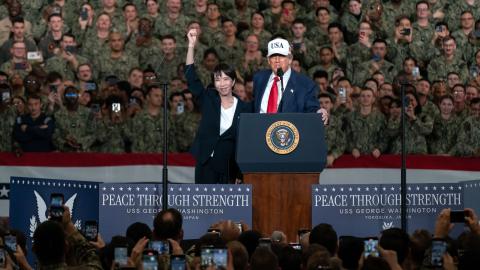
When newly elected Prime Minister Sanae Takaichi welcomed President Donald Trump to Tokyo last October, it was only natural for the White House to extend a reciprocal invitation for her to visit Washington.
This week's visit, which was to have been a diplomatic formality that celebrates the U.S.-Japan alliance, the two countries' economic relationship and their shared history -- including the gifting of 250 cherry trees to honor America's 250th birthday -- has now become a challenge for the alliance.
Takaichi will arrive in Washington just weeks after U.S. and Israeli forces began systematically removing any threat from Iran, an effort that has since generated regional instability and sent shocks through oil markets. Asian allies such as Japan have become concerned about what the long-term effects of another conflict in the Middle East could mean for their security partnership with the U.S. and their domestic energy needs.
Alliance managers are likely confused as well because, since the second Trump administration's inauguration, there has been an expectation that the U.S. wants to be less active in global security. Trump's recently published National Security Strategy emphasized that allies and partners needed to take on more responsibility in their regions, and that Japan needed to counterbalance China's growing militarism.
Now, the U.S. may be drawing its allies into a conflict they were never expecting. And the issue is likely to overshadow any discussion between Trump and Takaichi.
Just days before her visit, there have been increasing calls for Japan to assist in the conflict. Trump posted on social media that countries like Japan will send ships to the Strait of Hormuz, although this has not been the position of the Japanese government. In a subsequent post, he suggested countries that receive oil through the passage should take on more responsibility for its security. About 95% of Japan's oil imports come from the Middle East.
Already, the Takaichi government has been struggling to find a balance between showing support for Japan's only treaty ally and open condemnation of violence as it seeks to promote de-escalation of the conflict.
Trump has made clear that his administration is focused on results and will not be constrained by lengthy processes, whether on regulatory reform, trade negotiations, demanding that other countries increase their defense spending or confronting America's greatest security challenges.
While Takaichi's historic national election victory in February was a mandate from the Japanese public for her to similarly pursue bold, conservative policies, the Japanese government still very much adheres to lengthy processes, especially on sensitive issues that could involve Japan's participation in international conflict. Takaichi cannot simply sideline international institutions in the same way the Trump administration has.
At a minimum, the Japanese government will first need to confirm whether America's actions are even legal before discussing what sort of support it can offer -- as was recently suggested by former Japanese Prime Minister Shigeru Ishiba. Even if Japan decides to provide support, it would be nonlethal in nature, such as offering to help with resupply efforts or sea mine removal.
Although the U.S. and Japanese defense chiefs have remained in close contact throughout this conflict, news of the redeployment of American military assets from the Indo-Pacific to the Middle East adds to Japan's worries about Washington's long-term security priorities.
These events deepen Japan's existing concerns about its reliance on the U.S. defense industrial base, including its concerns over single-source production and previous delays in the delivery of arms sales.
The Japanese government has made significant efforts over the last four years to modernize and increase its defense capabilities through increased defense spending and reforms. Tokyo equally sees its ability to expand its roles and missions, and align closer with America's interests, as related to its ability to diversify away from overreliance on American defense production.
Despite how the U.S. conflict with Iran is reshaping her visit, many of Takaichi's objectives in visiting Washington remain the same. She'll want to demonstrate that her personal relationship with Trump remains strong, highlight the progress being made through the U.S.-Japan investment deal, praise the efforts both countries are making on energy security and reaffirm that at the center of Japan's foreign policy is a "free and open Indo-Pacific" that works alongside American interests.
Before Trump's trip to Beijing -- whenever that may be now that he's requested to postpone it by one month -- Takaichi will stress that China, as well as Russia and North Korea, which are all Japan's neighbors, have long been strategic and economic partners of Iran; that their interests are not in the Middle East but across the Asia continent and into the Indo-Pacific. Because of this, she'll raise the point that Japan cannot lose focus on the security of the Indo-Pacific -- and neither should the U.S.
Takaichi will continue to communicate that Japan is willing to take on more responsibility in its region, but that the U.S. cannot and should not expect Japan to participate in the Middle East in the same way as some of Washington's other allies.