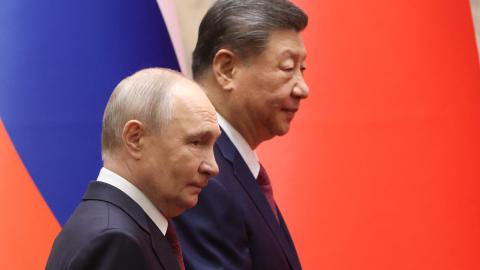















In foreign policy, “realism” is in bloom, with The Return of the Great Powers by Brendan Simms the latest entry. Simms is a professor at Cambridge University in the UK, and the task he has set himself is to make sense of the state of global order and its possible future directions. So, he takes on Donald Trump and the United States, Putin’s Russia, Xi’s China, other great- and middle-power candidates around the world, choke points like the Straits of Malacca and Hormuz and flash points like Taiwan and the Korean DMZ, geopolitics and geoeconomics—the full catastrophe, as Zorba the Greek says.
On one hand, tracing the ins and outs of renewed great-power rivalry is a proper endeavor and a formidable challenge. Simms has pulled it off with intelligence and aplomb. The scope and depth of his knowledge of post–Cold War history and international politics is immense. His book is thorough. On the other hand, it is thorough as of February 2026. Going forward, he would likely continue to be a reliable guide. But his book was already in galleys before the start of what will likely be the defining event in international politics for a generation, the Iran war, whose ramifications and significance will be our daily experience for years to come. Paradoxically, the war has come to the book’s rescue by demarcating the moment at which Simms leaves off. Rather than reading The Return of the Great Powers as a guidebook applicable going forward, we can take it as a snapshot of how the world looked to a perceptive author just before the war broke out.
One thing that will not change post-Iran is the validity of Simms’s central contention: To the extent that the thinking of the post–Cold War era took little account of great-power rivalry, that era is over. Simms notes that the collapse of the Soviet Union and the Warsaw Pact ushered in a generation of unipolarity and American hegemony. International politics in the first decade of this period proved baffling to both policymakers and observers. One set of conventional expectations—the mainstream realist perspective—held that NATO would wither away in the absence of the Soviet threat, and that other states would quickly seek to balance the power of the United States. Wrong on both counts. Others saw the prospect of universal convergence around democratic capitalism as the new way of the world: the “end of history” view. Also wrong. A third major point of view, that of liberal institutionalism, saw in U.S. dominance the prospect of forging a “rules-based international order” of independent authority that would regulate and pacify the conduct of states. Wrong as well. As of 2022 and Putin’s full-scale attempt to conquer Ukraine, alongside growing Chinese wealth and power, there could be no mistaking the challenge to the United States’ supposed unipolarity.
Simms declines to propound a definition of a great power. Rather, he offers a set of “characteristics with which they are associated, historically and today.” Great powers “expect to shape, or at least be consulted on, the main global issues of the day.” They insist on their own sovereignty but are less respectful of the sovereignty of other states. They “have the power to make rules, but also to break them; they are never just rule-takers.” What enables them to do so? Their “superior capabilities,” which Simms describes as fourfold: “resources, reach, reputation, and resilience.” Resources must include substantial military capability: “Deployable nuclear weapons are a vital component of Great Powerness today.” Reach is the ability to influence outcomes not just regionally but at a distance. Reputation comes from respect for one’s great-power status by others. Resilience is the ability to “absorb pain” and come back from adversity. Simms numbers five “almost Great Powers” today: Japan, France, Germany, India, and the European Union collectively. To the history of each, he devotes a chapter. Likewise to the four countries he says currently meet his criteria: the United States, Russia, China, and—the UK.
With all due respect to our Cambridge professor, let’s just say that an analysis according to which the UK is a great power and France is not demonstrates a certain elasticity to his four “superior capabilities” requirements. Perhaps his designation of the UK is chiefly aspirational, given a decade of post-Brexit drift and doldrums. Had Simms instead filed the UK under “Almost Great,” his lists would be unimpeachable. That would leave us with the United States, China, and Russia as the three current great powers.
That grouping comports with most contemporary assessments of current national capabilities. China has grown richer and undertaken a major military buildup, and Russia seems to have reacquired the desire for odious action in pursuit of empire. Most analysts tot up the net result as a relative decline in U.S. power at the hands of rivals.
But is this general assessment really the best way to understand our current state of global affairs as we enter a post–post–Cold War era? It understates two important aspects of the situation in which we find ourselves. The first is the extent to which U.S. power shaped events in the aftermath of the Cold War. The second is the role of values in shaping global politics now.
The fact that the United States did not need to fight wars or engage in proxy conflicts to preserve its hegemony in the decades following the Cold War hardly implies the irrelevance of power, specifically American power. The mainstream realists of the 1990s expected balancing behavior by other states but got instead bandwagoning behavior: states actively supporting the unipolar global order, or at least pretending to. That meant supporting (or not opposing) the United States. As for the supposed “relative decline” of the United States as China has grown more powerful and Russia more assertive with its power, the concept is of limited utility given that American power in the absolute sense has only increased since the end of the Cold War.
The “end of history” afficionados, meanwhile, may have believed convergence around democratic capitalism to be inevitable. But it was the power of the United States that protected democratic capitalism and gave others something to converge on—or not, were they determined not to, as was the case with China and Russia. Perhaps one could say that some states want to be market-based, rights-regarding democracies, and others don’t. During the Cold War, the United States was the power that upheld the security of these states—that is, the West—against the Communist challenge. The power of the United States continued uninterrupted through the post–Cold War era as the self-conscious supervisor of global order. Without it, the “end of history” would never have had a chance.
The liberal institutionalist agenda of “rules-based international order” was supposed to be a consensual project in which states agreed via negotiation to common rules on their merits. The conceit was that the rules would be self-enforcing. Benevolent global order was thus possible despite the absence of a central authority internationally. There is truth to the proposition that states sometimes agree to rules because they believe the rules are good (or as good as possible), and they intend to obey them. Except that in this period, there was a central authority that did come into play to deter and punish rule-breaking. It was the United States and U.S. power. Some spoke, for example, of an “emerging norm” according to which international borders were not subject to change by force. That was certainly an abiding rule among states that had no desire to conquer neighboring territory. But it took U.S. power and will to eject Saddam Hussein from Kuwait in 1991. And this is a “norm” that Vladimir Putin, like Saddam, emphatically does not subscribe to and had the power of his own to try to defy in Ukraine. Countering power met him there. One could describe the countering power as action to preserve a norm of non-conquest, but that abstraction is a by-product of the non-abstract goal of preserving Ukraine’s survival as a sovereign and independent state.
So there is a narrow sense in which Simms is right to call his book The Return of the Great Powers. That’s the plural “powers.” In a broader sense, though, it is slightly off-key. The United States hasn’t returned because it never left. Throughout, the United States was the great power.
An assessment of the abundance of Simms’s four Rs—resources, reach, reputation, and resilience—does not, however, provide a complete description of a great power or, for that matter, of any state. Though his realist inclinations incline him elsewhere, Simms does touch on what the four Rs leave out: “A Great Power always stands for something beyond just brute force. Its greatness is cultural and ideological as well as military.” In short, a state’s values matter. All states, however wretched their conduct, have a positive vision of themselves. Putin fancies Russia as a bastion of traditional Christian and family values in contrast to a Godless and decadent West. The UK and other Western powers uphold a vision of liberal international order. China sees itself as restoring itself to greatness following its “century of humiliation.” As of 2024, the United States stood among the Western powers. Following Trump’s return to office, Simms here professes himself to be uncertain about what the United States now stands for.
That won’t do. With a nod to the Magna Carta and its utility in promoting the rights of Englishmen, the principles of the Founding of the United States as a rights-regarding republic were the real-world instantiation of liberal democracy. It was the pivotal moment in the modern development of the West, and when Americans speak of Western values, they mean American principles that others have wisely come to share. The notion that Trump could somehow do away with these principles if he wanted to rests on an unstated conviction that these principles are very fragile. On the contrary, Americans hold to them deeply, and they have been robust in guiding American power from the Declaration of Independence forward.
The return of great powers adversarial to the United States doesn’t change that. It just makes the challenge of upholding those principles harder. That’s where American power once again comes to the foreground. It has always been the backdrop.