








If President Donald Trump’s deal with Iran is making you anxious, I’d love to sell you on an investment opportunity in Gaza—a beachfront resort.
It’s only natural that Americans would worry about the deal. At first glance, the memorandum of understanding (MOU) looks like a wish list drafted in Tehran and rubber-stamped by President Donald Trump. It grants Iran consultations with Oman on regulating traffic through the Strait of Hormuz, and even a $300 billion reconstruction and economic development fund to help rebuild and modernize Iran. In return, the U.S. receives little more than what Tehran has traditionally offered: a vague and completely dishonest commitment not to pursue a nuclear weapon.
The agreement proposes a grand windfall for Iran, including economic modernization, rebuilding infrastructure, and the removal of international sanctions. It envisions restoring Iran’s position as a major energy supplier, reopening international trade and investment, and providing access to frozen assets.
To many supporters of Trump’s stated war aims, this vision looks like a complete collapse of the American position. Words such as surrender, appeasement, and capitulation come easily. Before endorsing that assessment, however, let’s rewind to February 4, 2025, and recall the surprise that Trump sprang at a White House press conference alongside Israeli prime minister Benjamin Netanyahu.
Trump shocked even his Israeli guests when he announced that the U.S. intended to turn Gaza into “the Riviera of the Middle East.” He promised to “create an economic development that will supply unlimited numbers of jobs and housing for the people of the area.” Sixteen months later, no developer has broken ground on a beachfront resort in Gaza City. Sixteen months from now, there will be no $300 billion pouring into Iran.
No consortium of international investors will ever commit that much money to Iran’s jihadist regime. Trump understands this elementary fact, but his standard approach to thorny diplomatic problems begins with a picture of future prosperity. He offers adversaries a vision of economic transformation and stability. But that vision is always conditional. Advancement toward it requires satisfying core American demands.
In Trump’s first term, that approach produced the “Deal of the Century,” formally titled “Peace to Prosperity.” The plan promised Palestinians a pathway to statehood accompanied by massive economic investment: tens of billions of dollars for infrastructure, housing, and development. Trump offered a high-reward future, but only on the condition of political compromise. Palestinian leader Mahmoud Abbas rejected the proposal. Instead of becoming the midwife of a Palestinian state, Trump recognized Israeli sovereignty over the Golan Heights, moved the U.S. embassy to Jerusalem, and advanced the Abraham Accords, which sought peace with Arab states and circumvented the Palestinians.
What is the MOU if not an Iranian version of “Peace to Prosperity”? A similar fate assuredly awaits it. Trump has repeatedly made clear that one objective towers above all others: preventing Iran from acquiring a nuclear weapon. Unless Tehran satisfies him on that point, most of what it has been promised in the MOU will remain a dead letter.
Most, but not all. The MOU’s primary goals are to halt the fighting—or drastically reduce its severity—in the Persian Gulf and Lebanon, and to reopen the Strait of Hormuz. Convincing the Iranians to reopen the strait required concessions. The four largest appear to be the release of an undisclosed amount of frozen Iranian assets, the lifting of the U.S. naval blockade, the removal of U.S. sanctions on Iran’s oil sales, and pressure on Israel to restrain its military operations in Lebanon.
These concessions certainly represent a precipitous American climbdown, one that Trump’s rhetoric of victory cannot disguise. Why did he choose this path?
As I see it, the decision to retreat came on or just before Easter Sunday. While hosting the White House Easter Egg Roll, Trump said that if the Iranians refused to negotiate an end to the war, they would have “no bridges” and “no power plants.” Two days later, he posted on Truth Social: “A whole civilization will die tonight, never to be brought back again. I don’t want that to happen, but it probably will.”
Critics accused Trump of planning a war crime, but in retrospect, his words revealed the opposite intention. They violated Tuco Ramirez’s dictum from the classic movie The Good, the Bad, and the Ugly: “When you have to shoot, shoot. Don’t talk.” Trump was talking too much. All the verbiage was a tell.
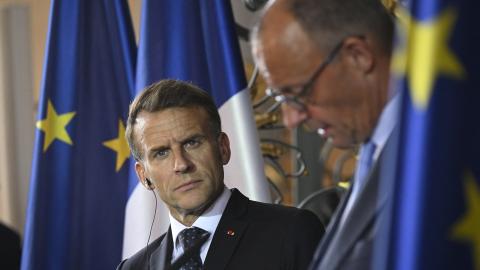
The president faced a clear dilemma. No American military officer could convincingly guarantee him that three or four more weeks of bombing would eliminate Iran’s ability to shoot drones and missiles at ships traversing the Strait of Hormuz. He admitted as much at this week’s G-7 summit in France. “If we didn’t do this deal,” he said, “we could have dropped more bombs for another three weeks, two weeks, four weeks, two years.” But the strait would not have reopened.
Further punishing Iran might have delivered greater leverage in subsequent negotiations. But it would also have come at a steep cost, which we can summarize as the three M’s: markets, munitions, and midterm elections.
The spike in oil prices rattled global markets and threatened even higher inflation. A prolonged bombing campaign would have required ever more munitions at a time when some U.S. stockpiles were already low. And with midterm elections looming, the political math was unforgiving: Voters have little appetite for open-ended conflicts that drive up gas prices and divert attention from domestic priorities.
Trump finally calculated that retreat, however inelegant, was preferable to gambling on an uncertain endgame. His critics see this move as surrender. In their eyes, he has become Barack Hussein Trump, offering Iran a pathway to rebuild its nuclear program, proxy network, and ballistic missile arsenal, while demanding nothing in return.
This analysis is overwrought for many reasons, but consider just three. First of all, Trump revitalized the credibility of the American military threat. President Obama’s Joint Comprehensive Plan of Action (JCPOA) in 2015 not only paved the way for Iran to develop an industrial-scale uranium enrichment complex. It essentially removed our military from the U.S.-Iran equation, even as Iran used its proxies to harry our forces. Tehran used the post-JCPOA decade to build its integrated deterrence “trident”: precision missiles and drones capable of saturating regional defenses, proxy forces from Yemen to Lebanon, and a nuclear program that never stopped.
Trump has severely weakened every prong of that trident. So far during his second term, Trump has ordered three major military operations against Iran: against the Houthis in Operation Rough Rider, and against Iranian nuclear and military sites in Operations Midnight Hammer and Epic Fury. That is three more operations than ordered by any other American president since Iran began enriching uranium.
Each time under Trump, the operation ended abruptly without achieving the hyperbolic objectives he declared. Each time, critics accused him of deserting the fight. Remember TACO? But the cumulative effect has degraded Iranian power severely and quickly.
The president’s critics want us to believe that the MOU marks the super TACO, a definitive and permanent surrender, leaving Iran free to behave as it pleases. A more sober assessment would conclude that Trump is buying time. If Iran responds as it did after last year’s 12-Day War, seeking to revitalize its nuclear program and protect it with a shield of ballistic missiles, Trump’s record suggests that he will strike again.
Also consider the status of Iran’s nuclear program. Before the JCPOA, Iran continuously enriched uranium in open defiance of six United Nations Security Council resolutions ordering it to stop. The JCPOA legitimized Iran’s enrichment activities and charted a clear path to unrestricted industrial-scale enrichment by 2031, driving the period required to produce enough fissile material for a nuclear bomb toward zero.
For 19 of the past 20 years, Iran enriched uranium without interruption. In stark contrast, Trump and Netanyahu have prohibited Iran from enriching a single gram of uranium for a full year. That prohibition will continue as long as the MOU is in place. Trump has denied Tehran the leverage of nuclear advances that it used in negotiations with previous U.S. administrations.
Trump also is forcing the Iranian regime to confront a daunting reconstruction challenge. Precision strikes devastated nuclear facilities at Natanz, Fordow, and Isfahan, setting back Iran’s enrichment capabilities by at least a year. U.S. and Israeli forces destroyed roughly one-third of Iran’s ballistic missile arsenal, hundreds of launchers, and critical storage sites. Those forces dismantled most Iranian air defenses and obliterated its navy.
There is no question that the war halted Iran’s oil exports, shattered petrochemical and steel plants, and left the banking system in disarray. The regime is now saddled with wrenching economic dilemmas. Will it pour scarce funds into resurrecting its nuclear program and missile production lines? Or will it redirect resources toward rebuilding those damaged plants and other industries that could generate jobs and ease hardship? The regime’s history of brutality, and its recent takeover by the Islamic Revolutionary Guard Corps, suggests that it will always prioritize military buildup. But doing so could hasten unrest and rebellion among the already devastated Iranian public.
Iran faces the same zero-sum choice with proxy groups like Hezbollah. Limited capital and enormous competing demands threaten to bring further instability in Iran. The decapitation strikes that killed Supreme Leader Ali Khamenei and dozens of senior officials have sown confusion across a leadership divided into competing factions. Trump’s tactical retreat is real, but so are the war’s achievements.
But there is one area where Trump paid a higher price than necessary: Lebanon. The MOU’s central purpose is to reopen the Strait of Hormuz. That required an accommodation with Tehran. It did not require linking the strait to Israeli operations against Hezbollah.
By accepting that linkage, Trump restored a source of Iranian leverage that battlefield successes had largely eliminated. Tehran has always sought to transform its disputes with the U.S. into disputes between Washington and Jerusalem. The MOU risks doing precisely that.
Trump’s public attacks on Netanyahu only reinforce the problem. On Sunday, he told Axios that the Israeli prime minister had “no fucking judgment,” complaining that Israeli operations in Lebanon were endangering the agreement. It was reminiscent of the f-bomb dropped by Trump at the end of last year’s war, when he forced Israel to halt retaliatory strikes against Iran after a ceasefire violation.
Last year’s confrontation occurred at the culmination of an extraordinarily successful military campaign that deepened cooperation between Washington and Jerusalem. This time, the dispute centers on a diplomatic arrangement that constrains Israel while providing Iran an opportunity to drive wedges between allies.
No Israeli government can absorb Hezbollah attacks while refraining from military action. Yet the Trump administration has effectively made restraint in Lebanon a condition for preserving the broader agreement. Meanwhile, American criticism of Israeli operations has left many Israelis with the impression that they are being blamed for instability caused by an Iranian proxy force.
The political consequences for Netanyahu are already visible. He is in the midst of a difficult reelection battle. His strongest argument to voters has been that his special relationship with Trump delivered strategic benefits unavailable to any rival. Trump’s criticism weakens that claim precisely when Netanyahu needs it most.
Heightened expectations only magnified the power of the blow. Over the past year, military cooperation between Washington and Jerusalem reached a level few Israelis believed was possible. The resulting disappointment is especially acute among the Israeli right, Trump’s most enthusiastic supporters in Israel. Many of these politicians and voters now hear the same criticisms of Netanyahu simultaneously from Washington, Tehran, and Trump’s domestic foes, some of whom are antisemites.
Fairly or unfairly, Israelis increasingly feel that Israel is being cast as the obstacle to an agreement in which the primary concessions were made to Iran. Why does Iran get a multibillion-dollar fund to rebuild, while Israel and the Gulf states, which bore the brunt of Iran’s aggression, get nothing?
Presidents have often discovered that Israeli perceptions matter in American politics. Israeli public opinion reverberates through American Jewish communities, evangelical churches, congressional networks, and the broader coalition that has traditionally supported a strong U.S.-Israel relationship. Trump has accumulated enormous political capital in Israel. He would be wise not to squander it now.
Yet the larger reality remains unchanged. Together, the U.S. and Israel shattered Iran’s integrated deterrence system, crippled its military infrastructure, halted its uranium enrichment, and degraded Hezbollah. F-bombs do not blow away those facts.
Of course, we should be realistic about what the MOU does not do. It does not resolve the fate of Iran’s nuclear material. It does not eliminate Iran’s missile arsenal. It does not dismantle Tehran’s remaining proxy network.
The MOU achieves something narrower: It reopens the Strait of Hormuz and postpones the remaining issues to a second round of negotiations that will almost certainly be long, contentious, and inconclusive. The history of U.S.-Iranian diplomacy offers little reason to expect otherwise. Tehran has spent decades perfecting a strategy of delay, procedural disputes, and endless hairsplitting.
But this reality does not transform the MOU into a defeat. Its real significance is that it buys time. The enduring value of the MOU depends entirely on how that time is used.
If the Trump administration allows the Iranians to use the time more wisely, then the president’s critics will be vindicated. Iran will rebuild. The agreement will become just another chapter in the long history of failed diplomacy with Tehran. If the U.S. and Israel use the pause to replenish stockpiles of munitions, strengthen regional air and missile defenses, deepen intelligence cooperation, and prepare for Iran’s next attempt to rebuild its nuclear and missile programs, then the MOU will be remembered as a tactic to lay the basis for a future victory.
The MOU cost a higher price than was perhaps necessary. But Trump got us here from a position of strength, not weakness. That is the difference between a tactical retreat and a surrender.