















The trade relationship between the Republic of Korea (ROK) and China has quietly shifted from an economic asset into a source of growing imbalance and vulnerability. Spurred by global supply shocks and shifting demands, South Korea’s firms have diversified and built redundancies in their supply chains, but they still maintain a consistent presence in China for manufacturing and sales. Firms with significant dependencies on China are taking on more risk as Beijing modernizes its arsenal of legal tools to use against foreign entities for its political goals.
Meanwhile, more Chinese products are competing with South Korean products domestically and globally. Beijing is supporting Chinese firms in industries critical to South Korea’s competitiveness, such as semiconductors, personal electronics, shipping manufacturing, petrochemicals, and automobiles. Beijing also continues to encourage Chinese firms to reduce their reliance on foreign products from countries such as South Korea while seeking to increase foreign dependencies on China.
The government in Seoul appears to have adopted a nonconfrontational approach for dealing with China. This puts the burden on South Korean firms to take the initiative and prepare for China’s growing use of economic lawfare alongside its long-time goal of becoming a global leader in technology.
South Korea’s Political Economy
South Korea’s economic growth has been slowing in recent years. Annual growth in real GDP has been under 2% since 2023—slightly less than the average of over 3% seen in the 2010s.[1] This has made economic growth one of the leading issues for ROK politicians in the last several presidential elections.
Each year, South Korea’s economy increasingly relies more on trade. Exports have contributed the most to the economy over the last three years. The country has emerged as a global leader in semiconductor production, but it lacks the domestic demand to support other sectors of the manufacturing base. All this means that the South Korean economy is much more influenced by global trade than ever before.
The recent boom in demand for artificial intelligence has given South Korea, as well as the United States and Taiwan, a much-needed boost in investment, while also contributing to its growing exports, particularly of semiconductors. However, this growth masks underlying vulnerabilities in the South Korean economy from the growing trade imbalance with China and exposure to its increasing use of economic lawfare against foreign firms.
ROK-China Economic Relationship
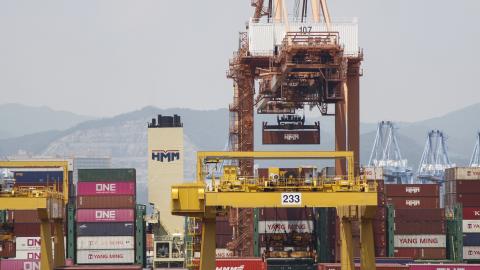
As trade becomes more important for the South Korean economy, China remains one of the ROK’s most significant trading partners. In 2025, China was the top destination for South Korean exports of goods ($131 billion) as well as the top source of imports ($142 billion).[2] Total annual trade (exports plus imports) between the two economies has increased by $61 billion, or 29%, in the last ten years. But during this period, the balance of trade has also shifted, and South Korea has maintained a trade deficit (imports exceeding exports) with China since 2023. Its trade-in-goods deficit with China in 2025 was $11 billion.
This deficit highlights how the nature of trade between the two economies has changed. South Korea’s exports to China last year were a modest 5% higher than its exports in 2016, while the country’s global exports have increased 43% over this same period. This has led to exports to China decreasing from 25% to 18% of South Korea’s total global exports. This means that China has become much less of an export market for companies in South Korea.
Meanwhile, South Korea’s imports from China last year were 63% higher than in 2016. The value of 2025 imports from China only represents 22% of South Korea’s global imports, just slightly higher than the 21% share that Chinese imports held ten years ago. Yet South Korea’s total global import of goods was 56% higher than in 2016. This suggests that while South Korea is importing a lot more than it used to, China remains a relatively consistent portion of these imports.
South Korea’s largest exports to China are mostly inputs and intermediary goods for manufacturing, including semiconductors, semiconductor manufacturing equipment, plastics, and parts for assembling personal electronics. Imports from China are mostly finished products, including semiconductors, servers, smartphones, and motor vehicles. Exporting intermediary goods, while importing finished products, demonstrates South Korean firms’ continued use of China as a location for manufacturing.
South Korea’s investment position in China makes the economic relationship appear even more unbalanced. Although the country’s direct investment position in China has been decreasing in recent years, it reached a cumulative $90 billion in 2024—an increase of more than $18 billion since 2016. In 2016, 23% of South Korea’s $310 billion of outward direct investment was in China. Since then, South Korean firms have more than doubled their direct investment abroad, with $763 billion in direct investment assets as of 2024. However, China’s share of this investment has fallen to just under 12%.[3]
While South Korean firms still invest in China, other countries are successfully attracting more South Korean capital, especially the United States. Although the ROK’s investment exposure in China has increased modestly over the last decade, this trend is not enough to explain the significant jump in the country’s imports from China. Chemicals for semiconductor manufacturing, automobiles and parts, structures made of steel, and clothing have seen some of the greatest increases over the last few years.
South Korean Companies’ Chinese Competition
China’s trade imbalance with the world has grown to unprecedented levels. According to national statistics, the country’s trade surplus with the world has doubled in the last five years to average more than $100 billion a month, or over $1 trillion a year. Meanwhile, South Korean firms are increasingly competing with Chinese products in some of the most critical industries for South Korea’s economy, including semiconductors, automobiles, smartphones, and petrochemical products.
South Korean automobile companies are perhaps struggling the most to compete within China. Hyundai sold only 128,000 retail units in China last year, less than one-third of the 502,000 units it sold in 2020.[4] Meanwhile, China imported half the number of motor vehicles it did in 2025 compared with just five years earlier, while exporting four times as many vehicles. South Korean companies are struggling to compete not only in China, where domestic demand is sluggish, but also increasingly in Southeast Asia against Chinese brands like BYD.[5]
The smartphone market is also challenging as Samsung fights to maintain roughly 20% of global shipments.[6] It continues to compete against not just Apple but several major Chinese brands like Xiaomi, Huawei, and BBK Electronics. Samsung’s annual shipments of smartphones globally have been on a steady decline for the last ten years, falling from 311 million units in 2016 to 241 units in 2025.
More Chinese brands are popping up in the cosmetics and beauty industry as well, supported by China’s low labor and petrochemical costs, making it harder for South Korean firms that used to rely on the Chinese market for sales. South Korean exports of skin and hair care products to China last year were less than half what they were just five years ago.[7] There are also some concerns about Chinese online retail apps making their way into South Korea’s online marketplace as companies like Temu, Shein, and AliExpress continue to expand their businesses. In 2024, AliExpress and Temu generated a combined 4 trillion won in sales in South Korea.[8] However, this represents only 2% of the 200 trillion won in mobile sales made in South Korea that year.[9]
Finally, the exposure of South Korea’s semiconductor industry to China is mixed. Chinese memory semiconductor manufacturers, such as YMTC and CXMT, are growing in market share against SK Hynix, Samsung, and Micron. But the recent boom in demand for artificial intelligence has caused a shortage in memory chips. SK’s sales in China have grown from 12 trillion won in 2020 to 19 trillion in 2025.[10] Semiconductor equipment manufacturers like SEMES and WonikIPS also saw sales to China increase last year.
China’s Growing Use of Economic Lawfare
In the past, Beijing used China’s position in global supply chains to apply political pressure and influence foreign firms and governments—usually in retaliation to an action it disapproved of. One example occurred in 2016, when Beijing retaliated against South Korea’s deployment of a new radar and missile defense system.[11] Anti-Korean sentiment was used to punish Lotte Group, Hyundai, Kia, and other export and tourism-related businesses operating in China. Other incidents include a garlic dispute that resulted in Beijing banning the import of South Korean mobile phones and a kimchi dispute that resulted in Beijing banning a dozen South Korean food products.
China is moving away from these ad hoc responses toward a systematic use of economic lawfare by reforming its financial, intellectual property, sanction, export control, foreign investment, and trade laws. Recent examples include sanctions on U.S.-based subsidiaries of Hanwha Ocean and the threat of sanctions against firms that export rare earth minerals to U.S. defense companies.[12]
According to a report published by South Korea’s National Assembly Futures Institute, China is preparing for stronger use of its legal and economic mechanisms against foreign firms. This is facilitated by greater information collection and continued efforts to build self-reliance, reducing China’s foreign dependencies and increasing foreign dependence on Chinese supply chains and technology.[13] South Korean firms with manufacturing facilities in China are particularly vulnerable to such economic lawfare. An example of this is an anti-monopoly investigation of memory semiconductor manufacturers Samsung, SK Hynix, and Micron, which Chinese authorities could use to support their country’s growing domestic memory chip industry.[14]
Conclusion
With free trade agreements with most of the world’s largest economies, South Korea has opened itself to the benefits and risks that come with global trade.[15] As trade becomes more important for the South Korean economy, so does the country’s relationship with these trading partners. The trade relationship the ROK has with China—once a large destination for South Korean exporters—has turned into a vulnerability. South Korea has become a net importer from China, and more Chinese firms are moving into industries that have been historically significant for South Korea’s economic development.
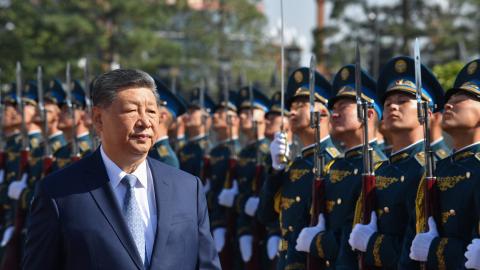
While Beijing is preparing a new toolkit of legal actions it can take against foreign firms to achieve its political goals, the government in Seoul is adopting a diplomatic approach to maintaining a steady relationship with Beijing. President Lee Jae-myung’s meeting with Xi Jinping at the beginning of the year highlights Lee’s “pragmatic” approach to bilateral relations.[16]
Seoul’s efforts put the initiative on firms to continue to manage their risk exposure to the Chinese market, whether they are hoping to access its manufacturing sector or potential consumer market. South Korean firms are also seeing more competition, not just within China but against Chinese brands in other countries, often supported by Beijing’s efforts. Preparation for this new competition will be difficult and could require more coordination between South Korea and its economic partners, particularly the United States, Japan, and Southeast Asian partners.
Read in the National Bureau of Asian Research.
Endnotes
[1] “Contributions to Real GDP Growth by Expenditures (Not Seasonally Adjusted, Quarterly and Annual),” Korean Statistical Information Service, https://kosis.kr/eng/statisticsList/statisticsListIndex.do.
[2] Trade statistics in this section are provided by the Korea Customs Service, while percent changes have been calculated by the author. “Trade Statistics by Country,” Korea Customs Service, https://tradedata.go.kr/cts/index_eng.do.
[3] “IIP for Nations,” Korean Statistical Information Service, https://kosis.kr/eng/statisticsList/statisticsListIndex.do.
[4] “Quarterly Earnings,” Hyundai Motor Company, https://www.hyundai.com/worldwide/en/company/ir/financial-information/q….
[5] Rowan Calder, “Chinese EV Makers Surge Ahead as BYD’s Global Push Gains Speed,” Morning Overview, April 14, 2026, https://www.msn.com/en-us/money/markets/chinese-ev-makers-surge-ahead-a….
[6] Nabila Popal, Francisco Jeronimo, and Ryan Reith, “Worldwide Smartphone Market Grows 2.3% in Q4 2025, Driven by Strong Performances from Samsung and Apple, according to IDC,” IDC, January 13, 2026, https://www.idc.com/resource-center/press-releases/q425mobilephonetop5.
[7] “Trade Statistics by HS Code and Country,” Korea Customs Service, https://tradedata.go.kr/cts/index_eng.do.
[8] Joey, “AliExpress and Temu Generate over 4 Trillion Won in South Korea Sales,” Chosun Biz, February 11, 2025, https://biz.chosun.com/en/en-retail/2025/02/11/6HV5NGTRBBH6DOTU6RQ3Y4YI….
[9] “Transaction Value of Online Shopping Mall by Commodity Groups/Sales Channel,” Korean Statistical Information Service, https://kosis.kr/eng/statisticsList/statisticsListIndex.do.
[10] “2025 Audit(Review) Report,” SK Hynix, https://www.skhynix.com/ir/UI-FR-IR12_T4.
[11] Ethan Meick and Nargiza Salidjanova, “China’s Response to U.S.–South Korean Missile Defense System Deployment and Its Implications,” U.S.-China Economic and Security Review Commission, Staff Research Report, July 26, 2017, https://www.uscc.gov/sites/default/files/Research/Report_China%27s%20Re….
[12] Chan Ho-Kim, “China Sanctions 5 U.S. Units of South Korean Shipbuilder Hanwha Ocean over Probe by Washington,” Associated Press, October 14, 2025, https://apnews.com/article/china-us-hanwha-shipbuilding-korea-trade-cb7….
[13] Jungmi Cha, “China’s Economic Security Strategy: Systematization and Institutionalization under the Comprehensive National Security Concept” (Korean), National Assembly Futures Institute, Future Strategy Insight, December, 2025. The article has been translated using ChatGPT.
[14] Bryan Harris, Song Jung-a, and Emily Fang, “China Alleges ‘Massive’ Evidence of Chipmaker Violations,” Financial Times, November 19, 2018, https://www.ft.com/content/d626833a-ebb5-11e8-89c8-d36339d835c0?syn-25a….
[15] “FTA Trend in Korea,” Korea Customs Service, https://www.customs.go.kr/engportal/cm/cntnts/cntntsView.do?cntntsId=23….
[16] Seong Hyeon Choi, “South Korean Leader Lee Takes ‘Pragmatic Approach’ to Reset Ties with China, Japan,” South China Morning Post, January 15, 2026, https://www.scmp.com/news/china/diplomacy/article/3339989/south-korean-….