
















Executive Summary
- The Russia-Ukraine War continued at a high operational tempo, with intense combat operations and mounting drone and missile strikes.
- Ukraine intensified its long-range robotic salvos targeting Russia’s energy and defense-industrial infrastructure, as well as the Moscow area.
- Kyiv’s development of its first indigenous glide bomb signaled a growing shift toward scalable, low-cost precision warfare.
1. Battlefield Assessment
Last week, fighting continued at a high operational tempo amid ongoing Russian pressure. Ukrainian reporting and open-source intelligence indicated that on some days Russian and Ukrainian forces waged roughly 200 to 250 tactical engagements.
The heaviest fighting continued to center around Pokrovsk, Kostiantynivka, and Huliaipole, where most combat took place. Russian forces also increased their activity along the Lyman, Sloviansk, and Kramatorsk axes, mounting sustained pressure across several sectors.
Last week also witnessed some of the most intense drone and missile action since the war’s outset, as Russia launched hundreds of drones and follow-on ballistic missile salvos. Because Ukraine lacks sufficient interceptors for its Patriot surface-to-air anti-ballistic missile systems, Russian projectiles, including the North Korean KN-23 and indigenous Iskander, continued to threaten Ukrainian missile defenses. Ukraine did mount an increasing number of drone-on-drone interceptions, though Russian drones continued to terrorize Ukrainian cities.
Kyiv’s improving robotic-warfare deterrent retaliated against Russian air raids. On the night of May 15, Ukraine’s Unmanned Systems Forces (USF)—working alongside the country’s Special Operations Forces, Defense Intelligence Directorate, and other components of Ukraine’s defense establishment—conducted a long-range strike against the Ryazan oil refinery, an installation owned by Russia’s state-controlled Rosneft corporation. Ukrainian military sources stated that the strike involved operators from the 1st Separate Center, the 414th Separate Unmanned Systems Brigade (“Magyar Birds”), and the Raid-413 robotic warfare formation.
The Ryazan refinery is one of Russia’s largest oil-processing facilities, with an annual refining capacity of approximately 17.1 million tons. The plant produces multiple grades of gasoline, diesel fuel, liquefied gases, jet fuel, and other petroleum products for both civilian and military uses. Additionally, Ukrainian intelligence analyses have indicated that each year the facility produces roughly 840,000 tons of TS-1 aviation kerosene, an important source of fuel for the Russian Aerospace Forces.
According to Ukrainian reporting, the strike on the Ryazan refinery triggered multiple explosions and a large-scale fire on the premises. While Ukrainian officials stated that battle-damage assessments of the strike are ongoing, the operation reflects Kyiv’s continuing campaign to degrade Russia’s energy infrastructure and constrain the logistical and operational sustainment capacities supporting Moscow’s war machine.
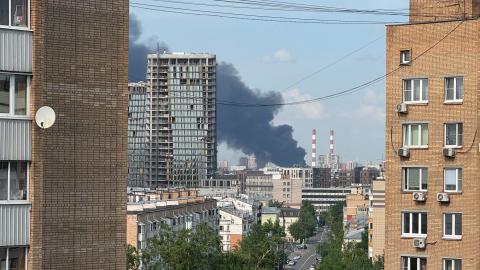
Ukraine also struck other Russian facilities last week. On the night of May 16, Ukrainian long-range strike assets—including indigenous robotic weapons such as the Bars RS-1, Fire Point FP-1, and Bars-SM Gladiator—conducted a coordinated wave of strikes against military-industrial and logistics targets in Moscow Oblast. Ukrainian military authorities confirmed a successful strike on a facility in Zelenograd owned by JSC Angstrem, a major Russian semiconductor developer and manufacturer. The facility serves as a key node in Russia’s defense-industrial base, and is responsible for the production of microelectronics, radio electronics, optical components, and robotic systems used in precision-guided weapons programs. Secondary fires were reported at the site following the attack.
Additionally, Ukrainian forces struck the Solnechnogorskaya pumping station, a critical component of the pipeline network encircling Moscow. The facility is responsible for storing, transferring, and distributing large volumes of petroleum products, including fuel supplies that support Russian military operations. Open-source satellite-imagery intelligence confirmed that four RVS-5000 storage tanks were destroyed at the pumping station, and visual uploads after the strike revealed fires at the impact site. Beyond the strikes they conducted inside Russia, Ukrainian forces also targeted multiple operational-level military assets across occupied territories and frontline sectors within Ukraine.
Lastly, social media posts from the 414th “Magyar Birds” unit of the USF revealed that the group is pioneering a new concept of employment (CONEMP): a rocket-drone hybrid that integrates unguided rockets into long-range FP-1 and FP-2 strike drones. The new asset can operate over 300 miles inside Russia’s operational depth and boasts a 60-kilogram-class strike-wing warhead.
Last week Ukraine launched salvos that used the drone-rocket hybrid, and video from its onboard camera was released for the first time. This new adaptation is important not only for its precision, but also for its ability to extend rotary-wing and attack-aviation effects into hostile airspace where conventional helicopters cannot usually survive.
2. Ukraine Introduces Its First Indigenously Developed Glide Bomb
Ukraine released images of its first indigenously developed guided glide bomb, a practical munition fit for use in precise and low-cost strikes. This development demonstrates Kyiv’s intention to manufacture a homegrown precision-attack system suited to its wartime needs. Ukrainian officials stated that the new bomb is now ready for combat after a 17-month design and testing process led by Brave1, a government-backed defense technology initiative.
The new weapon, reportedly a 250-pound-class bomb, comes with a detachable set of wings and an unspecified guidance mechanism. This combination of features allows the munition to hit fortified positions, command posts, logistics hubs, and other targets far behind enemy lines.
Ukraine’s defense minister, Mykhailo Fedorov, clarified that the weapon’s design is an original Ukrainian innovation, different in kind from both Western and Soviet-vintage bombs. Ukraine’s Ministry of Defense has already purchased initial experimental batches of the munition, and Ukrainian pilots are undergoing training for combat deployment of the weapon.
Available footage suggests that Ukraine tested its new glide bomb using a Ukrainian Air Force Su-24 Fencer strike aircraft. Open-source intelligence suggests that the bomb appears to utilize deployable glide wings and large cruciform tail surfaces to stabilize and guide the munition after release. Resembling Russian glide-bomb adaptations, the weapon’s design likely allows the bomb to transition to its attack profile immediately after separation from its deploying aircraft, but before wing deployment.
While the precise range and guidance architecture of the new weapon remain undisclosed, glide bombs fill an important niche in Ukraine’s battlefield needs. Compared to cruise missiles, glide bombs are less expensive to manufacture and can carry larger warheads than most drones. Tactical aircraft can also release glide bombs outside many short-to-mid-altitude engagement envelopes.
Guided munitions with mid-range standoff capabilities that are inexpensive to produce offer Kyiv a means to preserve its low long-range missile inventories while simultaneously sustaining pressure on Russia’s operational infrastructure and frontline concentrations.
3. What to Monitor in the Coming Weeks
Last week, Russia and Belarus conducted joint nuclear drills involving dual-capable delivery systems and tactical nuclear-warfare scenarios, underscoring Moscow’s continued reliance on nuclear signaling amid its protracted war in Ukraine. The joint exercises coincided with the Kremlin’s renewed rhetoric hinting at non-strategic nuclear deployments in Belarus and broader escalation messaging toward the North Atlantic Treaty Organization. NATO nations should closely monitor whether these drills evolve into nuclear-sharing mechanisms or new nuclear-use priorities.
Subscribe to Hudson’s Re: Ukraine Newsletter Here