








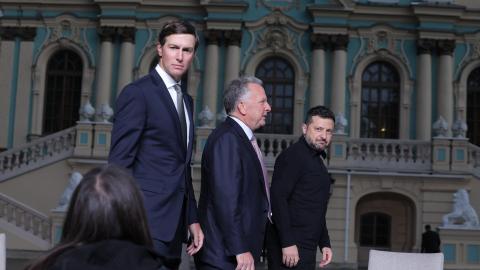

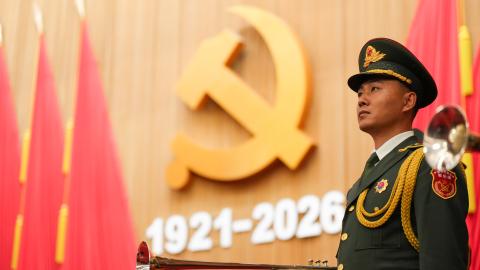


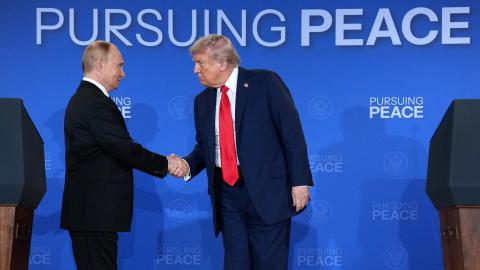
It has been about six weeks since U.S. Special Envoy to the Middle East Steve Witkoff championed the pro-Russia 28-point plan to end Russia’s war of aggression against Ukraine. The document was a scandal. It was a scandal in how far it went to represent Russian claims, how it embraced Russian nonsense about the cause of the war, and in its inclusion of provisions that have nothing to do with Russia’s war against Ukraine and would help Russia at the expense of American interests (i.e., extending the New START Treaty). Russian negotiator Kirill Dmitriev seemed to mock those who rightly found the approach hard to stomach by posting a video of him wake surfing in Miami, all while Russians were targeting civilian Ukrainians who were trying to survive the winter cold after the Russians bombed the power grid.
But after the last few weeks of successful diplomacy among the Europeans, and a whirlwind of Trump-ordered daring and successful American military operations, led by the capture of Nicolás Maduro in Venezuela, something has shifted. According to Senator Lindsey Graham, who has been traveling with the president, President Trump has now greenlit punishing secondary sanctions on Russia. This is excellent news and portends the possibility of — finally — a far more effective U.S. approach toward Russia. This should be the year the United States turns the screws on the Russian economy and embraces a plan to bolster Ukraine’s military strength and operational latitude to maximize its military effectiveness against Russia and to adapt the NATO Alliance to restore strategic stability with Russia.
Contrary to the false information that the president’s briefer has seemingly been providing him, Russia is not ten feet tall, nor does Vladimir Putin “want peace,” nor is Putin earnestly working toward a positive relationship with the United States. Russia is not dominating on the battlefield in Ukraine, it is not guaranteed that Russia will succeed in swallowing up highly prized Ukrainian territory, and standing up to Russia will not inevitably launch a world war. Believing those myths may cause one to conclude that it is necessary to pressure Ukraine to make concessions, and so busting them may lead to correction and a strategy that actually works.
Mere weeks before the U.S. raid against Maduro, Russia delivered more air defenses to Venezuela. Russia has been providing significant military equipment to Venezuela for years. None of the air defenses downed a single American aircraft during the raid. Secretary of Defense Pete Hegseth subsequently boasted that it “seems those Russian air defenses didn’t quite work so well, did they?” Russia’s declared support for Venezuela, and its denunciations of the U.S. naval blockade and anti–drug boat campaign, did not dissuade the United States from attacking Russia’s partner.
Days later, the United States was gaining on a rusty tanker it had been pursuing, called the Bella 1. The U.S. sanctioned it in 2024 for operating within a “shadow fleet” of tankers transporting illicit Iranian oil. To get the United States to stand down, a Russian flag was ham-fistedly painted on the tanker, and Russia even sent escorts for the ship. U.S. forces still boarded and seized it. Ever since Russia launched its full-scale invasion of Ukraine in 2022, officials in the Biden administration and experts outside the government feared that by confronting Russia directly, uncontrolled escalation was likely to ensue. Thus, the United States notably did not enforce sanctions against the Russian shadow fleet, and only recently did Europeans start to do so. The United States now joins several other European allies in boarding Russian-operated shadow fleet tankers trying to evade sanctions, prop up the Iran regime, and support its war machine. The Russian government accused the United States of piracy. One Russian official supported Russian military retaliation.
And, after assuring President Trump that he was operating in good faith (the obvious ongoing evidence of the war of aggression he launched and historical record notwithstanding), Putin lied to Trump by telling him that Ukraine had launched a drone swarm to target Putin’s residence. Trump initially expressed publicly that he thought Putin was telling the truth before learning from U.S. intelligence that Putin had clearly lied to derail U.S. collaboration with Ukraine and European allies.
To their credit, Europeans got busy working with the U.S. delegation to ensure there was a peace plan in the offing that was much more likely to bring peace than the one favored by the Russians. Ukrainians required credible security guarantees, as any serious nation who was an ongoing victim of Russian aggression would, and the Europeans and the U.S. team provided them. As of the time of this writing, the Russians have rejected the plan. Moscow aimed most of their ire at the credible security guarantees for Ukraine, describing the document as “continuing the militarization, escalation and further conflict aggravation.” It’s language that would work on an alliance paralyzed by fear of escalation, but after three years of those claims, and on the heels of world-class U.S. military competency, it just might not have its intended effect of intimidating Ukraine’s Western backers this time.
Meanwhile, Russia’s war of choice grinds on, and for little territorial gain at staggering human loss. The exact figures are unclear but high and as many as hundreds of thousands of Russian men — sons, brothers, husbands — have been killed or wounded for “Ukrainian territory slightly larger than the state of Rhode Island.” As Graeme Wood of The Atlantic quipped, “At that rate, Russia will control all of Ukraine in about 118 years.”
However, the wrong lesson to take away is that Russia is inherently weak, and that Ukraine can handle the Bear on its own. The right lesson is that Ukraine’s allies are comparatively far stronger. With the backing of American intelligence and weapons and European weapons and logistics, Ukraine has the resolve, the ability, and the discipline to hold off further Russian advances. Already, this tragic war has made Ukraine possess the largest defense force in Europe and has enabled the United States and the rest of NATO to learn how to adapt and fight Russia.
Despite the narrative that supporting Ukraine is a drain on the American defense industrial base, shipping weapons to Ukraine has prompted an increase in production capacity and workforce growth, and selling Europeans weapons for Ukraine will continue to boost America’s standing as the Arsenal of Freedom. Trump’s announcement that the United States will significantly increase its defense budget from $1 trillion to $1.5 trillion will pave the way for a serious military buildup that parallels Ronald Reagan’s during the Cold War. With this bump, the United States will increase investments on defense to roughly 5 percent of GDP, which means after insisting the rest of NATO spend 5 percent on defense, the leader of NATO is now leveling up. Unlike the Cold War, the United States must deter not just one imperialist nuclear peer, but two: China and Russia, in addition to the other countries in the axis of aggressors (North Korea, Iran, and their useful cartel regimes in Latin America).
Trump remains unpredictable, and he is surrounded by advisers who have been doggedly committed to an Obama-like Russia reset to normalize business deals with Russia, so a return to failed policies of accommodation is not entirely out of the realm of possibility. But successfully capturing one of Russia’s avowed allies could be a turning point, and gaining confidence in America’s own military might and competency may just give Trump the confidence to stand up to Putin and to turn the tide to a more effective and honorable posture towards Russia. Let us hope.