



















Each Sunday throughout Lent, my church has prayed The Great Litany, a liturgy formed by petitions. As a follower of Christ working in national security, this petition has arrested my soul every week:
To make wars to cease in all the world, and to give to all nations unity, peace, and concord:
We beseech you to hear us, good Lord.
The problem of war is the motivating question of international politics. Graduate degrees are formed around studying it. Many scholars and staffers have dedicated their professional lives to understanding it. Nation states exist, in large part, by waging it. To be human on this side of eternity entails preparing for the possibility and suffering the reality of warfare.
Many leaders have also labored to end it. From the League of Nations to the United Nations, global institutions have sought to restrain national interests and tame violent states. The logic is simple: economic cooperation, clear communication, and global governance can increase incentives for cooperation and mitigate conflicting desires before conflict breaks out.
On this holiest of weekends, where Christians around the world mark the death, burial, and resurrection of Jesus Christ, I am struck by the frailty of our efforts to sanctify the nations by human means, and the hope of the cross for a world of lasting comity.
It remains one of the great ironies of the twentieth century that many in the Western world initially viewed World War I as “a war to end all wars.” The saying comes from H.G. Wells and his 1914 book The War That Will End War. At the conflict’s outset, the famed British author declared that the conflict was “a war for peace.” “We face,” Wells wrote, “these horrors to make an end of them. There shall be no more Kaisers, there shall be no more Krupps, we are resolved. That foolery shall end.” He went on to insist that “a war that will merely beat Germany a little and restore the hateful tensions of the last forty years is not worth waging.” Tragically, that is exactly what transpired.
The fault lies not in the desire for peace but in the diagnosis of disease. Our focus is misplaced. One of the first books I read in graduate school was Man, The State, and War by Kenneth Waltz. Waltz recommended three layers of analysis to understand international politics and warfare: the global system, domestic institutions, and elite leaders. He left unaddressed the most foundational: human nature. The leaders that formed the League of Nations and the United Nations made this same error. Warfare arises not from nations and kingdoms, but from the heart.
The pages of scripture reveal this truth. Before the Bible’s first recorded battle in Genesis 14, wherein multiple tribes balanced with each other against a competing axis and fought to the death; before the Tower of Babel, an early experiment in ethno-tribalism; before Cain murdered his brother Abel: humans rebelled against God in Eden, and sin entered creation. The constant warfare that defined Israel’s political existence throughout the Old Testament was a consequence of mankind’s declaration of war against God.
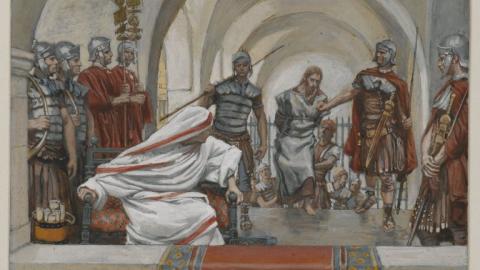
So it is with the wars that plague our lives today. James draws this connection in his epistle: “What causes quarrels and what causes fights among you? Is it not this, that your passions are at war within you? You desire and do not have, so you murder. You covet and cannot obtain, so you fight and quarrel.” Psalm 2 shows how sin manifests at a national scale. The nations rage because “the kings of the earth set themselves, and the rulers take counsel together, against the LORD and against his Anointed.” Even in fighting each other, they are allied in their rebellion against God. Look no further than the account in Luke’s gospel of Herod and Pilate. They were once at enmity with each other, then became friends on the day of Jesus’ crucifixion.
It was on that day, when Israel’s chief priests and rulers allied with the power of Caesar to crucify Jesus of Nazareth—the day when the nations waged war most violently against the sovereign God Himself—that Jesus atoned for the underlying cause of warfare. The unspeakable suffering that Christ endured was the judgment for the sin of the world. God laid on his body and spirit His judgment for every sin. The death He died brought the very thing humans have labored for in vain: peace. A more lasting peace than comity among nations: a cessation of hostilities between God and man. Christ’s resurrection days later confirmed this victory.
What of our Lenten prayers? Even with Christ’s passion and resurrection, we are still plagued by nuclear nightmares, killing fields, and dystopian fears of autonomous weaponry. We have beseeched our good Lord to hear us. Has He? It would be easy to despair and echo the words of the false teachers about which the Apostle Peter warned, that “Ever since the fathers fell asleep, all things are continuing as they were from the beginning of creation.” On this holiest of weekends, where is hope for the peace among nations?
We remember what Jesus told His followers, that wars and rumors of wars would persist in the last days. We recall the honesty of the author of Hebrews: “At present, we do not yet see everything in subjection under [Jesus].” But we look to Jesus, who—as was prophesied in Psalm 2— is “crowned with glory and honor because of the suffering of death, so that by the grace of God he might taste death for everyone.” By His resurrection power He sanctifies believers and “is able to help those who are being tempted.”
Christians pray for the peace of the world because we believe in God’s Word. He has promised to “judge between the nations,” and the prophet Isaiah spoke of the day when the nations “shall beat their swords into plowshares,” and “nation shall not lift up sword against nation, neither shall they learn war anymore.” We understand from Scripture that Jesus Christ will himself bring this peace about. The King of the nations in Psalm 2 is the rider on the white horse in Revelation 19, who will come to judge the nations with a sword—the true and actual war to end all wars.
For this day to come, and for perseverance and faith of the saints: we beseech you to hear us, good Lord.