











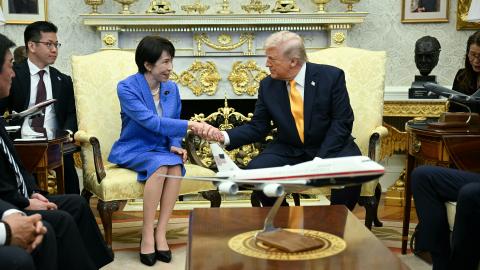
When Japanese Prime Minister Sanae Takaichi meets U.S. President Donald Trump in Washington on Thursday, the formalities of diplomacy will conceal a far more consequential negotiation. At stake is not simply bilateral cooperation, but Japan’s ability to operate within an increasingly transactional alliance framework—one in which economic access is implicitly tied to military contribution. For Tokyo, whose export-driven economy depends heavily on the U.S. market, meeting this “security-for-trade” expectation has become an urgent strategic necessity.
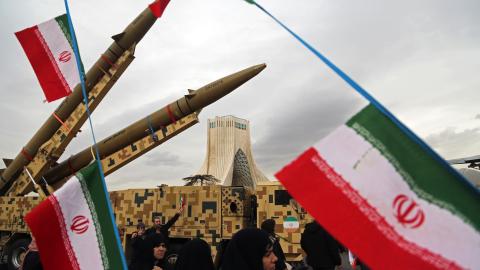
The Iran situation will of course be front and center in the talks. Military operations, now in their third week, have effectively closed the Strait of Hormuz, a chokepoint through which roughly 20 percent of global oil and liquefied natural gas flows. For Japan, which imports more than 90 percent of its crude oil from the region, the disruption represents a severe and immediate vulnerability.
Yet the situation also presents a strategic paradox. While the short-term impact is destabilizing, the ongoing military operations are achieving core objectives. By degrading hostile infrastructure and weakening proxy networks, the U.S. and Israel are eliminating the structural sources of instability that have long threatened global energy transit. From this perspective, current disruptions are the cost of producing a more secure and predictable energy environment in the future—an outcome that would disproportionately benefit energy-importing economies such as Japan. Moreover, Japan’s extensive strategic petroleum reserve, built in response to the oil shocks of the 1970s, offer some, albeit temporary, relief.
Against this backdrop, the United States has intensified calls for allied burden-sharing. Countries reliant on Middle Eastern energy are being urged to contribute directly to securing maritime routes. Although public pressure has focused heavily on European allies, Japan faces the same expectations. Washington has explicitly called on partners to deploy naval assets to the region, framing participation as a test of alliance credibility.
Japan’s response, however, is constrained by domestic legal and political realities. The deployment of the Maritime Self-Defense Force (MSDF) into an active conflict zone remains highly sensitive under Japan’s pacifist constitutional framework.
Recent diplomacy suggests a carefully calibrated approach. Foreign Minister Toshimitsu Motegi has engaged with U.S. Secretary of State Marco Rubio, while also conducting parallel outreach to Saudi Arabia and the United Arab Emirates to stabilize energy flows. These efforts point toward a limited but symbolically significant options, including intelligence sharing and the promise of post-conflict mine clearing operations.
At the same time, Tokyo is reinforcing its strategic value in other theaters. Recent U.S.–Japan agreements to expand joint missile production and intensify military exercises—particularly in Japan’s southwestern islands—signal a deepening of alliance integration in the Indo-Pacific. These initiatives demonstrate that Japan is already contributing meaningfully to shared security objectives, particularly in balancing China, which remains Washington’s primary long-term strategic concern.
This broader defense cooperation provides Tokyo with an important bargaining tool. By combining limited participation in Middle Eastern maritime security with expanded contributions in the Indo-Pacific, Japan can present a more comprehensive model of burden-sharing—one that extends beyond a single crisis.
Economic statecraft forms the final pillar of this strategy. Japan’s commitments to contribute hundreds of billions of dollars in investments and loans in the United States provide a powerful complement to its security contributions. By emphasizing the domestic economic benefits of these investments—especially job creation—Prime Minister Takaichi can align Japan’s approach with the political priorities of the Trump administration.
Ultimately, however, the outcome of this high-stakes meeting may depend as much on personal diplomacy as on policy substance. Prime Minister Takaichi has already invested heavily in cultivating a strong working relationship with President Trump, emphasizing rapport, symbolic gestures, and alignment with his strategic worldview. Early interactions between the two leaders have been notably positive, with Trump publicly describing their exchanges as productive and characterizing Takaichi as a strong and capable partner, while Takaichi herself has underscored the centrality of the U.S. alliance to her foreign policy.
This personal dynamic is not incidental, but central to Japan’s negotiating strategy. Trump has consistently demonstrated a preference for leaders he perceives as decisive, pragmatic, and willing to engage on his terms. Takaichi, a political protégé of former Prime Minister Shinzo Abe, appears to understand this calculus well, positioning herself as a reliable and strategically aligned counterpart.
In this context, her objective in Washington extends beyond avoiding tariffs or managing a single crisis. It is to frame Japan’s actions—whether a limited future naval deployment, expanded defense cooperation in Asia, or large-scale investment in the U.S. economy—not as reluctant concessions, but as the proactive choices of a committed ally benefiting from U.S. leadership. By doing so, she can align Japan’s contributions with the administration’s broader narrative: that American power is actively reshaping global conditions in ways that ultimately enhance allied security.
If successfully executed, this strategy offers multiple payoffs. It could secure relief from threatened trade measures, reinforce Japan’s role as a preferred U.S. partner, and help insulate its economy from the cascading effects of energy market disruption. More fundamentally, it would position Japan as a model participant in an evolving alliance system—one defined less by fixed commitments than by continuous negotiation, strategic substitution, and the ability to translate national constraints into credible contributions.
In an era of transactional diplomacy, that may be the most valuable currency of all.