















Executive Summary
The United States’ highest national security priority is deterring major-power conflict with nuclear-armed adversaries. In 2023, the bipartisan Strategic Posture Commission warned that the US is on the cusp of entering a threat environment from 2027–2035 that it is not prepared for, in which it must deter two nuclear peer adversaries and correct years of underinvestment in the infrastructure that supports the deterrent.[1] Investing in inertial confinement fusion (ICF) is a crucial imperative in this effort, both inside the government and through partnerships with the private sector, especially when it comes to countering China.
China’s ongoing nuclear breakout extends beyond the size of its arsenal. Beijing is building the fusion facilities and high-energy-density physics infrastructure needed to improve weapons simulation, effects testing, and future designs.[2]
ICF is central both to China’s nuclear expansion and to US objectives to adapt its deterrent as quickly as possible. ICF is often discussed as a future energy technology, but it is also a core stockpile-stewardship capability.
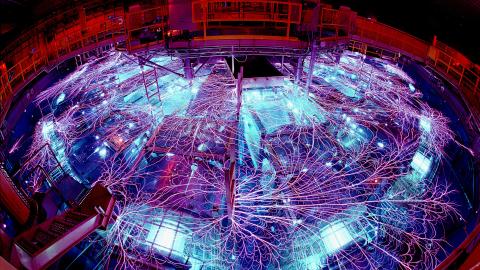
Since the United States chose to halt explosive underground nuclear testing in 1992, facilities such as Lawrence Livermore National Laboratory’s National Ignition Facility (NIF), Sandia’s Z machine, and the University of Rochester’s Omega Laser Facility have helped provide the experimental data needed to validate weapons simulations, gain new insights in high-energy-density science, and sustain confidence in the nuclear stockpile.[3]
The US has significant advantages: world-class laboratories, the only facility to achieve fusion ignition, deep private capital markets, and leading fusion startups.[4] But those assets are not yet organized into a national strategy to support either the energy or deterrence applications of fusion. China, by contrast, is treating fusion as a strategic national priority and is moving to build new laser and pulsed-power facilities that could strengthen its nuclear-weapons enterprise and its commercial fusion ambitions.[5]
While there are many demands on the defense and energy budgets, there is no greater priority than the nation’s strategic deterrent. The Trump administration, building on previous administrations’ efforts to deliver national security capabilities and invest in the industrial base, has continued to adapt and expand the deterrent to meet tomorrow’s challenges. Investing in ICF is an essential next step. Congress and the Trump administration should direct the National Nuclear Security Administration (NNSA) to enter into public-private partnerships to deliver next-generation ICF capabilities while sustaining existing facilities.
Introduction: The Stakes
The United States’ highest national security priority is deterring major-power conflict with nuclear-armed adversaries. For the first time in its history, the US must prepare to deter two major nuclear powers. Russia remains the nation’s most immediate nuclear adversary, but China is amid a nuclear breakout that is expanding the size of its arsenal and revolutionizing its nuclear technology.[6]
The danger is not simply that China may field more nuclear weapons. It is that Beijing is investing in the weapons-science infrastructure needed to make its arsenal more sophisticated, survivable, and adaptable over time. Deterrence is therefore not a numbers game alone. It depends on whether the United States can maintain the scientific capacity to certify the stockpile, understand weapons effects, validate simulations, and adapt its deterrent faster than adversaries can exploit new capabilities.[7]
Senior US officials have warned that this challenge is already underway. Former commander of the US Strategic Command, Admiral Charles Richard, described China’s nuclear expansion as a “strategic breakout” and warned that the US had entered “uncharted waters” as it faced two peer nuclear-capable adversaries.[8] The Department of War has assessed that China is rapidly expanding and modernizing its nuclear forces, while State Department officials have also disclosed that China has conducted very low-yield nuclear explosive testing.[9] These developments reinforce the same point: The US should ensure that its weapons-science enterprise remains fully capable now and into the future to develop and sustain a credible nuclear deterrent.
ICF is central to this goal and to ensuring that neither China nor Russia gains a technological advantage. ICF is also a weapons-science capability with direct relevance to stockpile stewardship, effects testing, and nuclear design confidence. China appears to understand this. The US should ensure it continues to modernize and expand its ICF capabilities.
Strategic Backdrop: ICF and the Next Nuclear Technology Race
To ensure that the United States can adapt its deterrent to preserve the peace, it must invest in its weapons-science infrastructure. Credible deterrence relies in part on an adversary’s confidence that US weapons are safe, secure, reliable, survivable, adaptable, and backed by the scientific and computational capacity to certify and improve them. In that competition, ICF is an underappreciated but essential strategic technology.
ICF uses lasers (laser-based ICF), pulsed-power systems (pulser-based ICF), or other inertially coupled mechanisms to compress a tiny fuel target and create fusion conditions, the same basic process that powers the sun. The United States still holds the most important scientific milestone: Lawrence Livermore National Laboratory's NIF, the only facility in the world to achieve fusion ignition and produce more energy from the target than the lasers delivered to it.[10] That achievement proved the scientific possibility of fusion energy. It also underscored ICF’s continuing importance to the weapons mission that made the breakthrough possible.[11]
ICF creates extreme temperatures and pressures, radiation outputs, and material conditions that inform weapons simulations, help scientists understand weapons performance and effects, support radiation hardness testing, and support the design and certification of nuclear weapons. Since the US stopped underground explosive nuclear testing in 1992, ICF and other laboratory capabilities have become central to science-based stockpile stewardship.[12] These assets remain an essential component of a credible deterrence strategy.
The commercial stakes in fusion energy are also large. Dozens of startups are now competing across multiple technical pathways involving lasers, magnets, and hybrid approaches to replicate the NIF’s ignition achievement, convert that into electricity, and ultimately build economically viable fusion power plants.[13]
China, meanwhile, is rapidly building the infrastructure to replicate, improve upon, and scale America’s ICF achievements. America is at risk of falling behind China in ICF, which would have serious implications for both nuclear deterrence and energy dominance. ICF is too important for national security to be treated as ordinary energy technology, and too commercially promising to be left solely to national lab timelines and government acquisition pathways. America needs a new public-private model.
China’s Fusion Leapfrog Strategy
The People’s Republic of China views fusion as a strategic national imperative. It can advance energy security, technological self-reliance, and nuclear-weapons modernization at the same time. Beijing has embedded fusion into national planning and is marshaling military and civilian institutions to leapfrog US weapons and next-generation clean energy production capabilities.[14]
China is pursuing both laser- and pulser-based ICF. Laser-based ICF uses powerful lasers to rapidly heat a tiny fuel pellet to sun-like temperatures and densities, creating the extreme conditions needed for atoms to fuse and release energy. Pulsed power stores energy in capacitors and releases it in a very short burst to create extremely high power, like controlled lightning.[15]
Pulser-based ICF deserves special attention because it is commercially promising and strategically relevant. Strategically, pulsed power can generate high-energy-density environments and radiation outputs that help physicists model weapons effects and develop new military technologies.[16]
The scale of China’s effort is visible in money, talent, and poured concrete. China has invested roughly $10 billion in new laser- and pulsed-power ICF projects, including research laboratories and full-scale demonstration facilities. At the center is the China Academy of Engineering Physics (CAEP), a People’s Liberation Army–administered nuclear-weapons research institution analogous to US weapons laboratories. CAEP is recruiting thousands of scientists and engineers into its ICF programs. China is also building five large ICF facilities, including three under construction and two in advanced planning. Its Shenguang-IV laser facility is expected to be at least 50 percent larger than NIF. Its Julong-2 pulsed-power machine is designed to operate at 50 million amperes, exceeding the Z machine’s current capability.[17]
China’s commercial fusion mission is directly linked to this strategic effort. CAEP’s Z-pinch fusion-fission reactor, referenced in China's 14th Five-Year Plan, builds directly on the Julong-2 pulsed-power pathway. The implications go well beyond clean energy. These facilities could help China simulate nuclear-weapons conditions in the absence of underground explosive nuclear testing; design smaller and higher-yield warheads; harden missiles, satellites, and communications systems against nuclear effects; and develop countermeasures against US missile defenses.[18]
For the United States, the issue is not simply whether China has more facilities. It is whether China gains access to experimental regimes that improve its weapons codes, effects testing, materials understanding, and design confidence in ways that could undermine the US nuclear deterrent through strategic surprise. If that happens, China may not only grow its nuclear weapons arsenal faster but, more importantly, mature its nuclear weapons technology to challenge or surpass US technological superiority. This would undermine the credibility of the US nuclear deterrent.
The challenge for the United States is to help disincentivize China’s continued technological and numerical breakout, including by imposing costs and demonstrating that America has the will and capacity to adapt its own deterrent in a timely manner.
America’s Legacy Weapons-Science Enterprise
Since the US stopped underground explosive nuclear testing in 1992, the secretary of war, the secretary of energy, the National Laboratory directors, and the commander of US Strategic Command have certified to the president annually that the US nuclear deterrent is safe, secure, and reliable. Officials verify this through science-based stockpile stewardship, combining advanced computational capabilities and experimental facilities with deep technical knowledge. America’s stockpile stewardship capabilities are the best in the world, but gathering sufficient experimental data used for validation remains an enduring problem.[19]
Three primary NNSA-funded high-energy-density science facilities generate the data that keep weapons codes anchored in physical reality: NIF, the Z machine, and the Omega Laser Facility. NIF remains the world’s premier laser ICF facility and the only facility to achieve ignition. The Z machine is indispensable for pulsed-power weapons-effects testing, producing X-ray and neutron environments that help qualify components and assess material performance. The Omega Laser Facility contributes to high-shot-rate experiments, diagnostics development, and workforce training.[20]
These facilities are essential, but like other aspects of the nuclear deterrent, they are aging. Incremental maintenance and upgrades are underway, but today’s threat environment requires more robust development and modernization than is present in NNSA roadmaps. The US now faces two major nuclear strategic rivals, including a China that has apparently resumed at least some form of nuclear testing and is building next-generation laboratory facilities.[21]
The pulsed-power gap is especially urgent. NIF and the Z machine remain indispensable, but their original architectures hamper development. The limits of laser-driver energy and optics constrain NIF, and the existing pulsed-power design restricts the Z machine’s capability. Incremental upgrades can improve performance, but they will not by themselves provide access to the high-yield regimes officials need to study propagating burn physics, weapons-relevant neutron and radiation environments, and the most demanding validation requirements for advanced simulation codes. A next-generation pulsed-power driver would not replace NIF, the Z machine, or the Omega Laser Facility; it would add the next layer of experimental capability, enabling higher-yield experiments and more realistic effects testing than current US facilities can provide.[22] Similarly, an expansion of laser beam lines would also provide valuable insight into high-energy-density physics.
A modernized ICF program would support the Stockpile Stewardship Program, effects testing, and future design confidence in the absence of underground explosive nuclear tests. The US should therefore treat high-yield ICF as a near-term strategic requirement for maintaining a credible and adaptable deterrent.
The Bottom Line: America’s ICF Lead Is in Jeopardy
The United States retains a lead in ICF that is built on decades of scientific leadership. America pioneered the field, achieved ignition, and maintains unmatched expertise across NNSA, the national laboratories, universities, and private industry. But that lead is not guaranteed.
Comparisons to US adversaries are sobering. While China treats fusion as a strategic national priority, the United States divides it across energy, science, and weapons bureaucracies. While China is building five new ICF facilities, America has no comparable new facility under construction. While China is channeling billions into fusion for both deterrence and commercial energy, the US has yet to align public resources and weapons-science requirements with the private capital flooding into commercial fusion companies.
America’s advantages are enormous but diffuse, cutting across capital markets, a thriving startup culture, academic talent, and decades of technical expertise forged in our national laboratories. China’s advantages are speed and state direction. The United States should not copy Beijing’s model, but it cannot allow its own strengths to remain disconnected.
A Winning Strategy for Twenty-First-Century Weapons Science
America should not imitate China’s state-directed fusion strategy. It should instead play to its strengths and modernize its own model of national technology leadership. The Manhattan Project built America’s weapons-science enterprise around a government-led, industry-centered model to meet an urgent national security need.[23] Later, the Apollo program similarly demonstrated America’s ability to mobilize government, industry, and scientific talent to achieve a once-impossible engineering feat: landing Americans on the Moon and returning them safely home.[24]
Yet while weapons science largely continues under the model built for the Manhattan Project, the National Aeronautics and Space Administration (NASA) recognized that sustaining US space leadership required a different relationship with industry. Through the Commercial Orbital Transportation Services (COTS) program, NASA set requirements, shared risk, and became an early customer for privately built space transportation capabilities, helping seed a world-leading US commercial space industry.[25] That public-private model now underpins the Artemis campaign, which is enabling America’s return to the Moon after more than half a century.[26]
NNSA can make a similar shift for weapons-relevant fusion by partnering with and leveraging the massive capital investments in the private commercial fusion industry. Such a partnership would preserve the national laboratory foundations but use private capital and commercial execution, coupled with government demand, to accelerate next-generation strategic deterrence.
The US has the ingredients: world-leading labs, NIF, Z, the Omega Laser Facility, private fusion companies, deep capital markets, universities, and a record of public-private technology success. What it lacks is integration. For ICF in particular, US startups are pursuing both laser and pulsed power approaches that show promise. An American ICF strategy fit for the twenty-first century would sustain existing facilities while creating a new public-private pathway for next-generation fusion energy.
The division of labor should be clear. Government should define the mission, set requirements, protect sensitive information, and serve as an early customer of privately built capabilities. Industry should accelerate engineering, financing, construction, and iteration. National labs should provide technical expertise, validation, diagnostics (as appropriate), and mission alignment.
Congress has already begun laying the legal groundwork for these kinds of partnerships beyond the authorities that already exist. Both the Senate and House of Representatives have incorporated language into the Fiscal Year 2027 National Defense Authorization Act that would authorize new public-private partnerships and commercial agreements for nuclear effects testing capabilities.[27] In addition, the enacted Fiscal Year 2026 Energy and Water included up to $10 million for public-private partnerships. While this is a good start, to deliver capabilities on a China-competition-relevant timeline, the program will need to be scaled to something similar to the Advanced Reactor Demonstration Program. These authorities and appropriations mark important steps in the right direction, but on their own are likely to be insufficient in changing the structural relationship between weapons labs and the private sector.
To be sure, weapons-relevant fusion is different than commercial development. NNSA’s laboratories and private fusion companies operate under different incentives, timelines, and security obligations. Companies are building facilities to validate commercial energy concepts, raise capital, and iterate quickly. NNSA needs capabilities tailored to stockpile stewardship, weapons-effects testing, diagnostics, data validation, and future design confidence. Some of the most valuable knowledge in this field, including simulation tools, target designs, diagnostics, and effects data, is classified nuclear-weapons science and cannot be shared in the absence of cleared individuals in the private sector.
Yet the risks of inaction are also real: If NNSA waits too long to define its needs, private facilities may be built in ways that are impressive for energy but unusable for deterrence. The right model must protect sensitive information while giving industry clear requirements, predictable access, and a government demand signal strong enough to shape investment.
These challenges are serious, but they cannot be an excuse for stasis. America should turn its distributed strengths into an integrated weapons-science ecosystem that can move faster than China while preserving US standards for safety, security, and nonproliferation.
Recommendations
1. Create an NNSA-led milestone program for deterrence-relevant ICF. Congress and the Trump administration should direct NNSA to establish milestones for a competitive public-private partnership for next-generation fusion capabilities, using NASA’s COTS program as a guide while recognizing the program is not fully applicable. NNSA should set mission requirements, share risk, and support demonstrated progress toward fusion capabilities. This support could take the form of time-on-machine commitments as well as design and operational characteristics tailored for NNSA requirements. Early participation and commitments could benefit both communities.
2. Define evolving US capability needs. NNSA should identify the high-yield capabilities the US needs for stockpile stewardship. These could include weapons-effects testing and future design confidence, driver requirements, diagnostics, shot access, data rights, and security requirements. NNSA should track milestones achieved, private capital leveraged, barriers to lab-industry cooperation, and progress toward a high-yield demonstration relative to that of China.
3. Launch early public-private partnerships immediately. NNSA should use flexible pathways such as Cooperative Research and Development Agreements, Other Transaction Authority, milestone payments, lab access agreements, and service-purchase contracts to launch phase zero and phase one partnerships. NNSA should review and assess opportunities to buy access to privately built ICF capabilities that ultimately save taxpayer dollars, including experimental shots, diagnostics, data, or facility time, and not always assume every strategic facility must be government-owned.
4. Recapitalize existing ICF facilities in parallel with investing in next-generation capabilities. Congress should fund the modernization of NIF, the Z machine, and the Omega Laser Facility, which remain indispensable to current stockpile certification. These facilities should be strengthened in parallel with a next-generation high-yield path.
5. Build security guardrails that enable, rather than block, partnership. Any NNSA-industry fusion partnership should include clear rules for classified information, weapons-design knowledge, export controls, foreign ownership, cybersecurity, sensitive data, and supply-chain integrity. These guardrails should protect the mission without creating unnecessary red tape or becoming a pretext for inaction.
6. Treat the ICF industrial base as part of the nuclear deterrence enterprise. Congress, the Department of Energy, and NNSA should support domestic capacity for pulsed-power components, capacitors, targets, diagnostics, optics, advanced manufacturing, and specialized high-energy-density ICF workforce training. NNSA should also work with the Department of War, including the Office of Strategic Capital, to leverage loans, loan guarantees, and defense-industrial-base programs to expand domestic capacity for dual-use fusion inputs and secure supply chains. NNSA should consult the Department of War to assess its needs, particularly in weapons effects for conventional and missile-defense applications.
Conclusion
The United States should prioritize strategic deterrence in an increasingly dangerous threat environment. Dominance in ICF has become critical to answering China’s decision to engage in a strategic nuclear breakout. Beijing is pursuing fusion as a strategic capability: a path to energy security, technological self-reliance, and more advanced nuclear-weapons science. The US should ensure China doesn’t overtake decades of US scientific leadership in a technology that could strengthen China’s nuclear deterrent and its industrial base.
America’s goal should be energy and technological self-reliance: robust domestic fusion capabilities, a stronger weapons-science enterprise, and a resilient industrial base. Fusion energy also has broader strategic implications. Firm, high-density clean power could strengthen US industry, reduce allied dependence on adversarial energy sources, and create new leverage in trade and alliances.
The US still has the assets to lead, but only if it treats ICF as a national-security priority and organizes NNSA, the national laboratories, private industry, Congress, and the Department of War around that mission.
- America’s Strategic Posture: The Final Report of the Congressional Commission on the Strategic Posture of the United States (Institute for Defense Analyses, 2023), vii–viii, https://www.ida.org/research-and-publications/publication/americas-stra…. ↑
- Annual Report to Congress: Military and Security Developments Involving the People’s Republic of China 2025 (US Department of Defense, December 2025), 29–30; Jimmy Goodrich, “China’s Hidden Quest to Win in Pulsed Power Fusion,” UC Institute on Global Conflict and Cooperation, January 14, 2026. ↑
- National Nuclear Security Administration: Improvements Needed for Managing Recapitalization of Fusion Facilities (US Government Accountability Office, September 2025), 1–2; “The U.S. Nuclear Weapons Stockpile,” US Department of Energy, March 5, 2026, https://www.energy.gov/nnsa/us-nuclear-weapons-stockpile. ↑
- “DOE National Laboratory Makes History by Achieving Fusion Ignition,” US Department of Energy, December 12, 2022, https://www.energy.gov/articles/doe-national-laboratory-makes-history-achieving-fusion-ignition; “Over $2.5 Billion Invested in Fusion Industry in Past Year,” Fusion Industry Association, July 22, 2025, https://www.fusionindustryassociation.org/over-2-5-billion-invested-in-fusion-industry-in-past-year/. ↑
- Goodrich, “China’s Hidden Quest to Win in Pulsed Power Fusion.” ↑
- America’s Strategic Posture, vii–viii. ↑
- America’s Strategic Posture, vii–viii; National Nuclear Security Administration, 1–2. ↑
- “Collaboration Between China, Russia Compounds Threat, Stratcom Commander Says,” US Strategic Command, August 30, 2021, https://www.stratcom.mil/Media/News/News-Article-View/Article/2761497/collaboration-between-china-russia-compounds-threat-stratcom-commander-says/; US Strategic Command and US Space Command before the House Armed Services Committee Subcommittee on Strategic Forces, 117th Cong. (2021) (statement of Adm. Charles A. Richard, commander, US Strategic Command), https://www.stratcom.mil/Media/Speeches/Article/2582731/us-strategic-command-and-us-space-command-hasc-sf-testimony/. ↑
- Annual Report to Congress: Military and Security Developments Involving the People’s Republic of China 2025 (US Department of Defense, December 23, 2025), 29–30, https://media.defense.gov/2025/Dec/23/2003849070/-1/-1/1/ANNUAL-REPORT-…; “Statement by Thomas G. DiNanno at the Conference on Disarmament,” US State Department, February 6, 2026, transcript, https://www.state.gov/releases/under-secretary-for-arms-control-and-int…; “Statement by Christopher Yeaw at the Conference on Disarmament,” US State Department, February 23, 2026, transcript, https://www.state.gov/releases/under-secretary-for-arms-control-and-int…. ↑
- “DOE National Laboratory Makes History by Achieving Fusion Ignition”; “Achieving Fusion Ignition,” National Ignition Facility & Photon Science, accessed July 27, 2026, https://lasers.llnl.gov/science/achieving-fusion-ignition. ↑
- “Ignition Experiment Advances Stockpile Stewardship Mission,” Lawrence Livermore National Laboratory, March 9, 2023, https://www.llnl.gov/article/49576/ignition-experiment-advances-stockpile-stewardship-mission. ↑
- “The US Nuclear Weapons Stockpile”; National Nuclear Security Administration, 1–2. ↑
- “Over $2.5 Billion Invested in Fusion Industry in Past Year.” ↑
- Goodrich, “China’s Hidden Quest to Win in Pulsed Power Fusion.” ↑
- Goodrich, “China’s Hidden Quest to Win in Pulsed Power Fusion.” ↑
- Goodrich, “China’s Hidden Quest to Win in Pulsed Power Fusion”; National Nuclear Security Administration, 1–2. ↑
- Goodrich, “China’s Hidden Quest to Win in Pulsed Power Fusion.” ↑
- Goodrich, “China’s Hidden Quest to Win in Pulsed Power Fusion.” ↑
- “The US Nuclear Weapons Stockpile”; National Nuclear Security Administration, 1–2. ↑
- National Nuclear Security Administration, 1–2, 5–6; Fiscal Year 2025 Stockpile Stewardship and Management Plan: Biennial Plan Summary, Report to Congress (US Department of Energy, September 2024), 3–7, https://www.energy.gov/sites/default/files/2024-10/FY2025%20Stockpile%2…. ↑
- National Nuclear Security Administration 1–2, 24–25; Goodrich, “China’s Hidden Quest to Win in Pulsed Power Fusion”; DiNanno, “Statement to the Conference on Disarmament.” ↑
- NNSA has long treated pulsed-power ICF as a complementary path to high-yield fusion. DOE/NNSA budget materials state that the pulsed-power ICF subprogram sought to determine requirements for an advanced pulsed-power driver capable of “robust ignition and single-shot high fusion yield,” and that the approach had the potential to provide “significantly higher yields than will be possible on the NIF.” The Government Accountability Office separately notes that NNSA relies on NIF, the Z machine, and the Omega Laser Facility for ICF high-energy-density experiments and that these aging facilities require recapitalization. “FY 2016 Congressional Budget Request, Volume 1: National Nuclear Security Administration,” US Department of Energy, February 2015; National Nuclear Security Administration, 24–25. ↑
- “Manhattan Project Background Information and Preservation Work,” US Department of Energy, accessed July 27, 2026, https://www.energy.gov/lm/manhattan-project-background-information-and-preservation-work. ↑
- “The Apollo Program,” National Aeronautics and Space Administration, accessed July 27, 2026, https://www.nasa.gov/the-apollo-program; “Apollo 11,” National Aeronautics and Space Administration, accessed July 27, 2026, https://www.nasa.gov/mission/apollo-11. ↑
- Commercial Orbital Transportation Services: A New Era in Spaceflight (National Aeronautics and Space Administration, 2014), https://www.nasa.gov/wp-content/uploads/2016/08/sp-2014-617.pdf. ↑
- “Human Landing System (HLS),” National Aeronautics and Space Administration, accessed July 27, 2026, https://www.nasa.gov/reference/human-landing-systems/. ↑
- Amendment to H.R. 8800, offered by Mr. Messmer of Indiana (Log 6180, Revision 1), “Contracting Authority to Acquire Commercial Testing Services for Effects of Radiation,” House Committee on Armed Services, 119th Cong., June 4, 2026, https://docs.house.gov/meetings/AS/AS00/20260604/119333/HMKP-119-AS00-20260604-SD001.pdf. ↑