

















Many Western analysts believe that a failed Taiwan operation could threaten Communist rule in China and that Chinese Communist Party General Secretary Xi Jinping therefore would not risk everything on such a high-stakes gamble. This hypothesis may or may not be true. But China’s own imperial history suggests another possibility. Over seven centuries ago, Kublai Khan, Great Khan of the Mongols and emperor of China’s Yuan Dynasty, launched two massive amphibious invasions of Japan. Both ended in failure. Yet Kublai remained on the throne, and the Yuan Dynasty survived for nearly another century. Why? Because the defeat at sea did not destroy the Yuan’s continental foundations of power.
Today, the People’s Republic of China under Xi has approached its near-environs in Eurasia and the Pacific with a strikingly similar logic. That Xi hopes to bolster China’s power in the Pacific is hardly a secret. Yet under an increasingly continental conception of strategy, Beijing is also building sources of power that extend far into the Asian landmass. The United States and its allies need to grasp this continental dimension of Chinese power, so as not to overlook the larger strategic system that could allow Beijing to take risks at sea.
The Mongol Empire was first forged on the high steppe under Genghis Khan, and consolidated in China under his grandson Kublai Khan. Kublai ruled China as emperor of the Yuan Dynasty (1271–1368), establishing his capital in present-day Beijing. It was under the Yuan that the far-flung regions of Tibet and Yunnan were brought under Chinese rule. At the same time, the Yuan Emperor, as Great Khan, claimed nominal supremacy over the other Mongol khanates ruled by members of his extended family: the Golden Horde in what is now southern Russia, the Chagatai Khanate in Central Asia, and the Ilkhanate centered on Iran. Together with tributary and vassal relationships extending into Korea and parts of Southeast Asia, this gave the Yuan court a political horizon that stretched far beyond China proper, deep into the Eurasian continent.
The Han-led Ming Dynasty, which succeeded the Yuan in 1368, cast the Mongols as barbarians and rhetorically distanced itself from their rule. Yet in strategic practice, the continental focus the Yuan brought to Chinese foreign relations endured. Yongle, the Ming’s third emperor, repeatedly led armies deep into Mongolia, competing with the descendants of Genghis Khan to shape the balance of power across the Eurasian steppe.
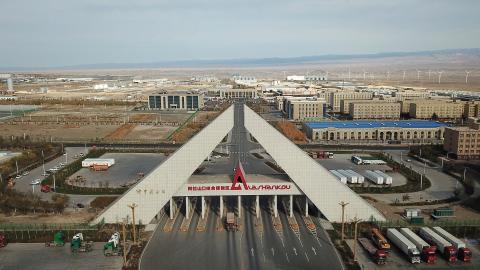
Modern China’s behavior echoes this continental strategic logic. Like the Ming, the rhetoric of Xi’s China has hedged towards a promotion of Han nationalism. However, like the Yuan before it, the modern Chinese state has devoted enormous resources to securing its land frontiers, strengthening political and economic ties across Central Asia, and building infrastructure that binds China more closely to the Eurasian interior. In both the medieval and modern cases, security on the Asian continent provides the strategic depth that allows the Chinese state to devote greater attention and resources to its maritime periphery.
Divine Winds, Medieval and Modern
In War on the Rocks, we argued that Eurasia, not just the Indo-Pacific, will be crucial to the next phase of Taiwan deterrence. We focused on the trade and energy corridors that China is building across the Eurasian landmass, as well as Beijing’s engagement with crucial swing states along those routes. Pipelines and railways traversing the continent are less vulnerable to US maritime power than maritime routes, and could provide China with alternative economic and energy lifelines in a contingency such as a war over Taiwan.
The Belt and Road Initiative’s overland component is oriented toward Inner Asia and evokes the Silk Road caravans of the 13th-century Pax Mongolica, when Mongol rule facilitated the movement of merchants, goods, technologies, and ideas across much of Eurasia. Under Kublai, Beijing sat at the eastern end of a vast political and commercial network extending through Mongol-ruled territories far into the continental interior.
Why does this matter for Taiwan? Kublai offers a history lesson.
In the late 13th century, the Yuan launched naval expeditions as far afield as Japan and Java as Kublai sought to extend his authority beyond China’s shores. It was the failed invasions of Japan, during which storms devastated the Yuan-led fleets, that gave rise to the Japanese legend of the kamikaze, or “divine wind”—later lending its name to the notorious World War II suicide attacks, but predating them by centuries.
To prepare for the invasions, Kublai mustered thousands of soldiers and sailors for both the 1274 campaign and the far larger second campaign in 1281. Korea supplied much of the fleet for the first invasion, while in 1281 Yuan forces launched a two-pronged assault on southern Japan involving Chinese and Korean ships and troops. Kublai’s secure position on the Asian mainland gave him the strategic depth to undertake these expeditions at enormous cost in personnel and materiel.
Logistical difficulties, Japanese resistance, storms, and the inherent limitations of premodern warfare ultimately thwarted Kublai’s ambitions against the shogunate. Yet the very fact that he could mount two such expeditions demonstrates both the resources at his command and the importance the Yuan attached to the effort. Despite these military failures, the dynasty survived for nearly another century. Its collapse in the late 14th century was not due to the sorts of major military invasions that had featured in its rise, but rather to popular rebellions that arose from domestic mismanagement.
Ultimately, the Yuan was able to sponsor significant overseas campaigns against Japan and survive their failure because it could absorb the losses without jeopardizing its position at home. It was the preeminent continental power in Eurasia, with no significant rivals capable of threatening its northern Chinese heartland.
Seven centuries later, the Communist Party today has staked much of its political capital on the promise of “reunifying” the Chinese nation, tying that goal to Xi’s broader project of national “rejuvenation.” Taiwan occupies a far more central place in the Chinese Communist Party’s conception of sovereignty and national rejuvenation than Kublai’s Japan campaigns, which were about imperial expansion. A defeat over Taiwan would therefore carry political stakes far greater than those of Kublai’s failures.
Yet extraordinary shocks do not necessarily produce regime change. The Chinese Communist Party has already survived civil war, world war, the Cultural Revolution, and the 1989 Tiananmen Square protests. It should not be assumed that a failed Taiwan operation would automatically trigger regime collapse in China.
Disrupting the “Khanate” in Inner Asia
Modern China differs from Mongol China in another way. Unlike the Yuan Dynasty, which sat at the center of a broader political order across Eurasia, today’s China must actively compete with the United States and other powers for influence across the continent. While we offer a broader set of recommendations for strengthening that competition in our War on the Rocks piece, here we propose a narrower set of administrative changes within the US government. The objective is to place Central Asia at the heart of America’s China strategy.
Our first recommendation is to move military responsibility for the five Central Asian republics—Kazakhstan, Uzbekistan, Kyrgyzstan, Turkmenistan, and Tajikistan—from the US Central Command (CENTCOM) to the newly renamed US Pacific Command (USPACOM). All five currently fall under CENTCOM, lumped in with the greater Middle East from Egypt to Pakistan. It is time to stop viewing Central Asia primarily through the legacy of US operations in Afghanistan and instead see the region through the prism of long-term strategic competition with China. Making the USPACOM commander responsible for Central Asia would integrate the region into planning for Pacific contingencies and encourage planners to consider how developments along China’s continental periphery could affect Beijing’s calculations over Taiwan.
Second, the undersecretary of defense for policy should shift responsibility for the five Central Asian republics to the assistant secretary for Indo-Pacific security affairs—and establish a dedicated office for Central Asia and Mongolia, headed by a deputy assistant secretary for Inner Asian affairs. A new Inner Asia office would consolidate expertise and give the region an institutional advocate able to assess Central Asia not simply as an adjunct to other theaters, but as a strategic arena in its own right.
Third, the same logic should extend to the State Department and Congress. At State, Central Asia should be severed from the Bureau of South and Central Asian Affairs and brought into the bureau responsible for East Asia and the Pacific, aligning the diplomatic and defense bureaucracies around the same strategic geography. Congress should similarly pair Central Asia with East Asia and the Pacific rather than South Asia. Washington needs to adapt to the geopolitical reality that Central Asia is no longer primarily an adjunct to stabilizing Afghanistan, and is strategically distinct from the maritime-oriented Indian subcontinent: it is increasingly part of the China challenge, and must be treated accordingly.
If the United States wants to deter a modern Chinese maritime campaign against Taiwan, it should draw a lesson from medieval China’s maritime failures more than 700 years ago. A continental power’s willingness to accept risk at sea depends on the security and resilience it enjoys on land. If Beijing does not like what it sees in the west—courtesy of thoughtful and well-executed US policy planning—it may have second thoughts about moving east.