















Threatened by an Axis of Challengers, the United States and Europe Need to Reclaim the Initiative Together
The free and open global order is under attack. A new anti-Western axis, centered on China and Russia and reinforced by Iran and North Korea, is threatening the security and prosperity of the free world. While the West has treated China and Russia as partners and has long hoped to facilitate their integration into the United States–led international system, the ruling elites in Moscow and Beijing have instead used their access to amass vast power that they are now turning against the US, Europe, and their allies and partners.
Yet a strengthened, newly self-confident West, together with its Asian and other partners, still has every chance to prevail. Building on economic strength and technological genius, the West can chart the way into a new golden age of prosperity and freedom. The US, Europe, and their Asian allies can renew the promises of democracy, the market economy, and international cooperation that have led humanity toward progress for many decades. In doing so, the West can weaken the dangerous alternative that China and Russia have built.
To prevail in this struggle, the US and Europe need to focus—together—on the growing threat from what we hereby dub the axis of challengers. Only by joining forces can the West shift the balance of power in its favor.
Today, however, many voices in the US and Europe are pushing for a transatlantic divorce.
On the US side, restrainers regard alliances and partnerships not as assets to be leveraged but as burdens to be overcome through deals with the anti-Western challengers. On the European side, supporters of strategic autonomy believe that a united Europe can somehow rise as a major pole in world politics.
Thought leaders and politicians in both camps see transatlantic cooperation as a Cold War relic rather than a key element of a new strategy to push back against China, Russia, and their regional partners.
We, by contrast, believe that the axis of challengers poses a fundamental challenge to world order. China and Russia, together with their partners, aim to construct a hierarchical system of coercion that is antithetical to the American and European ways of life. At both the nation-state and international-system levels, this new order would dramatically diminish the global weight and influence of the US, Europe, and their partners. Over time, this could even spell the end of democracy and the market economy, the West’s seminal achievements since the end of the eighteenth century.
Given the existential nature of this threat, the US and Europe need to overcome their many differences and forge a new pact for a new era. They should strive for nothing less than a renewal of the West.
The first requirement for building a stronger West is to establish a new division of labor in defense. Europeans can and should take responsibility for large parts of the continent’s conventional defenses against Russia. Second, Americans and Europeans need to build a joint techno-economic space that is open to partners but guards against dependencies and technological leakage. Third, the US and Europe have to renew the transatlantic relationship with the understanding that the US-European relationship is only one dimension of a global system of alliances and partnerships. Given that China is the primary challenger to today’s free and open order, key Asian countries such as Japan, Taiwan, and South Korea should be equal stakeholders in a renewal of a West defined less by geography than by shared interests and values.
The Axis of Challengers Is Increasing the Pressure
Europe, the US, and their Asian partners face pressure from a new axis of challengers. This axis is led by the People’s Republic of China (PRC) and Russia and supported by Iran and North Korea.
Russia’s full-scale war against Ukraine is the most visible front line in this conflict. Iran and North Korea openly support Moscow’s war effort with technology and weapons—and, in North Korea’s case, even with combat troops. China is the war’s key enabler, buying Russian oil and providing dual-use goods vital to the Russian arms industry. Beijing also supports Moscow diplomatically, shielding it from isolation.
In the war in the Middle East, Russia and China have provided important support to Tehran. Again, China plays the key economic role in this effort, buying almost all of Iran’s oil despite a US-led sanctions regime arrayed against the Islamic Republic.
What might have been regional clashes in other areas have become front lines in a broader power struggle between the US-led camp and the axis of challengers.
A potentially more catastrophic war is on the horizon.
China’s pressure on Taiwan increases almost daily. If Beijing decides to attack Taipei, a Third World War scenario becomes possible, if not likely: while China attacks Taiwan, Russia attacks the North Atlantic Treaty Organization, and Iran attacks Israel or the Gulf states. In such an eventuality, the US would likely be overwhelmed.
China clearly is preparing for war. Beijing has invested massively in its armed forces, turning them into peer or near-peer competitors of the US military. At the same time, China is working to reduce its dependence on the outside world and its exposure to economic pressure. The PRC has also invested in building its own economic weapon: a quasi-monopoly on the production of rare-earth elements on which the US and Europe depend, not only for civilian industrial production but also for weapons of war.
To Topple Pax Americana
The confluence of these conflicts is not accidental. Russia’s war against Ukraine, the war in the Middle East, and China’s saber-rattling over Taiwan are not rooted in misunderstandings that diplomacy could repair. Rather, these wars are part of a systematic effort to overturn the US-led global order. The axis of challengers considers the free and open West—and the powers that represent it—to be a threat. The leaders of the axis feel that they are gaining weight and power, and they smell what they identify as Western weakness.
What unites China, Russia, Iran, and North Korea is the ambition to unmake the world that the US spent decades building. During the twentieth century, the US ended the absolute rule of kings, the primacy of colonial empires, and the terrors of Nazism and Communism. The American model of democracy and free-market economics became aspirational for many peoples around the globe, and turned oppressed citizenries against their autocratic rulers. At the same time, the US tried to establish an international order that would prevent major wars, build trust among nations, and enable free trade.
These efforts culminated in a vision of a new post–Cold War order: a world with levels of peace and prosperity unseen at any point in history.
China and Russia had the opportunity to join this new world order. But instead of liberalizing, the elites in Beijing and Moscow tightened their grip at home. Over time, they have built a bulwark against free societies and open economies, keeping the reins of political and economic power in their own hands.
And yet, throughout the Middle East and the post-Soviet space, citizens have advocated for greater participation in their own societies. The so-called color revolutions of the former Soviet republics and the Arab Spring saw democratic uprisings that kept autocratic leaders awake at night. When Chinese leader Xi Jinping spoke to American leaders in the early 2010s, he would reportedly “talk all the time about color revolutions.”[1]
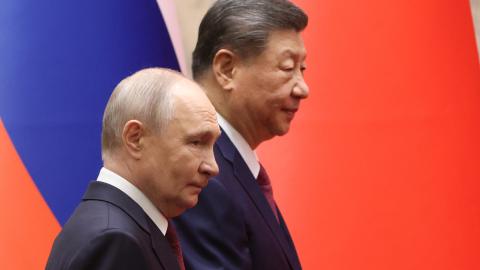
This fear of democracy has mixed with an imperial sense of great-power entitlement, which has prevented China and Russia from becoming pillars of the existing order as Germany, France, Japan, or India have. Instead, Moscow and Beijing have turned increasingly against the international order. Vladimir Putin and Xi Jinping have visited each other over 40 times and coordinate closely on a broad range of economic, political, and military questions. In March 2023, Xi, seemingly unaware that nearby microphones were picking up his remarks, told Vladimir Putin, “Right now there are changes—the likes of which we haven’t seen for 100 years—and we are the ones driving these changes together.” The Russian leader responded, “I agree.”[2]
What makes the present moment so dangerous is that the axis of challengers increasingly sense opportunity—and a potential path to victory. Both Xi and Putin believe that the West is declining and that their countries are the leading powers of the future. Just before Russia’s full-scale invasion of Ukraine in February 2022, Beijing and Moscow cosigned a manifesto that articulated their claim to global leadership.[3]
The Failure of Western Post–Cold War Strategy
The emergence of an anti-Western axis of challengers that the West faces has been driven primarily by developments within China and Russia. But the rise of these challengers also stems from the West’s post–Cold War integration strategy. The West fully opened up to Russia and China and shared its scientific and technological know-how with both countries. This effort was meant as an advance payment on liberalization.
But that liberalization never took place. Instead of becoming more democratic and transforming their economies according to market principles, Russia’s and China’s ruling regimes turned more autocratic at home and more aggressive toward their neighbors. The West continued blithely down the path of openness, integration, and engagement.
Only in recent years, as concerns have grown about the emergence of an axis of challengers and its hostility toward the US and its partners, have Western leaders at least partially rethought the wisdom of this one-sided, post–Cold War orientation toward openness. But economic interdependence connecting the West with China has sharply raised the price of reversing course—making it even harder for the US and Europe to push back against China.
Yet the West is held back by more than economic constraints. For the West, it is hard to accept that its outstretched hand has been rejected, and that China and Russia are pursuing a project designed to end the US-led global order.
There are many reasons why the West has been slow to realize that its old strategy has failed: an unwillingness to abandon the optimistic beliefs of a bygone era, a widespread tendency to blame America first for disruptions in the relationship, and business interests’ desire to stay deeply engaged with China. Russian and Chinese cognitive-warfare efforts to shape how the West thinks about itself have slowed many US and European leaders’ reactions. The West’s openness, especially online, only facilitates such insidious operations.
Once the new geopolitical reality has set in, different questions emerge: What can and what should the West do to push back against the axis of challengers? What is the right strategy—and what won’t work?
Why Splitting the Axis of Challengers Won’t Work
In some circles, the idea of splitting the axis of challengers with a strategy of divide-and-conquer has gained traction. It is indeed tempting to try a Kissinger reverse. Just as President Richard Nixon and his counselor Henry Kissinger in the early 1970s engaged with China to cleave it from the Soviet Union, today the West should engage Russia to isolate China. Yet such a strategy won’t work. It worked for Nixon and Kissinger because the split between Beijing and Moscow already existed before they strove to widen it.
Today, however, China and Russia are intensifying their relationship with regular strategic consultations at the highest levels. Both Moscow and Beijing see more value in working with each other than in working with the US and Europe. Both want to redraw the geopolitical map and change the current international order to weaken the West.
Many issues divide China and Russia, but both countries’ leaders are accustomed to reaching pragmatic compromises when necessary. Realizing their geopolitical ambitions matters most to Xi and Putin. Both men know that only by working together do they stand a chance of weakening US power and the US-led system of free markets and free peoples.
A Stronger West Is the Only Response
The West is under attack from the axis of challengers. Putin and Xi see the US and its allies as adversaries that stand in the way of their imperial dreams. Both see themselves as the guiding powers of the next world order. Leaders in both Beijing and Moscow want to enlarge their territory and subjugate their neighbors using force.
A weak Western response to this effort helps the axis of challengers advance its ambitions. Doing nothing is not an option as Russia and China work to enhance their relative power and strength. The status quo—still largely characterized by Western openness—allows China and Russia to operate relatively unrestricted to steal advanced Western technologies outright or through subterfuge.
Unfortunately, the status quo also reflects the West’s relative military weakness. While the axis of challengers has invested in its armed forces, the West still hasn’t done enough to gain the military superiority necessary to deter members of the axis from attacking. Moreover, the West has not developed the mindset necessary to contain the imperial ambitions of Russia, China, and their partners. Western leaders are often weakened by infighting when they should be concentrating their resources on the vital struggle with the axis of challengers.
The West needs to become strategically inclined once again. Each Western country’s first task is to build up its own strengths: economically, militarily, and politically. But to overcome the axis of challengers, Western nations should work together.
A stronger, more united West is less dependent on its adversaries and more able to resist pressure from Russia and China. A more coherent West can pressure the axis and considerably weaken it. By working together, Americans and Europeans can decisively shift the balance of power and capacity to their favor in nearly every domain.
Despite their differences, Americans and Europeans remain part of the same political and economic family. Both sides often frustrate each other. Yet by working together, they have immense potential. With partners in Asia and elsewhere, the US and Europe can define the next chapter in the evolution of the world order. Most importantly, they can keep Russia’s and China’s destructive ambitions in check.
Yet building a stronger West requires a major strategic effort. Three main tasks are vital for building a new transatlantic alliance to counter the axis of challengers:
- A better division of labor in defense
- The creation of a common technological-economic space
- The establishment of a geopolitical triangle with Asian partners
Task One: Establish a Forward-Looking Division of Labor in Defense
The current posture of the transatlantic alliance is a Cold War relic that does not reflect today’s or tomorrow’s strategic requirements. Since the fall of the Berlin Wall, Europe has grown more powerful, Russia has weakened, and China has become the primary threat to the US. NATO’s posture needs to reflect these changes.
For three decades after the end of the Cold War, the prospect of war among great powers seemed to have disappeared. Yet the expectation that Russia and China would integrate into the US-led order never materialized.
Instead, both Moscow and Beijing have emerged as military powers that threaten the US or its allies. Russia conducts an open war of aggression and conquest in Europe. China has built a military that is a peer or near-peer competitor of the US and is nearly every day increasing military pressure on Taiwan and its neighbors, namely the Philippines and Japan. The prospect of a three-front war involving China, Russia, and Iran against the US and its allies keeps military planners and political decision-makers awake at night.
Europeans and Americans have to rearm to hold Russia and China in check. The US and Europe also need to establish a new burden-sharing balance within the alliance: the US can no longer focus on Europe, but has to shift its resources to Asia and maintain a presence in the Middle East. As a result of this shift, and to gain more agency, Europeans need to take responsibility for large parts of conventional defense against Russia. To advance these changes, Elbridge Colby, the US under secretary of war for policy, is working to implement NATO 3.0.
At its core, NATO 3.0 transfers the primary responsibility for Europe’s conventional defense from the US to its European allies. This plan requires the Europeans to undertake a major effort. Rearmament is costly and requires massive political engagement, as military spending competes with social spending in the budgets of Europe’s nations and the minds of its people.
During this transition phase, Washington ought to maintain a meaningful troop presence in Europe to ensure credible defense. This American presence matters because Russia respects only the US military. Replacing American units with European ones will tempt the Kremlin to test the alliance.
Additionally, the US nuclear umbrella cannot be replaced in the foreseeable future. A dramatic drawdown in conventional forces could limit American options in a conflict and potentially undermine the credibility of America’s extended deterrent in Europe and around the world.
The paradox of NATO 3.0, therefore, is that it will require US leadership, capabilities, and troops to succeed. The purpose of that American presence, however, should be to enable Europe to assume greater responsibility—not to make it permanently dependent on the US.
Task Two: Create a Common Technological-Economic Space
Today, rapid technological development, particularly in artificial intelligence, affects almost every dimension of the economy. AI will also shape the future of warfare and society writ large in ways that are hard to predict. The winner of the AI arms race will gain a major advantage in the competition for global leadership. The West urgently needs to win this race—not only on the technological frontier but also in the areas of implementation in the economy and across society.
The ability to turn technological knowledge into industrial capacity will be one decisive factor in the battle between the US-led camp and the axis of challengers. This ability encompasses many skills, including producing weapons and ammunition at the necessary scale, which will require switching quickly from civilian to military production in the event of a major war. The West also needs to become largely independent of the axis’s supply chains, especially for military goods. It should ease China’s chokehold over the world’s supply of critical minerals.
To solve those problems, the US and Europe have to work together to create a common technological-economic space in which people, capital, goods, and expertise can move relatively freely.
The US leads in key categories of next-generation technologies, but Europe has major assets that can drive technological breakthroughs and enable large-scale production: significant pools of talent, major research and development centers, and the world’s largest single market. In addition, Germany and other European countries feature world-leading hidden champions well positioned to integrate AI and robotics and spearhead AI’s industrial application.
A collaborative venture that spans the Atlantic and includes Asian partners would give the West a decisive advantage. Along the way, it will be crucial that any lead the West maintains is protected against the illegal transfer of knowledge to, and unfair competition from, the axis of challengers.
In building such a space, the US, Europe, and their partners would gain massive technological and economic advantages in the competition with China and its partners. With this broader vision in mind, Americans and Europeans should expand existing efforts to build elements of such a joint space. These include an overhauled and functional European Union–US Trade and Technology Council, Pax Silica, the Minerals Security Partnership, and the US-EU Action Plan on Critical Minerals.
The Group of Seven also provides an important framework to advance such ideas and projects, and it already includes a vital Asian partner for both the US and Europe: Japan. India, another key Asian partner for the West, has been invited as a guest to the last five G7 summits, while South Korea has been invited three times and Australia twice.
Task Three: Build a Geopolitical Triangle with Asian Partners
To push back successfully against the axis of challengers, the West should be strong, capable, and united. But despite the enormous economic, technological, and military power of the US and Europe, including Asian partners ready to work with it is vital.
In combination, countries such as Japan, South Korea, India, Australia, and the Philippines bring enormous economic power to an enlarged West defined more by shared principles than geography. These countries may have differences but are fundamentally like-minded: they all share concerns about China’s growing power and its imperialist, hegemonically inclined mindset.
Including these countries in a geopolitical triangle connecting Asia, Europe, and the US would bring important economic and technological dynamism into the Western camp. Japan has abundant experience in securing supply chains against Chinese blackmail. All of the West’s key Asian partners have worked to limit Chinese expansionism. They all understand the connection between military and economic security and have launched their own initiatives in these fields.
To form or deepen such a triangle is a geopolitical imperative because the European and the Asian theaters are increasingly merging. As China and Russia have built a coherent autocratic axis, they have turned Eurasia into a more unitary geopolitical space. The response to their revisionist attempts to fundamentally change the current US-led order needs to be Eurasian in scope.
These Asian partners should become stakeholders in the new technological-economic space that the pro-Western alliance has to build. Together, such a triangular configuration could better resist China’s economic pressure and blackmail, maintain or build an edge in key future technologies, and cultivate the industrial mass necessary to outcompete China’s production of cheap weapons.
Outlook: Seizing the Initiative from China and Russia
In recent years, Vladimir Putin and Xi Jinping have worked to turn their global vision into a reality, actively seeking to undermine US power and the US-led global order on many fronts. In some areas, they have made progress; in others, they have met resistance.
Yet Xi and Putin remain convinced that the future is theirs because they possess the willpower the West lacks.
Only if the axis of challengers meets solid, credible resistance will the West succeed in keeping the peace and enjoying the fruits of its past victories: the preservation of the sovereign rights of smaller countries, the maintenance of largely secure borders, and the coherence of the international marketplace.
As long as they are convinced that the West is rotten to its core, weak, and unable to resist, the axis of challengers is going to double down on its current efforts. But every effort the West undertakes to strengthen its power and demonstrate its resolve discourages Xi and Putin from taking the axe to the US-led world order.
The West possesses almost unlimited potential. But it needs to put its house in order to more effectively safeguard the free and open world system that allows democracy and the market economy to thrive. By correcting the balance of burden-sharing between Europe and the US, creating a common technological-economic space, and building a triangular relationship connecting the US, Asia, and Europe, the West would not only deter Putin and Xi from following their worst instincts. The US, Europe, and their Asian partners would also unchain the productive forces that could lead humanity into a new golden age.
- Chris Buckley and Steven L. Myers, “In Turbulent Times, Xi Builds a Security Fortress for China, and Himself,” New York Times, August 6, 2022, https://www.nytimes.com/2022/08/06/world/asia/xi-jinping-china-security.html. ↑
- “China’s Xi Tells Putin of ‘Changes Not Seen for 100 Years,’” Al Jazeera, March 22, 2023, https://www.aljazeera.com/news/2023/3/22/xi-tells-putin-of-changes-not-seen-for-100. ↑
- “Joint Statement of the Russian Federation and the People’s Republic of China on the International Relations Entering a New Era and the Global Sustainable Development,” President of Russia, February 4, 2022, http://www.en.kremlin.ru/supplement/5770. ↑