















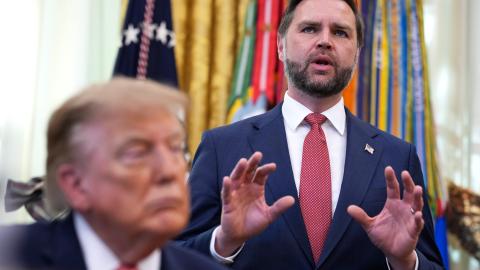
Last Sunday, President Donald Trump endorsed Benjamin Netanyahu for reelection as prime minister of Israel, calling him a “Great Warrior Prime Minister” and an indispensable partner against Iran. “If Israel has the wrong Leader,” Trump warned, “America will have to do this work ourselves, and I am not inclined to do so.” The following day, Vice President JD Vance pointedly declined to follow his lead. “I endorse American candidates,” Vance explained. This was an odd declaration from a vice president who traveled to Hungary earlier this year to campaign for Viktor Orbán. Apparently, endorsing foreign politicians is acceptable in Budapest but not in Jerusalem.
The disagreement raises a question that goes well beyond Netanyahu or Israeli electoral politics: What is the proper “America First” position on Israel? Trump has answered through his actions, taking American military cooperation with Israel to unprecedented heights and treating the Jewish state as a powerful partner against Iran. Vance’s position is more complicated. In a recent interview with Sean Spicer, he acknowledged having disagreed with Trump over the Iran war and expressed sympathy for Tucker Carlson’s anger about it. Carlson has depicted the war as a betrayal of American interests undertaken at Israel’s behest. The contrast between Trump and Vance therefore reaches beyond a disagreement over Netanyahu. It concerns the meaning of American nationalism, the country’s strategic interests, and the future of the political coalition Trump assembled.
The United States faces an emerging coalition linking China, Russia, Iran, and North Korea. These powers are developing military, economic, and technological relationships that threaten to consolidate a hostile Eurasian bloc increasingly insulated from American maritime power. Washington cannot contain this challenge alone. It needs capable allies positioned along the Eurasian periphery who are willing and able to defend the common interest. Israel is one of the most valuable.
The war against Iran has demonstrated why. Israel has contributed intelligence, targeting capabilities, technological innovation, and sustained offensive military power on a scale few American allies could match. The United States has supplied capabilities that Israel lacks, creating a formidable partnership against a common enemy. No dependent client receiving American protection, Israel is a force multiplier, capable of imposing costs on Iran that the United States would otherwise have to impose itself.
Nor is Iran merely a regional problem. Its missile and drone arsenals, supported by China, Russia, and North Korea, threaten the energy routes on which America’s Asian allies depend. In a confrontation over Taiwan, for example, Iran could help Beijing disrupt those supplies, weakening Japan, South Korea, and Taiwan without China firing a shot in the Pacific. Containing Iran is therefore part of containing China.
Trump understands that alliances are instruments of American power, not charitable enterprises. The $3.8 billion Washington provides to Israel annually is only one side of the ledger. The other includes military capabilities, intelligence, technology, and American influence over a powerful regional actor. Weakening the alliance would not make Israel disappear. It would make Israel more independent of Washington, reducing American influence while giving China, Russia, and North Korea new opportunities. America First does not mean “America alone.” It means organizing American power, including the power of allies, to prevent Eurasia from falling under the control of a hostile bloc.
That strategic understanding is increasingly contested within the American right. Carlson, Nick Fuentes, and an expanding network of broadcasters have popularized the claim that Jews manipulate American foreign policy, subordinating the United States to Israel. In this telling, the partnership that Trump regards as an asset becomes evidence of American subservience. Rather than assess what the United States gains from Israel, the conspiracists explain the relationship as the product of foreign manipulation.
The damage extends far beyond the American-Israeli relationship. Antisemitic agitation drives wedges into the American-led coalition at three levels. At home, it pits Jews against Christians, evangelical Zionists against other conservatives, and religious and ethnic communities against one another, weakening the national cohesion on which Trump’s political achievement rests. Abroad, conspiratorial attacks on American alliances encourage suspicion between the United States and its European and Arab partners. And in the Middle East, the allegation that Israel controls American policy undermines one of Washington’s most capable military allies. What begins as a conspiracy theory about Jewish influence becomes an attack on the political and strategic relationships that sustain American power.
China, Russia, and Iran have powerful reasons to welcome these divisions. Their information operations exploit distrust of American institutions and alliances, including antisemitic themes. The conspiracies offer a way to turn Americans against one another and against their partners without requiring America’s adversaries to confront American military power directly. Antisemitism can thus become a Trojan horse for hostile foreign influence. While Carlson has devoted enormous attention to alleged Jewish and Israeli manipulation of Washington, China has been building the military, technological, and economic capabilities to challenge American primacy. The country presenting the greatest long-term strategic challenge to the United States receives far less attention in Carlson’s account than the American ally helping contain one of Beijing’s principal partners.
The struggle to reconcile these competing tendencies on the right came into public view in early October, when the National Conservatism Conference traveled to Jerusalem. Its organizers hoped to demonstrate solidarity with Israel while maintaining relationships with a movement increasingly divided over the Jewish state. The most controversial panel took place on Oct. 7, the third anniversary of Hamas’ massacre of Israelis. Four American conservatives—Matthew Peterson, Amanda Milius, Jonathan Keeperman, and William Wolfe—explained to an Israeli audience why support for Israel was weakening among younger conservatives. Their message contained a major claim: The traditional methods of denouncing antisemitism no longer carry the persuasive force they once did.
For years, they argued, progressive activists have used accusations of racism and bigotry to police political speech, often treating disagreement as evidence of moral depravity. Many young conservatives have learned to regard such accusations not as arguments to be considered, but as instruments of ideological coercion. Charges of antisemitism, even when entirely justified, now trigger the same reflexive resistance, they said. The warning delivered at the National Conservative Conference deserves to be taken seriously. But it does not follow that antisemitic claims deserve accommodation. The alternative to moral denunciation is not silence or appeasement. It is a serious argument grounded in American interests, political principles, and historical facts.
The problem was that the warning came wrapped in a peculiar validation of the grievances it purported merely to describe. Keeperman criticized the immigration preferences of liberal American Jews and the Anti-Defamation League, as though the antisemitism of Carlson and Fuentes was an understandable response to Jewish progressivism. He gave comparatively little attention to the agitators actively shaping the attitudes he described. Nor did the panel seriously examine the extraordinary military partnership unfolding before its eyes. The United States and Israel were fighting together against Iran, a regime that has targeted Americans since 1979. Two countries pursuing common interests against a common enemy hardly constitute evidence that one has captured the other. The panelists, however, did not treat the campaign as a common American interest. They framed it instead as Israel’s problem—one that younger American conservatives could reasonably decline to make their own.
The deeper problem was the absence of a convincing answer to antisemitism. If denunciations no longer persuade, what replaces them? How does one counter broadcasters who profit from portraying Jewish Americans as agents of a foreign power? The conference offered dialogue with disaffected nationalists but little explanation of how dialogue would defeat the conspiracy theories influencing them. This omission exposed a contradiction within national conservatism. Some of its organizers recognize the rise of antisemitism on the right as a pernicious development yet remain committed to political relationships with figures through whom antisemitic ideas circulate. Not all of them share even that recognition. The message of the four American speakers was closer to accommodation: Jewish concerns about antisemitism should be subordinated to the requirements of coalition management, and Jews who wished to remain inside “the coalition” would have to accept a higher tolerance for the rhetoric directed at them.
The contradiction has two reinforcing explanations, one political and the other intellectual. The political calculation centers on the vice president. Call it the Vance straddle: maintaining a relationship with Carlson while distancing oneself selectively from his antisemitism, his opposition to Israel, and his increasingly bitter attacks on Trump. Vance has long treated Carlson as both a friend and a political asset. Carlson gave him repeated platforms as he remade himself from a conventional conservative into a populist, and privately lobbied for him as Trump’s running mate. Since becoming vice president, Vance has continued to affirm the friendship even as Carlson’s broadcasts have turned sharply against Trump.
In September, pressed about the relationship, Vance acknowledged that Carlson had said things about the president that were “just wrong.” But he refused to break with him. “I’m not going to play the game where I throw friends under the bus because I have political disagreements with them,” he explained.
The disagreements are hardly trivial. Carlson has called the Iran war an act of “treason” driven by Israeli pressure, urged Trump’s removal from office over the conflict, and mocked the president as “buffoonish.” Yet Vance’s own differences with Carlson are less clear than his defense of their friendship suggests. In the interview with Sean Spicer, he went further, acknowledging that he had shared some of Carlson’s views, including his anger at the decision to go to war with Iran. And in September, Vance warned, “We cannot let our Middle Eastern foreign policy be subservient to the State of Israel.” The remark raises the specter of Israeli domination of American policy at precisely the moment when the two countries are demonstrating the strategic value of their partnership.
Vance presents his refusal to abandon Carlson as personal loyalty. But he is also a politician preparing for the Republican succession struggle—and he is still working for the president. His continued association with Carlson preserves a relationship with a broadcaster whose audience includes nationalists deeply skeptical of Israel and American foreign commitments. It also allows Vance to signal disagreement with Carlson’s more objectionable positions without making their rejection a condition of political association. He distances himself from some of Carlson’s views without distancing himself from Carlson.
The same calculation is visible at The Heritage Foundation. After its president, Kevin Roberts, defended Carlson’s interview with Fuentes last year and denounced Carlson’s critics as a “venomous coalition,” Heritage suffered an internal revolt. Trustees and scholars resigned. Roberts subsequently retreated, condemning antisemitism as a “malignant sin.” At NatCon Jerusalem, he dismissed extremist broadcasters as irrelevant and declared that Heritage would not engage them. But the denunciation was directed at the fringe, not at Carlson, whose relationship with Roberts remained intact.
Heritage is positioning itself for a Vance presidency. The vice president wrote the foreword to Roberts’ book, Dawn’s Early Light, and the two men share long-standing intellectual and political relationships. Roberts’ handling of Carlson follows the same pattern as Vance’s: condemn the most objectionable ideas—or at least their crassest expression—while preserving the relationships that keep their promoters within reach of the coalition.
Yoram Hazony, the leading intellectual figure behind national conservatism, is engaged in the same enterprise. He speaks openly about Vance as Trump’s natural successor and is positioning national conservatism to supply intellectual leadership and personnel for a prospective Vance administration. When Roberts’ defense of Carlson threw Heritage into turmoil, Hazony offered to help. In May 2026, he joined Heritage’s board of trustees.
Hazony has explicitly condemned Carlson’s antisemitism. He told The New Yorker that Carlson was its leading promoter on the American right. But his intervention at Heritage helped Roberts preserve his position while maintaining the relationship with Carlson. The presence of a prominent Jewish Zionist on the board also gave Roberts a powerful answer to critics who questioned Heritage’s handling of antisemitism.
Vance, Roberts, and Hazony are not identical thinkers, and their reasons for maintaining these relationships differ. But their political projects converge on the succession to Trump. Each has reason to preserve access to the audiences Carlson has cultivated, even as Carlson attacks the president and promotes conspiratorial accounts of Jewish influence.
The result is a movement that recognizes the danger of antisemitism but struggles to establish boundaries against the figures spreading it. The Vance straddle helps explain the political calculation. It does not explain why national conservatism has so little to offer intellectually against the groyper conception of America. For that, we must examine what the movement believes about the American founding.
The political calculation is only half the explanation. The other half lies in national conservatism’s intellectual foundations. Its leading thinkers have devoted enormous energy to criticizing the liberal principles of the American founding. That preoccupation has diverted them from defending the constitutional inheritance that provides a common basis for American citizenship across religious and ethnic lines.
The groyper challenge is fundamentally a challenge to American nationhood. Its antisemitism does more than vilify Jews. It advances a conception of America in which religious and ethnic identity determine who truly belongs to the nation. Jews become alien manipulators of American institutions, their participation in public life evidence of foreign subversion. Once that principle is admitted, no minority is secure. The same reasoning can be turned against Catholics, Muslims, Black Americans, Indian Americans, or any other group whose loyalty an agitator chooses to question.
The American founding provides a direct answer. The Declaration of Independence grounds political legitimacy in human equality and inherent individual rights. The Constitution prohibits religious tests for federal office. The First Amendment protects religious liberty. These are not peripheral embellishments to the American political tradition. They are among its defining achievements.
Consider George Washington’s 1790 letter to the Hebrew Congregation of Newport, Rhode Island. Responding to an address from Moses Seixas, Washington declared that “all possess alike liberty of conscience and immunities of citizenship.” He then rejected the older European idea of toleration, under which a dominant community graciously permitted minorities to practice their faith. Religious liberty, he explained, was not an indulgence granted by one class to another. It was an inherent natural right.
Washington’s letter was steeped in biblical language. He invoked the God of Abraham and the prophetic image of every man sitting safely beneath his own vine and fig tree. Yet he did not address the Jews of Newport as a minority living by the indulgence of a Christian nation. He addressed them as fellow citizens, equal participants in the American republic.
Now consider Principle Four of the National Conservatism Statement of Principles, adopted in 2022. It declares, “Where a Christian majority exists, public life should be rooted in Christianity and its moral vision, which should be honored by the state and other institutions both public and private.” The next sentence provides that “Jews and other religious minorities are to be protected” in their religious observances, communal institutions, and the education of their children.
As the political philosopher Peter Berkowitz observed in 2024, this formulation sits uneasily with the American constitutional tradition of religious liberty. Set beside Washington’s letter, the contrast is striking. Washington repudiated the idea that one class enjoys its rights by the indulgence of another. National conservatism gives Christianity a privileged place in public life while describing minorities principally in terms of protections.
Principle Four does not advocate persecution or explicitly deny Jews equal citizenship. Indeed, national conservatism’s statement elsewhere affirms constitutional government and condemns racial discrimination. But the juxtaposition raises a fundamental question: Are religious minorities equal participants in defining the American political community, or protected communities within a nation whose public identity belongs principally to the religious majority?
National conservatives will reply that they, too, offer an account of American nationhood, one rooted in shared history, common culture, and the Bible. Hazony, an observant Jew living in Jerusalem, plainly does not intend to make Jews strangers in America. But the question is not Hazony’s intentions. It is the political logic of the principles he advocates.
Once the majority’s religion becomes the defining foundation of public life, political argument can shift from the equal standing of citizens to the terms on which the majority accommodates minorities. National conservatism’s explicit protections resist that conclusion, but its formulation leaves an opening for those who would make religious identity the measure of authentic national belonging.
That is the danger posed by the groypers. They do not merely question American policy toward Israel. They portray Jewish Americans as members of an alien interest group whose participation in national affairs is inherently suspect. Their conspiracy theories transform disagreements over policy into accusations of divided loyalty.
The American constitutional inheritance supplies a different principle. Religious, ethnic, and cultural communities are indispensable parts of American life. They have every right to preserve their traditions, organize their institutions, and pursue their interests. But none owns the republic. The state belongs to citizens as citizens, not to Christians, Jews, whites, Blacks, or any other group.
This is also where national conservatism’s intellectual project becomes relevant. Hazony has spent years challenging interpretations of the founding that emphasize John Locke and liberal political philosophy, preferring an account rooted in biblical political thought, English constitutional tradition, and Edmund Burke. Other postliberal thinkers, including Patrick Deneen and Adrian Vermeule, advance different but overlapping critiques of liberalism.
These disagreements need not be settled here. The question is not whether Locke or Burke deserves more credit for the American founding, nor whether Christianity contributed profoundly to American civilization. Of course it did. The real question is this: What do national conservatives intend to conserve? The Declaration, the Constitution, and Washington’s understanding of citizenship are the crown jewels of the American inheritance. Their principles make possible a political community whose members need not agree about theology, ancestry, or philosophy to belong to the same nation.
The groyper movement offers not an escape from progressive identity politics, but a rival version of it. Where progressives organize political claims around groups they regard as historically disadvantaged, the groypers define the nation through an exclusionary conception of its traditional majority. The identities change, but the underlying contest remains: Which ethnic and religious groups possess the greatest claims to political authority? The founding offers a different answer. Political rights do not belong to a religious or ethnic faction. They belong to citizens.
This brings us back to the disagreement between Trump and Vance. Trump’s understanding of America First, as expressed in his defense of the Israeli partnership, begins with a calculation of American power and interests. Israel’s military capabilities, intelligence, technology, and willingness to fight are strategic assets. Their value does not depend on the religion of the Americans who defend the alliance.
The conspiracy theory promoted by Carlson and Fuentes substitutes a different test. It asks whose influence lies behind American policy, assigning sinister significance to Jewish identity. In doing so, it corrupts strategic judgment while undermining the common citizenship on which a broad American political coalition depends.
Vance’s continued relationship with Carlson, and the efforts of Roberts and Hazony to maintain connections across the nationalist movement bring these competing approaches into serious tension. We have no reason to doubt their stated opposition to antisemitism. But their political and intellectual commitments provide them with no potent ideological ammunition with which to fight it.
Washington supplied that ammunition two centuries ago. He did not address the Jews of Newport as a tolerated minority living under the indulgence of a Christian nation. He addressed them as fellow citizens possessing the same rights as their neighbors. That distinction remains decisive. A capable ally strengthens the United States. The religion of American citizens does not diminish their standing at home. A conservatism that defends neither allies nor the full rights of all citizens will fail to conserve the American inheritance. It will merely manage its replacement.