




















View PDF of report.
Executive Summary
The companies that manufacture chipmaking tools, the machines used to produce semiconductors, are part of a concentrated industry largely headquartered in the United States, Japan, and the Netherlands, with a small cluster in Hong Kong and Singapore. ASML, which produces extreme ultraviolet (EUV) machines, arguably has a true monopoly in this area. The other toolmakers operate in duopolies and oligopolies bound together by recipe lock-in—the difficulty of switching from one supplier to another—and an installed-base service model, which gives suppliers ongoing revenue from servicing equipment they have already sold. This market concentration, combined with significant intellectual property (IP) held by these companies, provides an advantage for the United States and its allies. However, China, as part of its economic strategy, is seeking to develop its toolmaking industry, although progress has been uneven overall. China can equip a mature-node fab—a factory making chips with established technology—almost entirely from domestic suppliers, and the Huawei-SMIC-SiCarrier stack, a set of complementary Chinese chipmaking capabilities, is a real organizational threat to the US- and allied-owned tech stack. Nevertheless, significant gaps remain in several critical leading-edge capabilities, even as Chinese suppliers make progress in selected advanced applications.
Export controls have helped preserve the US and allied advantages for now. But these controls are also pushing Chinese demand toward mature-node (i.e., established) chipmaking technologies and mid-tier tools—less advanced semiconductor manufacturing equipment. In these areas, Chinese vendors are qualifying (testing and validating their tools) one process step at a time. Meanwhile, US policies and politics have inhibited the growth of the US semiconductor supply chain, including tariff exposure on tools and inputs like monocrystalline silicon, permitting fights in city councils and state courts nationwide, and a talent pipeline dependent on foreign nationals who may not legally stay in the country. In addition, a concentrated customer base increasingly weighted toward Asia makes toolmakers less likely to increase manufacturing capacity in the United States.
Against this backdrop, the nearer-term risk is not that China will leapfrog over Western toolmakers, but that Western firms in China’s own market and in third-country markets will be steadily displaced. This could erode the competitiveness of US and allied toolmakers, affect the development of advanced semiconductors, and weaken the broader semiconductor and artificial-intelligence ecosystem.
Implementing the following recommendations would help the US continue its industrial development:
1. Focus more on accelerating technological development than on delaying Chinese acquisition of advanced technology. Export controls can only delay China’s progress. These measures should help preserve a multigeneration technology gap and buy time, and they pay off only if the United States and its partners use that time to innovate and strengthen their industrial capabilities.
2. Seek further coordination between the US and its allies, especially the Netherlands and Japan. Washington should replace ad hoc coordination with harmonized control lists and shared licensing, based on rules the allies have agreed to in advance. The effort should eventually reach a wider coalition of partners, extend to areas such as investment screening and IP protection, and prepare for Chinese retaliation over critical minerals.
3. Map and protect critical lower-level suppliers. A supply shock coming from a single component manufacturer could stall several toolmakers at once, as VAT’s roughly 58 percent share of vacuum valves shows. The Commerce Department should extend its supply-chain mapping below the toolmaker level and fund backup capacity where single points of failure exist.
4. Treat field service engineers as strategic infrastructure. Tools are only useful if someone can install and service them, yet the US talent pipeline trains many foreign nationals who cannot stay in the country. A specialized visa for field engineers would help, and officials should also weigh whether service restrictions on China push Chinese firms to build their own maintenance capabilities.
5. Do not tariff the tools. Tariffs are supposed to help reshore manufacturing. But nearly every US fab expansion depends on imported tools, so tariffs on equipment and other inputs raise the cost of reshoring. Equipment and qualified spare parts should carry a standing exemption tied to investment requirements, which would replace exemptions that each fab must negotiate.
6. Widen the lead where it is already widest. China’s largest gap is inspection, metrology, and test, where KLA alone holds more than half the global market. Research and development as well as CHIPS Act follow-on funding should focus on sustaining US leadership in these fields and reinforcing the broader US and allied technological advantage.
1. The Semiconductor Toolmaker Industry
The semiconductor original equipment manufacturer (OEM) industry consists of roughly a dozen distinct equipment markets, each of which is highly concentrated. This industry has a few firms, known as toolmakers, that build and service the machines used by fab operators, the companies that run semiconductor factories, including TSMC, Samsung, and Intel.
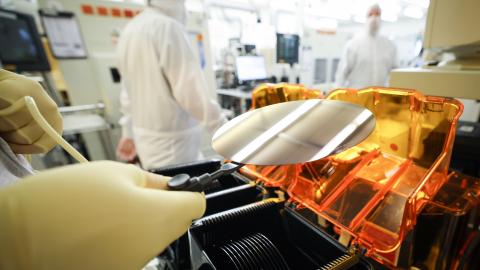
Most people, when they think of semiconductor toolmakers, think of ASML because of its EUV lithography machines. Yet a number of other tools are needed for the complicated work of fabricating (manufacturing) a semiconductor. Wafers—the thin, flat discs of semiconductor material, usually silicon, on which many chips are manufactured simultaneously—undergo several processes before being cut into finished dies, individual chips, which are then packaged for delivery.
Table 1 shows which toolmakers fabricate the equipment for each process. For several of these processes, there is only one primary toolmaker or a tight oligopoly headquartered in one or more of four locations: the United States, Japan, the Netherlands, and a smaller cluster in Hong Kong and Singapore anchored by ASMPT.
Companies including Applied Materials, Lam Research, and Tokyo Electron sell most of the equipment needed for fabrication rather than concentrating on one step. Although they compete directly in certain equipment categories, each company also has distinct areas of technical and market strength. The equipment requirements and performance expectations that shape competition in these markets are ultimately driven by the business needs and product roadmaps of customers. The leverage companies have across the market comes from the breadth of solutions they offer, deep relationships with leading fabricators, and near-monopolies in certain areas. ASML has a near-monopoly in EUV lithography—though Nikon and Canon do serve other markets; Tokyo Electron leads in coater/developer track tools; and KLA provides inspection and metrology solutions. Firms that can monopolize one step remain unchallenged because new entrants struggle to gain a foothold with established customers, and the industry is highly capital- and IP-intensive.
Despite the ubiquity of the major toolmakers, specialists fill gaps for certain procedures or chips, including ASM International, Screen Semiconductor Solutions, Kokusai Electric, Hitachi High-Tech, Onto Innovation, Axcelis, Veeco, Nikon, Canon, Besi, and ASMPT. While much smaller than the major players, they do hold enough market share and are sufficiently specialized so that a disruption, such as a blockade or loss of critical minerals, could still lead to a fab-level slowdown.
Component Systems and Manufacturers
Component suppliers are just as concentrated and potentially vulnerable to supply disruptions as semiconductor toolmakers. As table 2 highlights, some of the toolmakers’ suppliers of choice are their only suppliers.
The lithography process provides a strong example of how concentrated this industry can be. Lithography requires highly specialized mirrors for the silicon-etching process. These are supplied only by the German company Carl Zeiss SMT, also known for cameras and telescope lenses. Additionally, Trumpf, which is also German, supplies the high-power carbon-dioxide lasers that vaporize tin droplets to generate EUV light, and the ASML subsidiary Cymer develops and integrates those light sources in ASML’s lithography machines.[5]
Lower in the lithography-equipment supply chain is a fragmented but dense group of mechanical and electronic subsystem makers. This includes firms such as VDL ETG, Frencken Group, Neways Electronics, Prodrive Technologies, and NTS Group, which are part of the Eindhoven Dutch technology cluster. Such concentration will make any attempts by the Trump administration to bring jobs and investment to the US difficult, given that these firms contain hundreds of years of collective engineering knowledge that cannot easily be transferred to international counterparts.[6]
But just as there is a concentration of suppliers, there is also a concentration of buyers, making this market a combination of a natural oligopoly and a natural pseudo-monopsony—a market in which one buyer has disproportionately strong bargaining power over suppliers, even though it is not the only buyer. OEMs depend on component makers for parts, while component makers depend on OEMs for revenue. For example, Ichor Systems builds the gas- and chemical-delivery subsystems that meter reactive chemistries into etch and deposition chambers. A handful of firms buy Ichor’s work: in 2025, it drew 76 percent of its revenue from just two customers, Lam Research and Applied Materials. Declining demand would significantly impact Ichor’s financial health. A disruption among these lower-level suppliers is consequently harder to either forecast or assess costs than an OEM-level disruption, as it can occur before it is noticed.
Though there are multiple OEMs supplying chipmaking tools, these tools are not interchangeable, and switching etch or deposition vendors mid-process can cost a fab months as well as millions of dollars, with no guarantee the yield will recover, even after a full fabrication cycle. Additionally, the same OEMs tend to maintain these tools through their installed-base service model. In fact, a growing share of OEM revenue comes not from sales but from maintenance. Applied Materials, for example, reported in fiscal year 2025 that its services segment generated $6.4 billion in revenue, accounting for 22 percent of total company revenue.[7]
These vendors also develop strong business relationships with customers and become aware of changing demand before companies make an official announcement of investment or production expansion. Such relationships prevent the semiconductor industry from overinvesting in capacity that future demand cannot meet, but they are difficult to replicate. These relationships also encourage customers to stay with their vendor, which generates recurring service revenue for that company. This is particularly relevant with certain leading-edge fabs operated by global chipmakers.
Seeing OEMs only as toolmakers is outdated. AI chip manufacturing requires firms specializing in hybrid bonding, thermal-compression bonding, and precision dicing. The firms doing this work—Besi, ASMPT, EV Group, Kulicke & Soffa, and Disco on the dicing side—are smaller, and policymakers may scrutinize them less than Applied Materials or ASML. But the concentration is comparable.[8] Any attempt to increase semiconductor supply or to reshore capacity to the US should account for the industry’s concentration and for IP that is not easily transferable.
All these dynamics generally hold true for semiconductor manufacturing globally. But the picture is more complicated in China, where the government, at best, increasingly incentivizes or, at worst, directs domestic chipmakers to source from Chinese toolmakers and servicing suppliers. This will be discussed in a later section.
2. Toolmaker Constraints
Several toolmakers are incorporated in the United States. But four major constraints keep them from undertaking US expansion. The first is trade exposure on both inputs and outputs; the second is a permitting bottleneck at the local and state levels; the third is difficulties in hiring qualified workers, compounded by an immigration crackdown; and the fourth is a narrow customer base that has already announced major US investments.
Tariffs
Toolmakers wishing to export their equipment to the United States face two types of tariffs. The first and more direct tariff applies to finished tools crossing the border to be used in the fab. The second, which is less visible but arguably more consequential, is on the materials needed for fabrication. A single lithography or deposition system contains parts that cross borders repeatedly during fabrication, so steel, aluminum, and copper duties can raise costs before the tool is even finished. So far, carve-outs have prevented direct tariffs on finished tools, but they are provisional rather than settled policy. Washington has quickly announced and then walked back these tariffs with carve-outs or reductions, especially since 2025. Manufacturers therefore have difficulty determining whether tariffs apply to their industry, paralyzing investment decisions. Table 3 presents a brief demonstration of how the semiconductor industry has received carve-outs for the time being.
The presidential proclamation on polysilicon tariffs, signed by President Donald Trump on August 6, 2026, will have a notable impact on semiconductor manufacturing. The proclamation imposes a 15 percent ad valorem tariff—calculated on the basis of the item’s value—and minimum import prices on imported polysilicon, in order to counter Chinese market dominance and bolster domestic chip and solar manufacturing.[12] The impact on semiconductor manufacturing is mixed overall. While China dominates the polysilicon market with 95 percent market share, five non-Chinese firms supply semiconductor-grade polysilicon: Wacker Chemie (Germany), Hemlock Semiconductor (United States), Tokuyama and Sumco (Japan), and OCI (Korea).[13] Wacker and Hemlock alone account for roughly three-quarters of global capacity for semiconductor-grade polysilicon, which can cost up to 30 times more to produce than solar-grade material. However, some firms do work with monocrystalline silicon for R&D purposes, which could affect several firms with facilities in the United States. This will have a limited impact for now, though if China restricts silicon supply in retaliation, the tariff will have a greater impact for all silicon-based products.
Permitting and the Local Veto
TSMC’s CFO Wendell Huang has put the cost of building a fab in the United States at four to five times the cost of building the same fab in Taiwan.[14] Part of this is due to higher input costs and the lack of 24/7 construction, though a major part of this is due to permitting. The federal government has worked to speed domestic fab construction through NEPA (National Environmental Policy Act) carve-outs for projects funded through the CHIPS (Creating Helpful Incentives to Produce Semiconductors) Act. But there are now bottlenecks due to zoning boards, county environmental reviews, water-rights allocations, and utility-capacity planning bodies that have nothing to do with federal industrial policy and everything to do with local politics.
Two examples show how local politics have international implications. A plan by US-based semiconductor manufacturer Micron to build a $100 billion four-fab complex in Clay, New York, drew opposition from local and regional groups. They sued the state over what they called a rushed environmental review: in about 32 business days, the county development agency reviewed a 700-plus-page environmental impact statement discussing water usage from Lake Ontario, wetlands, and contamination risks from PFAS (per- and polyfluoroalkyl substances).[15] While the project cleared its environmental review, state-level litigation and political risk still set the pace.
The other case highlights a common issue. The $3.87 billion fab built in West Lafayette, Indiana, by South Korean company SK Hynix, which manufactures semiconductor memory, also faced serious local opposition, leaving it in a sort of legal limbo. A May 2025 city council vote to rezone more than 100 acres from residential to heavy industrial use drew a lawsuit from local residents who alleged that the council exceeded its authority and asserted that there had been an inadequate environmental review as well as “backroom negotiations.” As of mid-2026, the litigation was still unresolved even as construction proceeded, with the presiding judge saying there was an “impasse.”[16]
Regardless of the validity of these environmental claims, the fact that local opposition can impact a multibillion-dollar project with clear national security implications is concerning. As domestic opposition to data centers and AI grows, permitting-related litigation risks may lead firms to restrict investment and to prefer to export to the United States rather than deal with a volatile local government.
The Talent Problem
Two separate issues lead to a talent problem: the process-engineering pipeline and the field service engineer (FSE) workforce, which installs and services tools on the fab floor. As for the pipeline, industry projections point to the US semiconductor workforce growing from roughly 345,000 jobs today to about 460,000 by 2030. However, around 58 percent of the net new jobs are at risk of going unfilled at current degree-completion rates.[17] In addition, more than half of US master’s engineering graduates and roughly 60 percent of doctorate engineering graduates are foreign nationals, and an estimated 16,000 engineers with a master’s degree or doctorate who are trained in the United States leave the country each year after graduating.[18]
The problem of the FSE workforce is that there are not enough qualified Americans who can fill these jobs, and those who are qualified are foreigners who are vulnerable to visa issues. This has received less attention, even though FSEs are needed to ensure that an installed tool will produce wafers. The clearest recent illustration of the issue comes from last year’s raid at the construction site of the Hyundai–LG Energy Solution battery plant in Ellabell, Georgia, where US Immigration and Customs Enforcement detained and eventually deported 475 workers, most of them South Korean nationals.[19] The government’s rationale centered on visa-category mismatches: specialized workers brought in to perform hands-on installation and commissioning work under visa categories that arguably did not authorize that work. This precedent applies directly to chipmaking. Foreign FSEs have extensive knowledge that is not easy to transfer to Americans—hence the need for foreign talent—but they remain in the same visa gray zone that the Georgia case exposed.
Reindustrialization and the development of a domestic semiconductor industry will require foreign employees with specialized knowledge that is not easy to transfer. While the national security implications of dependency on non-Americans are real, very few Americans have the knowledge needed to produce and maintain the highly efficient tools that fabs need. Encouraging Americans to enter careers in science, technology, engineering, and mathematics and funding apprenticeships could solve this issue in the long term. But in the immediate term, the US will need skilled foreign employees so that investment can remain on budget and on schedule.
Demand Concentration
Demand concentration is a major constraint for toolmakers, but it also helps protect them from competition. According to a Citigroup estimate, TSMC, Samsung, and Intel together account for roughly 60 percent of global spending on wafer-fab equipment, and AI-driven capital expenditure across the industry has further concentrated demand through 2025 and into 2026.[20] Neither party can credibly threaten this relationship: TSMC cannot switch to a different EUV supplier because there is none, and the toolmakers have few other customers to which they can sell. While toolmakers hedge against economic ups and downs through installed-base service revenue, their orders increase when their fab customers decide to expand. Even though demand for chips is currently strong, chip development and fab build-out have multiyear lead times and cannot be rushed. That mismatch is exactly why toolmakers are conservative about cash and capacity commitments and are not racing to meet a boom that could correct before new supply comes online.
The demand that is growing, meanwhile, is concentrated geographically as much as it is by customer, and is overwhelmingly in Asia. In ASML’s most recent quarter, 87 percent of its revenue came from three markets alone: Taiwan (30 percent), South Korea (43 percent), and China (14 percent).[21] While analysts expect the US to increase chip production thanks to TSMC’s recent $100 billion investment, most toolmakers already include that in their sales projections.[22] Additionally, TSMC is building not only in the United States but also in other countries, given that demand for chips is projected to increase permanently due to AI development. Expanding further in the US makes little sense for toolmakers if the country’s market share only grows by so much. They will expand manufacturing and R&D domestically only if additional demand signals emerge.
Export Controls as an Operating Cost
The last constraint that semiconductor toolmakers face is export controls, which are becoming increasingly burdensome. These regulations require firms to map every sale against a shifting entity list; reconcile US, Dutch, and Japanese rules that are not fully aligned; and price unpredictable license-review timelines into sales planning rather than simply writing off lost revenue. Compliance costs are an increasing expense for toolmakers as they also focus on preserving IP and market share.
3. Export Control Benefits and Limits
The United States has steadily expanded export controls on Chinese telecommunications, advanced computing, and semiconductor manufacturing, starting with Huawei in May 2019.[23] The controls expanded decisively in October 2022, when the US Commerce Department imposed controls on advanced computing chips and important categories of semiconductor manufacturing equipment (SME), then revised the thresholds in 2023.[24] Then–National Security Adviser Jake Sullivan framed the policy in May 2022 as a “small yard, high fence” focused on a limited set of foundational technologies, including advanced logic and memory chips and the tools needed to make them.[25]
The controls have undoubtedly had a major impact on China’s AI and semiconductor ecosystem—largely preventing China from legally obtaining the most advanced logic and memory chips necessary for frontier AI—and have raised the price of manufacturing more mature chips. Furthermore, export controls on SME have slowed the easiest path to frontier chips and preserved important US and allied advantages.
However, export controls have not been a panacea. Policymakers have asked US and allied firms to carry much of the burden of these controls, not only through loss of access to the large Chinese market, but also through complicated compliance requirements. Meanwhile, export controls have created additional qualification and production opportunities for Chinese equipment suppliers, as they now have a fixed demand from buyers with few alternatives, strengthening their ability to compete. Export controls are not a permanent solution; instead, they buy time. Their long-term value depends on how the US and its allies use that time, and on whether governments can enforce the controls without unnecessarily weakening the companies that hold the technological lead.
What Has Worked: Buying Time at the Leading Edge
China’s leading chipmaker, Huawei, serves as a useful case study of how export controls affect a Chinese company. In 2019, TSMC disclosed that an unnamed customer accounted for 14 percent of its 2019 revenue, second only to Apple.[26] Congressional and industry reporting identified that customer as Huawei. After US rules prevented TSMC from continuing unlicensed production for Huawei in 2020, Huawei lost direct access to the world’s most capable foundry—a company that manufactures semiconductor chips designed by other companies.
This is a key point, as Huawei announced its original Ascend 910, a 7-nanometer AI processor, even before NVIDIA announced its own 7-nanometer A100 in May 2020. The Chinese company arguably would have entered the generative-AI boom in a much stronger position had it not lost its foundry access. Furthermore, if Huawei had remained a major customer for TSMC’s leading-edge capacity, it would have been competing with NVIDIA and AMD for both TSMC’s production capacity and market share.[27]
The Clearest Win: EUV Denial
Export controls’ clearest success has been in denying China access to extreme-ultraviolet lithography. China is not known to have obtained an EUV machine to date, despite attempting to purchase one and to develop one domestically. One close call occurred in 2018, when the Dutch government granted ASML an export license to sell one of its EUV machines to an unnamed Chinese customer, widely believed to be SMIC, the country’s leading chip foundry. Reports claimed that the Netherlands did not extend the license after US officials warned Dutch officials about the potential repercussions of China acquiring ASML’s technology.[28] Had that sale gone forward, a Chinese company would have obtained at least one of the machines that has given the US and its allies their most meaningful SME advantage. China is therefore unlikely to produce an economically competitive sub-7-nanometer production line in the near term, despite speculation in the media.
This story also illustrates the trade-offs SME firms face between national security concerns and their bottom lines. At the time, US companies accounted for 16 percent of ASML’s revenue, compared to China’s faster-growing 19 percent. According to a source speaking at the time, ASML did not want to upset the United States, but “at the same time it does not want to make China and its Chinese customers feel bad [about the delay], as that is its fastest-growing [tech] market.”[29]
As in the case of Huawei, preventing China from obtaining EUV technology has not only slowed its domestic chipmaking development; it has also affected the capacity of US and allied chipmakers. ASML told investors that it expected to produce around 65 low–numerical aperture (NA) EUV systems in 2026, and that its 2027 capacity was already fully booked. If China had unrestricted access to EUV, US firms would be competing for the small number of EUV machines made each year.[30]
The Memory Problem
High-bandwidth memory (HBM) is essential to modern AI accelerators; while EUV technology is not required for basic HBM, it is required for the latest generations. The December 2024 rules from the Department of Commerce, which focused on semiconductors, brought specific HBM products under export control, tightening restrictions on China’s access to the most capable products.[31]
The global memory market is suffering from a major supply crunch, even without selling advanced HBM to China.[32] Micron reported sharp company-level price increases in the fiscal third quarter in 2026 and stated that demand for DRAM (dynamic random-access memory) and NAND flash memory would significantly exceed supply beyond 2027.[33] Memory demand has become so great that Apple has even petitioned the US government to allow it to use Chinese-made memory from CXMT in its products for the Chinese market. Additional Chinese demand would put more pressure on the market. Allowing advanced SME exports to Chinese memory producers could enable them to produce more HBM, thereby expanding supply and easing the so-called RAMageddon. However, over time this could also increase global reliance on Chinese memory production. Conversely, tightening current controls might further constrain memory supply, exacerbate shortages, and encourage Chinese memory producers to accelerate the adoption of domestic equipment suppliers, potentially strengthening China’s semiconductor ecosystem over the longer term.
China’s AI Labs Rely on US Chips
China’s most advanced model developers still appear to depend heavily on US chips. Bloomberg reported in July 2026 that the Chinese AI lab Moonshot trained its Kimi K3 model, at least in part, on a cluster of twenty thousand export-controlled NVIDIA Blackwell chips that Chinese hyperscaler Alibaba obtained.[34] DeepSeek also reportedly trained its most recent model on Blackwell clusters located in Inner Mongolia.[35] Earlier in August 2025, DeepSeek reportedly had a failed training run for its R2 model using Huawei chips, forcing it to switch back to NVIDIA chips to complete the training.[36]
US export controls do not prevent Chinese smuggling of US chips and do not stop Chinese AI labs from accessing US chips in the cloud. In fact, according to White House science and technology adviser Michael Kratsios, China AI company Moonshot trained its most recent AI model by using NVIDIA Blackwell chips that were in Thailand.[37]
Comments from the labs themselves reveal how the US has a competitive advantage in computing power. In leaked comments from July 2026 attributed to DeepSeek Chief Executive Officer Liang Wenfeng, he makes the point bluntly: “Every difference we observe—whether in talent, model performance, or applications—can ultimately be traced back to differences in compute resources. . . . The only thing preventing us from scaling is computing power. It’s not that we don’t want to scale—we simply don’t have enough compute to do it.” Wenfeng’s comments suggest that US export controls have preserved a real compute gap that allows America to maintain a lead in AI. They also suggest that Chinese smuggling, access to chips outside of China or restricted countries, and remote access are diminishing some of the advantage the controls aim to protect and that enforcement remains a major challenge.
Limitations
Despite some of the short-term benefits of export controls, they risk imposing long-term costs on US and allied technology. These measures have several limitations, and the main ones most relevant to advanced technology are mentioned below.
Are Export Controls Pushing China to Increase Indigenization?
China’s pursuit of semiconductor self-reliance, both in SME tools and in chip manufacturing, predates US export controls. Beijing launched the National Integrated Circuit Industry Investment Fund (also known as the Big Fund) in 2014, and the Made in China 2025 project followed in 2015 with aggressive localization goals,[38] aiming to achieve 70 percent domestic sourcing for semiconductor production by 2025.[39] In addition, in late 2025, Beijing mandated that all new chip plants must use at least 50 percent Chinese-built equipment to gain state approval.[40] And a 2026 industry proposal from companies like NAURA Microelectronics Equipment aims to achieve 80 percent semiconductor self-sufficiency and to build and test production lines using domestically developed equipment for 7nm chips by 2030.[41]
China’s SME spending has increased sharply since export controls went into effect. Beijing spent $36.6 billion on SME in 2023, up 29 percent from the previous year, and nearly $50 billion in 2025. When foreign tools become unavailable or less predictable, much of that spending shifts to Chinese entrants, which reinforces localization efforts that predate the current export controls.[42] Chinese equipment makers—by gaining additional qualification and production opportunities, including some created by export controls—have strengthened feedback loops with domestic chipmakers. This enables them to improve their tools and increasingly replace Western equipment. So Chinese equipment makers have a protected domestic market where they can secure customers and gain experience while foreign suppliers lose revenue and access to Chinese fabs. This has not yet caused a broad decline in US or allied R&D spending, but the effects could build over time.[43]
Friction Between Allies
Some US allies have grown frustrated with Washington’s frequent rule changes and perceived overreach. One particular point of contention is the foreign direct product rule (FDPR), which can bring certain foreign-made items under US jurisdiction when they are considered the “direct product” of specified US technology. The US has interpreted this term quite broadly to include not only direct inputs but also software and sub-components.[44]
However, no US law requires other countries to match the American export control regime exactly. So certain US products are controlled while their foreign equivalents are not. The Multilateral Alignment of Technology Controls on Hardware (MATCH) Act, now being debated in the US Congress, would require other countries to align their controls with the US approach or risk having their products brought under US jurisdiction through the FDPR. Dutch officials expressed their objections to Congress in May 2026.[45]
Servicing SME tools already in China, which firms must do regularly, creates another area of friction between the US and its allies. Under the House Foreign Affairs Committee’s substitute version of the MATCH Act, US companies and companies from allied countries that receive a license could still service equipment at designated facilities in China, but their license requests would face a presumption of denial.[46]
SME suppliers are concerned that this could have unintended effects, such as inadvertent IP transfer. Beijing could push Chinese technicians who currently service foreign equipment under the toolmakers’ supervision to master more of the servicing themselves. In addition, without regular visits by toolmaking staff, customers may have a greater incentive to attempt to disassemble and reverse-engineer the equipment.[47] Policymakers should weigh these risks against any demonstrated operational effects the restrictions have. Publicly available evidence does not indicate that the US person restrictions introduced as part of the October 2022 export control expansion caused sustained shutdowns of China’s advanced fabs.
Mature Nodes Remain a Risk
Export controls have the greatest impact on leading-edge chips, but many industries still depend on mature-node chips used in vehicles, infrastructure, medical devices, power systems, and defense electronics. China accounted for at least one-third of global mature-node capacity in 2024.[48] If the Chinese semiconductor industry focuses on producing these more common chips, it could dominate the market in a way that would be difficult to reverse. Given the availability of Chinese SME for mature-node production, however, broader controls may accelerate China’s replacement of foreign tools with domestic alternatives with limited effect on China’s overall production capacity.
The Commerce Department’s Bureau of Industry and Security (BIS) has already warned that China’s unfair trade practices and growing production capacity could make the United States more dependent on Chinese imports of mature-node chips and weaken the US semiconductor industry.[49] In December 2025, a United States Trade Representative (USTR) investigation reached a similar conclusion, though tariffs remain set at 0 percent until June 2027.[50]
Loopholes, Policy Inconsistency, and Enforcement
Loopholes and workarounds have been a problem since the 2022 export controls were issued. Though the controls specified that interconnect bandwidth—the speed at which different processors or chips can communicate with each other—was a criterion for determining whether a chip was subject to export controls, vendors could reduce interconnect bandwidth while leaving much of the underlying processor capability intact. This allowed NVIDIA to produce China-specific products such as the A800 and H800. In 2023 the Commerce Department removed interconnect bandwidth as the controlling parameter and added a threshold for performance density—a limit based on how much computing power a chip can deliver relative to its size. But the episode showed how quickly technical rules can be designed around.[51]
Smuggling controlled chips into China remains a major challenge for law enforcement authorities and a multibillion-dollar business for smugglers. A March 2026 US indictment alleged that three people associated with US server maker Supermicro, including its co-founder, diverted $2.5 billion in NVIDIA-powered server purchases to China.[52] Taiwanese prosecutors also indicted nine people over alleged exports of NVIDIA B300-equipped servers to China.[53] Earlier cases involved chips routed through Malaysia, Thailand, and Singapore.[54]
Export controls’ apparently inconsistent goals have complicated its strategy. No policy illustrates this more clearly than the decision to allow exports of NVIDIA’s second-most powerful AI chips, such as the H200 and its equivalents, to Chinese companies in exchange for US chipmakers paying a 25 percent fee to the US government.[55] Leaving aside the fact that the fee is likely an unconstitutional export tax,[56] charging US companies to sell advanced chips to China is inconsistent with the logic of export controls. While Beijing initially raised security concerns about US chips and pushed Chinese buyers toward domestic alternatives, the Financial Times reported in August 2026 that Chinese AI giants ByteDance and Tencent had each received about ten thousand H200s.[57]
Furthermore, BIS, the agency tasked with enforcing the controls, lacks the capacity for such a complex mandate. A 2025 US Government Accountability Office report found that while funded positions at the agency rose overall between 2013 and 2025, 52 positions remained vacant, and the agency had not completed a bureau-wide long-term workforce plan since 2016.[58] Given the scale and technical complexity of the rules, BIS needs many more agents to license, investigate, verify end use, and coordinate with foreign partners.
Unclear Criteria for Success
Finally, the US government has repeatedly explained that export controls are supposed to slow China’s acquisition of the ability to produce advanced semiconductors for military applications and preserve a US lead in foundational technologies.[59] However, there are no definitive quantitative benchmarks indicating how much delay counts as success or when a control should be tightened, revised, or removed. In addition, evaluations of success should consider whether China has been able to acquire comparable items from foreign or domestic Chinese sources, since such availability can undermine the export controls. Although foreign availability has historically been a key consideration in US export control policy, there is little indication that current controls on China systematically account for it.
Without a shared definition of success, each rule change looks like either an arbitrary tightening of controls or an arbitrary retreat. That makes business planning harder, and it also raises the political cost of asking allies to align with each sudden move. Furthermore, without definitive criteria for success, it is unclear whether these export controls can truly succeed in slowing Chinese AI development or semiconductor R&D, which continue despite restrictions.
4. China’s Domestic Toolmakers
Despite export controls, China’s semiconductor-equipment push is producing real, if uneven, gains. Chinese suppliers are producing viable commercial tools in cleaning, electroplating, chemical-mechanical planarization (CMP), deposition, thermal processing, selected etch, and lower-end test. Yet significant capability gaps persist in EUV lithography as well as in the performance and production of deep ultraviolet light (DUV) immersion systems.
Foreign suppliers to China face the potential risk of Chinese equipment suppliers steadily displacing them one qualified process step at a time. For Chinese fabs selecting equipment, technological progress remains important, but their choices are not determined solely by technical performance. Cost, lead time, field service, and process-support availability can also influence purchasing decisions. As Chinese domestic vendors gain market share, they gain revenue, installed-base data, customer feedback, and a better chance of entering the next, harder category. But the most important questions from a policy perspective are, How far behind China remains in each tool class, and which firms are closing the gap?
China has been the largest market for SME for several years, reaching nearly $50 billion per year in both 2024 and 2025, up from about $30 billion in 2022.[60] It has financed indigenization efforts at a national scale, beginning years before the US imposed export controls. The main source of state financing has been the National Integrated Circuit Industry Investment Fund (ICF), also known as the Big Fund, which Beijing has ramped up in three subsequent phases (see table 4).[61]
SMIC’s earnings also reflect growing demand, as the company’s Q2 2026 revenue rose 36.1 percent year-on-year, primarily due to mature-node demand. Revenue from wafers for smartphones and computers/tablets (which include AI chips) remained 16.9 percent and 15.6 percent of revenue, respectively.[65]
As mentioned earlier, Chinese authorities are requiring chipmakers to use a minimum of 50 percent domestically produced equipment to add new capacity, with limited exceptions if domestic tools are unavailable. According to three sources cited by Reuters, this threshold was mostly an unwritten condition embedded within the procurement-tender process, though one source indicated that Beijing is looking to have domestic producers fully replace foreign producers. Domestic SME suppliers NAURA and AMEC have been the primary beneficiaries of this rule and are increasingly replacing Lam Research and Tokyo Electron in certain etch applications. Applications failing to meet the threshold are generally rejected, although officials have shown flexibility for advanced-node lines awaiting viable Chinese lithography tools.[66]
So far, this requirement has had mixed success; after roughly ¥1.33 trillion in cumulative state investment, the country was only about 23 percent self-sufficient in semiconductor equipment manufacturing. Officials are reportedly encouraging consolidation in the industry and have identified 11 national champions, as seen in exhibit A.[67] NAURA, already China’s largest toolmaker, provided an early test case in March 2025 when it agreed to pay ¥1.69 billion for a 9.5 percent stake in lithography-track maker Kingsemi. This deal was one of the roughly ¥13 billion worth of equipment-sector deals recorded in the first 10 months of 2025.[68] The logic mirrors the vertically integrated, one-stop-shop model that SiCarrier is already pursuing organically: a broader in-house or affiliated product line shortens the qualification path for a domestic fab that would otherwise have to vet a dozen single-purpose vendors separately.
Consolidation also concentrates the industry’s exposure to US export controls, because the champions Beijing is promoting are the firms Washington has already targeted. BIS named NAURA, SiCarrier, and the semiconductor-equipment manufacturer Piotech in entity list additions in December 2024, which covered roughly two dozen Chinese toolmakers.[69] In September 2025, the bureau adopted a new rule extending entity list restrictions automatically to any foreign affiliate that is 50 percent or more owned by a listed party, then suspended this for one year as part of the broader trade truce President Trump reached with Chinese leader Xi Jinping. Absent further action, the rule is set to take effect again in November 2026.[70]
China has been focusing on building its champions for major tool categories, though their global market share remains very small, particularly in categories where there is a single provider or there is a surmountable technological lead. Table 5 shows the major categories and what type of competitive risk China poses to the incumbents.
Outlook: Where True Chinese Competition Is Most Likely to Occur
The likeliest competitive shock will not come from a sudden Chinese EUV breakthrough. A 2026 forecast from the AI Futures Project and Institute for AI Policy and Strategy predicts that large-scale Chinese immersion DUV will arrive between 2032 and 2038 and EUV between 2038 and 2044.[81] The more likely path is a rolling replacement, category by category, of non-Chinese equipment, which is already underway in some segments and only beginning in others. Chinese equipment suppliers are gaining production experience and becoming more competitive at home, and their emerging sales beyond China suggest that Western toolmakers will increasingly face Chinese competition in third-country markets. Chinese products are already commercialized, with a domestic market established for cleaning and electroplating, CMP, mature-node physical vapor deposition and chemical vapor deposition, furnaces and thermal processing, and lower-complexity testing. Chinese firms are becoming increasingly competitive in dry etch, advanced-packaging wet processes, coater and developer tracks, mature-node process control, and ion implantation technologies. And they are already replacing foreign tools at some steps, though the incumbents still have the advantage with the hardest process windows, components, uptime, and fleet performance. The major area where China is struggling is production-scale immersion DUV, commercial EUV, leading-edge reticle and wafer inspection, high-throughput e-beam metrology, and the integrated software and field-service stack that keeps a fab running reliably.
High-bandwidth memory cuts across these tiers rather than sitting neatly in one. China’s domestic tools appear capable of polishing wafers and forming through-silicon vias (tiny vertical electrical connections through the silicon), though likely at lower yields than leading foreign equipment. China still depends heavily on imported tools for the etching and lithography steps advanced DRAM requires, and it cannot yet produce competitive HBM in volume using only domestic equipment.
5. Recommendations
The United States and its allies still have several tools at their disposal to slow China’s acquisition of advanced semiconductor technology. Slowing China only buys time, though, and that time matters only if the allies use it to extend their lead. However, self-inflicted damage is preventing them from making faster progress in advanced technology. The recommendations below are intended to increase their ability to slow China’s access and strengthen their technological base.
1. Focus more on accelerating technological development than on delaying Chinese acquisition of advanced technology. Export controls have worked best when the objective was clear and worst when the goal was left implicit. In rapidly advancing technology areas, that objective should be to maintain a meaningful multigeneration technology gap, which means that policymakers will need to change export controls as the underlying technology and market evolve. But because export controls primarily delay rather than permanently prevent technological advancement, the Commerce Department should evaluate them not only by the costs they impose on China, but also by whether the time they buy is being used to strengthen US and allied capabilities. Export controls buy time, not victory. They succeed in the long term if the US and its partners use that time to strengthen the innovation ecosystems, markets, and industrial capabilities that ultimately sustain their technological advantage.
2. Seek further coordination between the United States and its allies, especially the Netherlands and Japan. Key US allies like the Netherlands and Japan play a critical role. Washington should convert ad hoc coordination into a consistent approach with harmonized export control and restriction lists and shared licensing, which would allow the countries involved to work collaboratively. Any export restrictions on companies should be based on clear rules on which the governments have agreed rather than on informal pressure or behind-the-scenes requests.
At the same time, export controls alone are unlikely to sustain long-term US and allied technological leadership. While they remain important for addressing critical national security vulnerabilities, policymakers should develop a broader strategy that includes investment screening, IP protection, cybersecurity, workforce development, and technology cooperation among allies. This effort should extend beyond the United States, the Netherlands, and Japan to include a wider coalition of like-minded partners, given that maintaining a technological advantage over China will require coordinated action across multiple domains, not export controls alone.
Finally, all three countries should protect themselves from Chinese retaliation, especially given that they have supply chain vulnerabilities for key inputs from China, including critical minerals and rare earth elements.
3. Map and protect critical lower-level suppliers. The roughly 58 percent share of vacuum valves held by VAT and Ichor’s concentration of revenue between two customers show that any shock from a supplier could stall several toolmakers at once. The Commerce Department should extend supply-chain mapping below the OEM layer and fund redundancy, such as excess capacity in secondary locations, to address single points of failure.
4. Treat field service engineers as strategic human capital. A tool that cannot be serviced is not a working tool, and as noted in section 2, the US semiconductor industry has a talent pipeline that trains foreign nationals it cannot retain. A specialized visa option, similar to the O-1 Visa, for field engineers to help build capability and IP in the United States would protect the installed-base service model on which incumbents depend and encourage further development. At the same time, policymakers should view field service engineers as strategic human capital for China as well. Service restrictions are often premised on the assumption that Chinese firms will remain dependent on foreign OEMs for maintenance and support. However, the extent of China’s existing service capabilities remains unclear, and it may vary considerably by equipment type and maintenance task. Policymakers should therefore assess how dependent China is on foreign service providers for maintenance, as well as China’s domestic maintenance capabilities, before assuming that service restrictions will produce significant operational disruption. Restrictions may also create incentives for Chinese firms to recruit experienced personnel, develop indigenous maintenance capabilities, and build domestic service ecosystems. Officials should therefore evaluate any future service restrictions on China for their short-term disruptive effects and for their long-term impact on talent flows, knowledge transfer, and the development of competing service capabilities.
5. Do not tariff the tools. Section 232 tariffs—which are the tariff legal authority the Trump administration used to replace the International Emergency Economic Powers Act tariffs in April 2025—on equipment and inputs like polysilicon tax the same reshoring they are meant to encourage, since nearly every US fab expansion depends on imported tools. While there have been some exemptions, the tariffs have been ad hoc and can be removed at any point. Equipment and qualified spare parts should carry a standing exemption subject to certain investment requirements, not one negotiated fab by fab.
6. Widen the lead where it is already widest. China’s biggest gap is inspection, metrology, and test, where KLA alone holds more than half the global market. R&D and CHIPS Act follow-on funding should focus on ensuring that the US has a more permanent advantage in this field.
Definitions
Ad valorem tariff: a tariff calculated on the basis of the item’s value
Die: an individual chip cut from a processed wafer
Fab operators: the companies that run the semiconductor factories
Fabrication: manufacturing
Foundry: a company that manufactures semiconductor chips designed by other companies
Installed-base service model: a model in which suppliers generate ongoing revenue from servicing equipment they have already sold
Mature-node: relating to established chipmaking technologies
Mature-node fab: a factory making chips with established technology
Mid-tier tools: less advanced semiconductor manufacturing equipment
Pseudo-monopsony: a market in which one buyer has disproportionately strong bargaining power over suppliers, even though it is not the only buyer
Qualifying: the process of testing and validating
Recipe lock-in: the difficulty of switching from one supplier to another
Reshoring: bringing manufacturing back to the original country where it was being done after it has been moved abroad
Semiconductor: a material used to conduct electricity and is the basis for electronic circuits and chips
Through-silicon vias: tiny vertical electrical connections through the silicon
Toolmaker: a company that manufactures chipmaking tools (i.e., equipment used to produce semiconductor chips)
Wafer: a thin, flat disc of semiconductor material, usually silicon, on which many chips are manufactured simultaneously
The companies and individuals interviewed for this report had no influence over its analysis, findings, or conclusions.
Endnotes
- Process-step attributions are compiled from public company disclosures and semiconductor industry ecosystem overviews. For example, see “Understanding the Semiconductor Industry: A Deep Dive Into Its Ecosystem and Value Chain,” Dual Insights, Medium, February 5, 2025, https://medium.com/@dualinsightshub/understanding-the-semiconductor-industry-a-deep-dive-into-its-ecosystem-and-value-chain-f42b2c36d55f; Eric Flaningam, “An Overview of the Semiconductor Industry: A Primer on the Various Market Segments and Market Leaders Across the Industry,” Generative Value, November 16, 2023, https://www.generativevalue.com/p/an-overview-of-the-semiconductor. ↑
- VAT Group is estimated to hold roughly 58 percent of the global vacuum-valve market. Trung Nguyen, “SWI Pick #2—VAT Group—Hidden Vacuum Valve Monopoly at the Right Price,” Sleep Well Investments, July 26, 2022, https://www.sleepwellinvestments.com/p/vat-group-hidden-monopoly-that-keeps. ↑
- Ichor Holdings, Ltd., Form 10-K (fiscal year ended December 26, 2025), US Securities and Exchange Commission, https://www.sec.gov/Archives/edgar/data/1652535/000165253526000012/ichr-20251226.htm. ↑
- “MKS Becomes #1 Market Leader in RF Power Supplies,” MKS Instruments, April 12, 2022, https://investor.mks.com/news-releases/news-release-details/mks-becomes-1-market-leader-rf-power-supplies. ↑
- “History of Lithography Optics: How It All Began,” ZEISS, accessed September 10, 2026, https://www.zeiss.com/corporate/en/about-zeiss/past/history/technological-milestones/lithography-optics.html; “Who Supplies ASML? The Hidden Companies Behind the World’s Most Important Machine,” Make Sure I Know It, July 9, 2026, https://www.makesureiknowit.com/blog/who-supplies-asml. ↑
- Christopher Parkmond, “The Netherlands Semiconductor Industry: A Global Powerhouse,” TechAnnouncer, July 1, 2025, https://techannouncer.com/the-netherlands-semiconductor-industry-a-global-powerhouse/. ↑
- Applied Materials, “Applied Materials Announces Fourth Quarter and Fiscal Year 2025 Results,” news release, November 13, 2025, https://ir.appliedmaterials.com/news-releases/news-release-details/applied-materials-announces-fourth-quarter-and-fiscal-year-2025/. ↑
- “BESI at the Center of the Packaging Power Shift,” Yole Group, March 20, 2026, https://www.yolegroup.com/strategy-insights/besi-at-the-center-of-the-packaging-power-shift/. ↑
- “President Trump Orders Narrowly Targeted 25 Percent Section 232 Tariff on Certain Advanced Semiconductor Articles,” White and Case LLP, January 21, 2026, https://www.whitecase.com/insight-alert/president-trump-orders-narrowly-targeted-25-section-232-tariff-certain-advanced. ↑
- Paul van Gerven, “Semi Equipment Exempt from Tariffs in EU-US Trade Deal,” Bits&Chips, July 28, 2025, https://bits-chips.com/article/semi-equipment-exempt-from-tariffs-in-eu-us-trade-deal/. ↑
- “Section 232 Semiconductor Tariff Deadline Arrives April 14—Equipment Makers Brace for Phase 2,” NineScrolls, April 7, 2026, https://ninescrolls.com/news/section-232-semiconductor-tariff-deadline-arrives-april-14-equipment-makers-brac/. ↑
- “Adjusting Imports of Polysilicon and Its Derivatives into the United States,” White House, August 6, 2026, https://www.whitehouse.gov/presidential-actions/2026/08/adjusting-imports-of-polysilicon-and-its-derivatives-into-the-united-states. ↑
-
“President Trump Orders Tariffs and Price Floors in Polysilicon Section 232 Action,” White and Case LLP, August 10, 2026, https://www.whitecase.com/insight-alert/president-trump-orders-tariffs-and-price-floors-polysilicon-section-232-action; Semiconductor Industry Association,
“Notice of Request for Public Comments on Section 232 National Security Investigation of Imports of Polysilicon and its Derivatives,” letter to Julia Khersonsky, Deputy Assistant Secretary for Strategic Trade, US Department of Commerce, Bureau of Industry and Security, August 6, 2025, https://www.semiconductors.org/wp-content/uploads/2025/08/Semiconductor-Industry-Association-SIA-Comments-Polysilicon-Section-232-Investigation.pdf. ↑
- Ramish Zafar, “TSMC’s CFO Admits US Fabs Cost Four to Five Times More Than Taiwan, Yet Doubles Down with $100B Bet,” WCCFTECH, July 20, 2026, https://wccftech.com/tsmcs-cfo-admits-us-fabs-cost-four-to-five-times-more-than-taiwan-yet-doubles-down-with-100b-bet/. ↑
- Kalena Thomhave, “Effort to Fast-Track Semiconductor Manufacturing Faces Community Pushback,” Capital and Main, February 18, 2026, https://capitalandmain.com/effort-to-fast-track-semiconductor-manufacturing-faces-community-pushback. ↑
- Dave Bangert, “Lawsuits Challenging SK Hynix Rezoning: ‘There’s Just an Impasse,’” Based in Lafayette, Indiana, March 9, 2026, https://www.basedinlafayette.com/p/lawsuits-challenging-sk-hynix-rezoning. ↑
- Chipping Away: Assessing and Addressing the Labor Market Gap Facing the US Semiconductor Industry (Semiconductor Industry Association and Oxford Economics, July 2023), https://www.semiconductors.org/wp-content/uploads/2023/07/SIA_July2023_ChippingAway_website.pdf. ↑
- Chipping Away. ↑
- Sang M. Shin, “Major Immigration Raid at Hyundai-LG Battery Plant in Georgia: What Foreign Companies Need to Know,” Jackson Walker LLP, September 8, 2025, https://www.jw.com/news/insights-immigration-raid-hyundai-georgia/; Nicole Acevedo et al., “What We Know About the South Korean Workers Arrested in the Hyundai Raid in Georgia,” NBC News, September 10, 2025, https://www.nbcnews.com/news/us-news/south-korea-nationals-return-delayed-immigration-raid-hyundai-rcna230149. ↑
- “Expansion Must Continue! Citigroup: Samsung, TSMC, and Intel to Provide Positive Capital Expenditure Guidance,” Tiger Trade, January 6, 2026, https://www.itiger.com/news/1184295064. ↑
- TrendForce, “ASML Raises 2026 Guidance for Second Time This Year; Taiwan Sales Share Climbs to 30 Percent,” news release, July 15, 2026, https://www.trendforce.com/news/2026/07/15/news-asml-raises-2026-guidance-for-second-time-this-year-taiwan-sales-share-climbs-to-30/. ↑
- US Department of Commerce, “Trump Administration Secures an Additional $100 Billion US Semiconductor Manufacturing Investment for a Total of $265 Billion from TSMC,” news release, July 16, 2026, https://www.commerce.gov/news/press-releases/2026/07/trump-administration-secures-additional-100-billion-us-semiconductor. ↑
- Addition of Entities to the Entity List, 84 Fed. Reg. 22961 (May 21, 2019), https://www.federalregister.gov/documents/2019/05/21/2019-10616/addition-of-entities-to-the-entity-list. ↑
- US Department of Commerce, Bureau of Industry and Security, “Commerce Implements New Export Controls on Advanced Computing and Semiconductor Manufacturing Items to the People’s Republic of China,” news release, October 7, 2022, https://www.bis.gov/press-release/commerce-implements-new-export-controls-advanced-computing-semiconductor-manufacturing-items-peoples. ↑
- Jake Sullivan, “Remarks by National Security Advisor Jake Sullivan on the Biden-Harris Administration’s National Security Strategy,” White House, October 13, 2022, https://bidenwhitehouse.archives.gov/briefing-room/speeches-remarks/2022/10/13/remarks-by-national-security-advisor-jake-sullivan-on-the-biden-harris-administrations-national-security-strategy/. ↑
- Michaela D. Platzer, Emily G. Blevins, and Karen M. Sutter, Semiconductors: US Industry, Global Competition, and Federal Policy (Congressional Research Service, October 26, 2020), https://www.congress.gov/crs_external_products/R/PDF/R46581/R46581.6.pdf; TSMC Annual Report 2019 (Taiwan Semiconductor Manufacturing Company, 2020), 103, https://investor.tsmc.com/static/annualReports/2019/english/ebook/files/basic-html/page105.html; China: Possible Missile Technology Transfers under US Satellite Export Policy—Actions and Chronology (Congressional Research Service, updated October 6, 2003), https://www.everycrsreport.com/files/20031006_98-485_da6014009a3511321a51c2ee3b73f061906f7bf5.pdf. ↑
- MindSpore, “Huawei Launches Ascend 910 and MindSpore,” news release, August 23, 2019, https://www.mindspore.cn/news/en/172; NVIDIA, “NVIDIA’s New Ampere Data Center GPU in Full Production,” news release, May 14, 2020, https://nvidianews.nvidia.com/news/nvidias-new-ampere-data-center-gpu-in-full-production; AMD, “AMD Unveils World’s First 7nm Datacenter GPUs—Powering the Next Era of Artificial Intelligence, Cloud Computing and High Performance Computing (HPC),” news release, November 6, 2018, https://ir.amd.com/news-events/press-releases/detail/859/amd-unveils-worlds-first-7nm-datacenter-gpus----powering-the-next-era-of-artificial-intelligence-cloud-computing-and-high-performance-computing-hpc; TSMC Annual Report 2020 (Taiwan Semiconductor Manufacturing Company, 2021), 123, https://investor.tsmc.com/static/annualReports/2020/english/ebook/files/basic-html/page125.html. ↑
- Alexandra Alper, Toby Sterling, and Stephen Nellis, “Trump Administration Pressed Dutch Hard to Cancel China Chip-Equipment Sale: Sources,” Reuters, January 6, 2020, https://www.reuters.com/article/world/uk/trump-administration-pressed-dutch-hard-to-cancel-china-chip-equipment-sale-so-idUSKBN1Z50H4/. ↑
- “Exclusive: ASML Chip Tool Delivery to China Delayed amid US Ire,” Nikkei Asia, November 6, 2019, https://asia.nikkei.com/economy/trade-war/exclusive-asml-chip-tool-delivery-to-china-delayed-amid-us-ire. It should be noted that this incident took place before the 2022 export controls were announced and was justified on the grounds that EUV constituted a dual-use technology controlled under the Wassenaar Arrangement, which is typically used for arms control. ↑
- ASML, “ASML Reports €9.3 Billion Total Net Sales and €2.9 Billion Net Income in Q2 2026,” news release, July 15, 2026, https://www.asml.com/en/news/press-releases/2026/q2-2026-financial-results; “Transcript: Investor Call, ASML CEO Christophe Fouquet and CFO Roger Dassen, Q2 2026 Results,” ASML, July 15, 2026, 3–4, https://ourbrand.asml.com/asset/1fd3908a-0381-47b5-9b69-a3094f656651/2026_07_15-ASML-Transcript-investor-call-Q2-2026.pdf. ↑
- US Department of Commerce, Bureau of Industry and Security, “Commerce Strengthens Export Controls to Restrict China’s Capability to Produce Advanced Semiconductors for Military Applications,” news release, December 2, 2024, https://www.bis.gov/press-release/commerce-strengthens-export-controls-restrict-chinas-capability-produce-advanced-semiconductors-military. ↑
- Meritz Securities (@meritz_research), “[메리츠증권 인터넷/게임 이효진]” [Meritz Securities, Internet/Games — Lee Hyo-jin], Telegram, August 2, 2026, https://t.me/meritz_research/44275; TrendForce, “AI Server Demand Continues to Support Memory Prices in 3Q26, but Gains Moderate as Consumer Demand Weakens and High Base Effects Take Hold,” news release, July 3, 2026, https://www.trendforce.com/presscenter/news/20260703-13134.html. ↑
- Financial Results FQ3 2026 (Micron, June 24, 2026), 4, 16, https://s25.q4cdn.com/621799436/files/doc_financials/2026/q3/Micron_Q3_26_Earnings_Deck.pdf. ↑
- Mackenzie Hawkins and Haze Fan, “Moonshot’s Kimi Built on 20,000 Nvidia Chip Cluster from Alibaba,” Bloomberg, July 31, 2026, https://www.bloomberg.com/news/articles/2026-07-31/moonshot-s-kimi-built-on-20-000-nvidia-chip-cluster-from-alibaba. ↑
- Steve Holland and Alexandra Alper, “China’s DeepSeek Trained AI Model on Nvidia’s Best Chip Despite US Ban, Official Says,” Reuters, February 24, 2026, https://www.reuters.com/world/china/chinas-deepseek-trained-ai-model-nvidias-best-chip-despite-us-ban-official-says-2026-02-24/. ↑
- Eleanor Olcott and Zijing Wu, “DeepSeek’s Next AI Model Delayed by Attempt to Use Chinese Chips,” Financial Times, August 14, 2025, https://www.ft.com/content/eb984646-6320-4bfe-a78d-a1da2274b092. ↑
- Kai Nicol-Schwarz, “The US Banned Nvidia’s Best Chips from Going to China. Now It’s Trying to Close a Crucial Loophole,” CNBC, August 19, 2026, https://www.cnbc.com/2026/08/19/china-ai-nvidia-chips-us-export-controls.html. ↑
-
State Strategic Advisory Committee for Building China into a Manufacturing Superpower, Roadmap of Major Technical Domains for Made in China 2025, translated excerpt, trans. Etcetera Language Group, Inc., Center for Security and Emerging Technology, September 9, 2020,
https://cset.georgetown.edu/wp-content/uploads/t0181_Made_in_China_roadmap_EN.pdf; “Six Banks to Invest in Big Way in IC Fund,” State Council of the People’s Republic of China, May 29, 2024, https://english.www.gov.cn/news/202405/29/content_WS66569746c6d0868f4e8e7987.html. ↑
- Josh Ye, “China to Fall Short of Made in China 2025 Localisation Target for Integrated Circuits, Says US Research Firm,” South China Morning Post, May 22, 2020, https://www.scmp.com/tech/enterprises/article/3085656/china-fall-short-made-china-2025-localisation-target-integrated. ↑
- “Exclusive: China Mandates 50 Percent Domestic Equipment Rule for Chipmakers, Sources Say,” Reuters, December 31, 2025, https://www.reuters.com/world/china/china-mandates-50-domestic-equipment-rule-chipmakers-sources-say-2025-12-30/. ↑
- Yangyuan Wang et al., “Building an Independent and Controllable Integrated Circuit Industry System: Reflections and Suggestions on the Development of China’s Integrated Circuit Industry during the ‘Fifteenth Five-Year Plan’ Period,” Science & Technology Review 44, no. 3 (2026): 34–49. ↑
- SEMI, “Global Semiconductor Equipment Billings Slip to $106.3 Billion in 2023, SEMI Reports,” news release, April 10, 2024, https://www.semi.org/en/news-media-press-releases/semi-press-releases/global-semiconductor-equipment-billings-slip-to-%24106.3-billion-in-2023-semi-reports; SEMI, “SEMI Reports Global Semiconductor Equipment Billings Reached $135 Billion in 2025, Up 15 Percent Year-on-Year,” news release, April 7, 2026, https://www.semi.org/en/SEMI-Reports-Global-Semiconductor-Equipment-Billings-Reached-135-Billion-in-2025. ↑
- Assessment of the Status of the Microelectronics Industrial Base in the United States: A Study Conducted under Section 705 of the Defense Production Act of 1950, as Amended (US Department of Commerce, Bureau of Industry and Security, December 2023), 6, https://media.bis.gov/media/documents/section-9904-report-final-20231221.pdf. The report warns that a smaller addressable market may reduce revenue available for corporate research and development. It does not find that allied equipment-company R&D budgets have already declined in aggregate. ↑
- Foreign-Direct Product (FDP) Rules, 15 CFR § 734.9, https://www.ecfr.gov/current/title-15/subtitle-B/chapter-VII/subchapter-C/part-734/section-734.9. ↑
- “Antwoord op vragen van het lid Hoogeveen over de Amerikaanse MATCH Act en de gevolgen daarvan voor ASML” [Response to questions from Member Hoogeveen about the American MATCH Act and its implications for ASML], Dutch House of Representatives, May 12, 2026, https://www.tweedekamer.nl/kamerstukken/kamervragen/detail?did=2026D21750&id=2026Z07615. ↑
- “Amendment in the Nature of a Substitute to H.R. 8170 Offered by Mr. Baumgartner of Washington,” US House Committee on Foreign Affairs, April 22, 2026, https://docs.house.gov/meetings/FA/FA00/20260422/119191/BILLS-1198170ANSih-U1.pdf. ↑
- Aqib Zakaria, “Will the MATCH Act Change Chip Controls?: Congress’s Push to Take the Lead on China,” ChinaTalk, June 17, 2026, https://www.chinatalk.media/p/will-the-match-act-change-chip-controls. ↑
- 2025 Report to Congress of the US-China Economic and Security Review Commission (US-China Economic and Security Review Commission, November 2025), https://www.uscc.gov/sites/default/files/2025-11/2025_Annual_Report_to_Congress.pdf. ↑
- Bureau of Industry and Security, ”BIS Publishes Assessment on the Use of Mature-Node Chips,” news release, December 6, 2024. https://www.bis.gov/press-release/bis-publishes-assessment-use-mature-node-chips. ↑
- Office of the United States Trade Representative, “Notice of Action: China’s Acts, Policies, and Practices Related to Targeting of the Semiconductor Industry for Dominance,” 90 Fed. Reg. 60848 (December 29, 2025), https://www.govinfo.gov/content/pkg/FR-2025-12-29/pdf/2025-23912.pdf. ↑
- US Department of Commerce, Bureau of Industry and Security, “Commerce Strengthens Restrictions on Advanced Computing Semiconductors, Semiconductor Manufacturing Equipment, and Supercomputing Items to Countries of Concern,” news release, October 17, 2023, https://www.bis.gov/press-release/commerce-strengthens-restrictions-advanced-computing-semiconductors-semiconductor-manufacturing-equipment. ↑
- US Department of Justice, “Three Charged with Conspiring to Unlawfully Divert Cutting Edge US Artificial Intelligence Technology to China,” news release, March 19, 2026, https://www.justice.gov/opa/pr/three-charged-conspiring-unlawfully-divert-cutting-edge-us-artificial-intelligence. ↑
- Keelung District Prosecutor’s Office, “基隆地檢偵結不法出口高階伺服器案件,並起訴被告9人” [Keelung prosecutors conclude investigation into illegal exports of high-end servers and indict nine defendants], news release, August 24, 2026, https://www.klc.moj.gov.tw/media/450456/1150824基檢偵結不法出口高階伺服器案件新聞稿.pdf?mediaDL=true. ↑
- Karen Freifeld, “Alleged AI Chip Smuggling to China Leads to US Calls for Chip Tracking,” Reuters, November 20, 2025, https://www.reuters.com/world/us/alleged-ai-chip-smuggling-china-leads-us-calls-chip-tracking-2025-11-20/; Mackenzie Hawkins and Kari Soo Lindberg, “US Said to Suspect Nvidia Chips Smuggled to Alibaba Via Thailand,” Bloomberg, May 8, 2026, https://www.bloomberg.com/news/articles/2026-05-08/us-said-to-suspect-nvidia-chips-smuggled-to-alibaba-via-thailand; Max A. Cherney, “US Senator Seeks Commerce Department Investigation into Singapore-Based Megaspeed,” Reuters, October 14, 2025, https://www.reuters.com/world/asia-pacific/us-senator-seeks-commerce-department-investigation-into-megaspeed-2025-10-14/. ↑
- The fee is collected as an import tariff. Because the chips are fabricated in Taiwan, they are first brought through US customs, where a Section 232 proclamation signed the day before their arrival imposes a 25 percent duty on the same class of chips, before being sold and sent to China. ↑
- While export taxes are prohibited under the US Constitution, this arrangement manages to skirt the constitutional question by charging the 25 percent fee as a tariff on the chips, which are made in Taiwan for NVIDIA and AMD. The tax is therefore officially an import tax, not an export tax. The US chipmakers then re-export the final product to their Chinese customers. ↑
- US Department of Commerce, Bureau of Industry and Security, “Department of Commerce Revises License Review Policy for Semiconductors Exported to China,” news release, January 14, 2026, https://media.bis.gov/press-release/department-commerce-revises-license-review-policy-semiconductors-exported-china; Roadmap of Major Technical Domains for Made in China 2025; “Fact Sheet: President Donald J. Trump Takes Action on Certain Advanced Computing Chips to Protect America’s Economic and National Security,” White House, January 14, 2026, https://www.whitehouse.gov/fact-sheets/2026/01/fact-sheet-president-donald-j-trump-takes-action-on-certain-advanced-computing-chips-to-protect-americas-economic-and-national-security/; “国家互联网信息办公室就H20算力芯片漏洞后门安全风险约谈英伟达公司”[ China’s Cyberspace Administration summons NVIDIA over security risks related to vulnerabilities and backdoors in H20 computing chips], Cyberspace Administration of China, July 31, 2025, https://www.cac.gov.cn/2025-07/31/c_1755675743897163.htm; “Nvidia H200 Chips Reach China in Small Shipments, FT Reports,” Reuters, August 18, 2026, https://www.investing.com/news/stock-market-news/nvidia-h200-chips-reach-china-in-small-shipments-ft-reports-4866385. ↑
- “Export Controls: Commerce Should Improve Workforce Planning and Information Sharing,” US Government Accountability Office, June 26, 2025, https://files.gao.gov/reports/GAO-25-107431/index.html. ↑
- US Department of Commerce, Bureau of Industry and Security, “Commerce Strengthens Export Controls”; Kevin M. Coyne, “Measure Effectiveness and the Evidence Act,” presentation at the Bureau of Industry and Security Update Conference on Export Controls and Policy, March 18–20, 2025, https://www.bis.gov/media/documents/measure-effectiveness-evidence-act.pdf. ↑
- SEMI, “Global Semiconductor Equipment Billings Slip”; SEMI, “SEMI Reports Global Semiconductor Equipment Billings Reached $135 Billion in 2025.” ↑
- State Council of the People’s Republic of China, “国家集成电路产业发展推进纲要” [National integrated circuit industry development promotion outline], Guofa (2014) no. 4, June 24, 2014; Ministry of Finance of the People’s Republic of China, “国家集成电路产业投资基金正式设立” [National integrated circuit industry investment fund formally established], news release, October 14, 2014, http://www.mof.gov.cn/zhengwuxinxi/caizhengxinwen/201410/t20141014_1149902.htm. ↑
- Ministry of Finance of the People’s Republic of China, “国家集成电路产业投资基金正式设立” [National integrated circuit industry investment fund formally established]; “半导体产业研究报告” [Semiconductor industry research report], National Council for Social Security Fund, accessed September 10, 2026, https://www.ssf.gov.cn/portal/rootfile/P020181031558719418004.pdf. ↑
- National Development and Reform Commission, “上半年制造业投融资总体向好,复苏势头仍需进一步巩固” [Manufacturing investment and financing improved in the first half of the year, but recovery still needs consolidation], news release, July 30, 2021, https://www.ndrc.gov.cn/fggz/fgzy/xmtjd/202107/t20210730_1292664.html. ↑
- Liu Zhihua and Ma Si, “Six Banks to Invest in Big Way in IC Fund,” China Daily, May 29, 2024, State Council of the People’s Republic of China, https://english.www.gov.cn/news/202405/29/content_WS66569746c6d0868f4e8e7987.html; Lizzi C. Lee, “China’s Big Fund 3.0: Xi’s Boldest Gamble Yet for Chip Supremacy,” The Diplomat, June 6, 2024, https://thediplomat.com/2024/06/chinas-big-fund-3-0-xis-boldest-gamble-yet-for-chip-supremacy/. ↑
- SEMI, “Global Semiconductor Equipment Billings Slip to $106.3 Billion in 2023”; SEMI, “SEMI Reports Global Semiconductor Equipment Billings Reached $135 Billion in 2025”; “SMIC Reports Unaudited Results for the Three Months Ended June 30, 2026,” Semiconductor Manufacturing International Corporation, August 13, 2026, https://smic.cdn.shwebspace.com/uploads/6a7d7c4f/ER_EN.pdf. ↑
- “China Mandates 50 Percent Domestic Equipment Rule.” ↑
- TrendForce, “China Rumored to Speed up Semiconductor Integration, as it Aims to Merge 200 Chipmaking Tool Firms into 10,” news release, April 28, 2025, https://www.trendforce.com/news/2025/04/28/news-china-rumored-to-speed-up-semiconductor-integration-as-it-aims-to-merge-200-chipmaking-tool-firms-into-10/. ↑
- “Naura to Acquire Stake in Kingsemi for CNY1.69 Billion,” DigiTimes, March 11, 2025, https://www.digitimes.com/news/a20250311PD240/naura-technology-ic-manufacturing-equipment-acquisition.html; TrendForce, “China’s Chip Equipment Sector Lands ¥13B in Jan–Oct 2025: 7 Deals That Defined the Surge,” news release, October 27, 2025, https://www.trendforce.com/news/2025/10/27/insights-chinas-chip-equipment-sector-lands-%C2%A513b-in-jan-oct-2025-7-deals-that-defined-the-surge/. ↑
- “New US Chip Sanctions to Hit Chinese Tool Makers, but Japan, Netherlands Exempt,” South China Morning Post, December 2, 2024, https://www.scmp.com/tech/tech-war/article/3288963/new-us-chip-sanctions-hit-chinese-tool-makers-japan-netherlands-exempt. ↑
- US Department of Commerce, Bureau of Industry and Security, “One Year Suspension of Expansion of End-User Controls for Affiliates of Certain Listed Entities,” 90 Fed. Reg. 50857 (November 12, 2025), https://www.federalregister.gov/documents/2025/11/12/2025-19846/one-year-suspension-of-expansion-of-end-user-controls-for-affiliates-of-certain-listed-entities; “BIS Suspends the ‘Affiliates Rule’ Expanding End User Export Controls for One Year,” A Fresh Take (blog), Freshfields, November 20, 2025, https://www.freshfields.com/en/our-thinking/blogs/a-fresh-take/bis-suspends-the-affiliates-rule-expanding-end-user-export-controls-for-one-yea-102lvi4. ↑
- Jacob Feldgoise and Hanna Dohmen, “Inside Beijing’s Chipmaking Offensive: Where Is China Gaining Ground?,” Center for Security and Emerging Technology, July 14, 2025, https://cset.georgetown.edu/article/inside-beijings-chipmaking-offensive/; Hamish Low et al., “A Forecast of Chinese DUV and EUV Photolithography Progress: What We Can and Can’t Learn from ASML,” AI Futures Project, June 19, 2026, https://blog.aifutures.org/p/a-forecast-of-chinese-duv-and-euv. ↑
- “Exclusive: China Starts Production of Home-Grown Immersion DUV Chipmaking Tools—Source,” Reuters, July 28, 2026, https://www.investing.com/news/stock-market-news/exclusivechina-starts-production-of-homegrown-immersion-duv-chipmaking-tools--source-4815671; Low et al., “Forecast of Chinese DUV and EUV.” ↑
- “How China Built Its ‘Manhattan Project’ to Rival the West in AI Chips,” Reuters, December 17, 2025, https://www.investing.com/news/stock-market-news/exclusivehow-china-built-its-manhattan-project-to-rival-the-west-in-ai-chips-4413119; Low et al., “Forecast of Chinese DUV and EUV.” ↑
- Feldgoise and Dohmen, “Inside Beijing’s Chipmaking Offensive”; Hamish Low, “China Is Making Strides in Etching Machines for Memory,” The Substrate, March 17, 2026, https://www.the-substrate.net/p/china-is-making-strides-in-etching; Veronika Blablova and Erich Grunewald, “Where China’s AI Chip Supply Chain Stands in 2026,” The Substrate, June 2, 2026, https://www.the-substrate.net/p/where-chinas-ai-chip-supply-chain. ↑
- Feldgoise and Dohmen, “Inside Beijing’s Chipmaking Offensive”; Blablova and Grunewald, “Where China’s AI Chip Supply Chain Stands in 2026.” ↑
- “盛美半导体设备(上海)股份有限公司2025年年度报告摘要” [Semiconductor Manufacturing International Corporation (Shanghai) Co., Ltd. 2025 annual report summary], Shanghai Securities News, February 27, 2026, https://paper.cnstock.com/html/2026-02/27/content_2182516.htm; Hamish Low, “Making Through-Silicon Vias Is Not a Bottleneck for China’s HBM Production,” The Substrate, April 22, 2026, https://www.the-substrate.net/p/making-through-silicon-vias-is-not; Blablova and Grunewald, “Where China’s AI Chip Supply Chain Stands in 2026.” ↑
- Feldgoise and Dohmen, “Inside Beijing’s Chipmaking Offensive”; 2025 Annual Report (Hwatsing Technology, April 23, 2026), https://static.cninfo.com.cn/finalpage/2026-04-23/1225156951.PDF; Blablova and Grunewald, “Where China’s AI Chip Supply Chain Stands in 2026.” ↑
- “Summary of Consolidated Financial Results for the Year Ended March 31, 2026 (Japanese GAAP),” Tokyo Electron, April 30, 2026, https://www.tel.com/ir/library/report/pjuomj00000000tf-att/fy26q4tanshin-e.pdf. ↑
- 2025 Annual Report (Skyverse Technology, April 25, 2026), https://static.sse.com.cn/disclosure/listedinfo/announcement/c/new/2026-04-25/688361_20260425_UZSI.pdf; Feldgoise and Dohmen, “Inside Beijing’s Chipmaking Offensive”; Blablova and Grunewald, “Where China’s AI Chip Supply Chain Stands in 2026.” ↑
- Feldgoise and Dohmen, “Inside Beijing’s Chipmaking Offensive”; Low, “Making Through-Silicon Vias”; Blablova and Grunewald, “Where China’s AI Chip Supply Chain Stands in 2026.” ↑
- Low et al., “Forecast of Chinese DUV and EUV.” The forecast is a scenario based on a reference class, not a Chinese government or company roadmap. ↑