





This translation was generated using AI and edited lightly. Read the original in French here.
In response to Vladimir Putin’s declarations that Russia is “ready” for war, Tsiporah Fried examines the Kremlin’s strategy of coercion, the obsolescence of the hybrid warfare framework, and Europe’s industrial, military, and societal vulnerabilities in the face of Moscow’s threats.
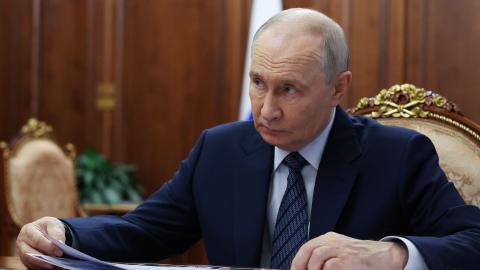
Atlantico: During a press conference in Moscow on Thursday, Vladimir Putin declared that Russia was “ready” for war with Europe, while insisting that it did not want one. How should we interpret this message? Who is its primary audience, and what is Putin seeking to achieve?
Tsiporah Fried: This statement must be understood as part of a coherent strategy of coercion. Vladimir Putin is not simply threatening Europe. He is seeking to control the very terms of the strategic debate by imposing his own interpretation of escalation and deterrence. By simultaneously asserting that Russia does not want war but is prepared to wage one, he portrays himself as a reasonable actor compelled to respond to Europeans whom he implicitly accuses of warmongering.
This reversal of responsibility is essential. Russia has been waging a war of aggression against Ukraine for several years, conducting destabilization operations across the European continent, and regularly resorting to military intimidation. Yet in the Kremlin’s narrative, it is the Europeans who are responsible for escalation because they are strengthening their defenses and supporting Ukraine.
The message is directed at several audiences. First, European public opinion, whose fears about the prospect of war Putin seeks to exploit. Second, European leaders, particularly those torn between the need to strengthen their military posture and the fear of provoking Moscow. Finally, Washington, whose decisions remain decisive for the credibility of European defense.
The context of his remarks is revealing. Putin welcomed exchanges with Finnish and Norwegian leaders and expressed a desire to restore relations with Europeans, while warning that a major conflict would have no winners. This juxtaposition of diplomatic overtures and military threats is not contradictory. It allows Moscow to reward those willing to engage in dialogue while increasing pressure on those advocating a firmer stance.
There is also a temporal dimension. By referring to European military preparations for 2030, Putin seeks to delegitimize the rearmament effort itself, as though preparing to defend against aggression were tantamount to intending to provoke it.
I believe this is where the real stakes lie: Moscow seeks to retain the initiative not only in escalation but also in de-escalation, setting the conditions under which Europeans should exercise restraint, negotiate, or refrain from acting. The danger would be to allow the Kremlin alone to define what constitutes a provocation and what qualifies as a legitimate response.
European officials primarily describe the Russian threat in terms of hybrid warfare. Do you believe this analytical framework is still relevant, or are Europeans already beginning to think about the threat differently?
I believe we need to move beyond this analytical framework. Indeed, several European countries are already doing so, particularly the Nordic countries, the Baltic states, and Poland. These countries no longer think simply in terms of hybrid warfare, but rather in terms of a strategic confrontation with Russia and preparations for the possibility of open war.
This shift is fundamental. Hybrid warfare has long been understood as a form of conflict below the threshold of conventional war, combining cyberattacks, sabotage, disinformation, interference, and economic pressure. The concept remains useful for describing certain methods of operation. But it becomes insufficient, even misleading, when it leads us to treat these acts of aggression as phenomena separate from a broader military confrontation.
For Moscow, these are not two distinct forms of warfare, but rather a continuum of confrontation in which hybrid, conventional, and nuclear capabilities are all components of the same strategy. Russia can simultaneously wage a high-intensity war in Ukraine, conduct destabilization operations across Europe, test NATO’s defenses, and invoke the nuclear threat to deter any Western response.
This obviously does not mean that every cyberattack or violation of airspace should legally be considered an act of war justifying an armed response. Legal thresholds remain essential. But remaining below the threshold of armed conflict does not preclude either a firm response or a strategy of deterrence. Above all, the way we characterize these actions must not become a justification for inaction.
Russia must understand that its aggression will neither be cost-free nor without risks to itself. But as long as we focus exclusively on our ability to absorb blows, without developing a credible capacity to impose costs in return, we will continue to leave Moscow with the strategic initiative.
Based on your exchanges with European officials, how do you assess Europe’s level of preparedness, and France’s in particular, for the possibility of an open conflict with Russia? Where do the most concerning vulnerabilities lie?
We need to distinguish three dimensions: strategic awareness, military and civilian preparedness, and the political willingness to use force. On the first, Europeans have unquestionably made progress. On the other two, the assessment remains more troubling.
The war in Ukraine has fundamentally changed perceptions of the Russian threat and accelerated European rearmament. But increasing defense budgets does not automatically translate into forces capable of sustaining a high-intensity conflict. The commitment made at The Hague to devote 5 percent of GDP to defense and security by 2035 reflects a new level of ambition. Yet deterrence depends on the capabilities available today, not those promised ten years from now.
The first vulnerability concerns mass and endurance. European armed forces possess sophisticated equipment but remain insufficiently sized for a prolonged conflict. Shortfalls include ammunition stockpiles, air defense, deep-strike capabilities, logistics, reserves, and the ability to regenerate forces.
The second vulnerability is industrial. As Admiral Pierre Vandier, NATO’s Supreme Allied Commander Transformation, recently emphasized: “It’s not a question of money. It’s a question of speed.” The Alliance can take two to three years simply to define its military requirements, while Russia has placed its economy on a war footing.
This mismatch, which also extends to production timelines, directly undermines the credibility of our deterrence. If an adversary believes it can exhaust our defenses faster than we can replenish them, it may be tempted to test our resilience. We must therefore produce faster, at sustainable costs, and accelerate innovation cycles. Industrial timelines have become a strategic factor in deterrence.
The third vulnerability remains our dependence on the United States, particularly for intelligence, command and control, strategic airlift, missile defense, and certain strike and support capabilities. Europe possesses substantial military forces, but their collective effectiveness still depends heavily on the American operational architecture.
The episodes involving Starlink in Ukraine have also illustrated the vulnerabilities associated with dependence on critical capabilities controlled by external, non-state actors.
France has considerable strengths: its nuclear deterrent, experienced armed forces, a relatively comprehensive defense industrial base, and a strong culture of operational engagement. The 2026 update to its Military Programming Law provides for an additional €36 billion to strengthen critical capabilities. Nevertheless, France is not immune to the constraints of mass, stockpiles, and endurance. Being able to enter a conflict rapidly does not necessarily mean being able to sustain it over time.
Finally, the fourth vulnerability, too often overlooked, concerns the preparedness of our societies. The Nordic countries, particularly Sweden and Finland, have restored total defense to the heart of their strategies. This concept encompasses both military and civil defense.
In modern warfare, armed forces cannot fight for an extended period without the support of society as a whole. This requires close coordination, beginning in peacetime, among the military, civilian authorities, local governments, emergency services, and private companies.
It means identifying strategic infrastructure that must be protected, preparing continuity and recovery plans, securing essential supply chains—including energy, food, healthcare, transportation, and communications—and ensuring the logistical capabilities necessary for force deployment.
The private sector must also be capable of maintaining essential operations for several weeks, including without immediate government assistance.
Finally, such preparation requires clear communication with the public. Informing citizens about threats and explaining how to prepare does not mean generating fear, but rather strengthening confidence and collective resilience. Finland and Sweden have already accelerated their cooperation in this area. This is also where action from the European Union is particularly needed.
The European paradox is that we have begun preparing our armed forces for war without yet adequately preparing our states, economies, and societies for such a possibility.
Total defense is not about militarizing society. It is about giving society the means to continue functioning and supporting the defense effort, even during a major crisis.
This capacity for resilience also contributes to deterrence: an adversary will be less inclined to act if it knows it cannot paralyze a country or permanently undermine its military effort.
It is precisely in this area of civil-military coordination that Europe, and France in particular, still need to make decisive progress.
Does deterrence remain effective against a strategy built on ambiguity and pressure below the threshold of armed conflict? Is there a gap between the political red lines declared in Paris and the strategic reality?
This is probably the most complex question because it brings us back to a fundamental issue: Who is deterring whom today?
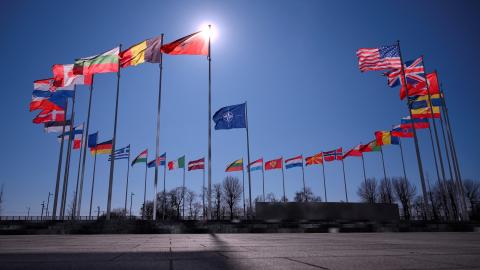
Europeans seek to deter Russia from attacking NATO, while Moscow seeks to deter Europeans from responding to its provocations, increasing their support for Ukraine, or reinforcing their military presence on the eastern flank. We are engaged in a constant interplay of deterrence and counter-deterrence, in which each side seeks to influence the other's strategic calculations.
Moscow's objective is not necessarily to prepare for a direct war against NATO, but to convince Europeans that Russia is willing to take risks they themselves would be unwilling to accept. It is a way of shifting the deterrence balance without triggering open conflict.
We are no longer operating within the relatively clear framework of the Cold War, structured around nuclear balance and mutually assured destruction. The confrontation increasingly resembles a game of Go: each player positions pieces, consolidates advantages, probes the opponent's vulnerabilities, and gradually seeks to restrict the other's freedom of action.
Russia combines conventional warfare, hybrid operations, nuclear intimidation, and diplomatic initiatives to retain the initiative in escalation.
In this context, the French proposal for forward deterrence, which seeks to extend the strategic reach of France's nuclear deterrent to certain European partners, is particularly interesting. It introduces an additional degree of uncertainty into Russia's calculations.
But how does Moscow interpret this development? As a credible extension of French protection, or as a political ambition whose limits could be tested? The question remains open, particularly because nuclear decision-making remains exclusively in French hands.
The real challenge today extends beyond nuclear deterrence. It concerns what Americans call conventional deterrence: the ability to prevent an adversary from achieving its military objectives and to impose costs it would be unwilling to bear.
Despite its firepower and wartime economy, Russia faces considerable difficulties regenerating its forces and mobilizing sufficiently trained personnel. A credible European conventional capability, able to respond quickly and deliver significant blows, could therefore directly influence Moscow's strategic calculations.
Yet the most decisive factor probably remains the American military presence in Europe. What truly deters Moscow from attacking a NATO country is undoubtedly the risk of triggering a direct confrontation with the United States, particularly by striking American forces stationed on European territory.
The strategic value of these troops goes far beyond their numbers. This is precisely what is at stake in the Europe Force Posture Review and the concept of NATO 3.0.
Europeans must assume an increasing share of the continent's conventional defense responsibilities, but without weakening one of the principal foundations of the Alliance's credibility: an American Supreme Allied Commander Europe (SACEUR), an integrated command-and-control structure in which the United States remains fully engaged, and a sufficiently significant military presence to ensure that any conflict with NATO could potentially become inseparable from a confrontation with Washington.
This is precisely where current uncertainties become troubling.
The easing of certain American sanctions against Russia, Donald Trump's willingness to negotiate with Moscow, and questions surrounding the future of the U.S. military posture in Europe may all be interpreted by the Kremlin as signs of diminished American resolve.
Putin's threats must be understood in this context. They may reflect a belief that Russia has a window of opportunity to increase pressure on Europeans, test their cohesion, and seek to decouple their security from the American commitment—at a time when Europeans can no longer be certain that American forces would fight alongside them.
Europeans appear divided between those advocating direct dialogue with Moscow and those who believe such engagement is premature. What does this divergence reveal about Europe's ability to maintain a common position, and who benefits from it?
Europeans are no longer truly divided over the nature of the Russian threat, which is already a significant step forward. They do, however, disagree on how to respond to it.
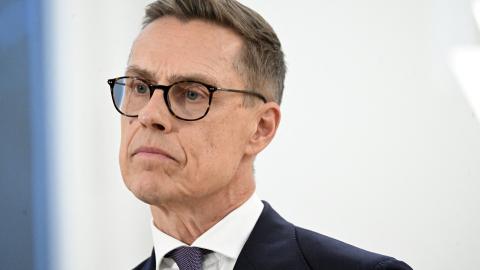
These differences emerged once again this week. On October 27, Finnish President Alexander Stubb and Norwegian Prime Minister Jonas Gahr Støre initiated direct exchanges with Vladimir Putin, prompting reservations from Denmark, Sweden, and Poland.
Earlier this year, France and Italy had also advocated reopening dialogue with Moscow, unlike Germany and the Baltic states, which considered such a move premature. Slovakia went further by resuming bilateral consultations with Russia, particularly on energy.
The problem is not whether to talk to Moscow, but who is speaking, on whose behalf, to achieve what, and from what position of strength.
These disagreements allow Putin to choose his interlocutors and test European cohesion. This is all the more problematic because Washington is conducting its own negotiations with Moscow, potentially further marginalizing the Europeans.
But the real test will be how Europe responds to Russian provocations.
The recent attacks on commercial vessels in the Black Sea provide an illustration. NATO has strengthened its surveillance and protective capabilities, but will these measures be sufficient to prevent further attacks? And if the attacks continue, will the Allies be prepared to do more to secure navigation and impose costs on those responsible?
It is through such concrete responses that Moscow will assess our resolve.
If provocations continue without meaningful consequences, Putin may conclude that he retains the initiative. Conversely, a collective, proportionate, but sufficiently firm response to alter his calculations would strengthen the credibility of deterrence.
This is precisely what is at stake in Putin's current threats: convincing Europeans that any response carries greater risks than inaction, thereby preserving his control over both escalation and de-escalation.
The question is whether our responses will deter him from continuing his provocations or reinforce his conviction that he remains in control of the game.