











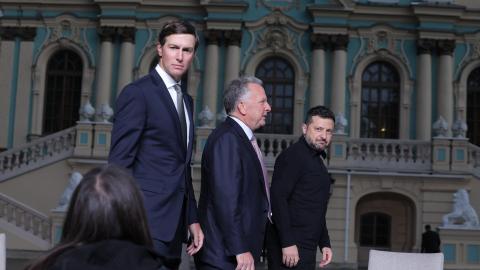
After months of inaction and more than a year and a half of limited progress, the Trump administration recently attempted to reenergize efforts to end the Russia-Ukraine War. On September 5, United States Special Envoy to the Middle East Steve Witkoff and Jared Kushner traveled to Moscow for more than three hours of talks with Russian President Vladimir Putin. It was Witkoff’s eighth visit to Moscow in this capacity. Twenty-four hours later, the two arrived in Kyiv for their first visit to Ukraine as US negotiators, where they met President Volodymyr Zelenskyy and his team.
Zelenskyy subsequently said Witkoff had conveyed that Putin was ready to negotiate a deal. Russia’s actions, however, continue to raise questions about the Kremlin’s intentions. Knowing that Ukraine is dangerously low on ballistic missile interceptors, Russia has continued targeting major population centers, including Kyiv and Odesa. As summer turns to fall and Russia intensifies its attacks on energy infrastructure and civilians, there is growing concern that the coming winter could be the most difficult yet for Ukrainians.
Although details of the discussions in Moscow and Kyiv remain largely outside the public domain, the visits have reignited debate over what a fair and just peace might look like. The following five guiding principles should form the basis of such a settlement:
- Declare the US will not recognize Russian-controlled Ukrainian territory. Ukraine recognizes that, at current levels of military and financial support, regaining every piece of territory seized by Russia since 2014 may not be achievable in the near term. But there is an important distinction between accepting de facto Russian control and recognizing these territories as de jure Russian sovereign territory. There is strong historical precedent for this kind of policy. The 1940 Welles Declaration established US nonrecognition of the Soviet annexation of Estonia, Latvia, and Lithuania. Also, Ukraine should not be forced to hand over any territory to Russia that Moscow has not been able to take by military force—particularly in Donetsk Oblast.
- Provide meaningful reconstruction assistance. After years of war, Ukraine needs to rebuild. This effort would draw on several sources: frozen Russian assets repurposed for reconstruction; private investment, including regional frameworks such as the Three Seas Initiative; bilateral arrangements such as the US-Ukraine critical minerals agreement; and direct assistance from the US, European Union, and other international partners. Reconstruction will be essential to repair damage and ensure Ukraine’s long-term economic viability and deeper integration into Western institutions.
- Facilitate the return of prisoners of war, political prisoners, and abducted children. Russia holds large numbers of Ukrainian POWs and civilian detainees, and has transferred or deported thousands of Ukrainian children to Russia or Russian-occupied territory. Their return should not be treated as a peripheral humanitarian or moral issue but as a core component of any peace agreement.
- Preserve Ukrainian sovereignty. Ukrainians should retain the sovereign right to determine how and by whom they are governed. They should decide when to hold national elections under their existing constitutional framework; which international, regional, and intergovernmental organizations Ukraine joins; and the size and composition of the Ukrainian Armed Forces. Under this approach, no outside actor, including Russia, would possess either an explicit or implicit veto over these choices.
- Institute meaningful and realistic security guarantees. Any ceasefire risks becoming temporary if Russia concludes that renewed military action would be advantageous. The 1994 Budapest Memorandum proved inadequate to protect Ukraine’s territorial integrity. North Atlantic Treaty Organization membership would provide the strongest available security guarantee, but it is politically unattainable in the immediate term. In the meantime, a five-layered security framework could provide a credible alternative:
Layer 1: Civilian monitoring mission. This would operate on both sides of the line of occupation established by a ceasefire and combine personnel on the ground with technological surveillance.
Layer 2: A European coalition of the willing. Countries such as the United Kingdom and France have signaled a willingness to send deployments to Ukraine following a ceasefire. These forces do not need to be directly along the line of occupation, but they should be sufficiently capable and positioned to contribute to deterrence.
Layer 3: American support for European allies and partners. Even if Washington is unwilling to station American troops inside Ukraine, it could provide over-the-horizon capabilities that enable European forces to operate effectively, including aerial refueling, intelligence sharing, and the pre-positioning of US forces elsewhere in Europe for potential deployment during a crisis. US-Ukraine defense-industrial cooperation could also be expanded. Ultimately, Ukraine’s own armed forces, and the domestic defense industry that equips them, will remain the country’s most immediate deterrent against renewed Russian aggression.
Layer 4: Continued Euro-Atlantic engagement. Ensuring that Ukraine remains on a path toward membership in NATO and the EU, no matter how distant, should include deeper cooperation.
Layer 5: Sustained US military presence in Europe and improved defenses on NATO’s eastern flank. While neither move constitutes a direct guarantee to Ukraine, both contribute to regional stability and reinforce NATO’s broader deterrence posture.
Ukraine seeks a just and fair peace, not a surrender. The US needs a comprehensive strategy that demonstrates American strength, resolve, and commitment to ending the war honorably and on just terms. Alongside the war with Iran, President Donald Trump’s success or failure in bringing Russia’s invasion of Ukraine to an acceptable conclusion—an objective he repeatedly emphasized during his campaign—will be an important measure of his administration’s foreign policy record.
For more on this topic, see Luke Coffey’s policy memo “Principled, Enforceable, and Strategically Sound: A Just Peace for Ukraine,” published at Hudson Institute in April 2025.