


















Executive Summary
- Battlefield assessment: The battle space remained largely static, while the war’s operational tempo eased to roughly 100 to 150 combat engagements per day, down from the levels of the previous several weeks.
- Ukrainian counter-drone assistance: Ukraine’s wartime expertise in countering Iranian-designed Shahed drones is attracting growing international demand, and could forge new defense ties between Kyiv and the Gulf Arab states.
1. Battlefield Assessment
The operational tempo moderated slightly across the battlespace last week, with Ukrainian reporting and open-source indicators suggesting that Ukraine and Russia waged roughly 100 to 150 combat engagements per day, down from the 200-plus daily engagements that characterized the previous several weeks. This reduction likely signals a temporary ease in the fighting rather than a structural shift in either side’s campaign.
Several sectors remained principal flashpoints. Kupiansk, Lyman, Kramatorsk, Sloviansk, Huliaipole, Pokrovsk, and Orikhiv continued to be the focus of most ground combat and probing attacks. These areas form the operational spine of the war’s eastern and southeastern fronts and will likely remain decisive terrain in the coming weeks. Kyiv suffered tactical-level losses in the Huliaipole sector—where Russia has deployed marine infantry and combat formations from the 68th Army Corps—and in Udachne.
In addition to the slowed operational tempo, the battlefield also remained largely static. Lines of contact between Russian and Ukrainian forces moved little despite persistent assaults and localized counterattacks. The war continues to resemble a grinding positional contest rather than a maneuver campaign.
As they have in recent months, Russian occupation forces retained a broader offensive footing across the battlespace, and continued to initiate most of the conflict’s assaults and probing actions. Ukrainian forces, however, maintain localized tactical advantages in selected sectors, which prevents operational breakthroughs and stabilizes the front.
Russian air raids, largely comprising mixed strike packages, continued to hit Ukraine. In last week’s air attacks, Moscow launched Russian and North Korean ballistic missiles, cruise missiles, and loitering munitions. Russian forces continued to widely employ the Iranian-developed Shahed baseline drone, which Moscow has adapted to make even more lethal. Russian overnight strikes hit Dnipro and Kharkiv on March 10. At least 20 civilians were injured in these strikes, for which damage assessments continued into the morning.
2. Global Demand Rises for Ukraine’s Counter-Drone Expertise
Ukraine’s wartime experience against Iranian-designed Shahed drones is drawing international attention—and requests for Ukrainian assistance. According to Ukrainian officials, as Operations Epic Fury and Roaring Lion continue to roil the Middle East, 11 countries in that region have approached Kyiv to seek assistance and operational insight on how to counter Iranian drone operations.
Over the course of the war with Russia, Ukrainian forces have built a layered response to one-way attack drones. The approach blends electronic warfare, mobile air-defense teams, and rapid tactical adaptations to emerging drone threats. Years of sustained Shahed attacks have effectively turned the Ukrainian theater into a real-world laboratory for counter-drone tactics. In February 2026 alone, more than 5,000 Shahed loitering munitions targeted Ukraine. Kyiv enjoyed an 87 percent interception rate against these potent weapons.
Ukraine is increasingly exporting low-cost counter-drone solutions born out of wartime innovation. Among the most notable of these is the Sky Fortress system, an acoustic detection network designed to identify and track Shahed-type drones using distributed ground sensors. Rather than relying solely on expensive radar coverage, Sky Fortress triangulates the sound signature of an incoming drone and uses that data to feed early warning and targeting cues to air-defense units.
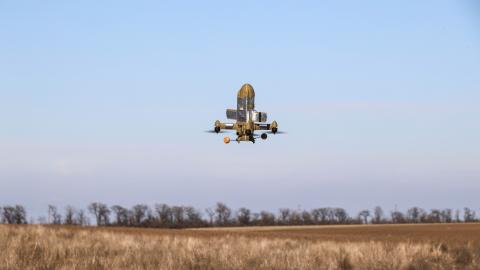
Alongside its detection networks, partnerships between Ukrainian industry and volunteer entrepreneurs are producing a growing family of interceptor drones. Ukrainian drone-hunting drones, most notably the Wild Hornets group’s STING munition, have achieved interception rates of 80 to 100 percent against incoming threats. These systems are cheaper to produce than the Shahed drones they are designed to shoot down, providing Ukraine—and, potentially, any nation Kyiv assists—with a defense-economics advantage over Iran and Russia.
As a result, several governments are looking to apply Ukraine’s battlefield lessons to their own security challenges, particularly as Iranian drone proliferation spreads across multiple regions. The Kingdom of Saudi Arabia is the first to move toward a major arms agreement with Ukraine amid rising Iranian drone and missile threats across the Gulf. Ukrainian defense industry sources indicate that a Saudi arms firm has already signed a contract for Ukrainian-made interceptor missiles, while Kyiv and Riyadh are negotiating a significantly larger weapons package that could be finalized imminently.
The discussions between Riyadh and Kyiv reflect a growing demand, especially among the Gulf Arab states, for cost-effective air-defense solutions against Shahed-type drones, which are far cheaper than the high-end interceptors currently used to counter Tehran. Following a recent national security meeting, Ukrainian President Volodymyr Zelenskyy noted clear international interest in Ukraine’s operational experience. In a message posted on X, Zelenskyy also highlighted Ukrainian advances in interceptor drones, electronic warfare systems, and specialized training for countering drone threats.
The Ukrainian leader indicated that some of the requests for assistance made to Ukraine have already resulted in concrete support, though he did not disclose further details. In his remarks to United States media outlets, Zelenskyy also indicated that Ukraine, at Washington’s request, had dispatched interceptor drones and a team of specialists to assist in protecting US military facilities in Jordan.
Taken together, these events show how Kyiv is attempting to convert its wartime experience against Russian drones—many of them derived from Iranian designs—into strategic leverage with its partners. Ukrainian authorities have indicated a willingness to share their expertise and training with allies, provided such cooperation does not undermine the country’s own defensive needs during wartime.
3. What to Monitor in the Coming Weeks
1. As the drone-threat landscape across the Middle East becomes more dangerous than ever, counter-drone collaboration between Kyiv and its Gulf Arab partners could cement new defense-industrial ties.
2. If the United States and its partners and allies increase their use of air- and missile-defense interceptors to counter the Iranian threat, Ukraine’s inventory of these important assets could fall.