Caption
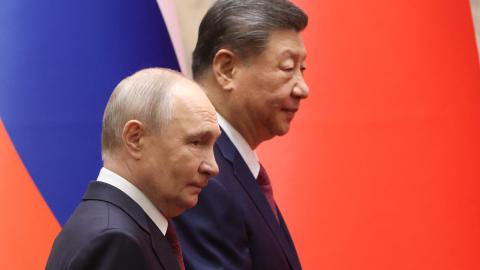
Russian President Vladimir Putin and Chinese President Xi Jinping enter the hall during a signing ceremony on May 20, 2026, in Beijing, China. (Getty Images)





As technology, supply chain resilience, and economic security become increasingly central to United States foreign policy and national security, trade and investment policy has taken on a leading role in advancing American interests abroad. Critical minerals, energy, artificial intelligence, and other strategic sectors have emerged as key areas for collaboration with allies and partners as Washington works to align markets, guard against adversarial manipulation, and leverage economic gains to create national security advantages.
Join Under Secretary of Commerce for International Trade William Kimmitt for a discussion with Executive Vice President Joel Scanlon on how the Trump administration’s trade and investment strategy is reshaping economic partnerships with allies across areas like industrial policy, digital services, and strategic competition.
Listen on Spotify and Apple Podcasts.
Transcript
This transcription is automatically generated and edited lightly for accuracy. Please excuse any errors.
Joel Scanlon:
Well, good afternoon, everyone. Thanks for being here. I’m Joel Scanlon, executive vice president here at Hudson. It’s our great honor today to welcome Undersecretary of Commerce for International Trade, William Kimmitt.
The International Trade Administration, which he leads, is the Department of Commerce’s principal arm for advancing American competitiveness, promoting exports and inbound investment, and enforcing fair trade. There are few issues, if any, more clearly identified as a priority of President Trump’s than trade, and few administrations in which the Commerce Department has played such an active and defining role. The president and Secretary Lutnick have undertaken an ambitious effort to rebalance the international trading order to better serve American workers, industry, and national security. ITA has been central to that monumental undertaking.
Undersecretary Kimmitt has struts the American business and innovation to the forefront of US foreign policy. Among many other initiatives, the undersecretary has launched the American AI Exports Program, sought to deepen defense and technological cooperation among the Quad partners, and signed bilateral critical minerals frameworks.
He has leveraged the strength of American industry to help build a network of partners that grow stronger through commerce, strategic investment, and balanced trade. The undersecretary comes to his job uniquely prepared, both from his prior experience in senior government roles and his experience in private practice. In the first Trump administration, he served as counselor to the United States trade representative, advising on trade policy and legal matters, playing a key role in the implementation of the USMCA, and with the Committee on Foreign Investment in the US.
In his private practice, he has advised clients on trade, geopolitical risks, supply chain assessments, and investment exposure. He brings an elite understanding of how trade rules are written, enforced, and, most importantly, how they affect American workers and businesses.
We’re delighted to have you here at Hudson. Welcome. The podium is yours.
William Kimmitt:
Thank you for that kind introduction, Joel, and thank you to Hudson Institute for hosting me today.
Hudson has long understood something that too many institutions in Washington forgot. Economic strength, industrial capacity, and national security cannot be separated. For decades, Hudson has served as a catalyst for serious discussion in the development of important policy ideas at the intersection of those issues. For too long, Washington behaved as though our economic strength and our national security could be separated, but the foundation of American strength was built on the recognition that the ability to produce is a source of national power. Alexander Hamilton understood at the founding of the Republic that political independence would never be secure without economic and industrial independence. A nation dependent on others for essential goods could not remain fully sovereign. The United States followed that vision and became the greatest industrial power the world has ever known.
That industrial bite did more than create prosperity. It saved the free world. We won World War II not only because of the courage of American and allied soldiers, but because American workers could roll tanks, aircraft, ships, trucks, and weapons off assembly lines at a scale no enemy could match. American factories became the arsenal for democracy. Our productive capacity gave our service members the tools to prevail and gave our country the strength to rebuild a shattered world.
But after the fall of the Soviet Union, Washington convinced itself that history was over. An imbalanced trading system created after World War II to rebuild our allies, strengthen the West, and prevail in the Cold War, became the unquestioned status quo. We were told that trade policy could be placed on autopilot and ignored. That production could move overseas without weakening the country. And while the United States slept at the wheel, other countries, friends and foes alike, understood the enormous value of access to the American market.
They subsidized, they dumped, they erected regulatory barriers. They supported state-owned enterprises. They used every tool available to build their industries and capture a greater share of the American market. At the same time, they used tariffs, regulations, and other barriers to shut American products out of their own markets. And while they acted with purpose, our government, too often, stood by and watched as American factories closed, American production moved overseas, and American workers were overlooked and forgotten.
Our leaders too often refused to recognize that reality, or worse, simply allowed it to happen. Our leaders offered increasingly unconditional access to the most valuable consumer market in the world while failing to insist on reciprocal access and failing to insist that the American people remained the principal beneficiaries of the prosperity our nation had spent more than two centuries building. We were told to accept the results.
We were told the factories would continue to close, production would continue to leave, and American industrial decline was inevitable. President Trump refused to accept that. He rejected the idea that our leaders were powerless to defend American workers, restore American production, and use the strength of our market to rebuild the country.
He understood from the beginning that America’s market is a source of tremendous economic leverage and that this leverage should be used to advance the interests of the American people. He campaigned on bringing industry back, rebuilding the nation’s productive capacity, and putting American workers and producers first. And that’s exactly what his administration is doing.
Under President Trump and Secretary Lutnick, the Department of Commerce is restoring a basic principle of economic policy. The United States must once again be a country that builds things and produces. We need factories. We need furnaces and smelters. We need machine tools, abundant energy, skilled workers, and companies prepared to invest for the long term. We need the capacity to manufacture the materials and technologies required for our economy, our infrastructure, and our national defense.
Government policy should reward the companies, workers, and investors willing to build here and create the conditions that allow them to succeed. That means making it easier to build and easier to invest. It means eliminating unnecessary regulations, accelerating permitting, unleashing affordable American energy, maintaining a competitive tax system, enforcing our trade laws, and giving companies confidence that the United States will stand behind those, making long-term investments to American production.
President Trump is focused on the sectors that are essential to the country’s ability to build, produce, and defend itself. He has crafted a tariff strategy designed to incentivize investment and production in the United States and combined that with regulatory reform, abundant energy, and an administration actively working to bring new factories and jobs to American communities.
President Reagan spoke of mourning in America, but the opportunity of mourning alone is not enough. You still have to wake up, get to work, and seize the day. President Trump recognized that notwithstanding more than two centuries of unmatched industrial achievement, America still remained a sleeping giant when it came to the full potential of industrial and innovative manufacturing. We have the workers. We have the energy. We have the capital, the technology, the entrepreneurs, and the greatest market in the world. But for too long, we failed to use those advantages with purpose.
President Trump reawakened the sleeping giant. And under his leadership, America is capitalizing on the promise of this new day. The results are already evident. In February of this year, American goods exports to the world reached the highest monthly level ever recorded. Then we broke the record again in March and then again in April. The most recent month available, we broke the record for a third consecutive month, reaching $220 billion in goods exports in April alone. Three straight months, three straight records.
The United States is on pace to export $2.5 trillion in goods in 2026, which would shatter the previous record. President Trump has already returned the United States to its position as an export powerhouse, and there is so much more to come. Just look at the scale of investment now being committed to the United States.
Automakers have announced nearly $40 billion in new American investment along with commitments to substantially increase production at American plants over the next three years. Pharmaceutical companies have committed more than $600 billion to expand manufacturing, research, production in the United States. Micron, TSMC, Texas Instruments and GlobalFoundries alone represent more than $440 billion in announced semiconductor manufacturing and research investment. And we’re seeing more than $20 billion in planned investments in steel and aluminum projects.
These aren’t marginal changes around the edges of the economy. These are decisions to build entire industrial ecosystems in the United States. President Trump’s objective is not merely to preserve the capacity that remains.
It’s to expand that capacity dramatically. A historic $4 billion investment in Oklahoma will mark the first US primary aluminum smelter in 45 years. That project alone will double American aluminum production capacity. US Steel is investing $14 billion in American steel production. Hyundai Steel is building a $5.8 billion steel mill in Louisiana that will produce 2.7 million tons of steel each year.
In 2025, the United States returned to the top three steel-producing countries for the first time in 26 years. So these historic investments in steel, aluminum, and autos are crucially important, but they’re also only part of the story. Reindustrialization also means building the technologies and innovative industries that will define the next century.
Last month, I attended Micron’s celebration of the start of 1α (1alpha) DRAM manufacturing at its facility in Manassas, Virginia. This is the most advanced memory technology ever produced in the United States. I’ve lived in Northern Virginia almost my entire life. Until I began engaging with Micron in this job, I had no idea there was an American company operating a memory chip fabrication plant in Manassas. And I would venture to guess that many people in this audience are similarly surprised that this critical technology is being manufactured less than an hour from where we are right now.
Micron isn’t only modernizing that Virginia facility. It’s investing $300 billion in American expansion that includes leading-edge memory fabs in Idaho and New York, advanced packaging, research and development, and a major expansion of domestic semiconductor production. That’s what reindustrialization means.
It means restoring the traditional industries that built this country: steel, automobiles, heavy machinery, and their supporting supply chains with major investments across Pennsylvania, Ohio, Michigan, Indiana, Georgia, Kansas, Kentucky, Tennessee, Louisiana, and Oklahoma. But it also means manufacturing semiconductors and memory chips in Idaho, Arizona, New York, Virginia, Texas, Vermont, and Utah. It means expanding pharmaceutical, biotechnology, diagnostics, and medical technology production in Indiana, North Carolina, California, Delaware, Virginia, and Florida. And it means building AI, cloud, data center, and power infrastructure of the future in Wyoming, Ohio, Georgia, North Carolina, Texas, Pennsylvania, and Mississippi.
I could continue through every major sector in all 50 states. The point is that this industrial revival is not confined to the traditional manufacturing heartland and it’s not confined to a few coastal technology centers. It’s reaching every region of the country.
We’re also working to make American technology the foundation for growth around the world. At Commerce, we are proudly implementing President Trump’s American AI exports program, building on his initiative to promote the American AI technology stack. We’re bringing together industry-led consortia that can offer a full range of AI capabilities, semiconductors, servers, data centers, cloud infrastructure, models, cybersecurity, software, and real-world applications.
Approved consortia under this program will benefit from America’s commercial diplomatic advocacy and financing tools for major projects abroad. We want countries choosing American chips, American infrastructure, American software, American standards, and American expertise. That will combine the two great sources of American economic power, the industrial capacity to build and the innovative ability to lead.
At the Department of Commerce, we have a unique role in advancing this agenda from beginning to end. We attract investment into the United States. We help American companies export. We advocate for them as they compete for major contracts abroad. And we work every day to connect American businesses with opportunities around the world.
Through our select USA. office, we go out, and we compete for foreign investment rather than simply waiting for it to come. And for companies that are building and producing here, we also help them win around the world with our US and foreign commercial service and our advocacy center.
For too long, government advocacy was sometimes treated as a nice government service, a letter, a meeting, a helpful introduction provided when an American company asks for assistance. Under President Trump and Secretary Lutnick, we are taking a fundamentally different approach. Commercial advocacy is not a courtesy. It’s a strategic instrument of economic policy. Since President Trump returned to office, the Advocacy Center at Commerce has helped secure 171 signed contracts worth $309 billion. That’s what happens when you have leadership focused on outcomes and leadership that expects us to leverage every tool and resource available to support American workers, American industry, and American companies.
President Trump has restored leverage to American trade policy. Our trading partners now understand that access to the American market carries responsibilities. They must provide meaningful access for American products. They must address barriers that discriminate against American businesses. And they must understand that the United States will defend industries connected to our economic and national security.
Secretary Lutnick has been central to President Trump’s historic trade and investment agreements around the world. Just this week, the European Parliament took its final vote on legislation implementing the president’s agreement with Europe and eliminating tariffs on US industrial goods. That means historic unprecedented access for US businesses to a $20 trillion market. And I want to take a moment to explain what that means through just one example.
When President Trump returned to office, the United States imposed a 2.5 percent tariff on passenger cars imported from Europe. Europe imposed a 10 percent tariff on American cars. Not surprisingly, the trade relationship reflected that tariff imbalance. In 2024, Europe exported more than four times as many new cars to the United States as the United States exported to Europe. President Trump’s historic agreement flips that tariff imbalance entirely. European automobiles entering the United States are now subject to a 15 percent tariff. Meanwhile, Europe has voted to reduce its tariff on American industrial goods, including American automobiles, to zero. That’s what leverage looks like. President Trump understands that the American market is the most powerful economic asset in the world. He understands that access to it should not be given away unconditionally. It should be used to open foreign markets, expand American exports, encourage production in the United States, and deliver results for American workers.
This is what happens when you have a president who recognizes the fundamental imbalances that were allowed to persist for decades and understands how to use the enormous leverage of the American market to secure better outcomes for American workers and producers. President Trump has restored the understanding that governments should not remain a passive observer while industries leave, competitors close their markets, and American communities bear the cost. We will use access to our market as leverage. We will reward companies that build in America and create the conditions that make that investment possible. We will bring capital, industrial capacity, and jobs to the United States. We will stand behind American businesses when they compete around the world. And we will recognize that the American worker is not an obstacle to economic efficiency. The American worker is the foundation of American strength. We are working to make the United States once again the greatest place in the world to invest, manufacture, innovate, export, and build.
That’s how we advance American interests. That’s how we restore American industrial power. And that’s how we build an economy worthy of the nation that created it in the 250 years of achievement behind it. Thank you.
Joel Scanlon:
Thank you for those remarks. I’m not aware of you being a prosecutor at any point in your private sector career, but that was quite a case on behalf of the president’s agenda. So again, welcome to Hudson and maybe we can jump right in.
Thinking about the trade side of your portfolio, obviously, I think you’ve used the term in the past “recalibration.” The administration has talked about unfair competition. This is maybe more of a philosophical start, but how do you differentiate between economic behavior that may just be sort of problematic in the sense that it creates imbalances, not necessarily a threat from an international security perspective, from something that is truly more predatory in its intent? And then the second part of that, how do you think then about the equilibrium between sort of protecting against those structural imbalances but also allowing for the competition that trade brings, improving our own domestic economic actors?
William Kimmitt:
Yeah. I mean, I think we have traditional tools at the Department of Commerce to address things like dumping and subsidies. We have our anti-dumping and countervailing duty process. And so that really addresses those issues, but that’s really more in a traditional price-focused context. As you look, particularly as economies become more intertwined and more complex, if you look at things like digital trade barriers and things that are really designed that may be neutral on their face, but the impact actually discriminates against US companies, it’s really identifying those.
And so certainly there are market forces that will push certain parts of the economy in different directions. There are things where certain countries have natural advantages over the United States. There are natural resources that we don’t have in the United States. So of course there are going to be imbalances on those products, but it’s really recognizing, particularly systemically ingrained issues that have persisted for decades, and as they modernize into things, as I said, like digital rules that really affect US companies. So, you have to think beyond sort of price impact in normal market forces and really look at what’s guiding them.
Joel Scanlon:
The suggestion there is that some part of this is even though the tariffs have been set at sort of a more standardized level, a lot of this actually is about government policies on the other side of the trade partnership?
William Kimmitt:
I think that the tariffs are basically an instrument that’s being used to recalibrate and rebalance trade relationships. And so there are different tariffs that are in effect right now. We have our 122 tariffs, which is a global 10 percent tariff with carve outs for certain products and categories. And then we have our 232 programs that are more industry-focused. And so I think in connection, they of course work together to level the playing field, but really we’re trying to drive investment in the United States. We’re trying to produce more in the United States, but the tariffs are an instrument we’re using to address these fundamental imbalances that have persisted.
Joel Scanlon:
On the topic of investment, you mentioned it several times in your remarks, obviously has been a focus of your work and the Commerce Department in general in negotiating trade deals. And it’s, I think, one of the most interesting aspects of the administration’s approach. I realize maybe sometimes frustrating for some of our trade partners, but noteworthy in the approach of thinking about economic statecraft, not just a series of negotiations about discrete issues like trade or like investment or like regulatory policies, but taking a more whole of the economy kind of approach.
You laid out a number of ways or some of the numbers about the pledges, the inflows. Some of the most obvious examples of this are the agreements with Japan, Korea, Taiwan. Can you give me a sense of how. . . Well, maybe first just how you think those agreements are being implemented, the successes so far, and maybe what you see coming in the near term on any of those three?
William Kimmitt:
Sure. So the agreements with the EU, with Taiwan, with Japan, and Korea, they’re really truly historic in their investment commitments from those countries, but it’s important to recognize that there are different. . . The investment commitments are slightly different for each. So Europe pledged to do $600 billion of foreign direct investment, and that’s more of the traditional FDI that we’re familiar with. Taiwan pledged to bring its entire semiconductor ecosystem to the United States through $500 billion worth of investment in the United States directed by them.
The Japanese and Korean investment pledges are altogether different. These are investments that they have agreed to make. Japan has agreed to make $550 billion worth of investment in the United States in strategic sectors with the United States directing those investments to critical sectors. We work with the Japanese, we coordinate with them. We look for opportunities maybe where there would be a Japanese company or a supplier that could be involved in that project. A perfect example is GE Vernova Hitachi SMRs. It’s something, it’s a critical capability we need to power the next generation and where there’s already an existing partnership between a great American company and a great Japanese company.
And then Korea as well pledged $350 billion. That’s broken down into $200 billion worth of investment that is similar to that Japanese model and then also $150 billion specifically designated to ship building. And actually this morning, I got an email from a counterpart in Korea informing us that the Korean government had passed their law to create the vehicle by which they can make these $350 billion worth of investments.
And so really as we look to where it’s going, there have already been Taiwanese companies already announced investment. Of course, there’s a significant amount of investment from Europe in the United States. The Japanese projects, I think we’ve announced $110 billion worth of projects under that 550 already. There’s a 9.2 gigawatt gas power plant in Ohio where shovels are already in the ground. I think that’s a $32 billion project, and there are other projects as well. And then with this great news from Korea that they’ve passed their law, the projects with Korean banking are going to pick up soon.
Joel Scanlon:
The shipbuilding is Philly or their Philly shipyards or they’re investing in other…
William Kimmitt:
All over. So there’s the Hanwha Philly shipyard. And then we’re talking about other shipbuilding opportunities that exist as well in the Gulf and on the West Coast.
Joel Scanlon:
If I understand correctly on the Japanese model, these are government-owned facilities essentially? And how is it working in terms of, without the equity stake, the private sector sort of profit mode of being involved here?
William Kimmitt:
Sure. So, you’re correct. So the Japanese government, we will identify a project, there’s a consultation committee with Japan. We discuss the project with them again to identify opportunities for Japanese involvement. But once Secretary Lutnick recommends a project to the president and the president approves it, then Japan has to commit the money to build the project. And so these are projects that are going to be built on federal land, the idea of there being faster permitting. And then the US government will own the asset and we will work with an operator to identify some sort of arrangement, a net lease arrangement or some sort of. . . It basically turns CapEx into OpEx for the company and they operate the company and the asset and the US government will own it. And then we split the cash flow with the Japanese 50/50 until they get their money back and then it’s 90/10 to the United States.
And so it’s really a historic and unprecedented investment arrangement with the Japanese. I think to your question for Japan, there really isn’t an opportunity with these commitments to participate in the upside of a project. And so because of that, we are focused on projects that really don’t have any or much downside. That’s why the focus has been on power thus far because everybody needs power. And so this gas plant in Ohio and the other projects we’re looking at, the offtake is almost certainly going to be guaranteed. And so we’re not so much looking at projects where there is risk. We’re not building the data center, but we can build the power that’s going to power the data center and then the private sector can work around that.
Joel Scanlon:
Right. And so with 440 some billion dollars left, we should expect sort of more of that style of investment?
William Kimmitt:
Absolutely. Big projects at scale, that’s what really we’re focused on.
Joel Scanlon:
If we can turn geographically to Europe, you mentioned the EU Parliament has just sort of passed the legislation to implement the Turnberry Agreement signed last summer. I think the council still has to vote next week maybe, but that’s seen as sort of a formality. The president and others in the administration had been expressing some frustration with the pace of the implementation from Europe. Any expectations of future hiccups or you think this is now ready to move forward at a faster pace?
William Kimmitt:
Yeah. So I think when we reached the agreement last August, I think, we very quickly implemented our side. The EU process has been longer than we had hoped, but the news this week that they passed is a great step and moving towards it. In the Turnberry Agreement, there are other commitments that the EU made that we continue to work with them on, but certainly it’s a great step that they took, and then we’re going to continue to work on the relationship going forward.
And so we’re very positive. And it’s great to see the tariffs will go down. I mentioned the export numbers in my remarks. I think once these tariffs go down to zero and the opportunity for American industry to export to that market will be. . . I mean, they’ll send those numbers. It has to send them higher.
Joel Scanlon:
Maybe turning to the other aspects of the relationship, a criticism I have heard frequently and frankly share is that some of the, which you alluded to in your remarks as well, sort of regulatory policies in the EU that seem intentionally discriminatory or designed to disadvantage US companies and then what appears to be sort of an active export of that regulatory framework to other parts of the world. I’m thinking particularly about US tech sector obviously, the Digital Markets Act, the GDPR Digital Services, the AI Act.
Now I think it’s the Cloud and AI Development Act is the latest, or the use of climate policies, the emission trading system that is a potential threat to US air carriers. Maybe if you could talk about those issues specifically and then sort of the next steps as you see them from the administration side and dealing with those questions.
William Kimmitt:
Sure. And so, I think those examples you just gave sort of go back to your first question about how do you identify these issues that really have the effect to discriminate against US companies. So I mean, it’s no secret that our tech companies find it extremely challenging to do business in Europe. And we find that problematic, of course.
One, we don’t want them discriminating against our tech companies. And two, the investment climate in Europe for these great tech companies, the appetite is very small because of the challenges they face. I mean, I think it was either earlier this month or last month there was a new reports of a new fine on Google that’s going to be in the hundreds of millions of euros. And so it’s really challenging for our companies to invest there.
And then if that remains the case, it’s going to be very challenging for Europe to modernize its economy as it needs to and to remain a trading partner with their $20 trillion economy with ours. And so we want to se them develop. We want our companies to succeed there.
And so as you talk about the relationship going forward, we were in Brussels last year, Secretary Lutnick mentioned that for continuation of progress in the relationship on the trade front, one of the things that was not part of the deal with the EU was an arrangement on steel and aluminum. And they remain subject to the steel and aluminum 232 tariffs without a unique arrangement.
Secretary Lutnick floated the possibility that, “Look, if you want to see progress in areas like steel and aluminum that are important to you, we need to see progress on the issues that are important to us as well with respect to digital and we need you to treat our digital companies fairly.” So like I said, it’s a great step that they pass the industrial tariff legislation, but there’s still work to be done.
Joel Scanlon:
Are there specific negotiations on the horizon or is this just going to be an ongoing conversation?
William Kimmitt:
I mean, USTR certainly is engaged on a daily basis, our team at Commerce as well. There’s not any particular date circled or anything moving forward, but it’s a relationship. It’s of course, an important relationship that we continue to engage with them on.
Joel Scanlon:
Continuing around the globe, I think one of the noteworthy areas of emphasis of this administration has been the almost brand new, actually, US focus on Central Asia as an area of opportunity. I know you were involved in the investment conference around the C5+1, signed, I think, something like $25 billion in commercial agreements. And this region in particular seems like a nexus of what you alluded to earlier, sort of economic and national security coming together, obviously, in part, access to things like critical minerals, but also because it’s just a region clearly of competition for influence right now. Maybe if you could say a little bit about what you have done in the region or with regional partners and how it fits more broadly into context for the administration.
William Kimmitt:
Yeah, absolutely. I mean, it’s an area that we have put an immense amount of focus on for the reasons you identify; critical minerals and just the tremendous opportunity that’s there in a part of the world that really has been overlooked for too long. And so we have had a lot of engagement particularly with Kazakhstan, with Uzbekistan.
My assistant secretary, David Fogel was in Kazakhstan. . . Kazakhstan? Okay. Or Uzbekistan last week. But we’ve really had a lot of engagement with them. I’ve met President Mirziyoyev and President Tokayev separately on multiple occasions, with Secretary Lutnick.
I think one example really that we’re proud of and it shows the work we do at Commerce, we have our advocacy center, like I mentioned in my remarks, which advocates for US companies around the world. And one company, Wabtec, makes locomotives and they won, with the help of our advocacy center, a $4.2 billion contract to provide 300 locomotives to Kazakhstan.
It’s the largest locomotive deal in history. And we were in Grove City, Pennsylvania at the Wabtec engine facility last week. It’s a great reminder. Being there and seeing the workers on the line working on those engines was incredible, but it really just shows everything we’re trying to do. It’s building industrial machinery in Pennsylvania to export to a part of the world that we care about. And the purpose of the locomotives is going to be the transport of critical minerals in that region. And so it really ties together everything we’re trying to achieve. And we’ve had a lot of success through our Advocacy Center and just in our bilateral engagements with those countries there.
Joel Scanlon:
I don’t know if my colleague Ken Moriyasu is in the audience, but he has made me a believer in the importance of Central Asia to our strategic future. USMCA, an issue you know intimately. You ran the implementation with the Office of the US Trade Representative in the first Trump administration. We’re a couple of weeks away from the joint review. I think due on July 1. When Ambassador Greer was here recently, he said publicly don’t expect a straight renewal. I think it’s clear that there are separate bilateral tracks taking place. What are America’s core priorities in these negotiations? Where do you see the two tracks going? What are the sort of prospects for USMCA? Share as many secrets as you’d like on the…
William Kimmitt:
Well, I mean, certainly when you look at USMCA, it’s important to think back that it was an achievement in that it replaced NAFTA. And NAFTA was just in desperate need of replacement, and USMCA was a great achievement to get there. If you think of it though, a six-year review was put into USMCA precisely for this reason, to have this conversation right now, where we weren’t going to agree to a trade deal that endured in perpetuity. We built in a mechanism by which we would ask ourselves every six years, “Is this agreement still working for the American people?” And that’s the conversation that’s taking place right now.
I like to bring up that I joined the Trump 45 administration a little later after the negotiations. And friends and former colleagues, CJ Mahoney and Jamieson Greer and Stephen Vaughn were more involved in the negotiations of the agreement. I focused more on the implementation after getting in, but I like to. . . So I mentioned them because I heard this secondhand from them, but during the USMCA negotiation, this idea of doing the evaluation, doing the review came up. And the US, we were insisting on doing it every three years. The Canadians and Mexicans said, “No, we don’t want to do it every three years. We want to do six years.” And then we said three years and they kept saying six years.
And finally, a colleague said to one of the negotiators like, “Why are you so insistent on the six years?” And remember this is summer of 2019. They said, “It needs to be six years because we never want to have to negotiate with the Trump administration ever again.” And so—
Joel Scanlon:
It worked out perfect.
William Kimmitt:
So here we are at six years in. I think there are parts of the USMCA agreement if you look at things on digital and other areas, that are working better than others, but of course our 232 national security tariffs are focused on a lot of sectors of importance to the USMCA relationship; autos, trucks, steel, and aluminum. And so we’re working to figure out what the path forward is. If it’s on the trilateral basis, how do we take those areas where I mentioned in my remarks. We’re seeing significant investment in the United States because of the tariff program the president has implemented. How do we continue to deliver the meaningful results for American industry and American workers in a framework that involves our North American partners?
Joel Scanlon:
Do you want to handicap the prospects of where things are headed?
William Kimmitt:
I think the president actually gave some remarks today where he talked about—
Joel Scanlon:
Oh. USMCA . . .
William Kimmitt:
. . . USMCA, so I will—.
Joel Scanlon:
Let me turn away from the geographic focus to another administration priority, which you referenced, your particular part of it, the American AI Exports Program. More broadly, winning the AI competition, for lack of a better way to say it.
ITA issued a call proposals, full-stack AI export packages. I think that closes at the end of this month, call for proposals?
William Kimmitt:
Mm-hmm.
Joel Scanlon:
I imagine there are some specifics you can’t share, but if you can give us a sense of what you’re seeing, what the expectations are for this moving forward, how you see the implementation as much as you can about that program.
William Kimmitt:
Sure. So this is a program that was called for by the president in EO last year. He called on Commerce to implement the AI exports program. And what we are doing, we work with state and others in the inner agency. We are basically right now we’ve issued a call for proposals. It came out in April. It’s a 90-day window where we are seeking full-stack industry-led consortia to apply to . . . It comes to the Department of Commerce.
These will be packages that the industry themselves put together and say, “We can provide a full stack offering with this company doing this, this company doing this, this company doing this” and Secretary Lutnick will review and approve those packages.
The idea is we have the greatest tech companies in the world and there’s tremendous opportunity throughout the world. Our tech companies, while great, may be more fragmented than other opportunities that are out there.
And so what we are trying to do as a US government is have the industry tell us, “Who do you want to work with on these projects as we pursue these opportunities around the world?” And then approve projects will get government advocacy, they will get priority licensing review at BIS, and then also access to financing tools at XM and DFC, and priority.
And so it’s basically, we call it, sort of creating a menu. And once these are approved, we’ll have a menu of opportunities and options for foreign countries that say this is. . . If it’s like the Malaysian Ministry of Health, we’ll say, “We need an AI solution.” And we can say, “Look, we have these opportunities here.” And they might look at that and say, “That’s exactly what we need.” And we’re trying to make it easier for partners and allies to pick American tech and we want them to build on American tech. And we’re trying to consolidate that to make it easier for our partners and allies to choose.
Joel Scanlon:
Are you doing any coordinating on the industry side or they come to you and say, “Here’s what we’d like to do” and then you’re the one stop shop that says, “Here’s how we’re going to go out to the potential foreign partners on this”?
William Kimmitt:
So, we’ve done a tremendous amount of engagement with industry actually preceding the call for proposals. We did a RFI specifically requesting and soliciting information from industry to explain to us what would be most helpful to see from the US government, what are the challenges you’re seeing, where could the government help, where is it helpful if the government doesn’t get involved. And so we are certainly significantly engaged with industry. You’ve mentioned that the window ends June 30th, and we’re seeing already multiple applications. We expect more to come. And look forward for those companies that have submitted to continue to work with them.
Joel Scanlon:
Presumably then do this again in the future. Same idea.
William Kimmitt:
Yeah. I mean, in the tech industry, things are going to continually evolve, and the program will evolve with it.
Joel Scanlon:
One of the concerns that I think legitimate one we hear debates about it all the time is the balance of exporting the US AI stack versus what we might call adversarial countries' access to very high-end technology. Are you involved in those discussions at all with the companies? How does that play in the process as you’re thinking about exporting these? Or is that just sort of determined somewhere else in the process, and you don’t have to worry about that part? Once somebody’s approved, they’re approved?
William Kimmitt:
So, there are eligibility criteria. Of course, these are American companies. We want as much American participation in these consortia as possible. I think to have a full 100 percent American tech stack is not something realistic given the state of the company. So there are partners and allies who can work in the stack, and those will be reviewed and approved by Secretary Lutnick. Of course, as I mentioned, these will get priority review in licensing determinations by the Bureau of Industry and Security. And so your specific question is one that is more directly handled by my friend and colleague, Jeff Kessler at BIS. But certainly there’s close coordination between ITA and BIS on these processes, and so it’s sort of a group commerce effort.
Joel Scanlon:
That’s great. I realize at risk of keeping you over time, and so thank you for generously being here this afternoon, but if maybe we can close because you gave such a full overview of the administration’s approach to economic statecraft, trade, investment in the current environment, and an update on the results so far. As we were talking beforehand, this is not a president that sort of sits back and rests and thinks that’s been a good day’s work. So what should we be looking forward to as sort of the next things coming down the line, the priorities for you at ITA over the next six months to a year?
William Kimmitt:
Yeah. So, I think we’re continuing to talk with countries who are interested in pursuing trade agreements. We work closely, of course, with USTR on those fronts. I’d say where we are with respect to the major countries, we have reached agreements with them. So we talked about the Japan and Korea, and the EU. And so I think that the big things that are coming next are these investments that are going to come online.
Like I said, 110 billion, you mentioned you did the math, to $440 billion left on Japan. And as I said, the great news is that Korea passed their legislation today and that we now have the investment vehicle with them. So continuing to engage with Korea and Japan on these projects, announcing more of them. And then as I mentioned, Taiwan, the investment they’re making in the United States and continuing to work and facilitate those, and just continue to see these big investment announcements.
Joel Scanlon:
Thank you for the great remarks. Thank you for covering an awful lot of territory here. We really appreciate your time today. You’re welcome back at Hudson anytime. Thanks so much.
William Kimmitt:
Thank you for having me. And thank you to Hudson. And again, congratulations to you. I know the news came out. And I really appreciate the opportunity to be here today and the work that Hudson does.
Joel Scanlon:
Thank you. Thank you very much.


Hudson welcomes Karel Řehka, former chief of the General Staff of the Czech Armed Forces, to discuss the changing security environment in Europe and its implications for the Czech Republic, the North Atlantic Treaty Organization, and the transatlantic alliance.


Join Hudson Institute Senior Fellow Peter Rough for an online conversation with Pancevski about his new book and the broader implications of the Nord Stream affair for European security, transatlantic relations, and the evolution of unconventional warfare.


Join Hudson Institute Senior Fellow Ludovic Hood for a panel with David Wurmser of the Jerusalem Center for Security and Foreign Affairs; David Makovsky of the Washington Institute; and Senior Fellow and Director of the Center for Peace and Security in the Middle East, Michael Doran, as they discuss the state of the race and potential paths forward for the United States–Israel relationship.