Caption
Russian President Vladimir Putin and Chinese President Xi Jinping enter the hall during a signing ceremony on May 20, 2026, in Beijing, China. (Getty Images)






Today’s wars in Ukraine and the Middle East show how adaptation is becoming the central military competition. The side that can field new tactical or technical innovations faster gains an advantage and can impose compounding costs on enemy forces. To win this competition, the United States Department of War implemented a new strategy to accelerate new capabilities by better leveraging the private sector and focusing government research where it is uniquely needed. These changes are beginning to bear fruit on the battlefield.
Artificial intelligence is arguably the Pentagon’s top technology priority. In addition to speeding planning and decision-making, AI is enabling a more adaptable US force and powering the next generation of autonomous systems. And AI is only one of several technologies where the US military can benefit from America’s world-leading commercial innovation sector.
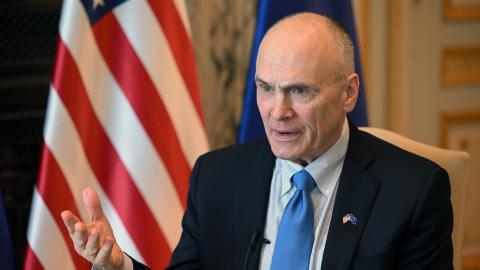
Please join Hudson Institute Senior Fellow Dan Patt for a conversation with Under Secretary of War for Research and Engineering Emil Michael about the Department of War’s efforts to bring AI to the battlefield and implement an innovation strategy that makes the most of America’s commercial and government research sectors. Following a fireside chat with the under secretary, a panel will discuss how adaptation is a new source of military advantage.
This event is part of Hudson Institute’s Apex Defense Conference series, which highlights the intersection of technology, military operations, and strategy. Hudson Institute hosts the Apex Conference in collaboration with Clarion Defence. To learn more about APEX 2027 participation or sponsorship opportunities, please visit apexdefense.org.
Fireside chat with Senior Fellow Dan Patt and Under Secretary Emil Michael
Panel Discussion with Nick Bucci, David Byrd, Joe Kochan, Sam Lisbonne, and Shawn Venditti
Listen on Spotify and Apple Podcasts.
Transcript
This transcription is automatically generated and edited lightly for accuracy. Please excuse any errors.
Panel Discussion with Nick Bucci, David Byrd, Joe Kochan, Sam Lisbonne, and Shawn Venditti
Brigham A. McCown:
Good morning, everyone, and welcome to the Hudson Institute. I’m Brigham McCown, senior fellow here.
You might notice that Emil Michael is not standing here yet. We have a distinguished group of expert panel. We’ve had to flip the expert panel and Secretary Michael’s address. He will be here shortly due to a scheduling conflict, so I apologize for that.
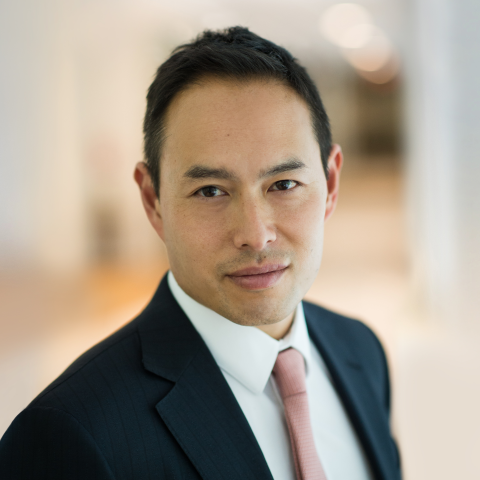
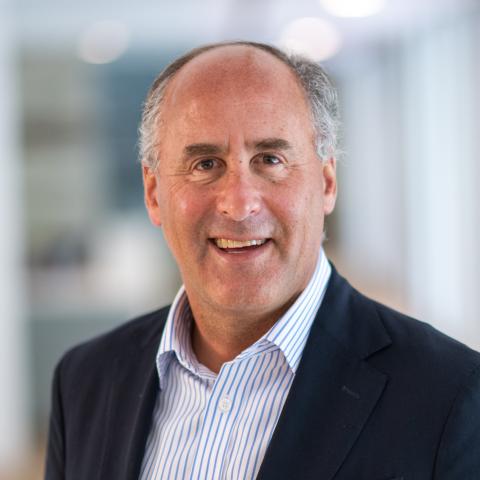
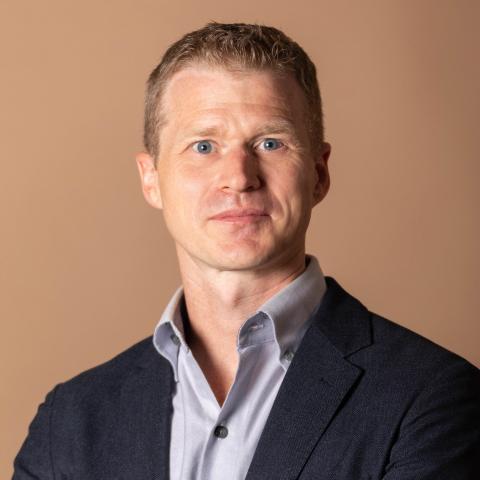
We’re honored to have such a distinguished group on stage now and thank you for joining us for Winning the Info competition. Innovation is critically important as many of you have seen and introducing the panel we have our moderator, Dave Byrd, fellow for the Center for Defense Concepts here at Hudson. Next to him is Nick Bucci, Vice President of Systems and Technologies at General Atomics Electromagnetic Systems. We have Shawn Venditti, Lockheed Martin, Rotary and Mission Advanced Concepts; followed by Joe Kochan, Executive Director of the National Spectrum Consortium; and last but not least, Sam Lisbonne, Vice President of Products at Saronic. Floor is yours.
David Byrd:
Thank you, Brigham. I’d like to thank everybody for coming today. I appreciate you all meeting us on this very warm morning, and to all of our panelists. And I’d also like to note that this event is one of the several lead-up events to the Apex Conference that will be held in January of 2027. So, it is a large defense conference about this exact topic and we’ll be hosting several workshops, panels, moderation events leading up to it, exploring all of these topics in more detail. So, check it out.
I’d like to start off with giving everybody a chance to both introduce themselves and just to level set the conversation. This whole discussion is about adaptability and innovation, but I’d like to start off with saying, what does adaptability mean to you and your organization and how do you define it in this military context?
Nick Bucci:
I guess for me, the quote from Mike Tyson kind of resonates with me when it comes to adaptability. And that is, “Everybody has a plan until they get punched in the face.” And so what that means from an adaptability from a defense systems perspective is being able to take a weapon or a system that is geared toward a particular environment or mission and figuring out how to use it when it’s in a different battle environment or in a different use case. And that is what always happens. The old plan or saying in military is, “Any plan doesn’t survive first contact with the enemy.” I prefer Mike Tyson’s version, though.
David Byrd:
Shawn?
Shawn Venditti:
Yeah, I love that definition. I mean, I really got into this about 12 years ago with the DARPA Adaptive Radar Countermeasures program, DARPA-ARC. And adaptive was right there in the title, and for about two years, it was a program about algorithms, and then we kind of realized it had to be about how do you tell what happens when you get punched in the mouth? What does it mean to get punched in the mouth? What are the different ways in which EW can punch you in the mouth or a different system can punch you in the mouth?
And so, we really drove home this idea that the evaluation environment and evaluation mechanism really were one of the core tenets to develop and to assess cognitive or adaptive systems. This is obviously before LLMs, but now that it’s vogue and it’s all in our collective consciousness, right? We’re at the point that it’s just like humans. You have to be able to assess the adaptation of the system. You have to be able to drive the adaptation of the system. You need to sensing capabilities within the system. You need the cognitive flexibility of the system, you need the resilience.
And so, it’s still a DARPA hard problem. It’s just the technology has evolved this to a different point where we’re not talking about beating chess masters, we’re not talking about beating StarCraft. We’re talking about beating real operational environments.
Joe Kochan:
Great. Thank you, and glad to be here this morning. Just very briefly, the National Spectrum Consortium is a 300-something member OTA consortium that’s focused on innovation broadly speaking in the spectrum space, anything wireless. So, anything that radiates or receives. Matter of fact, I think all three of the organizations here on stage are actually members of the consortium.
And I can talk about adaptability in two main thrusts. My main focus, I come from the telecom space, so from the communication space, but none of the technologies we talk about today or the systems that need to be adaptable don’t at their core have a comm sensing EW problem to solve there. So, it is central. It’s a technology that is central to almost everything else within the DOD space.
And these systems, there is a huge push for these systems to use and mesh with commercially available systems, which have now gotten extremely complex. Used to be that DOD comm systems were by far and away better than anything civilians have. Now we have something in our pockets, especially when you add an LLM over the top that you can access there, that rival anything that military technology can put out there. Not only that, but these systems, because they’ve proliferated now, also cause tremendous issues if we leave the United States and go elsewhere, because everyone else has them and they can use them, and there’s no way to control or find them. And so, it’s obvious what has come up just even recently in the recent conflicts from there.
The other sort of adaptability angle I’ll put on it is that I focus a lot of my time on DOD procurement and innovation. How do you get new innovation from smaller, more nimble commercial partners in through to the war fighter? The purpose of our OTA is prototype development in this space. And so, how do you form new partnerships? How do you solve new problems? How do you get solutions that go across DOD in the spectrum space? Shawn and I were just talking about it earlier. It’s a very difficult problem. Tons and tons of different system, tons of different programs, tons of different missions and goals, not all coordinated.
So, there’s a government coordination problem in the spectrum and wireless space there is a coordinate with industry problem. And then there is the, how do you rapidly get that through the innovation pipeline? And that is all a question of adapting the existing technology in the world, which has raced very far out ahead in some cases and can cause real problems in the defense space. How do you use that, adapt it, and quickly modify it and do so in a way that meets the mission of all of the various different agencies and units across DOD?
So, I kind of think about that in two different places, a little more upstream even. How do you get that innovation going, and the policy is correct? And then the acquisition framework and the innovation correct so that it goes from one end to the other more seamlessly?
Audience Member Sam Lisbonne:
Excellent. Good morning. Thank you for having me. Rather than converge on a single definition of adaptation, I’m going to add more definitions of adaptation just to make this more complicated.
So, when I think about our work at Saronic, there are two additional places in which I think adaptation is relevant. My fellow panelists have described how adaptation is relevant in a short-term, tactical environment, but there are two other places that our product work at Saronic use adaptation.
One is that we’re just a startup working in the defense space. And so, adaptation is a cultural value and something that our organization is constantly facing. I joined the company three years ago as employee 25. We’re at 1,700 people. You can believe that there’s adaptation on a day-to-day basis inside our organization. So, I think adaptation is something that’s a resident cultural value or an organizational value in addition to a practice.
And then, when I think about the products that we’re building, we think about building autonomous surface platforms that meet a variety of needs across the joint force. So, most people look at autonomous boats or ships and think that they’re Navy-only products, but that’s actually not the case. And the responsibility of our team and product is to think about how we can build products that adapt to different needs across the services or across the joint force. And so, adaptation is also not just in response to an adversary. It’s in response to divergent needs across DOW and that’s something that we place a high premium on.
David Byrd:
And I think that’s a great segue to jumping into sort of what actually enables this. So, kind of continuing on with your point, in these recent conflicts, both Ukraine and Iran have proven remarkably resilient against getting punched quite hard in the mouth. How do we, as the US industrial base, enable that kind of adaptability and that kind of modularity and flexible system composition at the industrial base level so that we can quickly find those new techniques, find those new innovations, and scale them quickly?
So, maybe start with you, Sam. If you could talk about Saronic’s approach to industrial manufacturing and your modularity in boat design, especially since you guys have been in the news lately?
Sam Lisbonne:
We have indeed.
Yeah, I’ll take that question a couple ways. So, the first thing I’ll say is that there are two lessons from Ukraine. One is about adaptation, but the other is about mass. There’s a fine balance here between building systems at scale, which typically requires that they look exactly the same, and building systems that are adaptive and can continue to respond to threats.
For us, the way we think about this is that we build common platforms. Our autonomous surface vessels are consistent, simple. In some ways we liken these to pickup trucks. And then we allow operators to put whatever payloads or kits or modifications into those platforms. So, for us, the adaptation and hardware is actually in the payloads, the sensors, and the integrations that we do on top of the base platform and that allows us to achieve scale in the base platform, but continue to meet discrete user needs and adapt to changing battlefield circumstances. And then we can also do the same thing in software where the software can change on a recurring basis. And part of the advantage that we have as a business is that, by bringing software and hardware and production under one roof, we’re able to increase the velocity of that cycle.
And the other point I’d just make is that when we think about flexibility and adaptation in production, there’s a distinction here between boat building and ship building. We’re trying to bridge that divide, but also recognize the inherent structural differences between those two disciplines.
If you visit our production facilities in Austin, Texas, most of the workstations are set up on caster wheels so that we can continue to move around workstations and make that process more efficient. And if all of a sudden we need to add a substation or we need to add a subsystem to the platform, we have the capacity to do that. Shipbuilding looks a little bit different. And so there, we’re embracing robotics and software to sort of expedite the ability to adapt ship-building practices. But in both cases we think about production as a necessary ingredient to adaptation in addition to technology development.
David Byrd:
So, Nick, I’d like to hear your perspective on how this kind of works at GA, because GA does something similar working across domains, even. Submarines, air-to-air missiles, vehicle bodies, you’ve tried to really find common approaches between these different domains and these different kinds of technologies.
Nick Bucci:
Yeah. I’ll take a step off of what was said, and that is most people don’t think about adaptability and being enabled by manufacturing and production. And you kind of highlighted a lot of the different things.
And the adaptability that we have in manufacturing across general atomics electromagnetics starts with, I’ll say, some of the commercial technologies that we leveraged into the defense world. We had a unique pressure vessel design that we needed to utilize for an electrostatic separation mechanism that we have. That helped us figure out how to do all of the welding certifications, all the infrastructure, all of the machining technologies, and all those kinds of things that we now use for things like Virginia payload tubes, for special parts for submarines, and things like that. So, it’s all about the ability.
And our president says it very well. We go from technologies that support undersea to outer space. And being able to figure out how to adapt your manufacturing space to have that broad mix is an important thing to do to be able to do it efficiently.
We had some visitors about a year ago to our facility in Tupelo, Mississippi. And they said, “You could fit our entire production facility in this one building.” That building is a couple hundred thousand square feet and we have over 700,000 square feet in Tupelo. And they said, “How is it possible that you can do things efficiently here?” And I was telling them the story about the adaptability of being able to do the different products. And that’s why we have large facilities, so that one day we’re making Virginia payload tubes and the next day we’re making these containment vessels for our commercial electrostatic separator. And they understood that, and they appreciated it.
And I think that’s a distinct piece of having the forethought of setting up, what are the personnel requirements that I need? What are the machines that I need? What are the welding techniques? All of the certifications for those people, the training, the buildings? Can I find enough land that’s contiguous where I can do this all-in-one place and take advantage of both adaptability and scale?
David Byrd:
And Shawn, I know we’ve talked a lot about physical processes, but I know you care a lot about the digital infrastructure, as well. Would you care to talk about some of the adaptable processes Lockheed’s been doing for like agent modification or C2?
Shawn Venditti:
Yeah. I mean, there’s a few things happening at once here that Advanced Concepts within our group is helping you drive. I mean, Lockheed is obviously a large company. There’s a lot of variation across the company and types of products we provide. And we’ve just reorganized in a way that the largest concentration of software for the department is within one P&L center.
And so, with that comes the cultural change and having to bring adaptation, as well as we’re within an environment where acquisition reform is happening with increasing velocity of policy and cultural changes that we have to adapt to. So, we’re helping to drive new business modeling and new interaction with how do we develop software while we’re being squeezed on the other end that the whole software development community in the commercial world is learning that the tool set is switching underneath our feet. So, it’s an interesting challenge and obviously we have to be adaptable to it.
But it’s also very exciting because we’re being given the flexibility to try to change the business, to change how we do business, while also changing the traditional methods of developing a product for a department that’s buying it a new way. So, it’s not just EGIS, right? The current perms record, which are obviously involved in current affairs globally, there’s public information about how we’re being flexible and how we’re working to update things quickly, but that just speaks to the prior investments we’ve had.
So, we’re really trying to skate to where the puck is going to be, which is multi-domain conflicts, multi-domain challenges that the customer has. And this is where we’re embracing these new cultural and technology enablers.
David Byrd:
And half of it is this. . . Oh, did you want to comment on that? Sorry, yeah.
Joe Kochan:
I’m just going to pick up on what you mentioned, acquisition reform, which I think is a great example when you talk about adaptability, because again, there is a place in which the government is trying to adapt itself to the speed and the pace of the world, especially in a thing, acquisitions, that had been, I think, pretty sclerotic. Everybody would agree.
And at the same time, you see some of those things, and by way of explanation, 70 percent of the membership of NSC is not represented by the companies here. They’re small, non-traditional, nimble trying to figure out how to become DOD contractors, not necessarily in that spot, 100 percent as established as these folks are. And so, you see at the same time, you have sort of, “Oh, this whole method of acquisition, which you basically didn’t understand anyway, is now changing.” And, “We want to buy commercial off-the-shelf things, and can’t we just do things the way the Ukrainians are, and buying a DJI drone and strap up to it and away we go, and isn’t this innovative?” To CMMC level two requirements that just got issued, which has literally made it more difficult for the government to. . .
We’ve gone backwards. The government now cannot email me documents because in their way of being more compliant with cybersecurity requirements, they just put an LLM in place that is now stripping attachments out of their emails when they send them to me, and I’m not making that up. That just happened last week, where they’re like, “Didn’t get that thing I sent?” It’s like, “No, I didn’t because it’s gone and you didn’t realize it was gone.”
And so, when we talk about adaptability, it happens in these fits and starts where this whole thing has changed, and we’re racing to meet this brand new world challenge. And some of that is good, but it doesn’t happen at a pace where it all fits together well. So, you have these big gaps.
And one of the things that we do as an organization is try to take a smaller company or a startup or somebody who can’t possibly understand all of those pieces and help fill the gaps. “Hey, we can help you be more compliant. Hey, we can help you learn how to get a security clearance,” dumb things. But in order to be nimble and be more adaptable and get that technology that new small company that might grow in to become a Saronic not so long from now and then eventually become a huge defense contractor—
Audience Member Sam Lisbonne:
Hey—
Joe Kochan:
No, there’s plenty of innovative things. We love all of our children equally. I have a soft spot for the startups, but my point is to get you up the chain in the direction of where all these companies want to go anyway, the notion of innovation and adaptability has to be more widespread and more evenly distributed. It happens in these weird fits and starts, which cause very odd like, “Hey, I can solve this problem quickly. Go get that thing off the shelf,” and whatever. And then, I hear these stories of like, such and such unit has figured out how to strap a Starlink to the top of their vehicle and accomplish their mission, everybody freaks out because they’re like, hey, you just bypassed all of our cybersecurity.
So, well, which did you want? Did you want them to solve the problem and be adaptable or do you want them to follow all the rules?
And I’m not saying don’t follow the rules. I am saying the rules are going to need to figure out how we get to that place. And it’s very unevenly distributed at the moment.
Sam Lisbonne:
Yeah, go.
Shawn Venditti:
So, what you’re hitting on is just like how one evolution is messy. Innovation is messy. But evolution goes faster if the ingredients for evolution are readily accessible.
Joe Kochan:
Yeah.
Shawn Venditti:
And one of the challenges in our work is classification has a purpose.
Joe Kochan:
Sure.
Shawn Venditti:
But classification has somewhat hindered innovation in the fact that you don’t know who solved what in what pockets and who really needs what and what’s a gap. And so, this push to commercial, a lot of people have thought about it, especially within our organization as, “Oh, the government wants to buy a dumb thing.” Well, what’s a commercial missile?
Joe Kochan:
Right.
Shawn Venditti:
What’s a commercial weapon system or a commercial agent, right?
Joe Kochan:
We have a sister consortium that does ground mobility and somebody put out a CSO for an autonomous Howitzer, a CSO. And she was like, “I’m sorry, excuse me. I really hope no one’s finding that on a shelf anywhere because if you are, we’ve got a way bigger problem.”
Shawn Venditti:
Yeah. So, what’s really needed is more of a consortium-like model on innovation and that’s where these consortiums like NSC have really helped, but we sort of need to broaden to really covering accessibility of the environment, how we’re solving the game. We made the joke in the green room that EW is hard, but that’s because EW is one of those work spaces where everybody’s trying to solve a different game.
But if you look at the kinetic side, whether it’s Northrop, Raytheon, Lockheed, there is a lot of collaboration on kinetic effects, fuel chains, orchestration. And that’s why we’re being successful in current conflicts. We need the same applied to a multi-domain battle.
David Byrd:
And there’s the flexibility of the industrial base, which you guys have talked about. There’s the bureaucratic integration of these companies, and especially these small players, into the system so that they can talk to each other and actually legally share information. And then there’s that last mile part of like, how do you actually get that innovation to the field and kind of make those updates and adjustments on the fly?
So, you mentioned strapping a Starlink onto a truck because that’s the solution that you need. What do you see as the opportunities for really accelerating that kind of operational level and in-field modification of systems, be it hardware or software?
Sam Lisbonne:
I’m happy to start here.
David Byrd:
Go for it.
Sam Lisbonne:
I would say two things. The first is that, as a technology developer, there’s no replacement for direct operator feedback and for direct access to operationally-relevant intel. So, for us, when we have the privilege of working extremely closely with DOW colleagues and those who are employing our systems, we see that the velocity of development is much higher and we see that the output is much more successful. And there’ve been a couple instances where we’ve been able to do that. I’ve never seen anything that is an equivalent substitute for that kind of input on behalf of the war fighter. So, I think that’s really critical for us.
Shawn Venditti:
And Sam, we were talking in the hall about how Saronic will go through and certify products and help to do that. And it’s like, do you have to do that kind of on your own? Do you need a government? You have to wait for a government test facility to open up their time, which is limited? Or if there was sort of this commercial ecosystem of test houses that could be certified, accredited facilities, that might help.
And that’s where like me and Brian Clark and you guys have talked about USB, universal serial bus, right as an example. Test houses exist for that. Test houses exist for 5G, which the NSC knows. How do we get that kind of independent certification cottage industry, I guess, to spring up and be supported to help expand what TRMC is able to do in organic test ranges?
Joe Kochan:
And what is interesting to me is that we have had this has come up recently quite a few times. And we are wholly supportive of it in whatever way we can. You’re seeing some of these things pop up, for instance, for drones and unmanned vehicles and things because it’s a fairly easy thing about go find a big open space of land and let people come and play around.
But what’s not easy in the world that I live in is, how do you get access to DOD frequencies on this private. . . There’s a huge coordination problem on the spectrum side. And not only is that a coordination problem within DOD, which. . . If you could solve that problem, that’s 75 percent of it. It’s then all of, you got to go to the FCC, you got to go to NTIA, there’s often FAA issues.
And in another program not related to NSC, I’ve helped solve some of this a little bit and it’s coming up in a huge way. I think this idea of certification labs or private test ranges or partnering test ranges would be great. There are two or three things like this spectrum being, I think, becomes obviously first of mind.
Shawn Venditti:
Sorry, Nick, can I?
Nick Bucci:
No, go ahead. That’s fine.
Shawn Venditti:
Just to be clear. I wasn’t saying physical ranges.
Joe Kochan:
No, no, I know, I know, I know, but even so, even some of those places, that’s come up too, is going out and testing some things.
Nick Bucci:
I think part of it goes back to adaptation in the acquisition process and the development process. We talk about adaptation that has been done in Ukraine and the Middle East, that is because they suffered a punch in the mouth, right? They had to adapt. Necessity is the mother of invention, all that kind of stuff, right? If they didn’t adapt, they would have gotten more punches to the mouth and probably suffered a lot worse losses than they have already.
So, part of this has to be how do we adapt things like test ranges and how do we immediately get, if not real time, darn close to real time insertion of new capabilities that we’ve adapted because we’ve got information. I used to work on the AGIS program and Admiral Meyer always said, “The data’s always talking to you, Nick. The data’s always talking to you.” So, when you get that information back from the battlefield and you get that through intel channels or whatever the source is and you learn something, you immediately want to be able to react to that.
And in many ways, we can as long as we’re able to. We have to be able to figure out how to, if there are barriers, break those barriers down to, whether it’s physical ranges or cyber ranges, if you want to look at it that way when it comes to software development, to get through those approval gates so that we can field these things as quickly as possible. Because thank goodness we don’t have to do it because we haven’t gotten punched in the face, but we want to be able to do it before we get punched in the face so that we can react faster once we do.
David Byrd:
And whether it’s the technical data that’s coming off of these systems or the operator feedback, you need that way to encode and disseminate that information across this community of interest.
Nick Bucci:
In some cases, all the way back to the manufacturing stage because you may have to tweak something in your manufacturing process.
David Byrd:
Yeah, there’s some tolerance or some physical property that needs to change that drives the rest of the system entirely differently.
Sam Lisbonne:
And the second half of your question was actually, how do operators also adapt this without necessarily coming back to a technology developer? Which is important too.
So, for us, we want to maintain a high development velocity, but we recognize there are going to be a number of instances in which we’re not there. It’s not our place to be there. The war fighter is making the change. And so, the way that we think about that from a system design perspective is that you need clean, good documentation and obvious commercial interfaces. We have APIs and ICDs for all of our technology. So if you want to interface with the hardware, if you want to interface with the software, it’s easy to do. And that allows people that aren’t just the technology developer. It’s not gated or bottlenecked on us. Operators can go make those changes.
I think that’s what you’ve also seen in Ukraine is that, yeah, you have companies developing technology at a higher rate, but you also have the actual operator making some of those changes. They’re putting the Starlink on the vehicle.
David Byrd:
I think that’s a good segue also into where you see the best opportunities for commercial products and commercial technology to be injected into this system because obviously you’re probably not going to buy Howitzer at Walmart. Sounds like a great Christmas present. But maybe interfaces, maybe it’s leveraging some of these network capabilities. What kind of pieces would you like to see most injected into this process? What would you be most excited to access from the commercial world?
Shawn Venditti:
I’m an outspoken change agent here, so I’ll go for it.
We talk about getting commercial, we talk about how to evaluate commercial, and the thing that’s most ironic to me is that we have so much in the department focused on making government-owned classified video games. And that’s a quote actually from a co-com commander. He’s like, “I’m tired of talking to these people. I have these classified video games and they’re telling me how it works.”
Shawn Venditti:
. . . classified video games and they’re telling me how it works. Somebody else talked about as part of the Red Sea conflicts and trying to analyze faults that occurred in contact and the CDA organization used their classified video game to come up with one explanation.
The two developers involved had their own simulations to try to assess the root cause. An independent auditor, UARC came up with their own conclusion and the COCOM’s own operation cell came up with a different conclusion.
Again, we can’t solve the problem if we’re all playing a different game. And we don’t do that in kinetics, but for some reason, the rest of the ecosystem is different. And it’s really good timing to be having this conversation because the commercial world is investing tons of money in physical AI.
You’ve got a 1.5 trillion or whatever IPO today that’s wrapped up in this discussion with SpaceX. You’ve got a brand new commercial standard unification and universal scene descriptor that just occurred last December. All of the modeling and SIM organizations commercially are signing onto it.
It’s like now is the perfect time to unify the department and this community’s ability to assess fit for purpose in these virtual environments and get more unified in what works and what doesn’t work.
Joe Kochan:
I like that a lot. I’ll add just in terms of where do you see good overlap just from my own little part of the world. There’s a lot of conversation about spectrum use and spectrum sharing or spectrum coexistence between DOD and the commercial world.
But there are technologies that could be developed here that would even allow in many cases DOD to collapse some spectrum uses in a particular place or mission to be more effective and more efficient on its own that even without any other commercial. . .
In other words, if you developed it for potential use in commercial, so integrated sensing communications is a perfect example. If we’re able to figure that out, it’s still a technology and development. You could imagine every single person, every single vehicle and battle space has multiple different radiating devices connected to it.
And if those things, instead of being single purpose were dual purpose, so it was in the same way that integrated sensing communications on the cell phone side is going to not only use your phone to communicate with you, but also to sense the world, you and all the phones and figure out, not exactly like a radar, but maybe figure out what the world looks like a little bit from the cell tower looking out.
You could imagine a DOD adapting those technologies for its own use and ultimately then making itself either more efficient on its spectrum use, less conflicted, or even just collapsing the number of vendors and the number of systems that any particular group of people has to manage.
“Oh, this sensor for this and this sensor for this and this.” In the same way that we at some point had seven different batteries strapped to a soldier and they figured out a way to skinny that down a little bit so it wasn’t so. . .
You could imagine doing the same thing and gathering more data with the same number of systems and becoming more efficient. And that I think is a huge example of being able to adapt commercial, what is being developed for the commercial 5G world into the military world.
Shawn Venditti:
And just to maybe pile on that, it’s not that we need one radio or anything, right?
Joe Kochan:
No.
Shawn Venditti:
In the commercial world, you have a variety of solutions.
Joe Kochan:
The thing in your pocket has six radios in it already.
Shawn Venditti:
But you have a unified reference architecture, you have unified standards.
Joe Kochan:
Yes.
Shawn Venditti:
We speak to MOSA—
Joe Kochan:
Right.
Shawn Venditti:
. . . but we don’t always build it from an acquisition-
Joe Kochan:
No, and it’s not happening. It’s still not happening right now. Agreed.
Nick Bucci:
And some things are, to your point about you’re not going to buy a Howitzer at a Walmart, some things are not going to be able to be commercialized. There are some things that maybe not off the top of your head you think about, “Well, we could use this commercial product in a weapon system.”
There are ways to take a commercial-grade IMU and put it in an architecture that will allow it to perform as well as or better than an IMU that’s 100, 500 times more expensive.
That is also not, that IMU is not necessarily made to support an environment of 30,000 times the force of gravity shock events fired in a gunfire projectile, but there are ways to harden that IMU so that it can help your projectile go longer than any projectile ever.
So, we have to think about how do we adapt the design and development process around commercial components sometimes to allow them to be used in an environment that they never would have been used for previously.
David Byrd:
And from a requirements and specifications perspective, getting out of, well, so specifically designing the tolerances and requirements of each individual component and expanding out to more system level, it needs to work this way.
And if you can find a commercial piece and harden it or adapt it, then great. You don’t have to make it de novo.
Joe Kochan:
And that gets to Shawn’s part about standards, right? If the standards are more universal and they bridge the commercial and the military, at least you know what this thing can do and you know what you need to harden it too.
It’s like, “Oh, well, if I buy one of these, stamped one of that off the shelf and I add 20 percent, now I know I can use it.” Versus every single one of these things brand new has to come in and be exactly how robust is it? I don’t know because it’s not. . .
Nick Bucci:
I like Dave’s point, though. It’s very important to sometimes step away from the requirements and say, “I need something that does this.” You figure out how to make it do that, right?
Shawn Venditti:
I was very disappointed to find out my master’s degree in system engineering lied to me. We started talking to Qualcomm. It’s like, “What do you mean you don’t have 12,000 requirements, database and doors? That’s not how you develop product? That’s wrong?”
David Byrd:
And I imagine this also plays into operator feedback because you probably build something, you test it out, it works to the nines. Operators say either it doesn’t work or all this work you did, I don’t care and I don’t need it. Having that flexibility to respond to those reactions is. . .
Sam Lisbonne:
Yeah. I mean, I think at Saronic, we have a slightly different relationship to commercial products perhaps than a conventional defense contractor because we build products for both commercial and defense markets.
So every one of our autonomous surface vessels is a commercial product at baseline. They’re not available at Walmart, but you actually could buy it at Walmart. These are not military systems by themselves.
And we think about burdening the payload integrations and sensor integrations with handling all of the military-specific requirements rather than the host platform.
So of course our vessels need to be able to perform and meet all of the broad mission needs, but those are actually, can be collapsed to commercial requirements as well.
If you want a vessel that can survive for 30 days and operate without humans on board like our 150-foot Marauder will, that’s a need that the oil and gas industry has just as much as the Navy has.
And so, we can take advantage of those commonalities to build commercial baseline products and then work with other system providers, technology providers to go integrate what’s required that’s specific to adapting to a military use case.
David Byrd:
I think broadly what this leads towards is like you’ve got these developments of kind of baseline standards, but you’ll have lots of variation within or kind of alongside them, and ultimately it produces a force that’s very heterogeneous.
It’s not going to be built to any particular spec. There’s going to be lots of new types of systems, new types of capabilities being introduced and retired all of the time.
So I’d like to hear all of your thoughts on what are ways that the US military can actually manage and keep a hold on such a heterogeneously defined system without being tempted to go back to these draconian standards in order just to simplify the process and ignore the problem.
Nick Bucci:
I think some of it comes from the business environments that all of our companies, we’re kind of for unique operations, right? Small, up and coming, large, well-established, medium-sized consortium, OTA management.
Being in the middle is always interesting because companies like Lockheed Martin look at us and say, “You’re small, you’re nimble, you’re fast, you’re innovative, you can move like that.” Smaller companies like Saronic look at us and say, “You’re big, you’ve got all the processes and all those kinds of things.”
Being able to adapt to the different environments like the service members do sometimes requires a mindset that’s adaptable. And I think all of our companies have that ability regardless of size. But sometimes you’re forced into a situation because of the circumstances in which you operate.
And that’s, I think, the way we have to think about it as we look to the different environments. Having a missile that can be air-launched from multiple services, but also put a booster on it and put it on a ship, or in a ground vehicle, or in a container launcher, and have it be able to be launched.
Great idea. Have a projectile that utilizes all of the existing logistics chain, like our long-range maneuvering projectile that fits in a 155 launcher, Marine Corps, Army, doesn’t matter. Auto loader already fits the same propellant loads, everything.
So, I think part of that is in some ways it’s almost being a little bit of with forethought and malice thinking ahead so that you can play in those multiple environments.
Shawn Venditti:
I think we should quantify how different product development is possible right now in this world. I mean, it’d be an interesting poll to see how many people have actually played beyond just using Chat to ask to verify something your doctor said or to like use it as a better Google.
But who’s actually used Claude Code? Who has recognized the disruption that’s happened there? I mean, I won’t quote what our slot count per hour is that we use in standard quoting, but it’s way lower than the 628,000 lines of code I was able to do with Claude Code in a week, and that’s just one project.
We’re democratizing the ability to quickly prototype a fully functional software element, but we’re also going beyond coding agents at this point. We’re at the point where I can get a systems engineering agent. I can do full hardware development using agents because all it takes is to take that LLM-based peaky knowledge that’s trained, take that model, and adapt it to new tool sets.
Excuse me. So I think there are a lot of people who aren’t recognizing the revolution in speed of development and adaptability, and the real impact to if you’re an engineering program manager, or if you’re a contracts person, or you’re somebody that’s asked to budget a program, and the gold standard on budgeting is actuals from prior performance.
How do I do a program plan for an agent that can put out 628,000 lines of code in a week? How do I manage a team where I’m used to having 15 people coordinated an Agile Scrum, but how do I have that one person manage 1,000 virtual agents developing in a swarm?
The disruption is more massive than the acquisition policy changes that are being considered right now.
Joe Kochan:
I’ll bring up something that is of interest to me. Shawn mentioned MOSA. We had a project that recently got launched, where it was, in fact, an open source software, OCUDU is the name, but it was open source radio software.
Wherein DOD actually asked for and paid for an open source software that is then going to become a part, it’s now part of the Linux Foundation as an open source project.
And to me, that’s whether or not you necessarily believe and think it’s going to get from here to there. There are a lot of opinions, but it is an interesting concept to where you’re talking about more decentralized, adaptable development, where now the idea is that then this open source OCUDU software is going to be a requirement or a benefit.
If you can write that into your next project, you’ll get perhaps a second look at your proposal. And there’s a case where you can have the community add features. It could be motoring along as an open-source project in the background.
Whereas then DOD can specify it, they know what’s in there, they can pick it up, they can actually bring it in, harden it, secure it as a part of an upcoming project. It’s an interesting flip on the version of how do you become more adaptable.
We will see, I think time will tell as to how well that works and whether or not it’s more applicable and can it be applied to more broadly the systems that are supposed to be a part of MOSA. But there was a very unique and innovative way of thinking about how to deal with the world where things are changing so rapidly.
Sam Lisbonne:
I think a lot of these comments address the speed of development for technology, but part of the question is also how do you go employ that technology?
And what’s important to recognize here is that we’re actually relatively early in the race with respect to how manned and unmanned systems are going to operate together, how a heterogeneous force is going to be employed.
As a former government civilian, one of the things that surprised me was that the tolerance for experimentation with technology greatly exceeded the tolerance and experimentation for organizations.
And, in fact, people weren’t necessarily willing to play with what organizational structures or definitions looked like in order to best employ the technology, which was changing quite quickly.
And so I’ve joked that for autonomous sort of surface maritime systems, autonomous maritime systems, the Navy has only recently architected the transition from the baking soda volcano science project to the Toyota Camry, and that’s what we try to build, is the Toyota Camrys of autonomous maritime systems.
But we’re earlier in that transition with respect to employment and with respect to organizational design that can best employ heterogeneous platforms.
So, my recommendation and my thought here with respect to how DOW will do this is be as willing to experiment with the organizations that are employing the technology as with the technology itself. And there’s not going to be maybe an org design chart that is as flexible as Claude Code, but we can at least use that as some North Star or some ambition.
David Byrd:
And I think it speaks to the fact that there’s heterogeneous technology and heterogeneous forces, heterogeneous organizational structures, and that also produces heterogeneous standards.
There’s not going to be one master standard that governs how quickly you’re able to develop something because it’ll depend on what it goes on.
I might not want to put my vibe-engineered missile on a destroyer that sounds dangerous, but I might put it on an autonomous speedboat and see how it works.
So, understanding that employment concept and you don’t have to always manage the risks through standards and compliance, you can manage it through employment and organization as well.
Nick Bucci:
I think Sam was spot on, though. The build it, and they will come philosophy, there’s an appetite for that. There isn’t an organizational structure that can support it, though. And I think back to your point of it just needs to do this, sometimes when you do the build it and they will come approach works.
Because you’re showing them that your vehicle can do what it says or you’re showing them that your missile can do what you said it can do. Then you've got to figure out how to get the organization within the department to figure out, “Yeah, that’s what we want to buy.”
Shawn Venditti:
Yeah, I was going to say that’s actually the thing that we need to address head-on. It’s in the public domain, so I don’t think I’m calling anybody out.
But there’s a public discussion happening from one of the Shield AI executives, where he posted a picture of all the CCA planes, and then I think it’s the expat, the vertical tail launch. It’s like, “One of these things is not like the other. Why do they all look the same? Where’s the innovation?”
And Colin Carroll, one of the guys that’s come here before, he’s like, “Because they all develop to a set of requirements from the government.” Of course, it’s going to look similar.
And so, if you have a customer, if we are in a monopsony where there’s one buyer, of course, we’re going to develop to those rigid requirements. And so I think there’s a real risk that we go off into a corner, create something we call innovative. Who’s going to buy it? And that’s where we need a little bit more clarity on the acquisition roadmaps and what’s actually in process.
I think there’s too many companies getting VC money right now that are putting together a good pitch deck and saying something’s a gap without really clarity on what’s actually in flight for acquisition and development.
David Byrd:
We have a couple more minutes, so I’d be happy to turn it over for audience questions for eight minutes. Sir.
Audience member Chris Servello:
I have a question because I want to follow up on what you just said. How much of that—
David Byrd:
Oh, can you speak into the mic.
Audience member Chris Servello:
Hi, Chris Servello with Provision Advisors. I want to follow up on the comment that you just made because I think that’s important because you all, whether you’re an organization like the NSC or whether you’re a new company or whether you’re more established, you’re all judged by your peers successes and failures.
And how much of that fake it till you make it charlatanism that is still very pervasive in this space, how disruptive is that to disruption efforts by those that have put in the work, that have done the pushups, pick your metaphor, and are serious?
But then you have these other folks that are out there as a distraction, either taking away bandwidth or money from those companies that actually have done the work.
Shawn Venditti:
So, if I understand your question, it’s like how distracting is all the VC movement? We’ve seen it go from; I think the statistic was about $20 billion of VC in the defense market to now this year it’s about like 75 billion, right? But in actuality, there’s been a billion in acquisition that went to NTDCs and VC-backed companies.
And so given the five-year timeline of VC and sovereign wealth wanting a return, somebody’s getting upset right now between when that curve. . . But at least for us, we don’t look in the other lane when we’re running a race.
And the point is, we, at least as part of our culture, we know what the mission is, we know what the customer is. I am personally running Advanced Concepts, which talks with a lot of startups and talks with a lot of technology companies that have value. I am concerned that they don’t always have the perspective that we are lucky enough to get.
And I know that’s something if anybody hasn’t looked into it, the mission engineering integration activity, that is core to what the department’s trying to do. Is to make sure that they can share as much as possible and make sure people are informed, and people are trying to solve the right issues.
So, I think, if your premise is that there’s some distraction or detractors on solving the right mission, in some way, but I think the only thing it’s doing is pulling sovereign wealth money into the wrong directions, which doesn’t impact me.
Nick Bucci:
In many ways, it becomes noise in the system, and you just battle through it.
William Winker:
William Winker. Don’t you think that, especially the VC money that is in the military industrial complex now, that that is making companies like yours and General Atomic as well, more innovative in the way, because you guys are competing now with Anduril Systems.
Lockheed Martin is competing with Anduril Systems, much smaller company, and with that, your company is being forced to rethink everything that you have been doing for the past decades. Isn’t that the ultimate goal of market competition?
Shawn Venditti:
Yeah. So, market competition is good. Again, I think it should be recognized that the US has the most competitive defense market. You go to another country in Europe, they have one defense company that’s in the nation. UK has a few, Spain has one. But that’s not to say that your premise is sound; the competition is good.
If the premise is that we’re only changing because of Anduril, I take exception to that. We absolutely have been part of the push for the acquisition reforms that are happening. The Anduril, and the founders, and The Kill Chain, right, of the seminal books that put a lot of this public, we agree with a lot of that and have been participating in it.
The press around the company certainly causes pockets of our company to react to the press as it probably in the other companies as well.
Nick Bucci:
Yeah, it’s competition. You innovate; you adapt. The old Marine Corps saying: improvise, adapt, overcome because of your environment and bring it on. That was for you, too.
David Byrd:
Last question.
Audience Member Sydney Freedberg:
Sydney Freedberg, Breaking Defense. Mr. Venditti, you mentioned that you were very excited by Claude Code work. You asked earlier who’s using it and nobody answered. So I’d just like a quick take from each of the panel because you hear on the one hand, “Oh my gosh, this is revolutionizing everything. It has a soul, it’s my girlfriend.”
To, “Well, actually it’s replacing all the low-level coders,” to, “especially for people who are not in the software business,” although you kind of all are to some degree.
Or for applications outside software, a lot of people are saying a lot of companies, “Huh, we’re spending a lot on tokens and a lot of time on integrating AI, but it’s not really doing anything measurable.” Or, “You spend as much time correcting the hallucinations and debugging the vibe code as you actually save on the other end.”
So, I’m just curious for the four of you what your experiences of how useful it is and where it maybe is less useful.
David Byrd:
You want to start?
Nick Bucci:
Yeah, I could start since I guess I kicked that off. There has been a dramatic change. I guess it started around 2022, 2023, I think, when the first ChatGPT agent model came out for chat use cases.
But the AI exponential, as it’s referred to as real, there’s a website METR that does an independent assessment and they analyze it in the standpoint of for an equivalent human task that would take some amount of time, where is each model confidently getting to a 50 percent or 80 percent completion criteria?
And you will see it is not a straight line like we’re used to. It’s not a Moore’s law. It is a very heavily increasing exponential curve of agent capability. And so this question of, “Well, it was doing hallucinations, where it’s how useful is it?” Or, “We spend more time fixing the vibe-coded nonsense.”
Yes, but if you’re not figuring out how to adapt your workflows and your processes to it now, you’re going to miss what the next agent’s going to be capable to do. Again, I’m only referencing Claude Code because Fable came out.
To be clear, legally we’re not using Claude Code in any contracts for the government right now and we are evaluating and invest that heavily in a lot of compliant agents, but nobody’s figured it out.
You go look at the filings from Meta or any of the other companies, they’re trying to figure out how do you set up your workflows to use these increasingly capable copilots and developers.
So, they’re at the point, maybe to answer your question directly, you can absolutely develop production code today. I think the vibe coding thing that’s been a fun pejorative because of how many people on Reddit are agog over this, but there are commercial companies, you are using code developed by an agent in your phone today. It’s production quality, it’s happening.
Joe Kochan:
I think it’s one of these things where I view it as, and I’ve done a little bit of coding, but I don’t code like Shawn does. But the way I would look at it is, I think, it lowers the barrier for an idea or a concept or a project to get out the door.
There are things that a small organization, or a few people, or a person even, might have done but for. But for that would have taken a long time, but for would have to raise money, but for I would have to do this for a week.
I’m not exactly sure how to do it so I could do half of it. That’ll get out the door and if you do enough experiments, in my opinion, that’s the heart of innovation, do it, take enough swings, one of those is going to, something’s going to hit and something will get escaped velocity that never would have gotten escape velocity before because someone using taste or judgment would have said, “Eh, that’s not really worth it.”
Well, now it’s worth it because the cost of it is lower. It was a silly thing to try or kind of a crazy idea and that crazy idea reached escape velocity. I think in my opinion, I think that’s where you’re going to really see it.
Not that you’re going to, if people are going to be vibe coding missiles, it’s that there are going to be, somebody’s going to come into your office with a, “Hey, I tried this out and you’ll never believe it, but it worked.”
And somebody would not have greenlit $100,000 worth of experimental R&D on that, but it only costs $10,000 of tokens and all of a sudden, it’s like, “Oh, actually we may have to rethink this project.” And you’re going to see that’s going to happen more and more. In my opinion, that’s how it’s going to influence.
Shawn Venditti:
In two sessions with Fable, I burned $8,000 this week. It definitely needs to be figured out quick.
Joe Kochan:
I won’t vouch at all for the economics. I think some of that’s still crazy, but in terms of the value, you’re going to see things reach escape velocity that never would have otherwise because it wasn’t worth it. I wasn’t going to try that.
Nick Bucci:
I think experimentation is, at least from my view, the perfect use for it for now, right? I also think on the back end of that adaptation from battlefield data and things like that, that’s where we will eventually see its implementation in the future.
Sam Lisbonne:
I don’t think I’ll add anything unique as a contribution here. I won’t be specific about the tools we use, but I don’t think it’s any surprise that a young startup is using a variety of different AI tools and they’re unbelievable.
And the more we embrace them, I think we’re seeing continued success and we’re seeing the return on investment grow not diminish.
David Byrd:
Well, with that, we’re in our last minute. Immediately following this, we’ll move to our fireside chat, so stick around. I’d like to thank all of our panelists for their time today and for their insights and thank you all for coming. So very much appreciate it.
- End of the panel discussion -
Brigham McCown:
All right. Good morning again, everybody. Brigham McCown, senior fellow here at Hudson Institute and on behalf of our present CEO, John Walters, thank you very much for coming today.
It’s my pleasure to introduce our guests this morning. Joining Emil Michael on stage will be Dan Patt, senior fellow at Hudson Institute. And it’s my honor to introduce the honorable Emil Michael, who serves as under secretary of war for research and engineering and as a department’s chief technology officer.
You may know Emil from Silicon Valley, but he’s no stranger to government service. He was a White House fellow and a special assistant to Secretary Bob Gates, and later served on the Defense Business Board. where he pushed the department to adopt commercial best practices.
I’ve had a chance to work with Emil in the past and what I’ll tell you is his mix that he brings to the table is rare, in my personal opinion. Tenacity, imagination, real business sense, that entrepreneurial spirit and a sense of warmth that comes through the moment you meet him. I will let you know that he does have a law degree too, something many people don’t know, from a fine institution, Stanford, and he went somewhere else on the East Coast before, which you can look up. Please join me in giving our own very warm welcome to the honorable Emil Michael.
Fireside chat with Senior Fellow Dan Patt and Under Secretary Emil Michael
Dan Patt:
All right. Thanks, Brigham. Thanks for the introduction. Thank you so much for joining us here today, Mr. Michael.
Emil Michael:
It’s good to see you.
Dan Patt:
So, I’d love to start off by talking about what inspired you to come back to the department. I mean, you had an established brand, you’ve done the whole tech journey from the startups to scaling to the advisory position. What was your motivation for coming back?
Emil Michael:
Well, I left Uber, which was the big success I’d had in the startup world in 2017. So, I was doing a family office, I got married, had kids, and I was getting kind of bored, one. I was like, I’m sitting by the pool all day or taking a boat out. But no, but I wanted my kids to see me work. I wanted them to see me do something for the country, which is important because the country’s done so much for me.
And then when President Trump got elected, and Secretary Hegseth got selected, you had two disruptors, and you’re like, “Okay, if you were an entrepreneur, you’re inherently trying to be disruptive to the status quo.” So, I said, “Well, I mean, how amazing would it be to be in government at a senior level where you could take that disruptive mentality and take a department you loved and really do something special with it?” And that was really the set of motivations that brought me here.
Dan Patt:
Yeah. But it definitely seems like a time of change. I mean, technology has been a part of the department since the post-World War II period. US has led in defense technology. But I think a lot of people think of R&E through a more traditional lens of it funds the labs. It does science and technology policy. Maybe there’s a joint prototyping shop. That seems to be pretty different than the current model when the secretary talks about one CTO or tell me about where R&E has been and what the new model is.
Emil Michael:
So, I thought about it as what was R&E before. It was a coordinator of labs, like you say. It was DARPA sits under it and so it was looking at deep tech and so on. But ultimately, those things don’t matter if they don’t translate into combat power, if they don’t translate into actual capabilities for warfighters. So, it’s more, I looked at it as how do I take all the research and goodness that’s happening and make it applied, like apply it to problems? And that makes it inherently more action-oriented. So instead of becoming the source of good ideas, the good idea fairy, the good steward of scientific research, which I still hope to be, it’s how do I become the problem solver in chief for technology problems, right?
The Iranians have the Shahed drone. How do I get a Shahed drone quickly built, put out to the theater, tested, and evaluated? What business model goes along with that so that we can produce hundreds and thousands of these more quickly, right? So get it out of lab, get it tested, get it in the warfighter’s hands. How do we take a mine detector that has just been built, get it off the shelf? What mission do I do in the Strait of Hormuz there today, not four years from now? So that’s how it’s changed, and that’s why we’ve been able to build a more forward-leaning R&E.
Dan Patt:
Yeah. So, I want to hit on a point there. I think there’s maybe this vision that classically, like the good idea fairy, the good idea would come from inside the department. This is my requirement for new tech. But a lot of what we’re talking about now, innovation’s commercial. AI is commercial. My computing components are commercial. It’s a golden era for venture-funded startups in defense. Some of the good ideas are happening on the outside. How does that change what R&E does?
Emil Michael:
So, it is simply true that the best inventors in the world over the last several decades have gone into industry. So, if you’re in my role and you’re not harnessing that, you’re missing out. So are we going to build our own AI frontier model and spend hundreds of billions of dollars doing that? No. So how do I work with the frontier models and have them help me deliver what I need?
So that requires not only a change in culture, but a change in how we do things. We used to have a requirements docket, an RFP. Say we want this airplane to be able to land on the water, sail for a while, shoot a missile, drive on terrain. Everyone added requirements, this all-singing, all-dancing thing that no one could really build. Instead, we say, “Well, here’s our problem that we’re trying to solve. We’re trying to solve X. How do we take down drones in a contested environment?” And go out to the industry and say, “Here’s a two-page description of the problem we’re trying to solve. You come back to me with solutions.”
That Saronic guy here or Anduril, some of these neo-primes, they’ll go out and say, “Well, here’s what’s possible based on the newest technology.” And we’re often surprised on how they propose to solve the problem and they do it cheaper, faster, and they’re consistent with the business model. I’m trying to deploy a department, which is fixed price, fixed bid, delivery on time or else, not cost plus.
Dan Patt:
I mean, that’s a powerful model, right? Problem first, figure out how to solve it externally. But if you take that idea to the extreme, if we really do have external innovators and ample venture backing, why do you need a DARPA? Why do you need any defense R&D? Why don’t you just let them take care of all of it?
Emil Michael:
Well, so there are three constituents. So, you have the new entrants, we call them, who are, with a clean sheet of paper, saying, “I’m designing this munition, the system for manufacturabilities, not the other way around. I have a manufacturing plan. I have to fill these requirements. How do I do it?” Instead, they say, “Okay, we’re building this.” So they can build it cheaper and faster.
Then you have the primes, who we still need and want, who are building exquisite systems because they have long histories of fair . . . You’re building a stealth fighter. The knowledge on how to do that, the capital required, the history of IP, you still want them to do those things.
And then the research labs, I want them to do stuff that is not economical for anyone else to do because a DARPA hard problem, something that may take five years, seven years, but it’s so hard and it’s so uncertain that it might work that no business would actually take that on. So that’s the problems that we want to solve at places like DARPA.
Dan Patt:
Yeah. So, speaking of investment, the president requested a $1.5 trillion budget. I mean, that’s an unprecedented level of defense spending. What’s the case that the department needs this in this moment, especially when there’s a lot of external capital in all of this going on? What’s the case for 1.5 trillion?
Emil Michael:
I mean, the case, and I’ll be a little political here, is the last administration, they basically did nothing in the Department of War. They stopped hypersonic missiles. There was no AI strategy that was applied AI strategy. There were languishing ship-building projects that were way over budget, languishing modernization of nuclear weapons. There were hundreds of billions of dollars over late and not deployed. So we have to clean all that up, and we have to prepare for the next war.
So, if you look at Ukraine-Russia, that’s a robot-on-robot war, drones on drones. We didn’t have a sophisticated drone program. And then you expand drones to all autonomous things, ships, undersea, collaborative, aircraft that were . . . So the unmanned piece of the portfolio, we’re essentially starting from scratch. So, you both have to fix what we have and you have to build for the new, and that’s AI, autonomous, attributable, mass. And for that reset, you need a one-time chunk of reinvigoration dollars.
And then the last thing I’ll add is we have to redomesticate our supply chain, right? China said that critical minerals, you only have a year. Batteries all developed in China. Brushless motors, which go into drones, China. So, if you want to be self-reliant, we have to redomesticate those things. So that’s part of where the money’s going to so that we are self-reliant on the things that matter.
Dan Patt:
Yeah. And can you briefly touch on, for example, drone dominance and how that might drive towards a more redomesticated supply chain?
Emil Michael:
Yeah, so the way the drone market has sort of grew up is everyone was watching Ukraine and Russia four years ago and said, “Well, this seems pretty simple. I can build a drone. I could do it for reconnaissance or I could do it, weaponize it.” So a lot of companies got started and funded because people saw the future.
The problem was the department wasn’t sending a demand signal. Little units were buying some units from all these different companies, but not enough volume to sustain any one company for very long, especially when the innovation cycles are measured in weeks and months, not years. So we launched a drone dominance program, which took all these disparate companies and said, “Okay, we’re going to kind of have a competition, if you will, with multiple stages,” gauntlets we call them, “and we’re going to test your product out, and we’re going to give you money at each step of the way.” And we’re going to have $1 billion toward it, so there’s going to be real money here. And then as you keep moving through the process, you get more and more money. And then eventually there’ll be a handful of winners who then can raise capital externally, and they have the demand signal, and then they could start the innovation.
Dan Patt:
I mean, that strikes me as just so different to how people in the policy community tend to think about supply chain resilience. We tend to think about it like we start with the analysis from the top down, we find the resilient links, and then we try to subsidize the company. You’re talking about a fundamentally different approach, where it’s demand. You’re using demand to stimulate that domestic supply chain.
Emil Michael:
Yeah, that’s the idea. And then at each step of the gauntlet, they have to have more and more American parts in them. So, it gives them time to figure out how to do batteries, brushless motors, and fiber optics, and the things you need for drones. And then from the Office of Strategic Capital, we’ll finance companies that are doing some of these narrow things to build them in the US with low-cost loans. So it’s a two-sided equation there. So, it helps the drone manufacturers because we’re helping them re-domesticate some of the components.
So yeah, these are sophisticated business-oriented strategies, but we have the capital and we’re clear about the demand signal. I always say the thing I hated as an entrepreneur was someone, some customer or investor would string you along, “I love you, man. You’re doing great. I love your product but can’t invest.” And you find that six months later, you’ve wasted six months on a strategy or in a process.
So, we try to do fast yeses and fast nos. So, we meet a lot of companies and if I don’t see a need for their product or their product’s not developed, there’s a better product out there, I said, “Look, this is not the time. Here’s what I would do if I were you.” And that gives them, it’s maybe disappointing in the moment, but then they go back to the drawing board and figure out what they want to do.
Dan Patt:
But how do you drive that cultural change? I mean, it’s so uncomfortable to tell a company, “No, your baby, your widget, your space laser is not the thing that I need right now.” How do you drive that change through all of the touchpoints and interactions that they may have?
Emil Michael:
I do a lot myself because if people are too nice to say no, I’m happy to say no in a nice way. But I’m not afraid of saying no because I’ve been on the other side of that and I would have rather heard the no than yes. So, the radical transparency on that is a good philosophy, and then eventually people on your team start doing that too. I can’t make the whole department do that because I get a lot of, “Well, the sergeant major over in Hawaii really likes this product.” I’m like, “Okay, well, we’re a fighting force. We have to do things that benefit the whole joint force.” And eventually, people get it, companies get it, and you’re sort of teaching the organization to behave in a different way. And that takes time, but it’s been a year, and I think we’re jamming.
Dan Patt:
Interesting balance because you talk about this opportunity for external innovators to come up with new ideas and find ways to solve problems, but you’re also talking about driving a hard line saying, “Not every external idea is a great idea. Not every problem is our priority.” And the saying no is kind of the key to vectoring private capital and external innovators in the right direction.
Emil Michael:
Yeah. Yeah, because if too much capital crowds around a smaller number of wide bets, none of them get off the ground. So if you’re ruthlessly prioritizing and honestly but kindly saying no or yes, then capital will flow to the companies that are winning from a technology standpoint or a manufacturing standpoint and everyone kind of wins. And then the capital keeps flowing because we’ve now shown that we’ll buy stuff if it works. And we’re communicating our priorities and people are listening and that ends up being just a healthier ecosystem.
Before, you just go say, “Okay, Lockheed, can you build this? Northrop, can you build this?” And they all say yes, and the requirement list gets longer and longer. The time for delivery gets longer and longer due to delays. So this is trying to flip the business model. And we can’t do that everywhere, but we could do that in the R&E world because we’re pushing, we’re on the front edge of that. So I’m seeing the younger companies where A&S or acquisition and sustainments seeing the primes, right?
Dan Patt:
I’d like to pivot to AI. A moment ago, you suggested that there wasn’t a real strategy in the prior administration, but I challenge you on that. I’ve seen the strategy, I’ve printed it out, I’ve read it. I’ve read it and I know there was a strategy even before that. There have been a series of strategies. This administration’s strategy looks really different, it’s a lot shorter and it has a big focus on projects. Why don’t you tell me about your view, your vision, your approach to AI strategy and why you think it’s different?
Emil Michael:
Look, a strategy on paper is an idea on paper. So, it doesn’t really translate into anything except get handed down and edited from administration to administration. Instead, it’s like you start from the end is what do warfighters need? What can AI do for them? So, then we set up, we call them pace-setting projects. It’s like, okay, how do I fulfill that one need? Well, we need to do orders in a conflict, which is like an incredible multi-week process with tons of paper. How do I simplify that and do that in an hour?
We take intelligence that we have reams and reams, 50 years of satellite imagery, and human analysts have to go through it. How do I automate that and tell them, “Here’s the anomalies I’ve seen”? So you take the human analysts and make them 10 times more effective. And then back that into the sort of what architecture do you need to have that? What models do you need to have? How do you do that? That’s a strategy that’s being real-world implemented, not a set of papers and committees sitting around trying to debate the finer points of autonomous weapon development, right?
Dan Patt:
Leading through projects and project execution.
Emil Michael:
Yeah.
Dan Patt:
So maybe let me pick the first of the projects, as I recall, which is GenAI.mil, which as I understand it, I mean this is basically about having your chat interface and GenAI availability across the department. Is that right?
Emil Michael:
Yeah. So, what I say that they didn’t really have a strategy, I would say they didn’t have an action plan. There were 80,000 users out of three and a half million people in the department in December of 2025, so less than six months ago, 80,000 out of three and a half million. And it was because to get to . . . It wasn’t really clear where to go for it, what you could use it for. The rules were unclear, so we just blew through that. We launched Gemini on our unclassed networks and today we have one and a half million people out of three and a half million people using AI every day.
So, think about that, if you just present it to people because these people were also in their private lives using it. So, they knew what it could do, it just wasn’t available at work. So, we just put it in front of them and then we do case studies on what are the things people are using it for. Those things are now proliferated throughout the department. So, more and more people are like, “Oh my God, I could write a job description.” I mean, very simple things to more exquisite things. I have to report to Congress every year on this thing. Let me load all the papers onto it and have it draft me a congressional report that would otherwise take 200 hours of staffing time and do it in five hours. So it’s just a matter of trying to catch up to, in this case, what’s basic in the commercial world.
Dan Patt:
But how do you think about the risks of that? I mean, there’s still a lot of people worried about things like hallucinations in models and is your workforce . . . How engaged are they if they’re just outsourcing it to the model? What do you think about, are there risks in doing this?
Emil Michael:
I mean, there’s risks in everything, and we also offer training. So, 50,000 people signed up for training and went through an hour-long training thing with Google. And there was a wait list, there’s still a wait list for people who get trained, so people want to learn how to do this stuff. The policies are written out clearly. They have appropriate guardrails and stuff for what people can do, the same that you have in your consumer life or anything.
So, what are the risks? I mean, right now at this level, we’re not talking about the warfighters in central command, we’re talking about the average employee. But I think we’re okay. The same rules apply to your web browser. You could do things in your web browser and search for certain things that DoW doesn’t want you to do, so you have policies against it. You could do the same thing with AI. It’s not that different.
Dan Patt:
Yeah. So pivoting to warfighting. So, if GenAI.mil is bringing the Department of War workforce up to commercial parity, there’s also a warfighting focus. And a bunch of the pace-setting projects have a warfighting bent. For example, using AI in targeting, presumably the risk tolerance is much . . . Excuse me, the risk, you really have to think a lot harder about risk here. Tell me a little bit about what the department is doing about pushing AI into these more warfighting-focused workflows and applications.
Emil Michael:
Well, so be clear, target lists are developed independently of AI. They’re done by a group that’s very sophisticated at doing that. But what AI could do is say, when do you hit that target because what’s happening in the weather? Where are your assets? Where are the allies assets? And what’ll happen when and when’s the ideal time to strike a target that someone else has selected? So you could use less resources, you could do it at a time of need that’s more specific, and you don’t have fratricide or conflict with other parts of your force. So we could just see and consume more data to make you make better, faster decisions. Right?
Dan Patt:
Yeah. So, there’s this dichotomy, I think, in much of our community’s collective stereotype of the United States. On the one hand, I think we tend to think about the Department of War as really a slow-moving bureaucracy that struggles to change, it struggles to adapt. And at the same time, I think we tend to think of the United States as the most tech-forward country in the world, right? Not only innovators, but early adopters.
Can you give us some kind of flavor of, let’s say there are warfighters who are in targeting workflows of like where we are on this adoption scale? Are we doing experiments and demos? Are we in operational use? Can you give me some sort of flavor of how far along this journey of change we are?
Emil Michael:
Well, every combatant command has access to AI now. So it’s proliferated, and we’re starting out with simpler use cases, and they’ll grow to more exquisite use cases as we get more familiar and have the right policies in place. So, you do have to have some policies in place on this stuff.
But you could use it, thinking about developing a weapon, you need to do aerodynamics, physics, and math. How can it speed up the creation of digital twins so that before you build something, you know it’s going to work? And modeling and stimulation. A lot of the things that lead up to a warfighting capability or combat power you could use AI to do, and so we’re trying to touch all those domains.
We certainly know the adversaries are using AI in these ways. In fact, I would argue that they’re using it in much more risky ways. If you look at the command structure of the Chinese military, all these generals have been taken out for corruption or other reasons. They might use AI to substitute for human judgment because they don’t trust the humans in the chain, because they’re worried about corruption or sort of the lack of command, so that their commands are going to be faithfully executed.
We’re going to use AI differently. We’re going to use it to expand the human context window to make and make better decisions, still within the same chain of command. So, it’s a different way of approaching using AI, much more risk on their side because they’re skipping human judgment, where we’re enhancing human judgment.
Dan Patt:
So, on the topic of adversary AI use, in your confirmation hearing, one of the things you talked about was Chinese aggression and Chinese IP theft. You talked about them getting innovation at 20 cents on the dollar. You talked about Salt Typhoon and Chinese cyber intrusions as being something that was very motivational to you. That was, I think, before we were really in the age of AI and cyber. What can you tell us now about the environment for US adversaries and how they’re adopting AI? And what does that mean for US cybersecurity?
Emil Michael:
Well, this new class of AI models, this next generation, starting with Mythos from Anthropic and soon to be OpenAI’s highly cyber capable model later this summer, and Google’s later in the fall, and xAI’s later in the winter. And it’s largely, I think, because of all the coding tools that these companies have built, now they have training data to train their models on code so they got better at that really fast.
They call them cyber nuclear weapons, not us. And there’s obviously a good side to these things that you could harden your own networks, you could say, “Hey, what are the vulnerabilities in my IT system?” And what have you, and therefore patch them and make them more resilient.
There’s an offense piece of that too where you worry about them being used against our systems, so you have to . . . Offense and defense in cyber are very sort of different sides of the same coin. And the good news is our American labs who have developed these capabilities, so we have them first, which gives us the opportunity to protect our . . . Have good hygiene from a cyber standpoint first and then have, which means we may prevent the next Salt Typhoon and Volt Typhoon because our systems are resilient to them.
And then similarly, if we do have bad cyber actors, we have the ability to impose costs on them for doing things. And that’s a critical part of trying to have some balance, some mutually assured destruction, some balance in not just taking the pain of bad cyber actors instead, but reducing that pain and then ensuring that anyone who tries to inflict pain knows that there’s a consequence.
Dan Patt:
So, I mean, you gave a pretty elaborate answer on that. I mean, just for clarity, I mean, is this a topic that has your sustained attention and the administration’s sustained attention?
Emil Michael:
Yeah, I mean, for sure. I mean, you saw the president did an AI security EO, an executive order, because these models have cyber capabilities, so how do we make sure that we understand them better? And the idea was to have a voluntary program where the labs can come to us for 30 days. We can evaluate these things, see how they might be used to hurt us, and how we might be using them to defend ourselves. So that’s all the way up to the president, become a topic of interest.
Dan Patt:
Yeah. So, let’s talk about Anthropic. I think that the common understanding of this is that Anthropic had drawn a line in contract negotiations that says, “We’re happy to work with the department. We have a red line, no domestic surveillance, no fully autonomous weapons.” And I think to the average American, that sort of sounds like a pretty reasonable request. I mean, tell me the department’s side of the story.
Dan Patt:
I mean, tell me the department side of the story.
Emil Michael:
It’s sort of odd in that the Department of War doesn’t do domestic surveillance. We’re not a law enforcement agency. We have intelligence agencies that look at our adversaries, but it’s not in our mission set. In fact, there are incredible procedures to ensure that we don’t touch Americans. There’s the National Security Act of 1947, there’s the FISA Act, and there are all kinds of things which prohibit the department from doing anything on the domestic side that we follow scrupulously. In fact, this administration has been wiretapped and had all the things happen to them and were very sensitive to civil liberties, and take them extreme. . . I’m a civil libertarian.
I believe in privacy, and so on. So, it was sort of a misplaced notion in our view because we don’t do that, we don’t want to do that on the domestic surveillance side. And it was sort of a notion that they. . . And if AI enabled some new capability that they’re worried about, I was perfectly happy to be like, “Let’s go to Congress.” Congress is the decider on rules and laws that protect Americans.
In fact, they told all these web companies, “You have to figure out how to be able to delete your data, delete your web browsing history, and delete your customer data from all these websites.” There are laws for that, and we support those laws. Ironically, the Anthropic model that they launched yesterday allows them to retain your private data, and you have no opt-out for 30 days. So you see this weird inversion of they were complaining about something that it’s not in our missions that were legally prohibited from doing that they were doing, or they are doing. So it was kind of curious.
On autonomous weapons, people misunderstand this, I think, a lot. And I gave their leadership an example. I said, “Okay, I’m on a military base. A drone swarm comes at me, which means thousands of drones. And we have a way, we have a laser, a directed energy laser that can take them down, use AI to spot them. What are decoys? What are dangerous? When do I hit them? And so on. Are you opposed to that?”
And they’re like, “No, that sounds like a good use case. We’ll give you that one.” And so I kept going through scenarios of where autonomous, and was like, “Okay, there’s a mine sweeper. It autonomously finds a mine and blows it up so that it can’t hurt a ship. Is that okay?”
Like, “Yeah, that sounds okay.” I said, “Okay, a Chinese hypersonic missile is coming up and got 10 minutes to react before it hits an American city and kills a million people, and we have a space-based intercept that could take it down, but obviously, a human might not be able to react in time, so it has an automated way of shooting down the missile.” Like, “Yeah, we’re not sure about that one.”
So, in a department of three million people, how many scenarios can I imagine today, much less imagine tomorrow? And we have, again, our own internal policies about human oversight in the right way for things that we do have control over, that we can react in time to. So, they wanted a say.
Dan Patt:
So, as I understand your position, it’s basically that. . . I mean, the department can’t afford to have a private company auditing every use case for acceptability. And your argument would be that the right lens for accountability is actually through the law and through the democratic process.
Emil Michael:
Through the democratic. . . We have a Congress, a judiciary, and an executive branch for a reason, and you either believe in that system. . . You could try to change that system. You do it with amendments, you do it with laws, you do it with regulations, we do it with elections. That’s how we work, and we have the best system in the world. We’ve been doing it for 250 years. A private company is not going to change that system on its own, was my principle.
Dan Patt:
Yeah. So, look, I mean, with the recent moves to designate Anthropic as a supply chain risk and to move to end contracts with them, what’s the impact to the warfighter of that? If Anthropic had been a leading provider on classified networks, is there an operational impact of this?
Emil Michael:
Well, we’ve already, I think, transitioned two-thirds or more to different model providers. Remember these model providers; you look at the benchmarks, every three months the leaderboard changes, and the capabilities of each. I think we’ll asymptote over time, and they’ll become more equivalent to one another. That’s one thing. The second thing is, we shouldn’t have been single threaded in the first place. Why are we having one provider? Because if that one provider after the Maduro raid was saying, “We’re not sure we like how our software might have been used in that raid,” that’s an alarm bell for us, because what happens in the Iran conflict after the Maduro raid if they build in a guardrail or a classifier that stops working in a time of need and it puts real lives at risk. So all lawful use cases was the standard, and I think these things will asymptote. Now, no matter what, we will have more than one provider.
We will always have two to three.
Dan Patt:
But you’re pointing at this interesting trend where maybe you’re envisioning AI as it sounds like it’s on a trend to become like foundational infrastructure for how the department operates and fights.
Emil Michael:
Yeah. They call it AGI, artificial general intelligence for a reason. It’s a horizontal general layer of which you could do many things, many applications of it. And in that sense, it could be used for enterprise use cases, intelligence use cases, war-fighting use cases, design weapons systems, or defensive systems with science, and that broad applicability means that it’s going to be a feature of our society and our Department of War for the rest of time.
Dan Patt:
Yeah. One of the indicators that AI seems to be a priority for this department shows up in the budget request. You already talked a little bit about the budget request, but AI arsenal is something that really stands out there. Can you tell us a little bit about what AI arsenal is?
Emil Michael:
So, AI arsenal is a big budget request to build out AI capacity. The country is out of data center capacity. Department of War needs more AI capacity if we’re going to expand our use cases. So, AI arsenal is about building an arsenal of compute. And so I’m trying to find a better word for data centers. I was thinking about combat compute commands, something like that, but we have to have enough so that we can do these more and more exquisite use cases, and that’s what AI arsenal is about.
And I am worried about this anti-data center movement, which were generally for the country because China, while they don’t have the exquisite chips that we have, they do have a lot of power like electricity, and they do have a lot of will. So, we have exquisite chips, the best researchers, the best models. We might be constrained by power and community resistance.
There’s no community resistance in China. They’ll put a data center wherever they want. So, it’s how do we make sure that that’s not the bottleneck for us?
Dan Patt:
But it’s one of the things you would expect the market in the US to stimulate data center construction. Protests aside, there’s clearly a demand as we’ve talked about. You would expect our hyperscalers or cloud providers to go build data centers. Why does the department itself not just rely on that? Why does it need its own investment to go launch an initiative here?
Emil Michael:
Because when we’re doing secret or top secret work that’s not done on a commercial cloud, we have to do that in a specialized cloud environment that’s air gapped, that’s protected from other systems and other intrusions, and it’s way more defended, if you will. So that means it’s a different kind of cloud. It’s bespoke, and it’s only usable by us. That’s why it has to be different.
Dan Patt:
So, there has been a bunch of reorganization inside the department. One of those is CDO itself, which had about like eight lives and four different names, and it’s JAIC and DDS and all these other acronyms rolled into CDAO. There has been some thought that reorganizing it, re-tasking it in the AI strategy, is a demotion of sorts; it’s a sign that the department’s not serious about AI. What’s your pushback to that?
Emil Michael:
Yeah, I think so right now the secretary put CDAO, the Chief Digital and AI Officer, Defense Innovation Unit, the Strategic Capabilities Office all inside of R&E. And the idea was to create one chief technology officer that can look across all these technology projects that these various organizations are doing and rationalize them, make sure we’re not duplicating them, and then harnessing the power of one for the other. And there is a misperception, I think, in Congress that, and generally speaking, government, where they’re like, “Well, if this thing reports to the deputy secretary or the secretary, it’s by definition going to get more attention and it’s more prominent.”
The reality is the Secretary of War has 55 direct reports. How much time do you think he’s spending on each one of these things? It doesn’t make sense. I can spend time with six organizations and really make them hum. So, it’s just an organizational management construct that’s just more efficient. So, you ask the people in these organizations, are they happy being under R&E and not reporting directly in these other places?
Yes, because now we have a way to get our budget request to get attention. When you go see the secretary, because I see them every day, you talk about six topics, so they’ll get more attention than they would otherwise get, and get more budget power in terms of asking Congress, “Here’s the set of things I want to do.” So far it has worked very well, and I’d say every one of those folks is getting more than they would have otherwise.
Dan Patt:
Yeah. So, you talked early on about your vision for the CTO being more outcome-oriented, focus on delivering combat effectiveness. One of the things, I think, that the whole community has watched is other department structural changes, too, right? That blew away the old requirements process and the new one’s supposed to be much more problem focused like you described. Describe the, here are the top priority you are fighting problems. R&E now has a big role in that. If the joint staff’s job is to come up with what are the highest priority operational problems that face the department, R&E’s mission capabilities arm now runs this activity, this mission engineering and integration activity that’s supposed to come up with the creative solutions to that.
To what extent do you think that you can operate that effectively? To what extent does that create natural tension with the services? There is always a tension between the joint initiatives that are top priorities and service interest, and now R&E is smack in the middle of that.
How do you see this working out?
Emil Michael:
I’d say that it has to work out. It is not logical to have four different services by essentially the same drone in four different configurations that reduce the economies of scale, increase price, elongate timelines, and so on. So, how do we give them a common framework?
So, if the requirements process can deliver, like here’s the standard sort of drone body or missile body, you customize it on the edges, and each service has expressed a need for this kind of machinery or system. Then we’ll just move faster. We’ll have more combat power. It will be economies of scale, and so on. Is there going to be resistance to that? There always is, but no department has tried to reform this in as dramatic a way as we have, and it’ll take years to drive it into the system and make it the way we do things, a new culture, but that’s why we did it early.
We did it in the first nine months of the term, so that we can make it essentially the way we do things by the end.
Dan Patt:
Yeah. So, I’m going to turn it over to audience questions here in just a moment, but right before that transition, let’s talk about munition scaling. This has been a topic that has been in the press a lot. Everybody knows it takes a really long time to build a Patriot. What has R&E been doing in the munitions and one-way attack space to help scaling?
Emil Michael:
So, we signed, I think last month, five deals with low-cost cruise missile providers. And the reason we chose cruise missile is because they’re relatively simple weapons. Anduril, Zone 5, Leidos, CoAspire are all building a less than $500,000 cruise missile. They go 500 miles. The equivalent cruise missile is $2 million, so it’s a fourth of the cost, and it’s designed for the manufacturing process. So, their ability to scale is flexible, and we gave them contracts at our firm fixed price, delivery dates that’ll start to deliver in ‘27. If you started a new cruise missile program today, it would deliver in 2030, and not all of them will work.
Dan Patt:
Yeah.
Emil Michael:
And so, it’s a little bit more of a shared risk model. We’re not funding the R&D or the facilitation; they’re funding it, but I allow them to make better margins. If it makes their process more efficient, they can make more than 15 percent, which is cost plus 15 percent is how other programs work. They make 30 percent, but they deliver more on time, faster, more lethal; we’re all about that. That’s kind of a capitalist mentality deployed into the department.
Same thing with low-cost hypersonics. And next will be low-cost interceptors. What is an alternative to the Patriot that’s 80 percent as good, but we could deliver a lot faster at one 10th the price? So that’s what I’m trying to do from the inside out.
Dan Patt:
Yeah, that’s very interesting. You’re really touching on not just the technology, but it’s a new acquisition model, a new model with industry. All right, with that, we’ll turn it over. We’ll start with you, Sydney. Wait for the microphone. All right.
Audience Member Sydney Freedberg:
Yes. Thanks very much for calling on me. Thank you.
Dan Patt:
Oh, and please share your name in general for—
Audience Member Sydney Freedberg:
Sorry. I’m Sydney Freedberg, breakingdefense.com. Pretty loud. Talk about tech. Mr. Under Secretary, you talked about the big $1.5 trillion investment and all the different ambitions you have. Of course, now we’re hearing rumblings on Capitol Hill, including from the Republicans, that, I guess, the third of the reconciliation apple, which is, I think, $350 million. There’s a lot of doubt that that’s going to pass. Obviously, you want it to pass, but could you give us a sense of what’s at stake in that for R&E, and what the fallback plan is if that money doesn’t come to you, because presumably your plan is not just to curl up and cry in a corner if it doesn’t happen.
Emil Michael:
Yeah, that won’t be what I do. Well, the R&E equities are AI arsenal. They are a big chunk for autonomous systems, whether it be Saronic-like systems, mine detection systems, drones, so on, really developing our AI or autonomous arsenal. We just won’t be able to buy as much and move as fast. And there’s no alternative and Congress does appropriations. That’s what they do. We receive them, and we do the best we can.
I think if we’re forced into that position, you just make other trade-offs, like against exquisite weapons and systems. How much of those are we willing to sacrifice in place of low-cost autonomous weapons, and how do we balance. . . It’s like balancing any budget and any portfolio is what we do, but we’re willing to meet any Congressman or Senator to talk about it. I think the logic is impeccable, but we’re in a midterm election year, so weird things happen.
Dan Patt:
All right. Up to you next. Go ahead. Just wait a second for the microphone. Please announce yourself.
Audience Member Stavroula Pabst:
Hi, I’m Stavroula Pabst. I’m a reporter at Responsible Statecraft. Thank you for having me today. Mr. Under Secretary, I realize we’ve touched some on the risks of AI use broadly within the Department of War, but I wanted to ask a little bit more directly. The military, as I understand it, already uses AI quite a lot in terms of its daily operations regarding the war in Iran.
For example, I understand that the military employed Claude about a thousand times within the first 24 hours of the war on locations in Iran. So, I’d like to ask, considering it’s already being used to this extent, how can you ensure, how can your department ensure broadly speaking that harms against civilians are being properly mitigated? Thank you.
Emil Michael:
Thank you. I can’t talk about how we’re using it, but like I said before, it’s not being used. . . Target lists are developed elsewhere. There is a lot of mundane stuff that happens in a conflict. A lot of, how do I generate an order to present to the chain of command to get permission to do X, Y, or Z? How do I reposition supply lines in a way that’s most efficient? How do I do that? What machinery and systems do I have where, and where do I want them to be, given how the enemy is moving their own defensive systems?
Dan Patt:
I mean, at some level, what you’re saying is almost a little disappointing because I think I would like to imagine a more sci-fi future where a lot of this is automated. What you’re describing sounds like a lot of bureaucracy and paperwork.
Emil Michael:
We’re very early stages, and this is, again, a misperception is that we’re very early stages of adoption of AI, and all these categories. So, we’re starting with the most mundane things, the things that take time up, and the things that are easily. . . You could see how it just organizes things better. It could read through materials faster. We’re not using it for the more exquisite things that require human judgment. We’re using it for the things that require human drudgery and trying to take the drudgery out, so that they have more time to focus and do the better things. You have more time on the most important consequential things.
Dan Patt:
Understand. Please move the microphone over here. Second row. Yeah.
Audience Member William Winkler:
William Winkler from the GW University. Question for you. We’ve seen with NDAA 2026 with the DIU, a budget of one billion, now that went up to 1.7 billion. If it were up to you, where do you think that DIU will play a part in the Department of War in, let’s say, five to 10 years?
Emil Michael:
Well, DIU, what I love about DIU is it’s the first front door for small businesses, often venture-backed business, but not completely. And they fund you to build a prototype that could be used in military service or a combat and command. And it could be a dual use thing, something that could be used in commercial world or not, or it could just be a new entrant that has got something that has an easy. . . They have a really fast contracting mechanism. So, part of the reason that startups haven’t approached the department in the past, it has been hard to contract, hire lobbyists, lawyers, the DFAR, the huge set of regulations. This is sort of exempt from most of that. You could do a regular commercial contract. So if you’re a startup, the overhead you have to do to compete for business department more through DIU is a lot lower.
So, I think it’s a great path. Saronic started their first. . . DIU’s biggest win was Saronic. They gave them one of their first contracts with the government and lots of others, I think Castilian… So, there are lots of companies that get their start there. So it’s an incredible funnel for new entrants to come into the department because of the speed and because of the contracting mechanism that it has. So, I hope it becomes a very standard part of what we do going forward.
Dan Patt:
One final question. We’ll take—
Emil Michael:
Let’s talk to some non-reporters, too. Yeah?
Dan Patt:
Absolutely.
Emil Michael:
Not that there is anything wrong with reporters.
Dan Patt:
All right. Let’s try third row. Sir?
Audience Member:
How can you drive a cultural change? Because look at all the questions that you’re getting. Safety this, safety that. And basically, if we were to start innovating today, we wouldn’t even have knives because they could hurt somebody. So, how do you really get to the point where you’re relying on these models to let you drive new capabilities, new ways of doing things and all of that, escape the bureaucracy of safety, which is kind of forcing small incrementalism. I mean, you’re talking about drudgery of this, drudgery of that. There’s a lot bigger visions that we could probably be achieving in all of these systems. How do you think about that?
Emil Michael:
I think that. . . What do I think? I do think of safety about our war fighters. I want them to be protected, one. We want to make fewer mistakes out there in any conflict as possible. We want to get more efficient. It’s really a risk tolerance thing, and it is somewhat driven by the adversarial environment in that if you believe that your adversaries are going to be using AI with reckless abandon against you, it raises your risk tolerance naturally. And now, since we have the best AI, we have a little bit more decision space to implement it at a pace that’s more reasonable than a fight tonight scenario, but we do know how to fight tonight scenario and take much more risk if we needed to, but we hadn’t had that kind of adversary in this latest set of conflicts. All I can say is you posture for different scenarios, and the scenario we’re in now, we could use it for the conflicts we have now in the way we use it, and it’s incredibly useful.
If we faced a major conflict in Taiwan Straits, we’d be using it much differently. So, it’s sort of scenario dependent, if that makes sense. But yes, the safety is becoming this bugaboo for you can’t make progress, and that is sort of, again, like a counter entrepreneurial mindset. And so how do you balance that? Because the American public does have to have faith and trust in its leadership and its department. So, we try to earn that trust, which is why some of the domestic surveillance thing was so frustrating because we don’t do domestic surveillance at the Department of War. We’re not ICE, we’re not FBI, that’s not our role in the ecosystem by law. So, to get tagged with that, the military is the most respected institution in the country by a lot, and we like to keep that, and we like to earn the trust of the people.
So those are the reasons that we reacted so strongly to those criticisms because they weren’t true.
Dan Patt:
All right. So, with that, I’d like to intrigue you, our audience here at Hudson and our audience online, to join me in thanking the honorable Mr. Emil Michael, the Under Secretary of Defense for Research and Engineering. Thank you.

Join Hudson Institute Senior Fellow Ludovic Hood for a panel with David Wurmser of the Jerusalem Center for Security and Foreign Affairs; David Makovsky of the Washington Institute; and Senior Fellow and Director of the Center for Peace and Security in the Middle East, Michael Doran, as they discuss the state of the race and potential paths forward for the United States–Israel relationship.


Join Hudson Institute for a conversation with the author on the eve of the book’s release. Babb, Director of The Promised Land Project at the Macdonald-Laurier Institute and an associate fellow at the Institute for National Security Studies in Tel Aviv, will discuss the book’s central argument and the practical ways Jews and non-Jews alike can embrace Zionist ideas in their lives.


Join Hudson Institute for a conversation with Lazarus, founder of Lazarus Consulting and former speechwriter to the Commander of the US Southern Command.

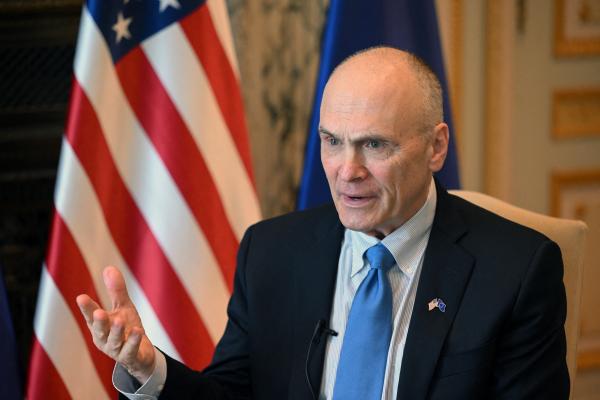
Join Hudson Institute for a conversation with US Ambassador to the EU Andrew Puzder and Senior Fellow Harold Furchtgott-Roth on America’s interests in reducing the harmful effects of CS3D and CSRD.