














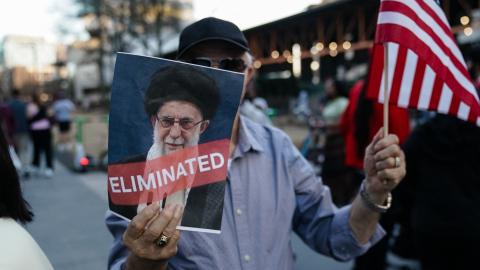
Black smoke rises from the rubble of Ali Khamenei’s compound in Tehran. Officially, the Supreme Leader’s fate remains unknown—no televised address, no formal communiqué, only Foreign Minister Abbas Araghchi’s cautious assurance that Ayatollah Khamenei and President Masoud Pezeshkian are, “as far as I know, alive.” Israeli intelligence, for its part, assesses that the opening strikes, launched by the United States and Israel this morning, likely killed the ayatollah.
Whether dead or sheltering deep underground, his status has changed irrevocably. He is now a target rather than a negotiating partner. President Donald Trump and Israeli prime minister Benjamin Netanyahu have moved from a strategy of coercion to one of decapitation.
Nevertheless, a clean and decisive American triumph is far from assured. Trump knows that America and Israel must brace for what could become, even without Khamenei, a prolonged and deadly conflict. “The lives of courageous American heroes may be lost, and we may have casualties,” the president warned in his Truth Social video announcing the launch of “major combat operations” against Iran.
Barack Obama once remarked that every president gets a single paragraph in the history books, and success lies in shaping it in advance. This war was not the paragraph Trump intended to write for himself. He envisioned himself as the peacemaker who ended “Biden’s wars,” avoided new entanglements, and forced adversaries to the table through leverage and negotiations.
Black smoke rises from the rubble of Ali Khamenei’s compound in Tehran. Officially, the Supreme Leader’s fate remains unknown—no televised address, no formal communiqué, only Foreign Minister Abbas Araghchi’s cautious assurance that Ayatollah Khamenei and President Masoud Pezeshkian are, “as far as I know, alive.” Israeli intelligence, for its part, assesses that the opening strikes, launched by the United States and Israel this morning, likely killed the ayatollah.
Whether dead or sheltering deep underground, his status has changed irrevocably. He is now a target rather than a negotiating partner. President Donald Trump and Israeli prime minister Benjamin Netanyahu have moved from a strategy of coercion to one of decapitation.
Nevertheless, a clean and decisive American triumph is far from assured. Trump knows that America and Israel must brace for what could become, even without Khamenei, a prolonged and deadly conflict. “The lives of courageous American heroes may be lost, and we may have casualties,” the president warned in his Truth Social video announcing the launch of “major combat operations” against Iran.
Barack Obama once remarked that every president gets a single paragraph in the history books, and success lies in shaping it in advance. This war was not the paragraph Trump intended to write for himself. He envisioned himself as the peacemaker who ended “Biden’s wars,” avoided new entanglements, and forced adversaries to the table through leverage and negotiations.
Trump has come to the same conclusion, as the smoke rising from the ruins of Khamenei’s compound in Tehran confirms. The operation signals a shared bet on leadership removal as the catalyst for change. The goal is a decisive shift in Iran’s strategic orientation: an end to its ballistic missile program, nuclear ambitions, proxy warfare, and domestic repression—all without the United States assuming responsibility for governing the country afterward.
In other words, Trump seeks an Iranian equivalent of what he carried out in Venezuela: applying force with precision to create conditions for Iranians themselves to overthrow or fundamentally reform the remnant regime.
That is a bold wager. The strategy deliberately seeks to create as many fissures as possible within Iran’s fractured power structure—pounding the regime’s coercive core while reassuring elements that could facilitate a post-Khamenei transition.
On one front, sustained U.S. and Israeli air strikes are hammering the regime’s coercive core—the Islamic Revolutionary Guard Corps (IRGC) and its paramilitary arm, the Basij, which enforces internal security and suppresses dissent. The targets include command centers, missile sites, surviving nuclear facilities, and leadership nodes. These strikes aim to degrade the regime’s capacity to crush opposition at home and project power abroad, gradually isolating the ideologically rigid revolutionary apparatus that has governed through repression for decades.
On another front, Trump and Netanyahu are actively courting internal pressure from below. Netanyahu’s address this morning was explicit: He spoke directly to the citizens of Iran, declaring them victims of the regime. He urged not just the Persians but also the country’s diverse ethnic communities—including Kurds, Azeris, Balochs, Arabs (Ahwazis), who together comprise more than half the population—to “cast off the yoke of this murderous regime” and build a “new and free Iran.” The message is unmistakable: The fight is against the ayatollah’s oppressive forces, the IRGC, and Basij.
Netanyahu also drew a crucial distinction between the Artesh, the conventional military, and the IRGC. It is a fascinating and revealing move. Since the 1979 Revolution, the regime has sidelined the Artesh, which it distrusts due to its origins as a professional, Western-oriented force loyal to the shah. By sparing it in strikes and publicly reassuring it, Trump and Netanyahu hope to fracture the regime without totally collapsing it. The calculation: With Khamenei eliminated, elements within the security services, potentially including Artesh officers, might step forward to stabilize the country and negotiate from a pragmatic position devoid of revolutionary dogma.
A source with intimate knowledge of the joint American-Israeli plan informs me that plans for the “day after” have long been in the works. Chances are good, he said, that when the guns fall silent, a unified coalition ready to take the country in a new direction will emerge.
In short, Trump seeks to hammer the enforcers and ignite popular unrest, while signaling a viable off-ramp for the regular military and, perhaps, elements of the IRGC willing to lay down their guns. If successful, the regime could transform itself without a total collapse of order and a descent into civil war.
There is a precedent. In 1999, the North Atlantic Treaty Organization’s’s 78-day air campaign against Slobodan Milošević degraded Yugoslavia’s military infrastructure and isolated the regime sufficiently to trigger internal political collapse. No NATO ground invasion followed. Airpower alone served as the lever for transformation.
But Kosovo worked under conditions that favored the attacker. Milošević was internationally isolated, economically strangled, and lacked escalation leverage beyond his borders. Iran is a different adversary.
The IRGC commands one of the Middle East’s largest ballistic missile arsenals, much of it dispersed across hardened underground complexes. It retains regional proxy networks capable of striking U.S. forces and allies.
Already, retaliatory barrages have targeted American installations and other sites in Bahrain, Qatar, the United Arab Emirates, Kuwait, and Jordan. The regime’s strategy is clear: regionalize the conflict, spike oil prices, inflict casualties, and force Washington to reconsider before internal conflict can do Trump and Netanyahu’s work for them.
Airpower alone cannot fully eliminate a dispersed missile network. If the conflict lasts long enough, and if the IRGC manages to launch enough missiles, American and Israeli interceptor stockpiles will grow thin. If oil markets convulse and American casualties mount, political pressure might rise in Washington. Much of Trump’s own domestic political coalition remains wary of foreign entanglement.
In other words, the IRGC is banking that it can weaponize time. In 1999, it took 78 days to break Milošević, and he was in some ways a weaker and more isolated leader. Iran’s regime is more entrenched, more ideologically hardened, and more capable of asymmetric retaliation. If the IRGC manages, against the odds, to maintain cohesion and suppress dissent, the conflict could grind down to another ceasefire, with an inconclusive ending. Trump and Netanyahu will have won the round, but the contest would continue.
Alternatively, if the coercive core fractures quickly, internal actors could accelerate collapse, and the country could descend into a complex civil war like the one that Syria recently experienced, with a weakened regime battling multiple militias that enjoy varying degrees of external support.
Trump is gambling that precision force can reconfigure the Iranian state without chaos. It is a high-risk strategy, but it has a realistic chance of succeeding. If the regime’s coercive core breaks but the state does not collapse, the result could be decisive and durable: a post-theocratic Iran, freer at home and less menacing abroad. If the core holds, the Islamic Republic will be gravely wounded, but its revolutionary flame will still flicker.
Either way, the paragraph Trump is now writing will not be the one he planned but the one history forced upon him—and upon the world.