













Hudson Institute Senior Fellow Can Kasapoglu examines what Taiwan can learn from recent conflicts in the Middle East and Ukraine as it prepares for potential confrontation with China.
Executive Summary
• China’s Taiwan options extend beyond invasion. Maritime coercion and blockade warfare remain Beijing’s most plausible escalation path due to their scalable and ambiguous nature.
• Taiwan should study—not imitate—the Islamic Revolutionary Guard Corps’ strategic logic. Taipei should pursue asymmetric concepts of operations and political warfare to stretch time, raise costs, and turn a local conflict into a global crisis.
• Taiwan cannot keep all sea lanes open during a blockade. Its aim should be to impose attrition on Chinese naval operations, logistics, trade, and supply chains, while increasing the People’s Liberation Army’s mission creep.
• Deterrence rests on three pillars: dense anti-ship missile architecture, Ukrainian-style artificial intelligence–enabled drone and uncrewed naval warfare, and deeper defense cooperation with partners.
• Taiwan cannot seek military parity with China. It should make aggression unbearably costly for Beijing politically, militarily, technologically, and economically, while leveraging its semiconductor dominance at the global scale.
Preparing for Conflict with China
Iran, Taiwan, and Ukraine exist in drastically different geopolitical, ideological, and military contexts. Iran is a revisionist theocracy, nowadays increasingly shaped by military-authoritarian rule under the Islamic Revolutionary Guard Corps (IRGC), pursuing a rogue nuclear program while driving a continental arc of instability across the Middle East and beyond. Ukraine is a frontline European state with a strong North Atlantic Treaty Organization (NATO) orientation in the post-Soviet landscape, fighting a large-scale war of national survival against Russian imperialism. Taiwan is a democratic island at the center of the technology-driven global economy, facing the Chinese Communist Party’s (CCP’s) expanding great-power ambitions and a growing threat of military aggression. Yet even though Taiwan and Iran are under different stages of pressure from military giants, both confront the same strategic question that Ukraine has faced for years: How does a materially weaker belligerent deny a stronger actor a quick, decisive victory?
While Iran’s actions across several decades have carried dangerous consequences for the Middle East and the world, Tehran’s posture in its conflict with the United States has been covert, high-risk, and—so far—relatively effective at staving off wholesale regime change. Iran’s IRGC has never sought battlefield dominance against superior US forces, but has sought to stretch time, raise costs, and escalate local confrontations into systemic risks by manipulating the flow of global commodities and maritime trade. Tehran has weaponized oil prices and turned the Strait of Hormuz into a strategic lever.
Ukraine, for its part, has built upon years of battlefield experience to scale an indigenous defense industry, producing asymmetric capabilities that are reshaping modern warfare. In particular, Ukrainian robotic naval systems have inflicted unprecedented losses on the Russian Black Sea Fleet, while first-person-view (FPV) drones, uncrewed ground vehicles, and deep-strike drone assets have transformed the economics and operational logic of the battlefield. Kyiv’s establishment of the Unmanned Systems Command, combined with the smart exploitation of combat data and rapid innovation cycles, has turned Ukraine into a laboratory for algorithmic and drone-centric warfare.
Facing the potential of coercion or invasion from the People’s Republic of China (PRC), Taiwan can draw lessons from Iran’s actions and Ukraine’s innovations despite the countries’ many differences. In particular, Taiwan should learn from, but not duplicate, the IRGC’s asymmetric warfare playbook. Ukraine offers some but fewer lessons because Taipei is only beginning to develop a defense-technological edge akin to that of Ukraine.
For one, Taiwan is still in the very early stages of building the combat-driven drone ecosystem that Ukraine forged through years of high-intensity war. Under its latest plan, Taipei aims to procure roughly 100,000 drones by 2028, including fewer than 50,000 locally produced military-grade systems. By comparison, Ukraine produced around 2 million drones in 2024 and around 4 million drones in 2025 alone. Kyiv has generated sufficient production capacity not only to sustain battlefield attrition, but also to train operators, refine concepts of operations (CONOPS), and build strategic stockpiles. Taiwan’s targets remain modest relative to the scale and intensity of a potential conflict with China, in which drone losses could reach thousands of systems per day in the opening phase of hostilities.
However, Taipei can internalize elements of Ukraine’s battlefield successes, along with aspects of the IRGC’s combat operations and political-military paradigm, to prepare for future conflicts across the Taiwan Strait.
Scenarios of Chinese Aggression
Any potential Chinese military action against Taiwan would be shaped by the convergence between Beijing’s intent and its capabilities. The PRC is increasingly frustrated with Taiwan’s drift away from the principle of unification, while China’s People’s Liberation Army (PLA) continues to rapidly modernize. These accelerating dynamics could compress the most likely timelines for conflict between the CCP’s China and Taiwan.
Drawing on open-source wargame scenarios, most major analytical works reduce Beijing’s likeliest courses of action against Taiwan to four primary approaches, with most contingencies falling somewhere within or between these: large-scale subversion, hostile quarantine, open blockade, and full-scale invasion driven by amphibious operations.
1. Large-Scale Subversion and Hybrid Warfare
China could pursue a campaign of large-scale subversion and hybrid warfare against Taiwan. This option would involve espionage networks, offensive cyber campaigns, and internal destabilization efforts. This hybrid pathway would owe much to the theories of former Soviet Committee for State Security (KGB) General Yuri Drozdov, whose eponymous “Drozdov binomial” posits that successful modern intelligence operations must combine deep-cover human intelligence (HUMINT) with special forces units engaging in combat, sabotage, or other disruptive activities. Notably, Drozdov served as the KGB resident in China in the mid-1960s, at the height of the Cultural Revolution and the subsequent Sino-Soviet split. Early indicators of a decisive Chinese subversive campaign against Taipei would include coordinated information operations, spikes in malign cyber activity, and influence efforts designed to fracture Taiwan’s political cohesion before any overt military moves are made.
2. Coercive Quarantine Under Civil Pretexts
Beijing could impose a quarantine under the guise of crisis management—for example, by invoking the threat of an epidemic, a biological incident, or related health emergencies. This approach could seek to normalize coercive control measures while avoiding the legal and political thresholds of conventional war, effectively blurring the line between the civil and military domains.
3. Gradual Escalation to a Maritime Blockade
China could escalate to an overt blockade, using naval and air power to interdict shipping, restrict airspace, and sever communications links between Taiwan and the outside world. Available writings suggest that this option has grown increasingly credible in the estimation of Chinese President Xi Jinping, who views it as ambiguous and scalable. With this option, Beijing could deploy the China Coast Guard (CCG) and Chinese Maritime Militia to lay siege to Taiwan and board or seize commercial vessels approaching or departing the island. The CCP could restrict trade with Taipei through incremental strangulation rather than with a decisive opening strike. Yet the effects of an overt blockade would be worldwide, particularly given Taiwan’s central global role in semiconductor production.
Chinese doctrine frames the blockade option as a graduated escalation involving a series of steps increasing in intensity: (1) start with non-kinetic boarding of merchant vessels, (2) move to submarine operations and naval-mine warfare, and (3) increase further to overt attacks on shipping before potentially expanding into wider war.
This option could have immediate impacts on Taiwan, which possesses a highly fragile energy profile that is heavily dependent on uninterrupted maritime trade and large-scale imports. With the shutdown of its last remaining nuclear reactor in 2025, Taiwan’s electricity grid is overwhelmingly reliant on imported fossil fuels, with natural gas and coal accounting for roughly 83 percent of the island’s power generation. Taiwan’s greatest resource vulnerability revolves around liquefied natural gas (LNG). While the country maintains substantial oil reserves, its projected LNG inventories in the event of emergency provide only a limited buffer that is measured in days rather than months. Because nearly all its LNG imports arrive by sea, primarily from Australia and Qatar, any blockade or disruption of maritime trade would rapidly threaten both Taiwan’s economy and its military’s resilience.
Taiwan’s economy depends on maritime trade to run efficiently. Merchant shipping would therefore become the focal point of any blockade. Airlifts, submarine resupply efforts, and relief initiatives via small craft cannot substitute for cargo vessels. Taiwan’s preparation for a possible blockade should accordingly focus on mobilizing its commercial fleets, securing its energy reserves, hardening its infrastructure, and establishing logistics hubs with its partners and allies.
Even with US engagement and support, accounting for Taiwan’s energy needs would be costly: its supply of LNG could run out in days, with oil and coal following over the subsequent weeks. A PRC-initiated blockade could prompt Taiwan and the United States to counter Chinese malfeasance according to their own escalation ladder—a structured, step-by-step framework used to manage, track, and respond to rising conflicts—that could result in constrained actions or more full-scale military engagement.
Worse, blockades rarely remain limited in scope even when they begin that way. Even the most calculated and reserved approaches to a blockade could generate political and military pressures toward further escalation. Taiwan could likely withstand non-military coercion, but if China deploys core PLA assets into the fight, Taiwan’s endurance would face severe strain without direct US engagement.
4. Full-Scale Invasion and Amphibious Assault
China’s most extreme option against Taiwan is a full-scale invasion aimed at attaining a decisive military resolution and political control of the island. A major Chinese attack on Taiwan would likely combine several operational pillars simultaneously: a joint blockade campaign that subsequently escalates to long-range salvos, amphibious assault operations, and extensive information warfare, or some hybridized combination of these approaches. In contemplating this extreme option, maps reveal what is perhaps Taiwan’s greatest advantage: the Taiwan Strait provides a natural defensive barrier to prospective invaders. Any Chinese invasion would require moving and sustaining large forces across roughly 90 nautical miles of contested water under sustained attack, while modern sensors and precision-strike systems would make amphibious warfare exceptionally difficult.
PLA doctrine, therefore, prioritizes cyber and information dominance in advance of any landing attempt. Most wargames scenarios predict that China would launch coordinated attacks designed to blind Taiwan’s sensors, disrupt its communications, and cripple its command-and-control (C2) networks. Beijing would likely then launch large-scale missile and air strikes against military and administrative targets across the island. Only then would amphibious and airborne assaults begin, with Chinese forces attempting to deceive Taiwan over the timing and location of any invasion while targeting the island’s airfields, infrastructure, and political leadership.
A 2023 defense-intelligence study by the RAND Corporation developed a framework to evaluate Taiwan’s capacity to resist a Chinese escalation over a 90-day period, the estimated minimum time the United States would need to mobilize sufficient forces for a large-scale and decisive intervention in East Asia. Within this 90-day period, Taiwan’s political authorities would strive to remain operational to preserve basic governing functions and maintain reliable communication and coordination with US and allied forces. Simultaneously, Taiwan’s military would attempt to rebuff Beijing’s attempts to overthrow the government or compel its capitulation on Chinese terms. Even under severe offensive pressure from the PLA, the ability of Taiwan’s armed forces to remain cohesive, stay organized, and continue resistance would have a decisive effect on the political leadership’s efforts to remain in power.
Iran’s experience in the current conflict highlights the importance of maintaining intra-elite and security-apparatus cohesion during hostilities. The relative resilience of the Iranian system under intense pressure from the United States and its allies has been only a partial reflection of Tehran’s military capabilities. In a broader sense, Iran’s resilience also reflects the durability of its security apparatus and its ability to maintain order under stress.
Taiwan, as a democracy at the center of the global economy, operates under different constraints than Iran. Taipei’s strength lies in its ability to innovate and in the capacity of its democratically represented population to endure disruption without fracturing politically.
What Taiwan Can Learn from the Conflicts in the Middle East and Ukraine?
Beyond highlighting the importance of maintaining intra-elite cohesion, Iran’s experience of the last several months—and Ukraine’s experience over four-plus years of war—holds several additional lessons for Taiwan as its leaders plan for any future conflict with Beijing.
1. Weather the Initial Shock
Almost all military campaigns begin with overtures of combat at a high operational tempo. Iran has demonstrated that the initial blow—no matter how precise or technologically advanced—does not always catalyze immediate strategic-scale state collapse. Despite sustained pressure on its missile and drone forces, its proxy networks, and the naval assets of its regular armed forces (or Artesh), the Islamic Republic has retained operational capabilities through the IRGC’s mosaic-defense order of battle augmented by decentralized provincial corps.
The implication of this dynamic for Taiwan is stark. Previous Hudson Institute writings have assessed that the PLA, despite the natural barrier that the Taiwan Strait provides, enjoys major geographic advantages in the event of any Taiwan contingency. Operating largely from the Chinese mainland, the PLA can pursue a counter-intervention strategy designed to delay or disrupt American and allied responses. Backed by an anti-access/area denial (A2/AD) approach, this strategy aims to persuade uncommitted regional actors that outside assistance would arrive too late or too little to be of any help to Taiwan—and that the damage inflicted by Chinese forces in the interim would be intolerable. US naval and air forces operating hundreds of miles from the region would need to detect, track, and engage an invading force with limited advance warning. Meanwhile, the PLA would retain numerous options to disrupt US kill chains with missile strikes, electronic warfare, deception, and layered air defenses. As per Taiwan’s Mainland Affairs Council, China’s aircraft carriers might also take part in a possible campaign.
In a scenario involving all-out war, China’s opening moves would likely rely on precision strikes, decapitation attempts on key political and military chains of command, and information warfare designed to paralyze decision-making. Taiwan’s resilience—political as much as military—will determine whether any potential conflict remains a brief shock or evolves into a protracted crisis. This resilience demands distributed command structures, redundant communications, hardened infrastructure, and mobile air defenses. It also requires planning for degraded conditions: damaged ports, cratered runways, and disrupted energy grids.
Taiwan’s objective in the event of conflict would not be to defeat an initial assault outright but to absorb it and continue functioning.
2. Deflect a Blockade
Taipei can also learn from the ongoing conflict in the Middle East by studying blockade dynamics. For China, launching a full-scale amphibious invasion against Taiwan without the necessary preparation is a high-risk strategy. As previously elaborated, quarantine or blockade—maritime, aerial, or informational—is a more plausible option for Beijing. This option allows the PRC to apply pressure incrementally while managing escalation, strangling the Taiwanese economy, and eroding Taiwan’s political and military resilience. Even if Beijing does opt to launch a full-scale invasion, a blockade will likely serve as the opening stage of such an effort.
Therefore, Taiwan’s leaders need to study the Strait of Hormuz. Iran has long understood that it cannot fight the US Navy and Air Force and win decisively. Instead, it has opted to employ disruptive tactics, using mines, anti-ship missiles, fast boats, and drones to raise the cost of maritime activity through the strait. The result for the important waterway has not been outright closure, but pervasive uncertainty. Insurance premiums have risen. Shipping routes have shifted. Markets have reacted on a global scale. The United States can still fight on and win the war in the Middle East, but at a higher economic, material, and diplomatic cost than it once foresaw.
Taiwan can similarly change the CCP’s calculus of projected costs and expected gains as Beijing weighs the pros and cons of a military action. In the event of a blockade, Taiwan’s goal should not be to reopen every sea lane by force, but to sow uncertainty in China’s own economy by ensuring that Beijing cannot geographically contain the effects of any crisis.
The Taiwan Strait, a major artery for the global economy, hosted roughly 21 percent of the world’s maritime trade in 2025, more by some measure than the Strait of Hormuz. Data from the Center for Strategic and International Studies (CSIS) suggests that in 2022 roughly $2.45 trillion in goods—over one-fifth of global maritime trade—passed through the Taiwan Strait. China alone accounted for approximately $1.4 trillion of that flow, highlighting Beijing’s heavy dependence on uninterrupted access to the corridor.
Moreover, one-third of China’s imports transit the strait, including oil, coal, natural gas, and key industrial inputs, and more than half of all voyages through the strait move between Chinese ports. Any major disruption to the Taiwan Strait would therefore not only damage China’s own trade prospects but also strain its supply chains, impede its energy distribution efforts, and slow its industrial production.
If blockaded, Taiwan should focus on imposing systematic attrition on Chinese naval operations, trade, merchant shipping, maritime insurance, and supply chains. Taipei’s defensive campaign should strive to maximize the CCP’s operational and economic troubles, as well as the PLA’s burden of growing mission creep.
3. Employ Asymmetric Capabilities
At every stage of a PLA campaign against the island—from the initial crossing of the strait to the attempt to establish a beachhead on land—Taiwanese forces could employ layered missile strikes, drones, loitering munitions, naval mines, and multidirectional fires to attrit Chinese invasion formations before they establish a sustainable foothold.
Indeed, Taiwan possesses asymmetric military capabilities that can threaten Chinese activity throughout the region. From 1,000 indigenous Hsiung Feng II and Hsiung Feng III missiles, to the hundreds of Harpoon systems Taiwan expects to receive from the United States by 2028, the island will soon field an arsenal of roughly 1,400 anti-ship missiles—one of the densest concentrations of anti-ship missiles in the world.
Recent developments in robotic warfare could also benefit Taiwan. The pace and scope of battlefield innovations in the Russia-Ukraine War suggest that naval warfare is changing fundamentally. In the Black Sea, Kyiv’s drone-centered campaign has forced a larger Russian fleet into a defensive posture and has helped Ukraine restore its maritime exports. Ukrainian uncrewed surface vehicles (USVs) carrying air-defense weaponry have even downed manned Russian aircraft.
The implications of these developments for Taiwan are significant. Despite geographic differences, both Ukraine and Taiwan face a major imbalance in conventional naval capabilities against larger revisionist powers. Ukraine has offset this imbalance by deploying low-cost, uncrewed systems integrated with conventional strike capabilities. Taiwanese deterrence will increasingly depend on similar innovations, especially on scalable autonomous systems capable of threatening Chinese warships, ports, and logistics across the strait.
Integrated into a broader porcupine strategy where Taiwan defends itself with a large number of small weapons systems, these new technologies could complicate Chinese blockade operations, slow amphibious assaults, and deny Beijing uncontested maritime dominance. One study has even proposed mimicking the Australia–United Kingdom–United States (AUKUS) security partnership into another coalition focused on emerging defense technologies that involves Taiwan and Ukraine. Such a partnership would enable Taiwan and its regional partners to cooperate on the development and deployment of robotic warfare systems designed to deter Chinese maritime coercion.
Ukrainian uncrewed surface vehicles, small explosive-laden craft equipped with cameras, have also entered the battlespace fast. In many cases, these craft are simple enough to be assembled in garages rather than in major shipyards. The USVs are critically enabled by resilient two-way satellite connectivity, including by systems such as Starlink. These networks allow operators to navigate and target remotely throughout a mission. Human-in-the-loop control, which provides USVs with greater adaptability and quicker deployment than fully autonomous systems, has also been a valuable innovation. Ukraine has increasingly explored augmenting its USVs with automated capabilities, particularly in the final attack phase where electronic warfare can disrupt communications. Across all these innovations, reliable connectivity has remained the foundation that enables rapid operational deployment.
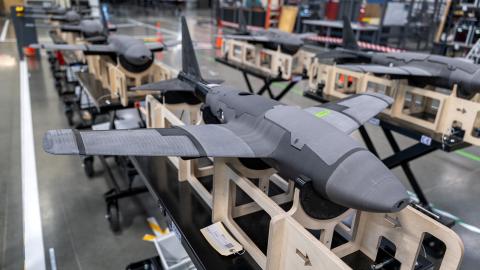
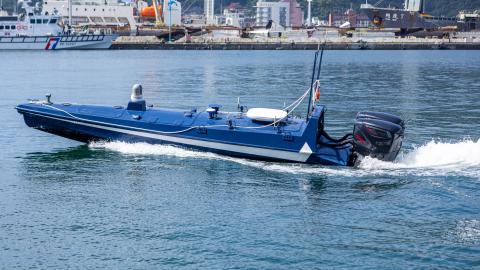
Inspired in part by Ukraine’s Black Sea operations, Taiwan has accelerated the development of its own indigenous uncrewed naval systems in the face of mounting pressure from China. The most prominent of these are weaponized USVs modeled on Ukrainian platforms such as the Magura V5.
One leading Taiwanese design is the Kuaiqi USV, developed by Lungteh Shipbuilding. First demonstrated publicly in 2025, the platform reflects the lessons of the Black Sea theater: it is compact, low-cost, and optimized for littoral strike missions. Some variants of the craft reportedly combine explosive bow charges with quadrotor drones and loitering munitions. Taiwanese defense industries are building more than 1,300 uncrewed naval platforms from the Kuaiqi USV baseline, while developing further technologies empowered by artificial intelligence.
Taipei’s broader shift toward asymmetric systems is also evident in the Endeavor Manta drone boat program, recently unveiled by Taiwan’s CSBC Corporation. Designed for a Taiwan Strait contingency, this USV integrates AI-assisted targeting, swarm functionality, and resilient multi-channel communications. CSBC statements indicate that the platform is so advanced that a single control station could coordinate dozens of vessels simultaneously.
The operational logic behind the drone boat revolves around small, mobile, and easily concealed platforms that could launch from minor ports, beaches, or coves across Taiwan’s jagged coastline. Integrated into a broader porcupine strategy, these asymmetric systems could provide a scalable way for Taipei to complicate Chinese amphibious operations and impose disproportionate attritional costs on Beijing at relatively little expense.
Taiwan is also learning from developments in FPV drone systems. Swarming FPV concepts could ease Taiwan’s manpower disadvantage against large Chinese combat formations. Since Ukraine is on its way to becoming a security provider rather than a mere recipient of aid, and is now helping Gulf Arab states defend against Iranian drones, extending Kyiv’s critical know-how to Taiwan despite a complicated diplomatic landscape is within the realm of possibility.
To strengthen its deterrence of a potential attack from Beijing, Taiwan should continue to build one of the world's densest anti-ship missile deterrents. Taipei should also accelerate the development of Ukrainian-inspired uncrewed surface vessels and AI-enabled drone-swarm systems as well as deepen defense cooperation with current and prospective partners despite ongoing diplomatic challenges.
4. Leverage Economic Power at Scale
Iran’s strategic weight derives less from its military power than from its ability to threaten global energy flows. Taiwan possesses a different but equally potent lever: it dominates the global manufacturing of advanced semiconductors, a critical node in the global technology ecosystem. Any disruption to this supply chain would reverberate across countless industries, from automotive production to artificial intelligence.
The global economic consequences of any Taiwan crisis could exceed those stemming from the ongoing shockwaves emerging from the Strait of Hormuz. Significant disruption to Taiwan’s semiconductor trade would generate cascading global effects. Unlike hydrocarbons such as oil and gas, semiconductors cannot be easily stockpiled or rapidly substituted. Shifting to alternative chip suppliers, moreover, often requires redesigning software architectures, reconfiguring certification processes, and shifting production chains—adjustments that can take months or years. As a result, a major Taiwan contingency would likely trigger not merely a supply shock, but a systemic technological and industrial disruption across the global economy.
Taiwan’s response to China would not bring physical closure of the strait but would enhance Beijing’s systemic risk. If China moves, Taiwan should ensure it communicates to the global strategic community that the consequences of its aggression would extend beyond the immediate theater. According to economic projections, a Chinese air and sea blockade of Taiwan could trigger a roughly five percent contraction in global gross domestic product, comparable to the economic shocks of the 2008–09 global financial crisis and the COVID-19 pandemic. Should the crisis escalate into direct conflict between the United States and China, the global economy could shrink by nearly 10 percent. This underscores how a Taiwan conflict could rapidly evolve from a regional security crisis to a systemic shock to the global economy.
Taiwan, in coordination with its partners and allies, should therefore develop contingency frameworks for the disruption of its semiconductor industry, including controlled production shutdowns, data and personnel relocation, and coordinated export restrictions. Taipei should also work with allies to plan financial and insurance responses that would raise the cost of Chinese maritime activity.
To understand Taiwan’s ideal political-military posture, it is crucial to recognize its unique strengths. Instead of trying to achieve an all-but-unattainable military parity, Taiwan should focus on making a significant move unbearable to Beijing, while leveraging its position at the heart of the global semiconductor ecosystem.
5. Shape the Political and Narrative Environment
Taiwan should expand the domain of contestation beyond the immediate battlespace. Iran has repeatedly demonstrated an ability to operate in the so-called gray zone, below the threshold of full-scale war but above that of mere signaling. Tehran has harassed shipping, calibrated its attacks, and made use of its regional proxies.
Though Taiwan operates in a different context than Iran, it can still apply the appropriate lessons from the ongoing conflict in the Middle East. This does not imply offensive escalation in the traditional sense, but a political warfare effort aimed at shaping the narrative and the economic environment of any engagements with Beijing.
Taiwan should quickly identify any Chinese action as a threat to global stability, not merely a regional two-way dispute. This would require coordinating its diplomatic efforts with the United States, Japan, the European Union, and key Southeast Asian actors.
Conclusion
Taiwan cannot and should not seek to mirror Iran’s strategy and cannot yet replicate the full scope of Ukraine’s innovations. The three countries and the situations they confront differ too fundamentally. But Taiwan should adopt key lessons from the underlying dynamics that have allowed Iran and Ukraine to endure thus far: survive the initial shock, deny a superior opponent a quick and clean victory, use asymmetric weapons and CONOPS, control the political-warfare narrative, and expand the conflict’s economic consequences beyond the immediate battlefield.
In practical terms, this means that Taiwan should design a defense posture oriented toward persistence rather than toward bare-minimum military parity. Taipei should prepare for a blockade and integrate economic strategy into its defense planning. Most important, Taiwan should ensure that any Chinese attempts at coercion trigger financial, technological, and political effects that Beijing cannot easily control.