




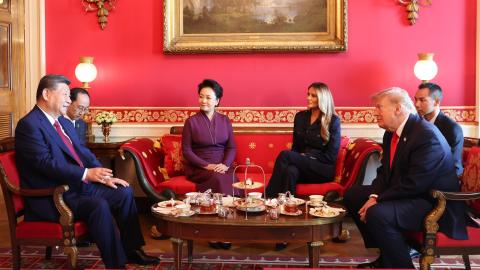




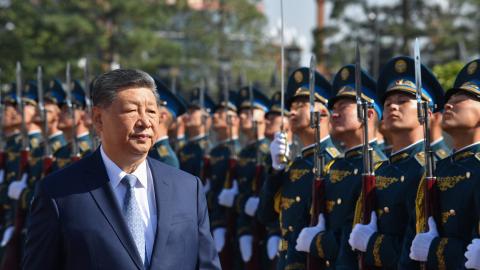



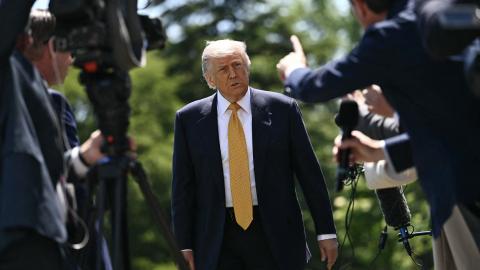
Taiwan has been at the top of the summitry list for Chinese leaders going all the way back to 1972 when Richard Nixon shocked the world and went to China, sitting down with Mao Zedong. Today is no different. The CCP still views Taiwan as unfinished business. That existence, particularly as a democracy, is an affront to the CCP’s primary propaganda line that it is the only political entity capable of governing the Chinese people.
Xi’s modern tactic is one of full-scale isolation—economically, diplomatically, and militarily. It’s not just isolation from the outside world. Xi wants the Taiwanese people to feel isolated and to convince them that the U.S. is not going to do a thing to save them if the day ever comes when the PLA invades. He wants Taiwan to believe that they are alone, and he wants the whole world to believe that Taiwan is isolated without any true friends.
As things stand today, there are generally three categories of effective deterrence keeping Xi from making a play for Taiwan. Number one is U.S. military might and deterrence, which has been on full display during the Trump administration. The second is China’s exposure and economic dependence on the rest of the world, and how it would be susceptible to crushing sanctions in the event of an invasion.
We have this huge debate in Washington about how we should decouple or de-risk critical sectors from China. While we wring our hands, China is moving at full speed to separate its economy from the free world’s economy. Xi is doing that because if the day ever comes when a conflict over Taiwan arises, he doesn’t want to be vulnerable and exposed to Western sanctions.
And the third is the readiness of the PLA. Right now, most of the war games out there say that the U.S. can prevail in a conflict over Taiwan, but at a significant cost. The war games are demonstrating pretty bleak scenarios for the U.S.
One thing that needs to be noted about this summit is the C-suite delegation traveling with President Trump: executives from Apple, Boeing, Citigroup, Goldman Sachs, and more. It’s very notable that Jensen Huang of Nvidia is not on this list. Huang has been vocal in his desire to sell the advanced Nvidia chips to China because it is a reliable revenue stream.
Huang’s absence signals that we shouldn’t really expect any significant concessions from the U.S. on export control policy for advanced AI chips, one of the fiercest debates over China policy. Elon Musk’s attendance is also something to watch. Musk has a history of being a public interlocutor for a lot of CCP positions. He has referred to Taiwan as “a part of China,” and has reportedly raised questions about the veracity of the Uyghur genocide.
Trump wanted to go to China with the Iran war settled. It’s possible that he asks Xi to help convince Iran to reopen the Strait of Hormuz, which gives Xi a lot of leverage. If Trump asks for help, it would be the same mistake that Joe Biden made with China in late 2021 when the U.S. government was increasingly concerned that Putin was preparing to invade Ukraine.
Officials asked the Chinese to help us convince the Russians not to do this, and then the Chinese were entirely unhelpful. They shared that conversation with the Russians instead of convincing them not to invade. It’s kind of ironic that Trump risks falling into the exact same mistake that Joe Biden did with China.