













Adm. Brad Cooper, commander of US Central Command, last week announced Task Force Iron Gate, a new initiative designed to disrupt the movement of illicit goods across Iran’s land borders and the Caspian Sea. It complements the existing US naval blockade of Iranian ports.
But implementing Iron Gate will be no easy task, given the sheer length of Iran’s borders and the region’s difficult terrain and geography. Iran shares land borders with Iraq, Turkiye, Armenia, Azerbaijan, Turkmenistan, Afghanistan and Pakistan, totaling about 5,900 km. That is greater than the straight-line distance between Dubai and London.
Yet Cooper specifically included the Caspian Sea in the initiative. Notwithstanding the remote and porous sections of Iran’s land borders, especially with Afghanistan and Turkmenistan, stopping illicit shipments through Iranian ports on the Caspian will likely prove the greatest challenge.
The Caspian Sea is the world’s largest landlocked body of water, situated between Europe and Asia. Four countries besides Iran have coastlines on the Caspian: Azerbaijan, Russia, Kazakhstan and Turkmenistan. It is a resource-rich region holding large deposits of oil and gas. In recent years, the Caspian has been central to the Middle Corridor — an emerging east-west transport route on the Eurasian landmass.
At the heart of the challenge is the fact that Iran and Russia have used the Caspian to transport goods for years, including shipments that circumvent international sanctions. Following Russia’s large-scale invasion of Ukraine in 2022, the strategic importance of the Caspian grew considerably. Yet it was not until Operation Epic Fury that policymakers, especially in Washington, began paying renewed attention to the Caspian’s role in Iran’s military supply networks.
For Washington, the Caspian represents the place where two separate geopolitical challenges meet: the war in Ukraine and the war with Iran. During the early stages of Russia’s large-scale invasion of Ukraine in 2022, Iranian drones and other munitions reportedly crossed the Caspian to Russia. There have also been reports of oil shipments and other commercial exchanges intended to bypass sanctions. More recently, Russia has used the same route to provide assistance to Iran.
Although Washington’s focus has intensified recently, Ukraine and Israel were quicker to recognize the strategic importance of the Caspian Sea.
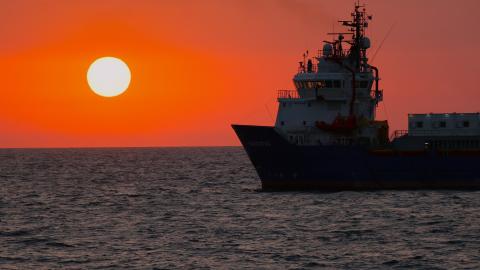
Over the past two years, Ukraine has launched a series of attacks against Russian military and logistical assets in the Caspian region. In August 2025, Ukrainian forces struck the Russian cargo vessel Port Olya-4 at the port of Olya, which Kyiv said was transporting Iranian weapons. In July, Ukraine also struck an Iranian vessel reportedly involved in transporting military cargo to Russia.
Meanwhile, during the early weeks of Operation Epic Fury, the Israeli air force carried out major strikes against Iranian naval vessels and infrastructure at Bandar Anzali on the Caspian coast. While this strike has had a significant impact on Iran’s ability to transit the Caspian, it has not stopped it altogether.
Today, the Caspian remains an important potential outlet for Iran to circumvent the US naval blockade.
Admittedly, American options in the region are limited. The US navy cannot operate in the Caspian as it is landlocked.
Recognizing the Caspian’s importance within Iron Gate is therefore a welcome step. But it must also encourage American policymakers to think creatively.
First, for too long, the Caspian Sea has been a bureaucratic black hole in US policymaking. Different bureaus within the State Department, the National Security Council and the Pentagon have responsibility for different Caspian littoral states. Consequently, Washington’s approach to the region has rarely been fully joined up.
The Trump administration should appoint a special envoy for the Caspian region. This official could serve as a single point of contact for regional governments seeking to engage Washington, while also coordinating a coherent American approach across the federal government.
Second, since the US navy cannot operate there, Washington should strengthen the maritime security capabilities of friendly regional partners, particularly Azerbaijan and Kazakhstan.
After the Sept. 11, 2001, terrorist attacks, the US launched the Caspian Guard initiative in 2003 to improve maritime security, surveillance and border protection capabilities in Azerbaijan and Kazakhstan. However, this was led by US European Command instead of CENTCOM and the initiative eventually lost momentum. CENTCOM should consider establishing a renewed Caspian Guard initiative in response to today’s strategic environment.
During Vice President J.D. Vance’s visit to Baku in February, he announced that the US would provide Azerbaijan with new boats to help protect its territorial waters. This was a welcome start and should be built on with additional maritime surveillance, coastal radar and joint training initiatives.
However, as Washington develops its Caspian policy, it must recognize that regional countries constantly balance competing relationships, including with Iran and Russia.
Sandwiched between these two powers, they understand very well the geopolitical threats posed by Moscow and Tehran. Yet they are also mindful of their geographical proximity, historical connections and regional economic relationships. Maintaining cordial relations with their neighbors remains a reality, even when they seek closer ties with the West.
Consequently, as CENTCOM implements Task Force Iron Gate, it must develop a bespoke approach to the Caspian. The objective should be to prevent Iran from exploiting the sea lanes for sanctioned and military-related shipments without forcing regional partners into an impossible geopolitical choice.
This will be easier said than done and will require diplomacy, intelligence cooperation and even military hardware assistance at levels not seen in the region in more than two decades. But if the Trump administration is serious about maintaining maximum pressure on Iran and reinforcing the existing naval blockade, the Caspian Sea cannot be ignored.