















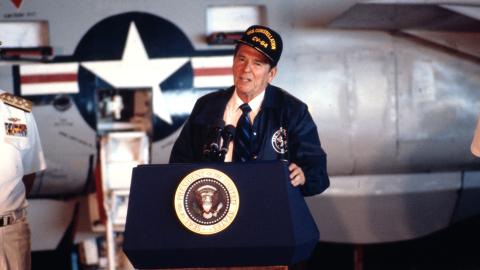
Despite being hectored by populists about “zombie Reaganism,” Republicans, including President Donald Trump, still claim Reagan’s “peace through strength” mantra. We could use more Reaganesque statecraft today, as well as a renewed appreciation for how much we continue to rely on the military buildup that Reagan had the foresight and focus to effect.
Roger Zakheim’s new book, Peace Through Strength, offers a just-in-time primer on how Ronald Reagan led and sustained the military buildup that facilitated the U.S. victory in the Cold War and how it continues to underpin U.S. power today. Zakheim plumbs the archives for new treasures and vignettes to bring to the page. He has spent his career not as a historian, though he clearly is a student of history, but as a defense policymaker and political operator who understands the importance of persuasion. He knows how a presidential administration can work with (or against) Congress because he spent years as a senior aide on the House Armed Services Committee, the committee charged with passing the National Defense Authorization Act. Congress used to muster the bipartisan grit to pass that bill annually, but since 2018 it has been unable to do so without a stopgap continuing resolution.
Zakheim has a special appreciation for the focus and political capital that President Reagan devoted to bringing Congress, allies, and the American public around on his peacetime military buildup. Many historians have praised and documented Reagan’s diplomacy and his work to avert major war with the Soviets. But Zakheim notes that historians have perhaps not fully explained how the massive arms buildup itself made Reagan’s diplomacy so effective. Before there could be arms caps and reductions, their antecedent had to be built. And that buildup was far more than rhetoric, more than contracts without appropriations: it was bent metal, roaring production lines, planes, ships, and munitions.
Zakheim writes:
The impact of the Reagan military buildup did not end when the Berlin Wall came down. Every president since Reagan has either used the military he built or sought a peace dividend from it. George H. W. Bush deployed it in 1989 during Operation Just Cause in Panama, and then again in 1991 during the First Gulf War. Bill Clinton used it sparingly yet fatefully in Yugoslavia and Somalia, while cashing in on a peace dividend by significantly reducing the size of the military and the defense industrial base. The latter decision continues to haunt the Pentagon today. Under Presidents Bush, Obama, and Trump, the military went to war for twenty years in Afghanistan and Iraq using technologies that Reagan’s team built. Reagan’s military remains on the front lines deterring China in Asia and Russia in Europe, and at the time of this writing, is making significant contributions to US military operations against Iran.
The HIMARS that Ukraine so desperately needed and that President Biden sent to stave off Russian advance? Thank the Reagan buildup. Those B-2s that President Trump ordered to stealthily soar over 32 hours from Missouri to Tehran in Operation Midnight Hammer to render Iran’s nuclear sites inoperable? We would not have those bombers without the Reagan buildup. The regional missile defense systems such as THAAD and Patriot that have defended American air bases and are in high demand all over the world? We would not have those had it not been for the Reagan buildup. The same goes for the Army’s tanks and most of our aircraft carriers: six of the eleven were either commissioned or ordered by Reagan.
On the one hand, it is breathtaking to see what President Reagan was able to orchestrate, as it took the coordination of so many players to bring the buildup to fruition. On the other hand, lest we spend too much time admiring the accomplishment, we should also realize that our current military is outmoded. The Department of Defense is talking a lot about rebuilding the defense-industrial base, and, while it is making progress, we have yet to see a real mobilization. The Trump administration’s request for $1.5 trillion in defense spending for fiscal year 2027, at roughly 5 percent of GDP, is a promising start, but Congress has not funded it, nor is there real pressure from the public for Congress to do so.
According to polling, the American people do not fully grasp that the United States is in another cold war. Only about 54 percent of adults have a critical view of the Chinese Communists, down from 68 percent in 2021. We are trending the wrong way. Not only is China backing the aggressors currently at war with the West, it is also rapidly expanding its nuclear forces to reach quantitative parity with U.S.-deployed warheads. The Trump administration, meanwhile, just like its predecessor, has not offered a coherent and constant message about the nature of the threat. There was nary an explanation of China’s massive military buildup in the second Trump administration’s National Security or National Defense Strategies — the two documents meant to organize the country’s response to such threats. China’s decision to withhold critical rare earth exports to the U.S. at the dawn of Trump’s trade war has caused something of a tactical détente between the adversaries. But this muted public rhetoric in the U.S. — combined with decisions to halt weapons deliveries and to scale back joint military exercises with and diplomatic support to democratic Asian allies — sure seems like appeasement.
Americans tend to dislike weakness. Zakheim details how Reagan tapped into this sentiment: Americans, Reagan said, were concerned about “our waning prestige in the world; about the neglect of our military strength” and “our utter failure to get America’s message to the rest of the world.” In a meeting during his campaign, he charged his foreign policy and defense advisers to “develop better policies in order to cope with the dangers and crises which confront the United States.” He added, “Our nation’s own history gives us a sense of pride and confidence. Pride in America and confidence is what we need to face the future.”
Of course Reagan was always willing to engage with adversaries and to make deals, but only after he was confident in the deterrent effect of the American military. He would not make concessions in exchange for promises of goodwill. Zakheim writes:
Reagan was buttressed by a resurgent American economy coupled with modernized conventional military strength from the buildup. With the Soviet economy buckling and the Red Army struggling to keep pace, Reagan could confidently negotiate from a position of strength. His fortitude in the face of ceaseless pressure to cave to Soviet demands ultimately paid dividends: the unprecedented elimination of an entire class of nuclear weapons and restoration of a margin of safety in Europe. It was, perhaps, Reagan’s purest application of his peace through strength program.
In some ways, today’s domestic challenges are similar to those Reagan faced: wariness of military adventures without a clear and achievable aim, skepticism of experts and politicians, and a populist energy that must be channeled into constructive change for the betterment of the American working class. But the external threats to this country are even more complex than those of the first Cold War. We have two nuclear powers to deter, China and Russia, along with North Korea and a weakened (but still dangerous) Islamic Republic of Iran. As Zakheim recalls, Reagan’s critics called him a warmonger, a militarist, and a wasteful spender. But Reagan knew that American sovereignty and our way of life were at stake. He could have done what President Jimmy Carter did and cut, or neglect, expensive defense programs when there was domestic political opposition. He could have retreated and accommodated the enemy.
Reagan stayed the course, inspired a nation and its all-volunteer fighting force, and built the world’s greatest military. He reminded the world why it’s for the best when America leads. And he defended the peace — a peace that is at risk and needs to be defended once again.