
















It is never a wise idea to write about historical events as they unfurl, but with much of France in flames, and pockets of Europe catching fire as well, two urgent questions emerge: Why is this happening? And how can we stop it?
These questions, sadly, are not for our brothers and sisters across the pond to ponder alone. Even without a full understanding of the conflagrations in Paris, Marseilles, and Milan, it’s not difficult to realize that the same chaos may trickle over the Atlantic to Manhattan, Minneapolis, or Malibu. Maybe not soon, and maybe not as forcefully, but in a globalized world, poison travels quickly through our collective bloodstream.
What, then, is going on?
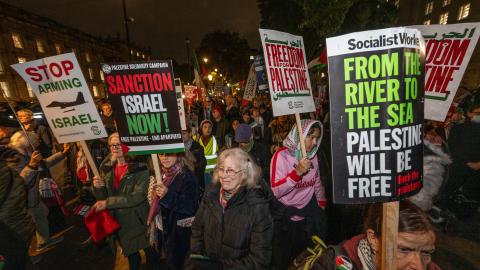
Our best available answer at the moment goes something like this: A coalition of almost five dozen organizations is orchestrating large-scale riots across France. Their purported rationale—students are frustrated with the nation’s educational system—is secondary, at best, as excuses for revolutions have been since at least the storming of the Bastille. The organizational affiliations of those in the streets matter more: The driving force behind the riots, we know, is La France Insoumise, the radical left-wing party led by the pro-Putin, pro-Hamas socialist Jean-Luc Mélenchon. And the party, recent reports show, is joined by a ragtag assembly of radical leftist and third-worldist groups, including several pro-Palestinian organizations. Moreover, the rioters they’ve recruited appear to consist largely of the children and grandchildren of immigrants from Muslim and African nations.
Why are they eager to burn it all down? Radical Islam plays a part here, but not in the way most of us Americans think. Last November, the French Institute of Public Opinion released a survey showing that 38 percent of French Muslims endorse fundamentalism, double the figure recorded in 1998. It also found that 57 percent of young French Muslims aged fifteen to twenty-four believe Shari’a law should be applied in France. But Islam, the survey’s editors suggest in their notes, is perceived primarily as an identity marker, not a belief system. The young, in other words, are rushing to identify as fervent Muslims mainly as a way of not identifying as French.
It makes sense. Sometime in the late 1970s, the formerly prosperous nation began sliding toward socialism, a process that reached its peak with the 1981 election of Francois Mitterrand. Mitterrand, who would go on to hold the office of president for longer than any other man in the republic’s history, rose to power based on the popularity of an agenda called “110 Propositions for France.” These included a thirty-five-hour workweek, five guaranteed weeks of annual paid vacation, and other measures designed to roll back capitalism. To make sure the economy didn’t collapse under the weight of these policies, France needed cheap labor, which it found right under its nose in the masses of migrants already living in the country. During Mitterrand’s first year in office alone, his government regularized more than 130,000 foreigners. It also passed a host of laws making family reunification much easier and ended the sensible practice of tying work permits to the needs of the labor market.
For a while, this arrangement worked somehow. But the French never cared too much about the foreigners they were absorbing—and cared even less about their children. For the most part, the neglect meant cramming them into their own neighborhoods and making little effort to instill in these second- and third-generation French citizens a love of France. It’s not too hard to understand, then, why these forgotten French are now responding enthusiastically to the left’s invitation and rushing to its orgy of violence and destruction. And it’s not hard to see disgruntled young Americans, many of them also the children and grandchildren of immigrants and raised on a steady diet of 1619 Project–style anti-Americanism, flirting with the same disastrous inclination.
Which leads us to our second question: What happens now? As European nations contemplate this conundrum, they will realize that the traditional arsenal democracies apply in self-defense simply won’t work when it comes to homegrown hoodlums. France cannot, for example, deport the thugs who defaced its monuments, looted its stores, and desecrated its synagogues and cathedrals—they are its citizens. Nor should it instruct its police to quell the violence by any means necessary. As we’ve seen time and again, each martyred marauder recruits newcomers to the cause. Authorities live in fear of the next George Floyd. And surrendering, naturally, is not an option either.
The republic can, and should, restore law and order judiciously and swiftly while avoiding needless casualties. It can, and should, contemplate measures like Denmark’s “parallel society” laws, designed to cap the share of low-income, non-Western residents in housing projects. But above all, it can—and must—stand up and fight for France.
And just what is France? That is the real question at hand. If France is nothing more than a pleasant and tepid brew of secularism and socialism—a beneficent distributor of goodies—there’s little reason to believe anyone will rush to its defense anytime soon. But if it is Balzac and Flaubert and Proust, Renoir and Degas and Monet, the Declaration of the Rights of Man and of the Citizen, the great and mighty engine of so much of European and Western civilization—then it has something to fight for, and not only stories past to preserve, but a glorious future to imagine as well.
In his darkly prophetic novel Submission, the French writer Michel Houellebecq imagined a France not very different from the one we see today, in which the Islamists have taken over. The novel’s protagonist, a college professor, is given the choice to convert to Islam or forfeit his academic career, while his girlfriend, a French Jew, decides to move to Israel. The professor is tempted to join her but then decides against it, saying, “There is no Israel for me.”
But as Alana Newhouse argued recently in Tablet Magazine, there is an Israel for Houellebecq’s beleaguered professor—it’s France, and he should fight for it. This, Newhouse suggests, is why all Europeans need a strong dose of that great technology for national renewal: Zionism. Because Zionism, she explains, isn’t just for Jews. Zionism is for everyone, because Zionism, in Newhouse’s reading, is a mix of cultural particularism, tough-minded pragmatism, and an almost unfathomable light-unto-the-nations idealism: a perfect prescription for creating and maintaining future-oriented societies that use their past as fuel to continue and thrive.
France should pay attention. So should America and every other Western nation eager to avoid getting sacked by the barbarians, who are not only at the gates but in the streets and on the ballots as well. To survive assaults like the one currently unfolding in Paris, and to propel ourselves toward brighter horizons, we need only follow Newhouse’s three-tiered proposal.
First, celebrate cultural particularism. Spend time and great resources defining and defending what is specifically yours. Reject the nebulous nonsense of multiculturalism, which argues that all cultures are alike and therefore none stands above the rest. Celebrate your heroes, your masterworks, your defining moments. Resist the demoralizers telling you that your Founding Fathers were ignoble, or that you oughtn’t read the classics because their authors aren’t diverse enough. Demand that every school receiving public funds graduate children who know and love the traditions and achievements of their homeland.
That’s not a hard goal to achieve. Neither is proposition number two, the one involving being tough and pragmatic. How many immigrants, for example, should we let in? Only as many as we absolutely need and can reliably assimilate. And which ones should we welcome? Only the ones who celebrate our culture and are eager to become a part of it. Any other approach—arguing, say, for open borders, or insisting that we have some sort of moral obligation to embrace anyone on earth claiming to be the victim of persecution—is madness.
Finally—and this is crucial—we must be relentlessly idealistic, which means spending our time not weeping for some yesterday, real or imagined, but working assiduously toward a rosier tomorrow. Wild-eyed idealists don’t sit at home and mope, claiming to be victims of some far-reaching and unstoppable plot. They’re not doomers, and they sure don’t riot. They build companies, have children, solve real-world problems, and go to bed each night convinced that things can only get better.
This spirit is already working very well in Israel, where, despite real challenges, the birth rate is high, the people are happy, and the productivity is commanding. The same spirit is also innate to America, a perpetually passionate nation that willed its way into orbit once, and now, thanks to the miracle workings of SpaceX, is doing it again. It’s time for Europe to follow this recipe for rebirth—or face a sad and strange demise.