









Vladimir Putin’s ambitions are dying in Africa. As jihadists swept through Mali late last month, they also swept aside the assurances that Moscow had dangled to governments in the Sahel for years. That collapse threatens the region but also offers Washington an opportunity to reassert the control it had foolishly relinquished.
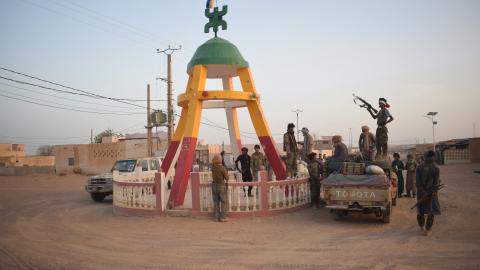
The scale of the terror offensive came into sharp view in a single weekend as the Jama’at Nusrat al-Islam wal-Muslimin (JNIM) — al-Qaeda’s Sahel affiliate — and nomadic Tuareg rebels seized towns and military installations across the country. On April 25 a JNIM suicide car bomber killed Defense Minister Gen. Sadio Camara at his residence in Kati. Abu Hudhayfa al-Bambari, a local jihadist commander, said that the “entire city” of Bamako, the capital, “is under lockdown.”
The Africa Corps, a group of Russian mercenaries that has operated in Mali since 2021, replied by partially retreating. Its abandonment of Kidal, a mineral-rich city in the north, marked the beginning of the end of Moscow’s influence on the continent.
That was perhaps a predictable conclusion of Russian overreach. As NATO concentrated on its eastern flank in the early 2020s, the Kremlin built a parallel pressure system along Europe’s southern perimeter, running from Libya through Mali, Burkina Faso and Niger. By August 2024, close to 2,000 Russian personnel operated across Libyan military sites; Sudan had offered Moscow a 25-year Red Sea naval base; and the juntas of the Sahel’s three coup states had cast Russia as their sole security guarantor.
Moscow presented this as liberation from Western dominance, while creating a corridor for migration and weapons transfers to put even more pressure on NATO’s southern flank. By granting Niger’s junta the political cover to sever ties with the West, Moscow also cleared the path for a $56 million deal in which Tehran acquired 300 tons of yellowcake uranium from Niamey in exchange for drones and missiles.
The Kremlin’s Sahel proposition rested on three pillars: regime protection, territorial control and military competence. At last May’s Africa Day, Russian Foreign Minister Sergei Lavrov delivered a message from Putin pledging to “broaden the scope of Russia-Africa relations, ... contributing to the emergence of a just and democratic multipolar world order.”
The reality on the ground moved in the opposite direction. The Africa Corps concentrated its resources around Bamako and gold-extraction corridors, leaving vast interior territories to the JNIM. The Tuareg, whose demands for autonomy Bamako had long rejected, found in the JNIM a more reliable partner. Since the July 2024 ambush that killed several Russian mercenaries, that convergence eliminated the maneuvering room between factions that Moscow needed to hold the country together.
The deeper irony is that Russia engineered these conditions. The Africa Corps ran a series of anti-French disinformation campaigns in Mali — the most notorious of which was a staged mass grave that it attributed to the departing French at the Gossi base in April 2022. Russian Houses, cultural and educational centers backed by Moscow, cultivated Pan-Africanist networks that amplified anti-French sentiment across Sahelian public life. The campaign succeeded in expelling France but also removed the only power capable of sustaining large-scale counterinsurgency operations. For all its interest in resources and prestige, Moscow never matched Paris’s commitment or capacity on the ground. The JNIM thus inherited the territory and imposed a blockade on Bamako that firepower alone couldn’t lift.
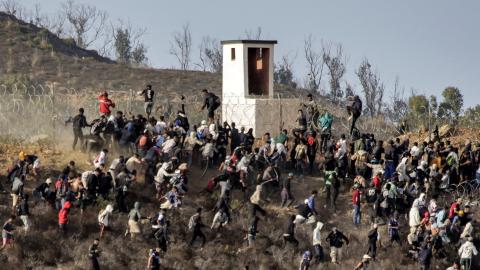
The stakes transcend Mali. Burkina Faso and Niger have also tied themselves to Putin’s benevolence as members of the Kremlin-backed Alliance of Sahel States. A jihadi-controlled Sahel would sit astride the main overland migration corridors from sub-Saharan Africa to the Mediterranean, giving al-Qaeda its largest sanctuary since Afghanistan. The 2015 migration crisis, which still sows discord among Europeans, originated from a single collapsing state. Bamako’s implosion threatens to drag its bloc down with it.
That is, unless the United States takes advantage of at least three opportunities to recover its standing with Mali.
The first is diplomatic. Washington lacks the accumulated resentments of Françafrique — the post-independence framework that enabled France to maintain ties to its former colonies. The disinformation machinery Moscow deployed against Paris has less purchase against a power without that colonial history. U.S. security and diplomatic channels with Mali’s military government are already reopening, with talks advancing toward the resumption of drone and intelligence flights. Washington should keep every such channel open. The Russian-aligned juntas are confronting a jihadist threat that Moscow has failed to suppress. By offering pragmatic security cooperation without heavy political preconditions, the U.S. can help protect vulnerable populations.
The second is economic. Project Vault, the U.S. initiative announced in February to build a strategic private-sector-led critical-minerals reserve, gives Washington a concrete framework to anchor reengagement on terms that Bamako can’t afford to refuse. Mali is one of Africa’s largest producers of lithium — an asset the junta needs to monetize. The U.S. project thus offers a commercially driven path without the political conditions Mali has rejected in the past. Resource revenue also funds the security apparatus the junta needs to survive, giving Washington leverage it currently lacks.
The third and most strategically consequential opportunity is deepening the U.S.-Morocco partnership. At the 13th African Land Forces summit in Rome in March, Gen. Christopher Donahue announced the establishment of a drone training center on Moroccan soil. Washington and Rabat signed a 10-year defense road map weeks later. In this sense, Morocco offers what no other transatlantic partner can: an ally with direct counterterrorism reach into the Sahel and decades of institutional knowledge. Delegating regional security to a capable partner would free American resources for the Indo-Pacific, the theater Beijing has worked hardest to keep Washington from focusing on.
African governments have seen what Russian reliability looks like. Moscow abandoned Syria’s Bashar al-Assad the moment rebel forces reached Damascus in December 2024, accepting his exile over any serious effort to sustain him. It is now doing the same in Mali. No government on the continent weighing its options can miss the pattern. The U.S. should seek to make that reversal permanent — knowing, as ever, that a Sahel in free fall won’t be contained.