





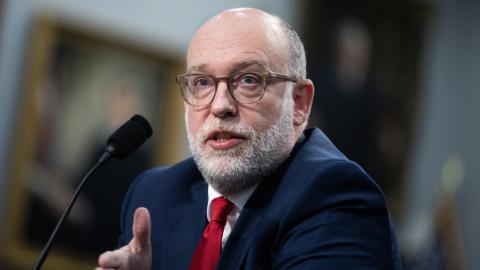





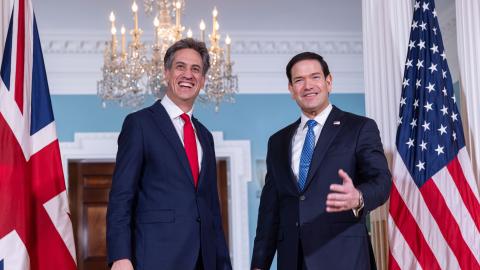
Ed Miliband, Britain’s new foreign secretary, met his US counterpart Marco Rubio in Washington this week. Although this was Miliband’s first official visit to the US capital since taking office, it was actually the second time the two men had met in their current roles. Last month, they held talks on the sidelines of the Association of Southeast Asian Nations meeting in the Philippines, an encounter that helped pave the way for the discussions in Washington.
The geopolitical context surrounding Miliband’s visit is important. In recent months, tensions emerged between President Donald Trump and Keir Starmer, UK Prime Minister Andy Burnham’s predecessor, particularly over Iran and London’s apparent lack of involvement in the military operation there. Meanwhile, after being on the front foot for several months this year, Ukraine is now being battered by a stream of Russian ballistic missiles. As inventories of advanced interceptors dwindle, Kyiv has become increasingly unable to defend itself against these weapons. Finally, the war with Iran continues with no meaningful end in sight. The Strait of Hormuz remains largely closed to normal commercial traffic, while the on-again, off-again talks between Trump and Tehran appear to be going nowhere.
Needless to say, there was no shortage of issues for the two foreign policy leaders to discuss. By all accounts, the meeting went well. It lasted 90 minutes, and both sides issued positive accounts of the discussions. Yet a closer examination of those releases reveals two different sets of priorities. Although Miliband and Rubio were representing their countries on the international stage, each also had a domestic political audience at home in mind.
Miliband raised the subject of Iran and the need to restore freedom of navigation, but he framed the issue first and foremost in the context of Britain’s cost-of-living problem. He argued that the sooner the strait reopens and a lasting peace agreement is reached with Tehran, the more quickly energy prices and the cost of other goods are likely to fall in the UK.
While the conflict is undoubtedly aggravating Britain’s economic difficulties, those problems predate the war. By presenting the reopening of the strait as central to bringing down living costs, Miliband risks overstating the conflict’s role and allowing the new Labour government to use an external crisis as a substitute for serious domestic economic reform.
Rubio, by contrast, stressed the need for Europe to do more for its own defense and become less dependent on the US. This is a message that he knows goes down well with much of the Make America Great Again, or MAGA, base. He also placed considerable emphasis on reopening the strait, but did so in a way that suggested Britain should play a direct role.
Behind the scenes, it has been reported that Rubio raised defense spending with his British counterpart. This is probably the most contentious issue in the US-UK relationship at present. Britain is spending around 2.6 percent of gross domestic product on defense, but the government has yet to publish a detailed and fully funded path toward NATO’s target of 3.5 percent by 2035.
The previous Labour government under Starmer collapsed in part because John Healey, then British defense secretary, publicly argued that there was not enough money and that ministers should commit to spending at least 3 percent of GDP by 2030. In a twist of political irony, Healey was appointed chancellor of the exchequer in Burnham’s new government. He now controls the purse strings and has an opportunity to live up to the expectations he helped create.
So far, Burnham has not publicly committed to increasing military expenditure at the pace Healey advocated when he held the defense portfolio. There is little doubt that many in Washington will monitor the situation closely. Britain has often been regarded as the European leader within NATO on which the US can depend, and any perceived retreat from that role would attract considerable concern across the Atlantic.
Perhaps the biggest takeaway from the meeting, however, is that the US-UK relationship continues largely as business as usual. Despite differences in recent months between policies emerging from Washington and London, the fundamentals of the special relationship remain sound and unchanged.
There had been concern that Miliband’s decade-old comments about Trump might create difficulties now that he is Britain’s top diplomat. Neither side mentioned those remarks in its public account of the meeting. This suggests that both men understood that their countries need to work closely on some of the world’s most serious challenges without becoming distracted by comparatively minor matters.
Trump himself has so far been positive in his limited engagement with Burnham. This suggests that despite some of the commentary surrounding the change in government, the special relationship will endure regardless of the personalities, ideological approaches, and leadership styles occupying 10 Downing Street and the White House.
That resilience is perhaps what makes the US-UK partnership so special and enduring. Governments change, leaders come and go, and political disagreements inevitably arise, yet the underlying strategic, diplomatic, military, and economic ties between the two countries remain too important for either to neglect.
For that reason, it is probably unsurprising that Miliband’s first visit to Washington as foreign secretary went off without a hitch. The meeting did not resolve every difference, nor did it produce any dramatic breakthrough. But it showed that even amid global instability and domestic political change, London and Washington remain capable of working together when it matters most.