
















After this month’s election, Hungary will, for the first time in 16 years, have a prime minister not named Viktor Orban. Americans across the political spectrum — including conservatives — should welcome the prospect for change.
Under Orban’s populist Fidesz government, Hungary has undermined U.S. interests by cozying up to the Kremlin, strengthening ties with China, stymying critical European assistance to Ukraine and reportedly even offering assistance to Tehran in the aftermath of Israel’s 2024 pager offensive against Hezbollah.
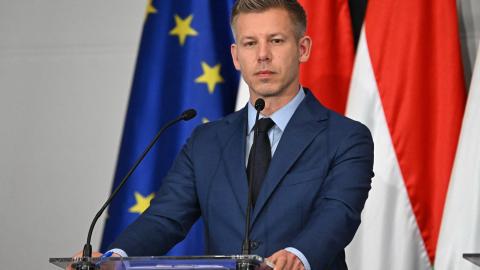
Hungary’s next prime minister, Peter Magyar — a former Fidesz official who now leads the Tisza party, relied on the support of a broad swathe of disaffected Hungarians to propel him to victory. Magyar campaigned on stamping out corruption, restoring the rule of law, fighting against the rising cost of living and repairing deteriorating public services.
Americans should wish him well.
Last fall, images of Orban’s lavish and unfinished family estate — complete with a private zoo — sparked public protests and lent credibility to Tisza’s allegations of broad corruption. Magyar has pledged to investigate claims of systematic corruption involving Orban and his inner circle.
Many prominent American conservatives admired Orban’s willingness to buck Brussels and stand tough on migration. To be sure, watching the former prime minister flout the European elite was cathartic to Americans wary of power centralizing in hands of an unaccountable bureaucracy. But too many on the right overlooked Hungary’s dangerous ties with American’s most potent adversaries.
Orban’s Hungary had forged close ties with Beijing, welcoming Chinese factories despite the environmental toll and strategic risk. It had even allowed Chinese police to operate within its borders.
Hungary became the lodestar of Chinese investment in Europe. One recent analysis found that from 2023 to 2025, one-fourth of China’s foreign direct investment in the European Union “went to Hungary, a country with just over 2 percent of the EU’s population and 1 percent of its gross domestic product.”
For a U.S. administration intent on reducing the West’s dependence on China, the implications are clear: Orban’s Hungary was not aligned with American interests.
Similarly on Russia, while much of Europe has been sprinting away to distance itself from the Kremlin, the Orbán government doubled down, signing a 12-point cooperation plan with Moscow across multiple sectors last December. Reports that Hungarian officials kept the Kremlin informed of sensitive, closed-door EU discussions underscore just how useful Orbán’s government had become to Moscow. This is combined with Orbán’s veto of a more than $100 billion EU loan package for Ukraine: a veto that, last week, Magyar asked Orban to lift before leaving office.
Hungary has also emerged as a hub for espionage, with an unusually high number of Russian personnel enjoying diplomatic immunity in the country at a time when they have become increasingly unwelcome elsewhere in Europe. That the former leader of a country that suffered so deeply under the yoke of Soviet communism would reportedly offer to act as a “mouse” aiding the Russian “lion” illustrates the strength of these ties.
Magyar, for his part, has pledged to prioritize Hungarian “sovereignty” in foreign policy — a goal that will require a fundamental rethinking of relations with China, Iran and Russia. It will also represent a clear win for the U.S. Time will tell how he governs. Unwinding years of entanglement with Beijing and Moscow will be neither simple nor painless.
What is clear is that Hungary will be governed by a conservative leadership when the dust settles. In the European Parliament, Tisza’s members sit with the center-right European People’s Party, alongside governing conservative parties from allied countries such as Croatia, Germany and Sweden.
Although improving relations with the EU is a stated priority, partly to unlock frozen funds, the new government in Budapest is unlikely to serve as a rubber stamp for Brussels. Tisza has already shown a willingness to break with European People’s Party positions when its interests diverge.
On defense and migration — issues central to U.S. interests — the incoming government’s positions closely align with what a Trump administration would favor. Tisza’s platform calls for raising defense spending to 5 percent of GDP and strengthening border security by maintaining the southern border fence while rejecting the EU’s migration pact and quota system.
How closely a Magyar-led Hungary adheres to campaign promises remains to be seen. Yet for too long, American conservatives have idealized Orban’s rule without looking under the hood. A stagnant Hungary aligned with America’s principal adversaries does not serve U.S. interests — and that is why Americans of all political stripes should welcome the winds of change now sweeping Budapest.