





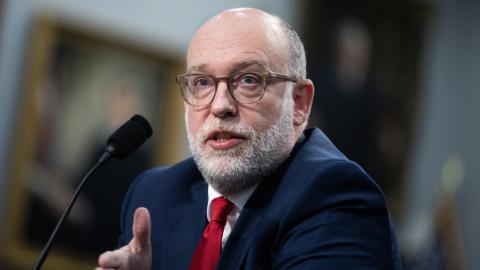





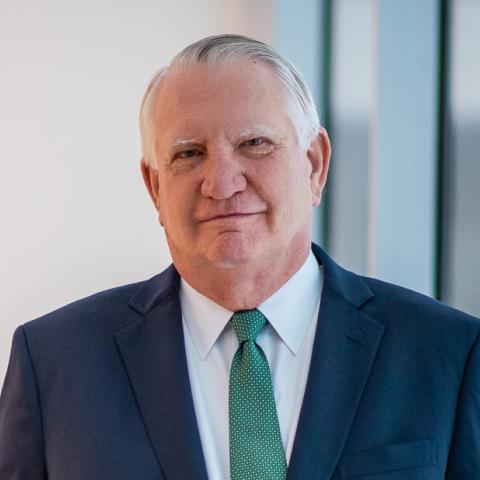
For the Revue Défense Nationale’s issue on political-military decision-making, we spoke with John P. Walters, the President and CEO of Hudson Institute. Drawing on his experience in government and two decades as the head of a major American think tank, one of the United States’ most influential, he reflects on how leaders really make decisions under pressure, why democracies struggle to prepare them, the evolving challenges of the civil military relationship in an era of strategic competition, and how extended deterrence and alliances are being tested in today’s strategic environment.
John Walters argues that the crisis of decision-making in democracies is not procedural but intellectual and moral. The central challenge is to cultivate leaders capable of confronting the truth, assembling diverse thinkers, and making Judgments under conditions of uncertainty and political constraint. He underscores that political will, allied cohesion, and strategic credibility are essential in an era marked by growing mistrust, diverging threat perceptions, and the re-nationalization of political priorities on both sides of the Atlantic, placing unprecedented strain on extended deterrence and the future of the transatlantic alliance. Finally, he helps us French readers—to better understand the American mind.
What follows is an edited Interview.
“The greatest danger in policy is not a lack of information—it is the refusal to confront the truth.”
From your experience in government and at the head of a think tank, how do people make good decisions in complex, high-pressure environments? And what role can the Hudson Institute play in improving that process?
I don’t believe that decision-making is primarily a matter of process design. We often talk about it as if it were an engineering problem: if only we had the right procedures, the right How charts, the right inter-agency mechanism, we would get better outcomes. I came from an academic background, so maybe that’s just to fall back into an academic habit, but I do think that one of the illusions of modern governance is the belief that we can design a scientific method for political decision-making. There’s a tendency in democracies to try to create a structure, a system, a process, that will produce the right answer. That is a false path.
What ultimately matters most in moments of danger is the caliber—intellectual, experiential, and moral of the leaders themselves, rather than the bureaucratic processes surrounding them.
In my time in government, going back to the Reagan administration, I worked with some very gifted people, and what I found most important when working through difficult issues was simply finding the smartest people on a given Problem and talking to them, enlisting them. You need people who are gifted, who have done the work, and understand the problems. Sometimes they need to debate in front of leaders; sometimes leaders themselves need rare intellectual gifts to synthesize what they learn—to see the center of gravity.
In some ways, this sounds obvious, but I will say there are still two profound limitations: democracies do not educate or prepare young people for public responsibility as they should, and to be as knowledgeable as you ought to be about the world and about the circumstances surrounding war and peace in our time. It is almost impossible to believe that a country with the history and responsibilities of the United States would do such a poor job preparing young people. I know we have, in the military and the Foreign Service, institutes and training programs, but it’s remarkable how those fail. They fail to go beyond conventional wisdom, and this is the second limitation.
That is one of the reasons institutions like Hudson exist. It was created to challenge and break the conventional wisdom that Herman Kahn, our founder, created Hudson Institute. He understood that specialists tend not to see only what is directly in front of them. Specialization involves learned limitations or blindness, as he saw it. Specialists put the world into the categories of their specialization. Kahn wanted a place where economists, strategists, scientists, and foreign-policy thinkers would constantly challenge one another, forcing them to confront assumptions and engage across disciplines. Interdisciplinary debate, even when it creates friction, is essential, not optional. This is especially true with simultaneous adversaries, rapid technological change, and deep political divisions, yet Kahn’s insight is overlooked in all our democracies.
Ultimately, the leadership we need rests on individuals who have unusual gifts. You need people who can see clearly when others cannot. You cannot automate that. You can, at best, create environments where such people are not crushed by the system before they have the chance to prove themselves. Identifying, nurturing, and elevating such individuals is the central challenge for creating prudent decision-making, especially in matters of national security.
History reveals a cruel pattern on this point. The United States has repeatedly found its great wartime leaders among people the system initially rejected or sidelined. Grant and Sherman in the Civil War, Patton in the Second World War. When we do not find such leaders in time, we do not do well. Our large organizations are very good at producing competence; they are very bad at identifying rare talent and often are hostile to it.
We live in an age saturated with information. We have never had so much information, but we still feel we lack information to see a situation clearly, and we often observe decisions that appear contradictory or counterproductive. What tools or habits help leaders preserve clarity amid cognitive bias and constant noise?
People often think the problem today is information overload, as if we were victims of the volume of data. I don’t think that’s quite right. The deepest obstacle to proper understanding is very old.
A wise person once said: “Human beings do not by nature love the truth; they want what they love to be true.” That remains the case. People don’t want to see threats or uncomfortable realities. They want either easy answers or to rely on dogmatic beliefs. Despite an abundance of information, individuals selectively consume content that aligns with their preexisting views. We select the information that confirms what we already want to believe. Digital tools have simply made it much easier to curate our own reality.
The first requirement for good decision-making is not technological; it is human. Leaders need people around them who can challenge their assumptions intelligently (and respectfully, if possible). Not professional contrarians, but individuals who can say: what if the world works this way, rather than the way we prefer to see it? Managing such a team is demanding, but it is indispensable.
With young analysts and interns at Hudson, I encourage them to adopt a very simple habit: keeping a diary focused on one policy area. Every day or every week, write down what you think is happening and where you think it is going. Then, six months or a year later, go back and ask: where was I right, and why? Where was I wrong, and why? What did I emphasize that did not deserve that weight? What did I ignore that turned out to be crucial?
Self-reflection and a willingness to refine our thinking will not guarantee perfect understanding, but it can enforce intellectual honesty about our biases and our ignorance. Over time, this process helps reveal recurring patterns in our mistakes. It also reveals what we need to learn.
If I try to generalize, as I get older, I think all our work is fundamentally about causes. What is causing what? We do not spend enough effort trying to get underneath events and identify the true causal forces. When we fail to do that, we design policies that are beautifully argued but cannot work or are deeply flawed, because they are not directed at the real drivers of a problem.
People sometimes say, “The world has become so complex that we can no longer identify causes, only correlations.” I understand that sentiment, but I would nuance it. Very capable people, through experience and insight, can still find the center of gravity in a complicated situation. That is what good commanders and good statesmen do: they make the complicated simple without making it simplistic. Simple is better, but simple has to be right in order to work.
The goal is not to make sense of everything; it is to find what’s important and to build the capacity to follow through on what’s important.
Policymaking resembles engineering rather than poetry: it begins with principles and goals, advances through action, and is continuously revised as reality exposes faulty assumptions and poorly framed objectives. Unlike the desire for elegant, coherent blueprints, effective governance, especially in crises, requires pragmatic adaptation with limited resources under pressure. It is about building a bridge with the materials and manpower at hand, while the river is flooding.
Public debates repeatedly reach for the same historical reference points- 1914, 1936, 1938, or 1956-to signal risks of escalation, polarization, appeasement, or the loss of strategic autonomy, as in the Suez precedent. But do these analogies genuinely really illuminate the strategic landscape we face today?
We often invoke historical references because they allow us to avoid confronting reality and the complexity of the challenges we face today. I read a great deal of history, mostly non-fiction, although I do appreciate ancient tragedy and comedy. And when I speak to students about history, I often remind them of Friedrich Nietzsche’s aphorism: history is a joke we play on the dead.
That’s why Nietzsche’s insight matters. Much of what we read as “history” is misleading. This is why you must read widely—and more importantly, you need enough experience to ask critical questions: do the explanations offered make sense? Would serious people, in those circumstances, really have thought and behaved that way? Often, the answer is no.
Historians have a particular weakness: they are drawn to large structural forces, which can turn individuals into mere puppets of history. In doing so, they often fail to understand real human motivation, especially that of major leaders.
Nietzsche can be a corrective again. I believe it is On the Use and Abuse of History for Life (1874) that he argues scholars/academics simply cannot grasp the soul of great historical figures—they think, what drives them. Scholars assume the great are like them, and as a result, they misunderstand what is happening. They misunderstand the fundamental causes.
How should we apply history? What is happening today—with Putin in Europe, with the alignment between Putin, Xi, Kim, and the Iranian leadership—is not simply a repetition of the past. There are continuities, of course, power, war, and rivalry, but there are also fundamental differences.
That does not mean history is useless. I read history because I believe it helps us understand human behavior, geography, and constraints. Geography is something we no longer teach adequately. I am a strong proponent of staff rides; I take students to Gettysburg every year. In our national security work, occasionally people say, “We’ll move forces from here to there,” and I say: Look at the map. Look at the distance. Look at the terrain. How exactly are you going to do that? When you stand on that terrain, you realize how many contemporary “plans” would collapse at the first encounter with real distance, real hills, real rivers. To say nothing of encountering the enemy.
Human beings naturally learn through analogy, but the danger is when historical analogy becomes a crutch and when it becomes false analogy. Forcing contemporary problems into familiar historical frameworks is a way of avoiding hard thinking. It creates more problems than it solves. It leads us to believe we know something we have not thought through. If we draw historical comparisons, we have to ask not only how things are similar, but how they are different. If we skip the second part, we risk blinding ourselves with history instead of illuminating the present.
Let me offer a quite different example to illustrate my point. It you ask the question, what kind of human beings built ancient Rome, from a small tribe to the Republic? You might compare two accounts of Coriolanus, one by Plutarch and one by Shakespeare. There are no contemporary accounts, so both descriptions are constructed (as is all history), and we should remember that Coriolanus and those with him may not be “like us.” So which account gives us the truest understanding the human type that likely built Rome and the tensions created by that type? What must Coriolanus have been like? I think the best answer is presented by Shakespeare. Is that history or something else? We are really looking for is understanding, and that is only captured by the very best history and is beyond history.
To what extent do US military strategies adequately account for political constraints and public consent? Is there a persistent gap between what is militarily desirable and what is politically sustainable in democracies?
All of this becomes even more complex in a democracy. We have a Congress representing many different constituents, and an executive branch composed of people with very different backgrounds and perspectives. That makes strategic clarity harder-but also more necessary.
Moreover, many people who enter government have no experience or understanding of the full range of specialties required to govern. In theory, bureaucracy is meant to compensate for this problem. But as we are seeing in current reform efforts, the bureaucracy itself is far from perfect-and in many cases, it becomes part of the problem rather than the solution. There is no substitute for thinking these issues through carefully, and there is no substitute for finding genuinely capable, indeed, brilliant people. That idea, however, runs against the grain of democracy. Democracies prize equality; we are uncomfortable saying that we must actively identify and elevate the most exceptional individuals.
The military plays a key educational and training role, preparing personnel for increasing responsibility, but its system is not geared to select the most brilliant leaders for specific historical moments. Additionally, its rigid bureaucracy often sidelines or punishes innovative (rebellious) thinkers, representing a significant functional weakness.
I want to connect this to the role of policy institutions like Hudson. Think tanks aim to analyze problems accurately and to propose the most effective policy options available to the United States and its allies. That work is essential. But too often, they fail to address the political resources required to implement those policies. The Implicit assumption is often: we provide the optimal policy, and it is then up to the president and Congress to generate the political will to carry it out.
The problem is that there is no mechanism in the White House or on Capitol Hill that simply manufactures political will. The American system is designed to reflect popular consent. Political will emerges through a continuous exchange—leaders explaining choices to the public, and the public responding through elections and other forms of engagement.
I believe this is where many military strategies fall short: they do not sufficiently grapple with the political constraints under which they must operate. Let me offer a concrete example:
After leaving government, and through my work at Hudson, I read extensively—not only memoirs from the Bush administration, but also those from the Obama administration-about Iraq and Afghanistan. I am not a political supporter of President Obama, but I came to believe something important about his approach. He entered office deeply skeptical of Iraq, perhaps for questionable reasons, but let’s set that aside. He viewed Afghanistan as the conflict where he could plausibly succeed—where he could say, “We can win here.” He also had a tense relationship with the military. What he was seeking was a strategy that was not only militarily sound but also politically sustainable. He had a finite amount of political capital, and he was prepared to spend it—but only within limits.
I came to believe that, from his perspective, that strategy never materialized. The military, as he experienced it, did not sufficiently account for the political constraints he faced. He came to believe that the advice he was receiving failed to reconcile military objectives with what he could realistically sustain politically. Endless troop commitments were simply not viable in his view. It is likely he judged that he could not accept long or open-ended commitments, especially since he took office in the middle of a long period of war and sustained conflict.
Political leaders’ judgments about what is feasible may not align with what is best for the country, but advisors must account for the political context. Political will—fragile today due to perceptions of costly or ineffective—US power is as crucial as military or economic strength. Ignoring the interplay between politics and military matters risks weakening governance, even though the military should not make political decisions.
How would you define the political-military relationship today? Where do you see its main strengths and weaknesses, in the United States but also in other countries you might use as points of comparison? And more broadly, would you say this is ultimately not just a political-military issue but a civil-military one as well?
I would like to focus on the United States. I am always reminded of a remark by Winston Churchill when he visited the United States during the Second World War. An election was approaching, and he was asked about the American political situation. He replied that most people do not understand politics in their own country, and no one understands politics in another country. It was a way of deflecting the question, but there is a deep truth in it.
Today, the American electorate is deeply divided—this is evident to everyone. My own, admittedly non-professional, political assessment is that President Trump relies on a base that is close to the minimum required to sustain a governing majority or to maintain sufficient support for his policies and for the current, slim Republican majorities in Congress. Given both his policy positions (his agenda) and his style of leadership, he has difficulty expanding his political base.
Traditionally, candidates are elected by mobilizing a strong ideological core and then, once nominated or in office, they reach out toward the center to broaden their appeal. I do not see President Trump following that pattern. Instead, he spends a great deal of time consolidating and maintaining his base, even when this leads to criticism that his language or positions are overly partisan or unnecessarily confrontational toward his adversaries. I do not claim to know his intentions, but if one looks at what I would call the “political physics” of the situation, he does not have much choice. Whether because of deep polarization or personal limitations, the result is the same: maintaining his base is essential.
This, in turn, constrains his policy options. He must keep that base aligned with him to retain political support. At the same time, he has reached out in various ways on different issues and has shown himself to be more internationalist than many expected—or feared—he would be. His governing style is also heavily shaped by today’s information environment. He generates news constantly. Social media was once assumed to favor the political left, simply because it was adopted earlier by progressive movements. President Trump has fundamentally changed that dynamic. He dominates the US social media space. Presidential announcements via tweet are now routine; public criticism of allies or adversaries through social media can be more impactful than formal speeches once were.
Some of the apparent pace of policy change reflects genuine collisions between major issues. Some of it reflects the fact that what captures attention on a given day may or may not be worthy of sustained policy debate. But the implications are real. Decisions that lead to the removal of senior military officers are serious. Policies that alter economic relations with allies through tariffs or other mechanisms are equally consequential. Yet President Trump often frames these actions as part of an ongoing negotiation, stating positions, inviting counterpositions, and seeking “deals.” This back-and-forth has become a central feature of the political dynamic, including in relations with adversaries such as Russia, China, and Iran.
We are therefore operating in a different environment. Many observers continue to analyze it using frameworks from an earlier era, which I believe is misleading. President Trump is harder to interpret than many of his predecessors. When we meet with allied officials, the underlying question is often simply: what is happening? I recently spoke with a senior Asian official who said, quite candidly, that his government wants to satisfy the Trump administration on trade, but they cannot determine what exactly is being asked of them.
That sense of being kept slightly off-balance is deliberate. It reflects, in some ways, a reassertion of American power-one that is surely uncomfortable. It is also a governing style that treats policy as an ongoing process rather than a clearly defined end state, achieving a particular objective. Whether efforts such as remaking the global trade system will succeed remains unclear. We will have to see where this ultimately leads. But the old system was failing and creating strategic problems for America.
In France, the President maintains a very direct relationship with the Chief of Defense, and the chain of command is relatively compact and centralized. In the United States, by contrast, the system is built around combatant commands and a more layered structure. Given today’s strategic environment and the technological transition, particularly the integration of Al-do you believe the current US chain of command, from the President to the combatant commanders, remains fit for future conflicts? Or do you see a need for restructuring or adaptation, and if so, in what direction?
Well, let me start by saying I’m not an expert on this question, but I can describe the broad direction of the American system. What the US military has been trying to do is push command authority downward. Yes, we technically have the capacity for what we jokingly call the “3,000-mile screwdriver, meaning Washington can insert itself into operational decisions at any moment, the temptation to micromanage from afar. But I do think that we have tried to push information and authority to those as close to the actual warfighting as possible. First, technology is going to allow us to do this more and more. Second, the disruption of things like communication and navigation make it necessary to plan for autonomous action. Third, I think the vulnerability of logistic support will require more flexibility for independent action—it’s going to be harder to try to move militaries as a kind of large army or navy block. I don’t think we have fully worked out the relationship between autonomous things and AI and the large capacity in an era of hard power. We’re facing the challenge that our military platforms are extremely expensive and sophisticated, yet increasingly vulnerable—sometimes to the point that one questions whether they are becoming obsolete.
That said, in an era where hard power still matters, we need tangible platforms capable of delivering real, lethal effects. We cannot simply stop relying on them. We must maintain deterrence with these existing systems, but at the same time, we should aim to gradually introduce new capabilities. Normally, this would involve phasing out the old while phasing in the new. The reality, however, is that we need to retain our legacy systems even as we accelerate the development of new ones—new systems that must be designed more rapidly and with less centralization.
For years, we have talked about reforming the acquisition process without seeing any meaningful change. Now there is finally a serious push to drive reform in this area, and I believe that effort is necessary. However, it’s also easy—when listening to reform advocates—to overlook the fact that this is not primarily an accounting or systems issue. At its core, it is a political problem.
We have facilities and bases that are underutilized, not because of poor planning at the Pentagon, but because there are political interests invested in keeping those bases as part of local communities whose representatives vote on appropriations in Congress. That is simply a reality.
Similarly, large defense systems often have components produced across many states—and sometimes in allied or partner countries—not because it is the most efficient approach, but because political considerations demand it. This creates an unavoidable need for balance. The process is inherently complex and does not lend itself to a simple, a priori solution. Progress requires negotiation and compromise to make the system function.
That said, it must move faster. And the driver for this urgency is not abstract. It is very clear: Communist China has, to the extent of its capabilities, weaponized virtually everything and is increasingly using those capabilities against the United States and its allies. It has weaponized information, while also continuing to build traditional military systems. At the same time, they are turning tools such as AI and cyber capabilities into weapons. This effort extends into the economic domain and into international regulatory bodies as well. From outer space to the seabed, they are developing increasingly powerful vectors to pressure and attack the United States and its allies.
Their objective is to achieve a level of overmatch that would allow them to avoid fighting altogether, forcing capitulation rather than conflict. We have not yet fully come to terms with this reality. While some steps have been taken, time is not on our side. We are not moving quickly enough, nor are we adequately preparing ourselves—politically, economically, and militarily—for the nature of the struggle we are facing.
Some work is being done on these issues, including at Hudson and elsewhere, but it remains insufficient relative to the scale and urgency of the challenge.
How do you see our preparedness for facing enemies like China? Russia? How do you see the future of our alliances? You mentioned alliances and extended deterrence.
How do you see the pressures on US commitments, particularly in Europe?
“Extended deterrence is under pressure—not because our values changed, but because the physics of power is changing.” We continue to believe that we are still in a period where it is possible to dissuade adversaries through peaceful means. However, when I look at Ukraine, the reason there is no ceasefire or peace is quite simple: Vladimir Putin does not want peace. He wants to conquer Ukraine, threaten Europe, and push as far as he believes he can without being stopped. This has included the use of chemical agents, deliberate attacks on civilians, the kidnapping of children, the torture of civilians, and the killing of captured combatants. He has repeatedly issued nuclear threats and may ultimately be prepared to use nuclear weapons in this theater. The issue is not a lack of understanding on his part of the benefits of economic cooperation or shared growth.
The administration is currently attempting to draw Putin toward a more peaceful posture, and of course, everyone prefers peace to war. But there is a fundamental risk in that approach. If an adversary can only be deterred by a credible threat, then deterrence requires appearing more prepared for war and less focused on accommodation. You must be ready to fight if deterrence fails, and the adversary must see and believe it.
This is not a matter of doing both simultaneously; it is a matter of choice. President Trump deserves significant credit for his efforts to end wars and prevent new ones. However, a determined adversary cannot simply be managed or persuaded—he must be deterred.
I also believe, frankly, that Europe has not done what it needs to do in this context. Europe has substantial economic power and, while its military capabilities are not on par with the United States, they are still significant. What is needed is greater unity and determination. President Trump’s frustration with the pace of European action is understandable.
To put it in perspective, Europe today reminds me of the United States under the Articles of Confederation, independent states loosely connected. NATO and the EU provide frameworks, but the core challenge remains how to accept burdens and share risk. When countries on the front line, like Ukraine, which is neither in NATO nor the EU, face direct threats, the question becomes how leaders can ask their populations to risk blood and treasure.
A few years ago, I attended a luncheon with the German National Security Advisor, where he presented their first national security strategy. They were also discussing efforts to reach 3% defense spending. During the Q&A, I noted that Germany’s size and influence make it exceptionally difficult for other European or NATO countries to act decisively without German leadership. I asked whether Germany could be more active in countering Russia, addressing the Ukraine situation, and supporting NATO. The response was candid: given the current political climate, Germany would prioritize internal issues first. I understood that as a reflection of Germany’s domestic constraints, but it illustrates the broader challenge of European unity and action.
The response I did not voice at the time—but which is often heard in parts of the United States—is that if that had been our attitude in the past, Europe would be speaking Russian today.
On the one hand, it is genuinely difficult for democratic leaders to tell their populations that a distant conflict is also their own—to ask them to send their sons and daughters into harm’s way and to commit significant national resources. On the other hand, if allies do not stand together, or if they expect the United States alone to shoulder the burden of projecting power, that becomes a serious and unsustainable problem.
I recently read Henry Kissinger’s book, in which he wrote about great historical figures he had met. I was particularly struck by his account of Charles de Gaulle. Kissinger had met de Gaulle first as a professor and later in other contexts, and he noted that in every encounter the topic of the nuclear umbrella inevitably arose. De Gaulle would ask, essentially, “Are you really going to risk New York and Washington for Paris?” Kissinger replied that yes, that is US policy.
But de Gaulle, being a very intelligent man, naturally questioned whether that made sense and whether he could truly trust it.
This illustrates a broader point: alliances—and the credibility of extended American nuclear deterrence, which we have often assumed would be constant—are now under scrutiny. When the United States is stretched by a rising and powerful adversary like China, while also facing pressures in Europe, questions arise about whether we have the resources to sustain all these commitments effectively.
Can our allies do more? When they don’t—especially when the threat is directly in front of them—it creates a political problem for the United States. I understand why, at times, President Trump’s words have been politically problematic in Europe. But there are two distinct issues at play: one is a problem of political will, and the other is what I would call a physics problem—you can only deploy so much hard power, and you need allies to share the burden.
When the response from allies is uncertainty or excuses about domestic constraints, it naturally leads to criticism in the United States from some political figures here: “We can’t care more about Europe’s security than the Europeans do themselves.”
That said, there is an independent, strategic reason why the US must care: our own security is deeply linked to the security of Europe.
I also believe there is much more I would like to see Europe do. That’s why we are working closely with NATO and other partners. In this era of new weapons, autonomous systems, drones, and other emerging technologies, you don’t necessarily need an aircraft carrier battle group or a ballistic missile submarine. Many of these capabilities can be derived from civilian technology and produced at scale.
Ukraine has demonstrated this remarkably with millions of unmanned systems. Imagine if Europe committed to producing ten times that number—either to support Ukraine or as a deterrent against Russian forces. While Russia can mobilize more soldiers and inflict high casualties, at some point, the ratio of drones to soldiers starts to neutralize their manpower advantage. Of course, we would still need to address other threats, but the principle is clear.
What troubles me—and what critics also highlight—is the slowness and limited scale of our allies’ commitments. This is not about criticizing them; it is about the severity of the situation. And that is why, now more than ever, we need to pull together here.
A few words in conclusion?
Policy is less like writing poetry than like building a bridge in a storm. The materials are imperfect, the plans are incomplete, but the work cannot be delayed. In an era of strategic competition, the ability, the freedom, to decide under pressure—with clarity about causes, constraints, and consequences—may prove to be the decisive advantage of free societies.