






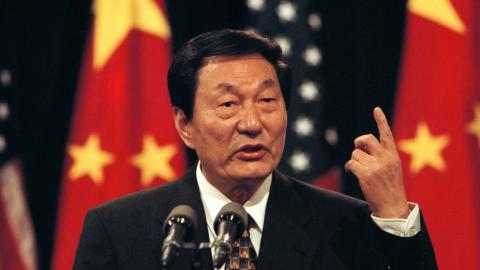
Premier Zhu Rongji's triumphal springtime visit to the United States offers an object lesson in the subtle Chinese art of political alchemy. Barely a week after Zhu arrived amidst page one features on Chinese spying, political repression, ecological disaster, and massive trade imbalances, the self-anointed pragmatist and stand-up comic managed to create headlines such as "Clinton 'Failed' on China Deal."
A chorus of criticism from business, influential senators such as Bill Roth, and steadfast friends of China seemed to have cowed the President, no doubt wondering if his usually sound political instincts had deserted him, into reconsidering his rejection of a trade agreement.
Meanwhile, not a word about human rights abuses or recidivist spying could make itself heard above the cacophony of praise for Zhu's statesmanship. Only the subsequent Cox Committee revelations of a massive espionage program could—albeit on a temporary basis—redress the balance.
How did such a remarkable reversal of fortune transpire in an American political atmosphere newly sensitive to foreign affairs and more deeply skeptical of our courtship of China than at any time since Henry Kissinger first toasted Zhou Enlai? We know of no major Chinese concessions on political prisoners, persecution of Christians, labor rights, nuclear proliferation, or environmental protection resulting from the visit.
In fact, Zhu seems to have adopted the battle-tested tactics of his host in denying any knowledge of the many serious allegations raised over the past few years. He brazenly denied any knowledge of spying at Los Alamos, channeling illegal contributions into American elections, or selling weapons of mass destruction to countries hostile to Western interests. Showing a deep and effective understanding of the Clintonesque art of the dodge, he turned serious questions into jokes. At MIT he deflected a line of inquiry about nuclear physics "because that reminds me of espionage." Zhu's bonhomie seems to have charmed and disarmed the American press as much as the legendary political skills of the man from Hope.
But what really turned the tide was a shrewd and unexpectedly broad appeal to the capitalist instincts of his hosts. The Chinese have been perfecting this tactic ever since Nixon's first visit to the Middle Kingdom in 1972, when they dangled the bait of buying commercial aircraft in return for what turned out to be secret concessions on Taiwan.
American business and trade negotiators legitimately want to craft a way for China to enter the World Trade Organization (WTO) and hence open Chinese markets and subject them to its more transparent disciplines. A long history of stonewalling on the part of the Chinese made the U.S. side wary and pessimistic about a breakthrough. Zhu skillfully used lowered expectations to gain the moral high ground by offering a sweeping set of promises to lower tariffs, remove even more serious non-tariff barriers to trade, and provide access to retail distribution channels in the immense Chinese consumer market.
After initially turning down a final deal due to lingering problems in the agreement concerning textiles, banking, securities services, auto finance, and antidumping protection, the Clinton team unwittingly hurt its own case for caution by releasing a list of concessions offered by the Chinese.
The panoply of trade-opening measures was indeed so broad that the business community was thrown into a state of near-panic that it would be lost because of what Republican Senator Frank Murkowski called a "lack of political will within the White House." The resulting pressure was so intense that Clinton was compelled to phone Zhu after he left town and arrange to restart the negotiations almost immediately and to assure the Chinese of strong American support for its entry into the WTO this year. Given the long history of secret deals with the Chinese leadership, one also wonders what else Clinton told Zhu in his desperate phone call.
This remarkable about-face puts into stark relief the ongoing dilemma of the entire WTO debate: whether to surrender the single most potent piece of leverage we have with China in exchange for better access to what may, some day, be the world's largest market. That the United States has considerable bargaining power with the Chinese ought to be evident in the scope of unilateral concessions that China has apparently agreed to in the WTO negotiations. The economic-growth model now employed by China depends heavily on selling manufactured goods abroad, attracting foreign investment, and acquiring foreign technology to move beyond the primitive manufacturing economy which now dominates in China.
China systematically discourages domestic consumption, relying on Confucian thrift to channel savings to inefficient government enterprises, hence increasing dependence on exports to fuel growth. Given the near-bankrupt state of Chinese banks, near-depression in much of Asia, and stagnation in Europe and Latin America, China has nowhere else to go—except the United States—for the export markets, capital, and technology needed to sustain a high level of growth. The United States takes about one-third of Chinese exports and provides more foreign investment than any non-Chinese country and, as we now know, much of the high technology needed to modernize China.
The Chinese leadership clearly depends on robust growth to maintain its political legitimacy at home and cannot meet its goals if denied full access to U.S. markets. Maintaining economic engagement with the United States has the added benefit of giving an incentive to American business to lobby against meddlesome criticism of China's human rights and weapons proliferation record, an advantage well understood by Zhu. Hence, American economic engagement is in many respects key to the future of the Chinese communist regime and ought to be deployed to maximum advantage by our leadership.
The entry of China into the WTO, with its requirement for permanent normal trading relations status, would make it much more difficult for the United States to exercise the economic leverage it now enjoys. Bringing a case in the WTO, with its cumbersome and lengthy adjudication process, with cases judged by panels of international arbitrators, would remove most of the flexibility the United States now has to calibrate its pressure and set its own timetable for conflict resolution.
Another reason for caution in finalizing an agreement concerns, to put it as delicately as possible, our level of comfort with Chinese compliance. Even though WTO rules would provide an international umbrella and an independent, quasi-judicial process for settling disputes, the Chinese record on compliance is suspect. Even setting aside China's apparent disregard for the proliferation and export control commitments it has undertaken, its record in honoring trade agreements is spotty at best.
The much-heralded, bilateral intellectual property rights (IPR) agreement had to be negotiated twice owing to massive violations of the first agreement. Even now, China confiscates illicit CD and CD-ROM equipment only to sell it to suspicious buyers in crime-ridden Macau. More than 90 percent of the software used in China is pirated.
The agriculture accord signed during the Zhu visit to remove artificial phytosanitary barriers to U.S. wheat and citrus exports only honored a commitment first made by the Chinese in 1994. In that same year, China announced it would allow foreign banks to conduct local currency transactions on Chinese territory for the first time.
By the end of 1996, only nine banks confined to a new development zone near Shanghai were able to benefit from this concession, and such geographic restrictions remain one of the important unresolved items in the WTO accession negotiations.
Given the importance of an independent banking sector to a functioning market economy, especially in China where the state-controlled system of credit allocation is highly inefficient, the financial services issues still outstanding are fundamental to the integrity of the WTO accession.
Further, recent reports from Beijing indicate that the Chinese are backtracking on the financial services breakthroughs American negotiators thought had been finalized in Washington. Another vital issue yet to be resolved involves protections against dumping and subsidies.
While U.S. insistence on adequate safeguards may sound protectionist to some, it is an essential part of this agreement simply because the Chinese economy is still dominated by subsidized, state-owned enterprises where prices are not fully set by markets.
Moreover, Zhu confidently told his American audience that never in 100 years could they expect to see China abandon its Marxist principles, presumably meaning the preservation of motives other than profits for state-owned and controlled enterprises.
Other areas where we need to have a better understanding of Chinese commitments before judging the value of the package include the elimination of quota arrangements in areas as diverse as agriculture and autos; the removal of all mandatory technology-sharing requirements; and the ability of foreign-owned retailers to compete fairly with existing Chinese operators.
Finally, the phase out of U.S. textile quotas is of considerable interest to the Chinese and to influential senators such as Trent Lott and Ernest Hollings.
Because it is not likely China will evolve into anything resembling a full market economy with an established rule of law in the near term, and because of the lingering questions about Chinese enforcement of agreements, American Enterprise Institute scholar Claude Barfield has made the sensible suggestion that additional protections be included in the so-called WTO protocol of accession, which helps specify how the agreement is enforced by the new member.
To simplify the case, Barfield argues that, absent a traditional and widely accepted system of commercial law and the independent judicial mechanisms to enforce it, we can anticipate serious problems in the domestic enforcement of everyday business disputes. The many routine disputes that will arise cannot be settled effectively through the WTO.
After all, most WTO cases take years to resolve, a lifetime for an operating business trying to enforce a contract. This is clearly a crucial problem as China evolves from a politically dominated, nontransparent, arbitrary economic system to one based on markets and rules. A rules-based system is also one of the cornerstones of democracy.
The tentative agreement outlined by U.S. Trade Representative Charlene Barshefsky is largely silent on this problem. Indeed, such questions are normally outside the scope of accession agreements. But the WTO has never faced the prospect of a nation with nearly 1.3 billion souls, a huge and fast-growing economy, and an authoritarian, socialist tradition joining the rest of the market-oriented members.
We have already seen the strains put on the WTO by the intransigent refusal of the European Union to honor WTO decisions, and the consensus-based organization can ill-afford to risk another large nation flaunting its rules by failing to provide for adequate enforcement mechanisms both internally and externally.
Hence, some written assurances in the protocol of accession for guaranteeing routine compliance with WTO obligations would inspire more confidence in the Chinese commitments.
Despite these thorny problems, which have largely been ignored by the "amen-corner" supporting a quick agreement, it is undeniable that Zhu offered some real and wide-ranging concessions from which it is difficult to walk away. Indeed, his strategy seems to be using these concessions to rally support and drown out the chorus of criticism on other, more political issues.
For his part, President Clinton, either because of some brilliant strategy of deception worthy of Sun Tzu or simply as a reaction to tactical opportunities, now seems content to let the process go forward to completion this year based on the newly found momentum.
Clinton is also relying yet again on the abysmal short-term memory of the American body politic to smooth the way toward a WTO agreement unencumbered by the unpleasant baggage of questions about technology acquisition and its military uses.
Congress ought not succumb quickly to the enthusiasm of the moment. Hard as it is to resist the entreaties of the many potent constituencies now backing a quick end to the WTO negotiations, Congress should insist that the details of the agreement, including both the business left unfinished when Zhu left Washington and any hitherto unannounced side deals, be available for careful scrutiny.
Congress should also insist on a full explanation of how the deal will be enforced both in domestic law and through the WTO. Only after these questions are answered can Congress make the sober political judgment whether our considerable economic leverage has been used to maximum advantage to change Chinese behavior and open its markets over the long term.