











President Trump lands in Beijing this week with an Iran file that gives Washington leverage over every other item on the agenda.
China has spent the past decade cultivating strategic depth in the Middle East through its economic relationship with Tehran - positioning itself as a trusted partner and mediator between Iran and Gulf capitals while absorbing Iranian crude shipments that Western sanctions were designed to curtail.
Operation Economic Fury is the first US effort to impose a direct cost on that positioning, and Beijing arrives at the summit already absorbing it.
The world has been fixating on the military dimension of Operation Epic Fury.
The more consequential campaign is unfolding in Treasury designations, sanctions lists, and the mechanics of dollar clearing.
As Secretary Bessent put it: "We will relentlessly target the regime's ability to generate, move, and repatriate funds, and pursue anyone enabling Tehran's attempts to evade sanctions."
The results are measurable.
The pressure operates on two levels, the first of which is revenue.
The US naval blockade has cut off the export stream on which the IRGC depends for operations, procurement, and proxy financing - and the strain is visible.
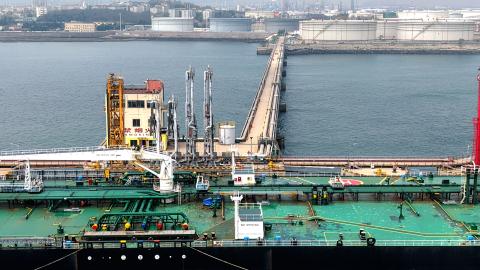
Kharg Island is nearing storage capacity, satellite imagery has captured a large oil slick west of the terminal, and Iran's Oil Terminals Company has issued a denial that tracks with a familiar pattern: Tehran denies what the data confirms since admitting failure would weaken their negotiating position and expose the true cost of the blockade to a domestic audience already under severe economic pressure.
The Pentagon now puts total lost of oil revenue at $4.8 billion, with each day of the blockade costing Tehran an estimated $170 million ($235 million AUD) in IRGC-linked income.
The second level is more significant, and it runs directly through Beijing: the IRGC requires supply chains as much as cash, and those chains run through China.
US Treasury targeted Hengli Petrochemical, China's second-largest teapot refinery, along with roughly 40 shipping firms tied to Iran's shadow fleet, then moved against five independently run teapot refineries, the primary processors of sanctioned Iranian crude.
Beijing responded with a formal "prohibition order" directing Chinese citizens and companies not to comply, deploying an anti-extraterritoriality law.
The order signals exposure: by formally committing to protect these firms, Beijing has acknowledged that Treasury's designations are landing — and that Chinese companies operating in dollar-clearing systems remain vulnerable regardless of what domestic law instructs them to do.
But more importantly, the US designations expose the full scope of Chinese complicity in Iran's military operations — a dimension that matters acutely to Gulf states that absorbed the costs of Iranian attacks while Beijing provided Tehran the intelligence infrastructure to sustain them.
Meentropy Technology, The Earth Eye, and Chang Guang Satellite Technology were each designated for supplying Iran with geospatial intelligence to monitor US and allied military movements.
For these reasons Washington holds a designation architecture it can extend - the satellite conduct alone gives US regulators a documented predicate for broader action against Chinese commercial remote sensing.
Any argument from Xi Jinping for sanctions relief on designated firms is a negotiating position Washington should reject outright: relief is a concession China must earn by withdrawing from the IRGC procurement network it spent a decade building, not a gesture Washington extends to open the conversation.
Most consequentially, combining economic statecraft with a military operation establishes a deterrence model that raises the cost of underwriting US adversaries.
A China that watches the US Treasury dismantle the financial architecture sustaining Iran must now calculate what a comparable designation campaign would do to the firms, banks and supply chains underwriting a move on Taiwan.
For years, Washington sanctioned selectively, enforced sporadically and left the IRGC enough running room to treat US pressure as a cyclical inconvenience.
Operation Economic Fury is the most coordinated effort yet to close that gap across revenue, logistics, and the firms sustaining both.
The summit is the test of whether Washington maintains that pressure.