














In the latter months of 2025, and again in April 2026,[1] many observers expressed concern that African Salafi-jihadists associated with al-Qaeda and the Islamic State could overtake African states, particularly Mali. In that sphere, discussions were rife surrounding the possibility of the Sahelian-based al-Qaeda affiliate Jama’at Nusrat al-Islam wal-Muslimeen (JNIM) capturing the Malian state, leading to the emergence of a jihadist state.
During the fall of 2025, JNIM imposed a blockade on the southern half of Mali, pushing the ruling military junta, led by Assimi Goïta, to what many believed was the brink of collapse.[2] The jihadists’ ability to deprive cities of fuel for months and coerce the junta into negotiations opened a serious debate over the likelihood of a jihadist state emerging in Africa.[3] For instance, in November 2025, analysts at the Soufan Center asserted that “Mali stands on the brink of collapse . . . leaving the government in the capital of Bamako vulnerable to being overrun.”[4] Around the same time, analysts at the Atlantic Council assessed that Mali’s military regime “may be on the brink of collapse after a months-long siege of Bamako by al-Qaeda aligned terrorists,”[5] while The Guardian wrote that “political instability and fuel shortages caused by the rebel group are driving Mali to the brink of becoming an Islamist republic.”[6] In perhaps the most alarmist of such articles, The Wall Street Journal titled its late October reporting, “Al-Qaeda Is on the Brink of Taking Over a Country.”[7]
Rhetoric around a jihadist takeover in Mali calmed during the first quarter of 2026. However, such concerns returned with rapidity in April, following JNIM’s stunning assaults in Mali in conjunction with ethnic Tuareg rebels from the Front for the Liberation of Azawad. In late April, JNIM and FLA launched coordinated assaults across northern and central Mali, targeting critical cities such as Bamako, Sévaré, and Kidal.[8] Analysts deemed the operation overwhelmingly successful for JNIM; the group not only temporarily overran the capital but also killed two of the five highest-ranking Malian security officials. They seized what may be the largest cache of weapons from the Malian army and took control of several urban centers, including Kidal, a regional capital.[9] The Washington Post called it the “largest coordinated attack in over a decade in Mali,” and the Soufan Center commented that the offensive “threatened to topple the ruling military junta.”[10] For its part, Reuters suggested that the attacks left Mali “at risk of splintering.”[11] However, to be sure, not all analysts held this opinion. As Boubacar Haidara raised in November 2025 when considering a JNIM takeover, the climate of crisis has fueled “some of the most alarmist hypotheses,” and this scenario is “at this stage, highly unlikely.”[12]
With the discussions of Mali’s potential fall in late 2025 and early 2026 came a cascade of other analyses that drew regional and even continental comparisons. For instance, Newsweek commentators warned that “if Mali’s capital were to fall to [JNIM], it would mark a stunning victory for the jihadists and increase the risk of Islamist takeovers in the rest of West Africa’s Sahel region and beyond.”[13] For their part, Raphael Parens and Delina Goxho noted that Mali, Niger, and Burkina Faso “are experiencing a collapse of the state. Jihadist and separatist insurgencies have fundamentally altered their capacity to conduct international affairs and manage sovereignty. No Sahelian government can claim full sovereignty or control over the means of violence within its borders.”[14] Forebodingly, the International Institute for Counter-Terrorism warned that the Sahel could become the “global headquarters of a jihadist state.”[15] Elsewhere, similar concerns existed about the collapse of Somalia, which analysts asserted risks being overrun by al-Shabaab.[16]
Yet, despite the proliferation of worry, a jihadist takeover has yet to come to fruition. In the Sahel and Somalia, jihadists routinely conduct attacks anywhere from five to 60 miles outside of national capitals, even attacking, albeit rarely, the capitals themselves.[17] But they have failed to stage, let alone successfully orchestrate, a state takeover to date.
Today we see a perplexing paradox emerging: Even when African jihadist groups have the capability to take over African states—and given that they apparently have the will to do so—they elect not to. What underlies this seemingly puzzling outcome? Why, despite the proliferation of rhetoric and worry about African state takeover, has such an event not occurred? Have analysts exaggerated these groups’ capabilities? Or have they somehow misinterpreted their desire to do so?
This piece seeks to shed light on the much-discussed phenomenon of an African jihadist state takeover by disaggregating African jihadist groups’ goals into theological/ideological goals on the one hand and practical/praxeological goals on the other.[18] In short, while several African jihadist groups (discussed below) seemingly have the military capability to take over African states and, inherently, to some degree, a theological/ideological will to do so, at their core, no group has shown evidence of a practical/praxeological will for state takeover. Thus, although all of the ingredients superficially seem present for such takeovers, observers must not allow their vision of African Salafi-jihadist groups’ religious commitments to myopically cloud their understanding of those groups’ goals. Instead, this piece urges observers to understand African jihadist groups not merely as blinded religious zealots but as rational actors whose perception of the shadow of the future fundamentally guides their actions (and inactions), especially those as significant as would-be state takeovers.
This piece proceeds in three primary sections. The first section lays out some definitions and parameters. Section 2 then assesses the capability of African jihadist groups to undertake state takeovers. Section 3 analyzes their will to do so, with particular attention to different types of will, disaggregating ideological/theological will and practical/praxeological will and showing how the latter trumps the former in their decision-making. A fourth section concludes the piece.
Setting the Parameters of the Discussion
Before delving into this discussion further, some terms bear explanation. First, what do we mean when we refer to the takeover and emergence of a jihadist state? This piece is referring to the process whereby a coalition of actors formally or informally connected to one of the two major transnational jihadist groups, al-Qaeda or the Islamic State, militarily ousts the sitting head of government of a preexisting, legally defined, sovereign African state (as recognized by the United Nations), then runs the country under a Salafist rule of law. The nearest—though not exact[19]—analogue is the Taliban takeover of Afghanistan in 2021.
Of note, our interest here is in the likelihood of a full state takeover rather than the creation of informal, transnational jihadist “statelets” or “provinces” (wilayat) that exist either within or across African states. Indeed, these entities already exist. One need only look at the Islamic State’s “provinces” or al-Qaeda’s affiliates to see that self-recognized state-like entities exist, and have for years.[20] These are not our concern. Instead, the primary goal of this piece is to interrogate what it might look like if one of these entities succeeded in taking over a formal, juridically sovereign African state. It is also worth noting that we are not considering the possibility of a change in a state’s borders even though such groups do not inherently recognize such borders as legitimate in the first place. (More on the topic of borders follows below.)
Second, what is the temporal scope of this project? Given the dynamism of the region, this thought experiment is intended to cover the relatively near future: Written in the first four months of 2026 and published in May 2026, this piece interrogates the subsequent 12 months, though its conclusions may ultimately have relevance beyond these dates. Alternatively, amid the ever-changing landscape of African security and politics, this thought exercise could prove patently incorrect for unforeseeable reasons.
Assessing Capability to Take Over a State
To investigate the seemingly puzzling lack of state takeovers by African jihadist groups, we now turn to assessing the capabilities of African jihadist groups. Which states, theoretically, are at greatest risk of takeover? Since the unit of analysis of this piece is the state, we present a useful heuristic to assess this risk, including the three most important phenomena to interrogate:
- Significant violent jihadist presence: The African state must be home to a significant jihadist presence that houses a large number of violent fighters (not merely supporters), al-Qaeda and/or Islamic State militants who view a state takeover as ideal. Moreover, an overriding group in power needs to declare that its ideals are rooted in a Salafist, or at least Islamist, worldview and that its rule would follow accordingly.
- Military capability for state ouster: A large number of citizens ideologically sympathetic to al-Qaeda or the Islamic State is important but not sufficient. A more pertinent risk factor is the capability of such a group to bring military forces into the capital city in numbers sufficient to challenge state or parastatal security forces. Primarily through violent efforts, the jihadist group must be able to oust the sitting head of state and a majority of their closest allies and declare itself the new ruler of the state.
- Capacity to hold the capital indefinitely: A jihadist group that can assassinate a leader but cannot sustain power would not be capable of a true state takeover. In our assessments, this metric concerns not only the abilities of the jihadist group itself but its capabilities vis-a-vis would-be national and international spoilers interested in removing it.
With these three metrics in hand, table 1 presents our assessment of the near-term (12-month) likelihood of the takeover of an African state by a jihadist group associated with al-Qaeda or the Islamic State, leading to an Overall Jihadist Takeover Risk.
At its core, by virtue of data limitations and the inherently fraught goal of forecasting, this assessment is imbued with limitations. While Metric 1 was assessed with some amount of certainty, Metrics 2 and 3 are far more speculative. Nevertheless, by using subject matter familiarity, we present a useful heuristic to broadly sketch—however unscientifically—the continent-wide dynamics of potential African jihadist state takeover.
Table 1. Assessing the Conceivable Risk of African Jihadist State Takeovers (April 2026–April 2027)
|
Country |
Overall Jihadist Takeover Risk |
1. Significant Violent Jihadist Presence |
Jihadist Group Presence |
2. Military Capability For State Ouster |
3. Capacity to Hold Capital Indefinitely |
|
Burkina Faso |
Conceivable |
High |
JNIM (AQ), IS-Sahel |
High |
High |
|
Mali |
Conceivable |
High |
JNIM (AQ), IS-Sahel |
High |
High |
|
Somalia |
Conceivable |
High |
Al-Shabaab (AQ), IS-Somalia |
High |
Medium |
|
Niger |
Somewhat Conceivable |
High |
JNIM, IS-Sahel, ISWAP |
Medium |
Medium |
|
Mozambique |
Conceivable But Unlikely |
Medium |
IS-Mozambique |
Medium |
Low |
|
Libya |
Conceivable But Unlikely |
Medium |
AQIM, IS-Libya |
Medium |
Medium |
|
Benin |
Conceivable But Unlikely |
Low |
JNIM, IS-Sahel |
Medium |
Low |
|
Togo |
Conceivable But Unlikely |
Low |
JNIM |
Low |
Low |
|
Algeria |
Scarcely Conceivable |
Low |
AQIM, IS-Algeria |
Little to None |
Little to None |
|
Cameroon |
Scarcely Conceivable |
High |
ISWAP, Boko Haram |
Medium |
Low |
|
Chad |
Scarcely Conceivable |
Medium |
ISWAP |
Low |
Low |
|
Côte d'Ivoire |
Scarcely Conceivable |
Low |
JNIM |
Low |
Little to None |
|
DR Congo |
Scarcely Conceivable |
Medium |
IS-Central Africa (ADF) |
Low |
Little to None |
|
Ethiopia |
Scarcely Conceivable |
Medium |
Al-Shabaab |
Little to None |
Little to None |
|
Egypt |
Scarcely Conceivable |
Medium |
IS-Sinai |
Little to None |
Little to None |
|
Ghana |
Scarcely Conceivable |
Low |
JNIM |
Low |
Little to None |
|
Kenya |
Scarcely Conceivable |
Medium |
Al-Shabaab |
Little to None |
Little to None |
|
Mauritania |
Scarcely Conceivable |
Low |
AQIM (latent presence) |
Low |
Little to None |
|
Nigeria |
Scarcely Conceivable |
High |
ISWAP, Boko Haram/JAS, Ansaru (AQ) |
Low |
Little to None |
|
South Africa |
Scarcely Conceivable |
Low |
(Financial/Logistical cells) |
Little to None |
Little to None |
|
Sudan |
Scarcely Conceivable |
Low |
Historical AQ links |
Low |
Little to None |
|
Tunisia |
Scarcely Conceivable |
Medium |
AQIM, IS-Tunisia |
Little to None |
Little to None |
|
Uganda |
Scarcely Conceivable |
Medium |
ADF (ISCAP) |
Low |
Little to None |
|
Tanzania |
Scarcely Conceivable |
Low |
IS-Mozambique (spillover) |
Little to None |
Little to None |
Table 1 shows only the states in which we assessed some conceivable risk of jihadist state takeover, no matter how small. This occurred in 24 of 54 African states (~44%). If a state is not listed in table 1, we assessed there to be no reasonably conceivable threat of a jihadist state takeover. Thus, the majority of African states (~56%) face no real risk of state takeover.
Second, as per table 2, our assessments reveal that while 24 African states have a shred of conceivability for a state takeover, in the vast majority, that conceivability is very low. In 16 of 54 African states (~30%), takeover is “scarcely conceivable,” and in five other states (~7%), it is “conceivable but unlikely.”
Table 2. Summary of Findings
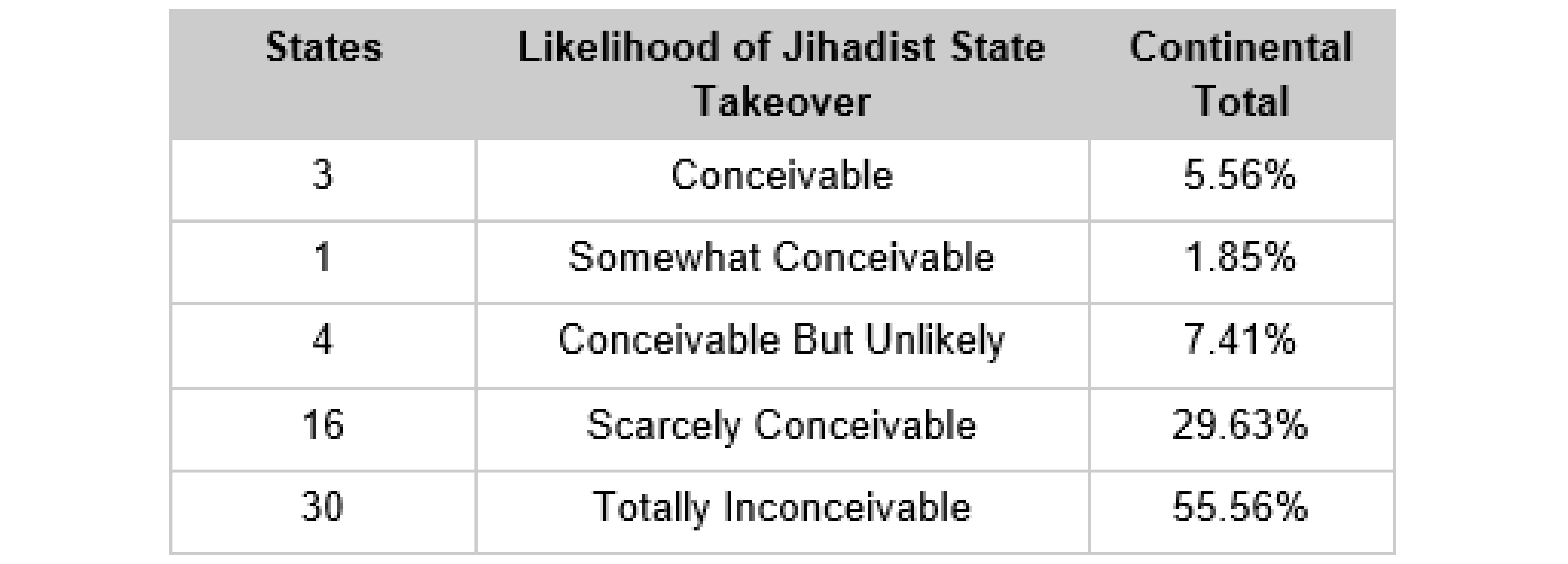
Third, and most germanely, our assessments suggest there are only four states—Burkina Faso, Mali, Somalia, and Niger—in which the capacity of jihadist groups is sufficiently high to make the likelihood of a takeover either “conceivable” (~6%) or “somewhat conceivable” (~2%). Given that these states are the ones that observers should most acutely focus on, we briefly explain the rationales for each of their rankings.
Burkina Faso
Burkina Faso remains among the most conceivable cases of an African jihadist state takeover. Notably, the Institute for Economics & Peace ranked it as the world’s most terrorism-afflicted country in 2024[21] and the second most terrorism-afflicted country in 2025.[22] In response, the ruling Burkinabè junta has siloed itself in urban centers, ceding much of the country to al-Qaeda and Islamic State jihadists.[23] Burkina Faso thus diverges from other Sahelian states in that the junta has concentrated its military capacity on safeguarding the capital and its surrounding area.[24] While this strategy has insulated Ouagadougou, the capital, it has forced the regime to overly depend on the Volontaires pour la défense de la patrie (Volunteers for the Defense of the Homeland, or VDP), an auxiliary civilian militia, to defend the country’s peripheries. Not coincidentally, Burkina Faso recorded nine of the world’s 20 deadliest terrorist attacks in 2024.[25]
- Significant violent jihadist presence—High: Burkina Faso has a highly significant violent jihadist presence. JNIM and the Islamic State Sahel Province (ISSP) field ~6,000 and ~2,000 fighters across the Sahel, respectively, and contest/control 60% of Burkina Faso, within which they frequently conduct violent operations.[26]
- Military capability for state ouster—High: JNIM, the likeliest actor to stage a takeover, has exhibited the potential capability to oust the ruling junta. It generally enjoys uninhibited freedom of movement, encroaching within 50 km of the capital, and security forces are largely unable to stop it.[27] The group has leveraged this and its size to coordinate complex attacks involving hundreds of militants. For example, in February 2026, JNIM launched assaults on military and civilian positions across multiple Burkinabè cities hundreds of miles apart.[28] The group’s operational freedom is partly due to the junta’s strategy of insulation, which has left the periphery of the country largely unprotected.
- Capacity to hold capital indefinitely—High: JNIM has demonstrated a high capacity to theoretically maintain long-term control of the capital. The group has surrounded the capital and displayed an ability to overrun and temporarily seize large cities, such as in its nine-hour seizure of Djibo, population 60,000, in northeastern Burkina Faso on May 11, 2025.[29] Alongside other factors, such as the transitory nature of governance in Burkina Faso, the seizure indicates that JNIM could launch a similar if not larger offensive in Burkina Faso than in Mali. Furthermore, the capital’s central location in the country has isolated it from allied support; the junta’s strategy of insulation has created a scenario in which, if JNIM is able to overrun the military core, it can likely maintain control.
However, JNIM could face challenges in holding the capital. One of its largest constraints is its antagonistic relationship with Burkina Faso’s majority ethnic group, the Mossi. Mossi constitute the majority of the VDP, the civilian militia that JNIM explicitly targets. This relationship maps onto a broader regional interethnic conflict between sedentary and pastoralist Fulani populations in which JNIM is often superficially regarded as Fulani-dominant.[30] The group’s rivalry with the ISSP further constrains its ability to maintain control.
Mali
Mali bears a close resemblance to Burkina Faso and faces a comparably conceivable risk of jihadist takeover. JNIM, again the dominant jihadist group, controls large swaths of uncontested territory, which it has leveraged to launch increasingly bold and pervasive attacks, including the April 26 multisite offensive.[31] The group has besieged cities and communities of varying size, frequently coercing the populations of urban centers into agreements that dictate citizens’ livelihoods and/or security forces’ rules of engagement.[32] Though its blockade of Bamako has eased as of April 2026, reportedly as a result of the junta negotiating with JNIM and agreeing to a prisoner release, concerns remain about how it lifted the blockade and how long fuel supply lines will remain open.[33]
- Significant violent jihadist presence—High: JNIM’s fighters number roughly 6,000 across the Sahel, and many operate in Mali. Moreover, the group controlled at least half the country in 2024 and routinely conducts violent operations in all parts of the country.[34]
- Military capability for state ouster—High: JNIM fields an extensive armory of weapons, land assets, and combat/surveillance drones, which it has built through transnational smuggling and looting of military camps it has overrun.[35] The group’s use of drones and motorbikes has granted it a degree of maneuverability that the state struggles to counteract, enabling it to launch large attacks before the state can respond. The group frequently coordinates attacks on mid-sized and large cities involving hundreds of fighters, such as its April 2026 offensive, while sustaining a campaign of economic warfare, underscoring its capability to oust the government.[36]
- Capacity to hold capital indefinitely—High: JNIM has demonstrated a high ability to hold the capital for an extended period. The group’s overwhelming April 24 assault on Bamako, among other key urban centers, and apparent seizure of Kidal, a regional capital with a population of 25,000, is the most compelling evidence of this. It similarly displayed such a capacity in its four-day seizure of southern Mali’s Loulouni (population 40,000) in November 2025, a region considered a secondary operational theater for the group.[37] However, despite an apparent capability to oust the government and seize Bamako, the group chose not to stage a takeover and agreed to let affiliated Tuareg fighters govern captured urban centers.[38] The decision, likely informed by an understanding of the practical cost associated with governing, is described further below and is at the core of this thesis.[39]
Somalia
Somalia faces an equally conceivable prospect of a jihadist takeover as Burkina Faso and Mali. Al-Shabaab, the Somalia-based al-Qaeda affiliate, exerts influence over much of southern Somalia and its roadways, isolating government-controlled cities in a manner similar to that of its Sahelian counterparts.[40] In late 2025 and early 2026, al-Shabaab increased its attacks on the capital and deployed more fighters to its environs.[41] The group’s daringness has coincided with an increasingly fragmented government, weakening potential state resistance.[42]
- Significant violent jihadist presence—High: Al-Shabaab, the largest African jihadist group, meets the criteria for a highly significant violent presence with 7,000–12,000 active fighters controlling approximately 30% of the country, more than the Somali state itself.[43]
- Military capability for state ouster—High: Al-Shabaab fields more fighters than its Sahelian counterpart and has an arsenal of weapons, land assets, and drones comparable to JNIM’s; new reports suggest a recent acquisition of missiles from the Yemeni Houthis.[44] Operationally, the group has not only reversed historically successful Somali-led counterinsurgency gains, underscoring its resilience, but has also conducted increasingly daring attacks on the capital, striking close to the presidential palace in October 2025.[45] Al-Shabaab’s growing military capabilities alongside the state’s fragmented resistance therefore put Somalia at relatively high risk.[46]
- Capacity to hold capital indefinitely—Medium: Al-Shabaab has demonstrated a moderate capacity to maintain control of the capital indefinitely. The group has controlled the cities of Jilib and Bua’aale (each with estimated populations of 100,000) in Middle Jubba as well as smaller cities in central Somalia since the late 2000s.[47]
However, the presence of regional and foreign actors committed to deterring a jihadist takeover significantly constrains its ability to maintain control of the capital. The African Union has maintained peacekeeping forces within Somalia since 2007; the current African Union Support and Stabilization Mission in Somalia (AUSSOM) numbers nearly 12,000 troops.[48] Separately, regional actors such as Kenya, Uganda, and Ethiopia, all of which contribute troops to AUSSOM, are unlikely to allow an uninhibited jihadist takeover. The group is also likely cognizant of its previous history, namely its failure to control districts within the capital from 2009–10 when it began losing ground to African Union troops.[49] Sustained attacks within Mogadishu that fall below the threshold of actual urban control therefore indicate a rational decision informed by the group’s constraints.[50]
Niger
Among the four states we have identified as at risk, a jihadist takeover is least likely yet somewhat conceivable in Niger. Unlike Mali and Burkina Faso, Nigerien jihadists have largely disregarded the country’s peripheries, concentrating their control around Niamey and its adjacent regions.[51] The ISSP, the dominant group in the country, uses Niger as its core area of operations.[52] The group is highly active and has shown the ability to conduct complex and deadly attacks. JNIM and the Islamic State West Africa Province (ISWAP) also maintain a presence, albeit at a reduced level.[53]
- Significant violent jihadist presence—Medium: ISSP, the smallest of the assessed groups, totals 2,000–3,000 fighters across all its territory. Within Niger, the group controls/contests less territory than the state; however, its zones are concentrated around Niamey and its adjacent regions. The group’s presence is best reflected in its violent operational ability, making Niger’s Tillaberi region the deadliest region in the central Sahel in 2025.[54]
- Military capability for state ouster—Medium: ISSP is considerably smaller than its al-Qaeda counterparts in the Sahel or Somalia, demonstrating only a moderate capability to violently oust the government. While the group has fewer fighters, it concentrates them within a smaller geographic range, enabling them to conduct complex attacks mobilizing hundreds of fighters across operational zones in a similar manner to JNIM.[55] The group exhibited such an ability in its February 2026 infiltration and assault on the capital’s military airport.[56] It also receives logistical assistance and potentially a limited number of fighters or trainers from its much larger Nigerian affiliate, ISWAP, thus bolstering its capability.[57]
- Capacity to hold capital indefinitely—Medium: ISSP has encircled the capital of Niamey and shown a clear shift from pure kinetic activity to governance. In recent years, the group has broadcasted political rhetoric in line with its sharia interpretation of governance alongside implementation of more structured governance, such as reopening local markets in areas it controls.[58] Nevertheless, the group’s prioritization of rural consolidation, general lack of urban control, and large attacks on the capital indicate a rational decision that seizing control would cost too much.[59]
Collectively, these four case studies underscore that at least three African jihadist groups—JNIM, al-Shabaab, and ISSP—have most if not all of the requisite capabilities to take over Burkina Faso, Mali, Somalia, or Niger.
Assessing Will to Take Over a State
While the above discussion laid out the assessed capabilities of groups to undertake a state takeover, this is only part of the story. In this section we ask, To what extent do various jihadist groups in Africa express the will, or the desire, to do so?
As one of our primary interventions, we argue that one must disaggregate two specific types of will: a theological/ideological will on the one hand and a practical/praxeological will on the other. In theory, all African jihadist groups are theologically and ideologically committed to overrunning the state(s) in which they operate. However, this section will demonstrate that, in reality, the practical and more quotidian dynamics of sustaining an insurgency make the prospect generally unappealing and thus a nonstarter for most African jihadist groups. We look at the two types of will—theological and practical—in turn, discussing the dynamics at play in African jihadist state takeover.
Theological Will
As Salafi-jihadist groups, al-Qaeda and Islamic State–linked insurgent groups in Africa have an inherent commitment to dismantling the African states in which they exist. At the core of Salafi-jihadist ideology is the destruction of man-made states (i.e., those created in the Westphalian mold) and their replacement with entities governed in accordance with Islamic law. This dismantlement is part and parcel of the creation of the global caliphate, or global Muslim state, which both al-Qaeda and the Islamic State seek, but the immediacy of this goal has been a key source of division between them. Efforts to dismantle tangible state borders were evident in the Islamic State’s early takeovers of parts of the Levant between 2014 and 2016, when insurgents literally dismantled the physical markers and barriers between Iraq and Syria.[60]
Salafi-jihadists derive their theological justification from the writings of prolific Salafi theologians such as Abul A’la Maududi (1903–79). Maududi, a Salafi theologian who helped shape the foundational ideology of Salafi-jihadism, argued that the objective of jihad is to “eliminate the rule of an un-Islamic system and establish in its stead an Islamic system to State rule.”[61] Jihad, as understood by Maududi, is a divine imperative concerning all efforts to exalt the word and thus the vision of Allah.[62] Similarly, Abu Muhammad al-Maqdisi, one of the most prominent Salafi-jihadist intellectuals, asserts that statehood is a challenge to Allah’s sovereignty, and thus true Muslims are obligated to fight against it and destroy its followers.[63]
Thus, whether affiliated with al-Qaeda or the Islamic State, all African jihadist groups are committed to a broad worldview in which the takeover, or at least destruction, of the states in which they exist is a central goal.
Practical Will
However, ideological and theological motives are not the only factors that influence jihadist behavior: African jihadist groups also have more practical desires related to the real-world experiences of the here and now. It is on this front, the practical will for state takeover, in which we see these groups expressing far lower desire. In short, while at least a few of them have the theoretical capability and inherently possess a theological will for state takeover, nearly all have shown they lack the practical will to do so. Below, this piece details four reasons that African groups find the practical realities of African state takeover less than attractive.
1. Governing States Is Hard. At least one reason African jihadist groups are wary of state takeover is that they recognize that managing any state—particularly one that was just overthrown—is a daunting task. Operating in the shadows and conducting one-off attacks is manageable. However, a state takeover would require them to undertake wide-ranging service provision, such as managing electricity, water, schooling, healthcare, and infrastructure, after undermining these very state-led services for years. Indeed, jihadist attempts at governance over the past two decades in Iraq, Syria, Afghanistan, Pakistan, and Libya, to name a few, have shown just how difficult such an endeavor can be.
In addition, jihadists appear to recognize that governing, particularly transitioning from the national spoiler to the national caretaker, is difficult from a reputational standpoint. For any element of civil society that supported the group’s rise to power, a would-be jihadist ruler would have to live up to its own ideals: Long having claimed that the state was the problem and touted the jihadist approach to governance, the group would need to prove its case. Successful jihadists risk looking like the dog that finally caught the car, unsure what to do with the long-sought prize once it is won. As Wassim Nasr articulated in 2025 regarding the reputational challenges of state takeover,
While in theory [African jihadists] would like to take over these cities militarily, taking Bamako or Ouagadougou or Niamey would be very costly for them in terms of governance and management. With large segments of the population in these cities being hostile to them, it would not be easy for them. It would also be used by the [ruling military] juntas to regain unconditional international support. So, it does not make sense for them to take the cities from a rational point of view, but of course, you should keep in mind that we are not talking only about rational actors here and it is possible for irrational decisions to lead to gains on the ground for them.[64]
2. Governing States Is Dangerous. A second reason African jihadist groups lack the practical will to take over states is that doing so presents some amount of danger. By officially installing themselves in a singular location, they become potential targets for adversaries—state and nonstate alike. For instance, one can reference the Taliban’s control of Afghanistan and its subsequent ouster by U.S. forces in the months following the September 11 attacks or the successful ouster of the Islamic State in Derna and Sirte, Libya, after the group decided to install itself formally in both locations.[65] Indeed, while leaders have assumed occupation of a seat of power in an African capital offers a degree of protection thanks to the sovereignty-granting powers of the United Nations, this is not a foregone conclusion in practice. The recent U.S. toppling of the Maduro regime in Venezuela and the targeted killings of top officials in Iran show that the protections of sovereignty are far from present in practice. And, especially in the Sahel, ECOWAS-aligned states have shown an openness to regime intervention, most recently in the bloc’s efforts to prevent a coup in Benin.[66]
Yet arguably even more dangerous than threats from antagonistic states or coalitions of states are threats from nonstate actors. Combinations of anti-government rebel groups, ethnic militias, rival jihadist groups, and even mercenaries can depose sitting regimes. This dynamic is particularly evident in Mali, where at least three major armed factions—JNIM, ISSP, and ethnic Tuareg militias—operate across the country. These three networks can trace their history to Mali’s early 2012 insurgency, and two of the groups could work together against the third.[67] JNIM and the Front for the Liberation of Azawad (FLA), the preeminent Tuareg militia, maintain a symbiotic relationship, infrequently collaborating. The two actors most recently worked together in JNIM’s April 2026 assault across central and northern Mali. They reportedly agreed to allow the FLA to govern captured cities in northern Mali under JNIM sharia law, underscoring a possibility of future collaboration.[68] Nonstate actors have not historically led the takeovers in the “coup belt” of Africa, where 11 military-led coup attempts have occurred since 2020,[69] but the multiplicity of such actors, coupled with other factors such as poor governance and insecurity, could well alter this trend.
Equally important, internal fragmentation poses as great a risk as any other factor to would-be African jihadist rulers. The aforementioned Salafi-jihadi groups, JNIM most prominently, maintain a centralized decision-making body within a decentralized body of sub-affiliates/groups.[70] The sub-affiliates typically operate autonomously, orchestrating their own operations and/or campaigns. A jihadist takeover could empower a sub-affiliate or factions within it to splinter and pursue their own ambitions.[71] Conversely, waiting too long to pursue a jihadist takeover or adopting Westphalian-like governance once in power, and thus rejecting their theological will, could force more ideological members to splinter. For example, because of the ideological transformation of Hay'at Tahrir al-Sham (HTS), the group’s more ideologically hardline fighters splintered, underscoring the risks of balancing group dynamics with state-building.[72] The dangers of fragmentation are magnified in the Sahel, where insurgencies are not only ethnically heterogeneous but have mapped onto interethnic conflicts between sedentary and pastoralist communities.
In short, coming out of the shadows, being centrally and reliably located, and officially owning the national problems that they once blamed on others can easily put a target on a would-be African jihadist regime’s back.
3. Governing States Is Boring. A third but no less important reason that capable African jihadist groups decline to overtake states is that state administration is less exciting than the life of an insurgent fighter. Several studies have shown that a portion of fighters join jihadist and other insurgent groups for adventure, thrills, or excitement, and many are nonplussed with the notion of giving up such a life to sit behind a desk as a bureaucrat.[73] Indeed, interviews with Taliban members in 2022–23 show that many expressed disdain for the monotony of governing Afghanistan as opposed to fighting.[74]
The leaders of the most capable African jihadist organizations are aware that their interests diverge from those of lower-ranked members. Moreover, the upper echelons understand the need to appease their members to maintain loyalty. In the case of JNIM in the Sahel, the group’s lower-ranking members may be more interested in expansion and its coinciding benefits than in fulfillment of the group’s theological will.[75] A JNIM takeover would likely require internal consolidation and a pause in expansion, which could anger foot soldiers. The pressure to placate lower-ranking members who may be more opportunistic, financially motivated, or thrill-seeking is an additional constraint on jihadist groups. Thus, combined with the difficulty and danger of governing, the ennui of governance for lower-level members gives yet another reason not to pursue state capture.
4. Governing States Is Not the Goal. Fourth, and finally, capable African jihadist groups are also electing not to take over states because the destruction of current states, not their governance under existing structures, is the actual goal. As per Salafi-jihadist ideology, the creation of the global caliphate will come about not due to the capture and management of individual states but due to the complete dismantling of the Westphalian system of states writ large.[76] In other words, while current states in Africa—Mali, Niger, Somalia, Burkina Faso, and others—are worthy of destruction, the goal is a de-territorialized system of governance that pays no heed to the boundaries of whatever structures it has destroyed. For instance, as Alex Thurston has assessed correctly of the April 26 attacks by JNIM, “Both JNIM and the FLA effectively say in their statements that they want the junta to fall, but neither is necessarily saying they want to step up to run Mali. Surely the headaches would be manifold, to say the least.”[77]
Indeed, JNIM’s indifference toward governance was apparent in its April 26 collaboration with the FLA. According to Wassim Nasr, JNIM agreed to allow the FLA to govern captured cities in northern Mali in exchange for its assistance in seizing the cities and agreeing to implement sharia law.[78] In this instance, JNIM showed that it sought to simply dismantle current structures rather than to assume the bureaucratic rule of new ones. The group reinforced this in a statement released on April 30 in which it called on the “patriots of Mali” to rise up against the “terrorist regime.”[79] The distinct political rhetoric underscores the group’s desire to not assume authority but instead inspire or abet an independent authority that will act more favorably toward the group.
African jihadists imagine a world in which their Salafist caliphates transcend not only borders but many of the sociopolitical and ethnic challenges of today’s African states. Such lofty visions appear in the rhetoric of African jihadists, such as in al-Shabaab’s vision of a great East Africa emirate or JNIM’s goal of a caliphate spanning West Africa.[80] Despite these religiously rooted ideals, the realities of the ecosystems in which they operate and their own pragmatism largely shape group decisions and objectives. As rational actors, they understand that the first step to such ends would involve seizing power within the confines of a recognized Westphalian state. Only thereafter could they pursue the second- and third-order effects of a transnationalization of such a caliphate. The imperative to walk before they can run may also explain, in part, why the visions of the Taliban and HTS became more accommodationist in the latter stages of their respective insurgencies.
Moreover, to the extent that dismantling and/or weakening states rather than governing them is the goal, one can view more evidence of the push and pull between the theological and the practical in African jihadists’ approach to state dialogue. While in theory, negotiating with the leaders of apostate secular states should be a nonstarter, more recently, African jihadists have shown a willingness and even a desire to open channels of dialogue with the state. JNIM’s indirect negotiations with the Malian junta to ease the fuel blockade present the most compelling example. The junta reportedly authorized local negotiations with JNIM in October 2025 to ease the blockade.[81] Shortly afterward, it brokered an agreement to temporarily lift the blockade in exchange for the release of 115 JNIM prisoners.[82] Unconfirmed reports indicate that it brokered an additional prisoner exchange in March 2026.[83] Practically, these actors understand the leverage they hold, the dangers of governing, and the costs of governance accrued by the state. Theologically, however, they are driven by a religious will to dismantle and replace Westphalian governance with their own Salafist interpretations. This dichotomy has manifested a scenario in which, as pragmatists, JNIM is willing to negotiate with the junta to an extent, enabling it to reap the benefits of its leverage without betraying its religious tenets. JNIM’s tactical accommodations are attributable to the core argument of this piece: the overriding desire to let the group’s practical will, rather than its theological will, guide its decision-making.
Conclusion
We have undertaken an intellectual exercise to understand why the much-discussed takeover of an African jihadist group has not yet materialized. To do so, we first charted the capacity and the will of African jihadist groups within each state to overthrow the central government and institute a jihadist-led form of national governance by early 2027. Using three metrics to determine the capacity of such groups, we showed that Burkina Faso, Mali, Somalia, and, to a slightly lesser extent, Niger are the four African states most susceptible to takeover. As our main contribution to this discussion, we then emphasized the difference not only between the capability and will of African jihadist groups to take over but also between the different types of will. As we have shown, even though the theological will for secular state takeover is always present, African jihadist actors are highly rational and thus often lack the practical will for takeover. We then delineated four factors that make such takeovers undesirable.
What should an observer take away from this piece?
First, and most broadly, despite a rising narrative of the risk of African jihadist state takeovers, this study suggests not only that their likelihood is relatively proscribed in a small number of states (three or four) but that even in those states, the lack of will among the most capable jihadist actors makes this scenario less likely than it might appear. In other words, while rhetoric looms large, real threats appear far more diminutive.
Second, this piece has clarified how imperative it is to understand African jihadist leaders as highly rational and not merely—or even primarily—guided by religious ideology. They may indeed be devout ideologues inspired by intangible and existential goals, but their actions and motivations are far more often guided by the real-world practicalities of managing insurgent groups.
Third, and relatedly, this piece underscores that it is important not to analytically succumb to “jihadi myopia,” or the tendency to view all jihadist-linked groups exclusively through the lens of their jihadist affiliations.[84] For instance, Kristof Titeca and Giovanni Salvaggio have warned against the ISIS-ification of the Allied Democratic Forces (ADF) in the Democratic Republic of the Congo (DRC).[85] While such African jihadist groups do have real and tangible links to al-Qaeda and the Islamic State (informing their theological will), they also have other imperatives for action that often trump any purely religious motivations.
Fourth, and more practically, the process of African state takeover is far more complex than it might appear at first blush. The mere fact that the ingredients for a takeover might be present—a significant jihadist presence with military capability and a relatively weak state—is far from a sufficient condition for a subsequent takeover. Although the specter of takeover appears to loom large, a more thorough understanding of the interplay between the ideology and practicality of African jihadist groups leads one to rethink their propensity to pursue such an outcome.
To conclude, what is likely to occur over the next 12 months? As this brief piece has assessed, the threat of African jihadists’ takeover of states is, at best, conceivable—in other words, imaginable—in only three or four of the most terrorism-afflicted states. While the worst-case scenario may indeed befall one or more of them, it appears highly unlikely in the near term, primarily because such takeovers do not align with most African jihadist groups’ immediate interests.
Editor’s note: This piece solely reflects the views of the author(s) and in no way expresses the opinions of the U.S. Government, Department of War or any associated entities.
Endnotes
- This piece was written in late 2025 and early 2026, and was in final production in April 2026, just before the JNIM’s widescale attacks in Mali. While the authors have made initial nods to these attacks, it should be noted that this piece was not written in response to those events and thus does not address them as centrally. ↑
- The Soufan Center, “Mali on the Brink of Collapse as Jihadists Threaten to Overrun the Country,” IntelBrief, November 4, 2025, https://thesoufancenter.org/intelbrief-2025-november-4. ↑
- David Bache, “Mali: l’approvisionnement en carburant semble stabilisé, mais à un niveau très insuffisant” [Mali: Fuel supply appears to be stabilized, but at a very low level], RFI, January 7, 2026, https://www.rfi.fr/fr/afrique/20260107-au-mali-l-acc%C3%A8s-au-carburant-se-stabilise-%C3%A0-bamako-mais-reste-compliqu%C3%A9-en-r%C3%A9gion. ↑
- Soufan Center, “Mali on the Brink of Collapse.” ↑
- Haleigh Bartos and John Chin, “Mali Is at a Turning Point That Risks a ‘Disastrous Domino Effect,’” Atlantic Council, November 25, 2025, https://www.atlanticcouncil.org/blogs/menasource/mali-is-at-a-turning-point-that-risks-a-disastrous-domino-effect. ↑
- Eromo Egbejule, “How al‑Qaida‑Linked Jihadist Group JNIM Is Bringing Mali to Its Knees,” The Guardian, November 1, 2025 https://www.theguardian.com/world/2025/nov/01/how-al-qaida-linked-jihadist-group-jnim-is-bringing-mali-to-its-knees. ↑
- Benoit Faucon, “Al Qaeda Is on the Brink of Taking Over a Country,” Wall Street Journal, October 30, 2025, https://www.wsj.com/world/africa/al-qaeda-is-on-the-brink-of-taking-over-a-country-ffd35ea4. ↑
- AFP, “Separate Goals, Common Enemy for Mali’s Jihadists and Separatists,” RFI, April 27, 2026, https://www.rfi.fr/en/international-news/20260427-separate-goals-common-enemy-for-mali-s-jihadists-and-separatists; David Lewis, Portia Crowe, and Robbie Corey-Boulet, “Mali at Risk of Splintering After Jihadi and Separatist Attacks,” Reuters, April 27, 2026, https://www.reuters.com/world/africa/mali-risk-splintering-after-jihadi-separatist-attacks-2026-04-27; Ruth Maclean, “Al Qaeda-Linked Militants Launch Major Attacks on Cities Across Mali,” New York Times, April 25, 2026, https://www.nytimes.com/2026/04/25/world/africa/mali-attacks-jnim-al-qaeda-bamako.html. ↑
- Lewis, Crowe, and Corey-Boulet, “Mali at Risk of Splintering”; AFP, “Separate Goals, Common Enemy”; Maclean, “Al Qaeda-Linked Militants Launch Major Attacks”; Jessica Donati, “Mali Defence Minister Sadio Camara Killed as al-Qaeda Linked Insurgents Launch Coordinated Attacks,” The Independent, April 27, 2026, https://www.the-independent.com/news/world/africa/mali-sadio-camara-death-b2965437.html; Eromo Egbejule, “Mali in Turmoil After Insurgents Seize Towns and Kill Defence Minister,” The Guardian, April 27, 2026, https://www.theguardian.com/world/2026/apr/27/mali-attacks-insurgents-seize-towns-kill-defence-minister. ↑
- Mark Banchereau, “What to Know About the Largest Coordinated Attack in over a Decade by Militants and Rebels in Mali,” Washington Post, April 27, 2026, https://www.washingtonpost.com/world/2026/04/27/mali-attacks-separatists-islamic-militants-russia/f6195804-4272-11f1-b19d-32431046b5b4_story.html; The Soufan Center, “Al-Qaeda Affiliate in the Sahel Could Topple the Government in Mali,” IntelBrief, April 27, 2026, https://thesoufancenter.org/intelbrief-2026-april-27. ↑
- Lewis, Crowe, and Corey-Boulet, “Mali at Risk of Splintering.” ↑
- Boubacar Haidara, “Le Mali bientôt sous contrôle djihadiste ? Analyse d’une rhétorique alarmiste” [Mali soon under jihadist control? Analysis of alarmist rhetoric], The Conversation, November 6, 2025, https://theconversation.com/le-mali-bientot-sous-controle-djihadiste-analyse-dune-rhetorique-alarmiste-269009. ↑
- Matthew Tostevin, “Jihadists Bring Another State to the Verge of Collapse,” Newsweek, November 4, 2025, https://www.newsweek.com/jihadists-bring-another-state-to-verge-of-collapse-10989230. ↑
- Raphael Parens and Delina Goxho, “The Feudalization of Mali,” Foreign Policy Research Institute, November 7, 2025, https://www.fpri.org/article/2025/11/the-feudalization-of-mali. ↑
- David Doukhan, “The Birth of a Jihadist State Is Closer Than Ever in West Africa,” International Institute for Counter‑Terrorism, Reichman University, January 22, 2025, https://ict.org.il/the-birth-of-a-jihadist-state-is-closer-than-ever-in-west-africa. ↑
- Matt Bryden, “Somalia at Risk of Becoming a Jihadist State,” Africa Center for Strategic Studies, November 17, 2025, https://africacenter.org/publication/asb45en-somalia-risk-jihadist-state. ↑
- Héni Nsaiba and Caleb Weiss, “Oil on the Jihadi Fire? The Repercussions of a Wagner Group Deployment to Burkina Faso,” CTC Sentinel 16, no. 1 (January 2023): 1–13, https://ctc.westpoint.edu/oil-on-the-jihadi-fire-the-repercussions-of-a-wagner-grup-deployment-to-burkina-faso; Caleb Weiss, “Shabaab Mounts Coordinated Assault North of Mogadishu,” Long War Journal, March 3, 2025, https://www.longwarjournal.org/archives/2025/03/shabaab-mounts-coordinated-assault-north-of-mogadishu.php; Halkano Boru, “Africa File, November 7, 2024: Niamey Threatened; Boko Haram Fallout in Chad; M23 Marches on Eastern DRC; Somalia‑Jubbaland Tensions,” Critical Threats Project, November 7, 2024, https://www.criticalthreats.org/analysis/africa-file-november-7-2024-niamey-threatened-boko-haram-fallout-in-chad-m23-marches-on-eastern-drc-somalia-jubbaland-tensions; Portia Crowe, “Jihadists’ Fuel Blockade Poses Biggest Threat Yet to Mali’s Military Rulers,” Reuters, November 3, 2025, https://www.reuters.com/sustainability/society-equity/jihadists-fuel-blockade-poses-biggest-threat-yet-malis-military-rulers-2025-11-03. ↑
- Praxeology is the study of human action and decision-making, specifically purposeful action. As used here, praxeological goals are strategic, rational, action-oriented objectives that jihadists pursue and are distinct from ideologically rooted actions. ↑
- The Taliban, despite its similarities to Salafi-jihadism and ties to al-Qaeda, is more precisely rooted in the Deobandi tradition than in Salafi-jihadism. While the traditions share certain theological concepts, such as the rejection of some popular Sufi practices and an emphasis on sharia governance, Deobandism is historically and institutionally distinct, emerging from nineteenth-century South Asian Islamic reform movements. The analogy to Salafism is here used for convenience, as Salafi-jihadism is the more recognizable frame for transnational jihadist governance. However, the distinction between Deobandism and Salafi-jihadism is meaningful. ↑
- Jason Warner, The Islamic State in Africa: The Emergence, Evolution, and Future of the Next Jihadist Battlefront (New York: Oxford University Press, 2022); Jason Warner, “Sub-Saharan Africa’s Three New Islamic State Affiliates,” CTC Sentinel 10, no. 1 (January 2017): 28–32, https://ctc.westpoint.edu/sub-saharan-africas-three-new-islamic-state-affiliates. ↑
- Institute for Economics & Peace, Global Terrorism Index 2025: Measuring the Impact of Terrorism, March 2025, https://www.visionofhumanity.org/wp-content/uploads/2025/03/Global-Terrorism-Index-2025.pdf. ↑
- Institute for Economics & Peace, Global Terrorism Index 2026: Measuring the Impact of Terrorism Sydney: Institute for Economics & Peace, 2026), https://www.visionofhumanity.org/wp-content/uploads/2026/03/Global-Terrorism-Index-2026-Report.pdf. ↑
- Michael DeAngelo, “Lessons from Burkina Faso’s Fight Against al‑Qaeda and the Islamic State,” Foreign Policy Research Institute, September 18, 2025, https://www.fpri.org/article/2025/09/local-militias-for-counterinsurgency-burkina-faso. ↑
- Michael DeAngelo, “Counterterrorism Shortcomings in Mali, Burkina Faso, and Niger,” Foreign Policy Research Institute, March 3, 2025, https://www.fpri.org/article/2025/03/counterterrorism-shortcomings-in-mali-burkina-faso-and-niger. ↑
- Africa Center for Strategic Studies, “A Growing Divergence of Security Narratives in Burkina Faso,” August 26, 2025, https://africacenter.org/spotlight/security-narratives-burkina-faso; DeAngelo, “Counterterrorism Shortcomings”; DeAngelo, “Lessons from Burkina Faso’s Fight”; Institute for Economics & Peace, Global Terrorism Index 2025: Measuring the Impact of Terrorism (Sydney: Institute for Economics & Peace, 2025), 8–9, https://www.visionofhumanity.org/wp-content/uploads/2025/03/Global-Terrorism-Index-2025.pdf. ↑
- Africa Center for Strategic Studies, “Africa’s Constantly Evolving Militant Islamist Threat,” August 13, 2024, https://africacenter.org/spotlight/mig-2024-africa-constantly-evolving-militant-islamist-threat; Christina Markus Lassen, letter from the chair of the Committee on IS and al‑Qaida to the president of the Security Council, S/2025/482, United Nations Security Council, July 21, 2025, https://docs.un.org/en/S/2025/482; Jon Temin, Between Armed Groups and Military Governments: Violence Against Civilians in the Sahel (Simon-Skjodt Center for the Prevention of Genocide, 2025), 11–12. https://sahelresearch.africa.ufl.edu/wp-content/uploads/sites/170/Between-Armed-Groups-and-Military-Governments-Violence-against-civilians-in-Sahel.pdf. The exact number of active Salafi-jihadists is undetermined due to the fluidity of both geographic positioning and membership. However, the centrality of Burkina Faso and fact that jihadists control approximately 60% of the country and frequently conduct attacks there lead us to reason that many of the ~8,000 jihadists in the Sahel are based in or around Burkina Faso. ↑
- Fu Cong, letter from the president of the Security Council concerning ISIL, al‑Qaida, and associated individuals and groups to the president of the Security Council, S/2025/71, United Nations Security Council, February 6, 2025, https://docs.un.org/en/S/2025/71; Africa Center for Strategic Studies, “The Widening Scope of Africa’s Militant Islamist Threat,” April 6, 2026, https://africacenter.org/spotlight/2026a-mig-widening-militant-islamist-threat. ↑
- Jessica Donati and Anait Miridzhanian, “Islamist Militants Show ‘Unprecedented Coordination’ in Burkina Faso Attacks,” Reuters, February 19, 2026, https://www.reuters.com/world/africa/islamist-militants-show-unprecedented-coordination-burkina-faso-attacks-2026-02-19. ↑
- “Africa File, May 15, 2025: JNIM Seizes Burkinabe Provincial Capital in Latest Blow to Traoré; IS West Africa Regains the Advantage in Lake Chad; IS Sahel Operationalizes Support Networks in Nigeria; Tripoli Clashes,” Critical Threats Project, May 15, 2025, https://www.criticalthreats.org/analysis/africa-file-may-15-2025-jnim-seizes-burkinabe-capital-blow-to-traore-iswap-advantage-in-lake-chad-is-sahel-operationalizes-nigeria-tripoli-clashes; Fatai Alli, “Revitalizing Integrated Tactical units to Combat West Africa’s Irregular Militant Group,” Africa Center for Strategic Studies, February 9, 2026, https://africacenter.org/publication/asb47en-integrated-tactical-units-west-africa; Matthieu Pellerin, “Major Jihadist Attack Exposes Military Failings in Burkina Faso,” International Crisis Group, May 15, 2025, https://www.crisisgroup.org/alr/africa/burkina-faso/major-jihadist-attack-exposes-military-failings-burkina-faso. ↑
- Charlie Jeffrey, “Burkina Faso’s VDP: Traore’s Civilian Militia,” Grey Dynamics, August 9, 2025, https://greydynamics.com/burkina-fasos-vdp-traores-civilian-militia; International Crisis Group, “Burkina Faso: Arming Civilians at the Cost of Social Cohesion?” December 15, 2023, https://www.crisisgroup.org/rpt/africa/sahel/burkina-faso/burkina-faso/313-armer-les-civils-au-prix-de-la-cohesion-sociale; “Sub-Saharan Africa: Burkina Faso,” Armed Conflict Survey 9, no. 1 (December 5, 2023): 172–77, https://doi.org/10.1080/23740973.2023.2277534. ↑
- “Salafi‑Jihadi Areas of Operation in West Africa: Interactive Map and Campaign Analysis,” Critical Threats Project, November 2025, https://www.criticalthreats.org/analysis/salafi-jihadi-areas-of-operation-in-west-africa-interactive-map-and-campaign-analysis. ↑
-
Al Khaleej Today and Nina Wilén, “Terror Group JNIM Uses Violence and Negotiation to Position Itself as a Political Force in the Sahel,” Egmont Institute, May 20, 2024,
https://egmontinstitute.be/media/terror-group-jnim-uses-violence-negotiation-to-position-itself-as-political-force-in-sahel; Michael DeAngelo et al., “Africa File, October 9, 2025: Mali Negotiates JNIM Blockade; DRC‑M23 Numbers Swell; Al‑Shabaab in Mogadishu; Somali Election Disputes; Boko Haram Cameroon‑Nigeria Border Update,” Critical Threats Project, October 9, 2025,
https://www.criticalthreats.org/analysis/mali-negotiates-jnim-blockade-drc-m23-numbers-swell-al-shabaab-mogadishu-somali-election-disputes-boko-haram-cameroon-nigeria-border-africa-file-october-9-2025. ↑
- David Baché, “Mali — colère et incompréhension des Bamakois face au manque d’électricité” [Mali: Anger and incomprehension of Bamako residents over lack of electricity], RFI, January 8, 2026, https://www.rfi.fr/fr/afrique/20260108-mali-col%C3%A8re-et-incompr%C3%A9hension-des-bamakois-face-au-manque-d-%C3%A9lectricit%C3%A9; Pius Adeleye, “Mali: JNIM’s Seige of Bamako Eases, but Fear Lingers,” The Africa Report, https://www.theafricareport.com/405044/mali-jnims-siege-of-bamako-eases-but-fear-lingers; “Malian Army Denies Releasing Jihadists to End Fuel Convoy Attacks,” Africanews, March 31, 2026, https://www.africanews.com/2026/03/31/malian-army-denies-releasing-jihadists-to-end-fuel-convoy-attacks. ↑
- Africa Center for Strategic Studies, “Africa’s Constantly Evolving Militant Islamist Threat.” ↑
- Soufan Center, “Mali on the Brink of Collapse.” ↑
- The Soufan Center “JNIM Expands Frontlines with a Coordinated Offensive Across Western Mali,” IntelBrief, July 15, 2025, https://thesoufancenter.org/intelbrief-2025-july-15; Liam Karr, Michael DeAngelo, and Yale Ford, “JNIM’s Economic Warfare: Africa File, September 11, 2025,” Critical Threats Project, September 11, 2025, https://www.criticalthreats.org/analysis/jnim-economic-warfare-africa-file-september-11-2025. ↑
- Soufan Center, “Mali on the Brink of Collapse.” ↑
- AFP, “Separate Goals, Common Enemy.” ↑
- Yale Ford and Liam Karr, “South Africa Attempts Internal Congolese Dialogue; JNIM Controls Farabougou: Africa File, September 4, 2025,” Critical Threats Project, September 4, 2025, https://www.criticalthreats.org/analysis/south-africa-attempts-internal-congolese-dialogue-jnim-controls-farabougou-africa-file-september-4-2025#Mali; “Escalation of JNIM Operations in Mali and Burkina Faso,” African Security Analysis, November 22, 2025, https://www.africansecurityanalysis.org/reports/escalation-of-jnim-operations-in-mali-and-burkina-faso. ↑
- Bryden, “Somalia at Risk”; Liam Karr, “Is Mali the Next Afghanistan, Syria, or Somalia? Comparing JNIM to Its Jihadist Peers,” Hudson Institute, February 4, 2026, https://www.hudson.org/mali-next-afghanistan-syria-or-somalia-comparing-jnim-its-jihadist-peers-liam-karr ↑
- Bryden, “Somalia at Risk”; Daisy Muibu and Yayedior Mbengue, “Somalia at a Crossroads: Resurgent Insurgents, Fragmented Politics, and the Uncertain Future of AUSSOM,” CTC Sentinel 18, no. 5 (May 2025): 1–11, https://ctc.westpoint.edu/somalia-at-a-crossroads-resurgent-insurgents-fragmented-politics-and-the-uncertain-future-of-aussom. ↑
- Bryden, “Somalia at Risk”; Muibu and Mbengue, “Somalia at a Crossroads.” ↑
- Bryden, “Somalia at Risk”; Muibu and Mbengue, “Somalia at a Crossroads”; The diverse array of actors with varying degrees and areas of control explain how Al-Shabaab, while controlling only 30% of Somalia, surpasses the federal government’s control. Somalia’s politically fragmented landscape includes local state or clan authorities, the Somali government, Al-Shabaab, and Somaliland. ↑
- Africa Center for Strategic Studies, "Expanding Al Shabaab-Houthi Ties Escalate Security Threats to Red Sea Region," May 28, 2025, https://africacenter.org/spotlight/al-shabaab-houthi-security-red-sea/. ↑
- European Union Agency for Asylum, Somalia: Security Situation, Country of Origin Information report (EUAA, 2025), 23-24, https://www.euaa.europa.eu/coi/somalia/2025/security-situation/1-general-description-security-situation-somalia/11-recent-political-and-security-developments; Bryden, “Somalia at Risk.” ↑
- EUAA, Somalia: Security Situation, 28. ↑
- Mapy, “Jilib,” accessed April 28, 2026, https://mapy.com/en/turisticka?source=osm&id=13485498&x=43.1416871&y=0.6217653&z=9; Data Commons, “Ranking by Population: All Cities in Somalia,” accessed April 28, 2026, https://datacommons.org/ranking/Count_Person/City/country/SOM. ↑
- UN Meetings Coverage and Press Releases, “Security Council Re-Authorizes African Union Support, Stabilization, Mission in Somalia, Adopting Resolution 2809 (2025),” 10078th meeting, United Nations, December 23, 2025, https://press.un.org/en/2025/sc16262.doc.htm; Corine van Emmerik, “The African Union Stabilization Mission,” Danish Institute for International Studies, October 7, 2025, https://www.diis.dk/en/research/the-african-union-stabilization-mission. ↑
- Christopher Anzalone, “Al‑Shabaab’s Tactical and Media Strategies in the Wake of Its Battlefield Setbacks,” CTC Sentinel 6, no. 3 (March 2013): 12–15, https://ctc.westpoint.edu/al-shababs-tactical-and-media-strategies-in-the-wake-of-its-battlefield-setbacks. ↑
- EUAA, Somalia: Security Situation, 23. ↑
- Critical Threats Project, “Salafi‑Jihadi Areas of Operation.” ↑
- International Crisis Group, Sidelining the Islamic State in Niger’s Tillabery, Report No. 289 (International Crisis Group, 2020), https://www.crisisgroup.org/rpt/africa/niger/289-sidelining-isjihadists’lamic-state-nigers-tillabery. ↑
- Ladd Serwat et al., “Africa Overview: January 2026,” Armed Conflict Location & Event Data Project (ACLED), January 13, 2026, https://acleddata.com/update/africa-overview-january-2026. ↑
- Serwat et al., “Africa Overview: January 2026.” ↑
- Temin, Between Armed Groups and Military Governments, 11–12. ↑
- Donati and Miridzhanian, “Islamist Militants Show ‘Unprecedented Coordination’”; Sarah Ambrose, “ISSP Claims Responsibility for Attack on Airport in Niamey, Niger,” Bloomsbury Intelligence and Security Institute, February 16, 2026, https://bisi.org.uk/reports/issp-claims-responsibility-for-attack-on-airport-in-niamey-niger; Liam Karr with Miles Charles, “Tigray Tensions; IS Sahel Offensive: Africa File, June 26, 2025,” Critical Threats Project, https://www.criticalthreats.org/analysis/tigray-tensions-is-sahel-offensive-africa-file-june-26-2025#Sahel; Critical Threats Project, “Salafi‑Jihadi Areas of Operation.” ↑
- Lassen, S/2025/482; “Counter-Terrorism: Briefing on the Secretary-General’s Strategic-Level Report on ISIL/Da’esh,” What’s in Blue, Security Council Report, February 3, 2026, https://www.securitycouncilreport.org/whatsinblue/2026/02/counter-terrorism-briefing-on-the-secretary-generals-strategic-level-report-on-isil-daesh-10.php; The Soufan Center, “Islamic State in the Sahel and the Danger of Continued Regional Upheaval,” IntelBrief, February 3, 2026, https://thesoufancenter.org/intelbrief-2026-february-3; Liam Karr, Zoe Sommer, and Alexis Thomas, “Boko Haram Massacre in Nigeria; Ethiopia on the Brink; M23 Drone Attacks; IS Attacks Niamey: Africa File, February 5, 2026,” Critical Threats Project, February 5, 2026, https://www.criticalthreats.org/analysis/boko-haram-nigeria-tplf-ethiopia-red-sea-drc-m23-rwanda-isis-niger-saf-rsf-sudan-africa-file-february-5-2026#isis-niger ↑
- Temin, Between Armed Groups and Military Governments; Héni Nsaibia, “Newly Restructured, the Islamic State in Sahel Aims for Regional Expansion,” ACLED, September 30, 2024, https://acleddata.com/report/newly-restructured-islamic-state-sahel-aims-regional-expansion. ↑
- Héni Nsaibia, “Economic Warfare Escalates; Militants Expand Beyond the Sahel,” ACLED, December 11, 2025, https://acleddata.com/report/economic-warfare-escalates-militants-expand-beyond-sahel; African Union, Analytical Report: Continental Early Warning and Security Outlook, Peace and Security Council 1320th Meeting (African Union, 2025), https://amaniafrica-et.org/wp-content/uploads/1320-Analytical-Report-EN.pdf. ↑
- Kevin Rawlinson, “ISIS Takes Control of Border Crossing Between Iraq and Syria,” The Guardian, June 21, 2014, https://www.theguardian.com/world/2014/jun/21/isis-iraq-crossing-border-syria ↑
- “Abul Ala Maududi,” Counter Extremism Project, accessed April 28, 2026, https://www.counterextremism.com/extremists/abul-ala-maududi. ↑
- “Abu Muhammad al-Maqdisi,” Counter Extremism Project, accessed April 28, 2026, https://www.counterextremism.com/extremists/abu-muhammad-al-maqdisi; Shiraz Maher, Salafi-Jihadism: The History of an Idea (Oxford: Oxford University Press, 2018), https://doi.org/10.1080/09546553.2017.1420127; Thomas Hegghammer, “Jihadi-Salafis or Revolutionaries? On Religion and Politics in the Study of Militant Islamism,” in Global Salafism: Islam’s New Religious Movement, ed. Roel Meijer (Oxford Academic, 2014), https://doi.org/10.1093/acprof:oso/9780199333431.003.0011. ↑
- William McCants and Jarret Brachman, Militant Ideology Atlas (West Point, New York: Combating Terrorism Center, 2006), https://www.scribd.com/document/122361260/Militant-Ideology-Atlas; Counter Extremism Project, “Abu Muhammad al-Maqdisi”; Abu Muhammad ‘Aasim al-Maqdisi, Democracy: A Religion, trans. Abu Muhammad al-Maleki, ed. Abu Sayf Muwahhid, available from Kalamullah, accessed February 2026, https://www.kalamullah.com/Books/DemocracyReligion.pdf; Steven Brooke, “The Preacher and the Jihadi,” Hudson Institute, February 16, 2006, https://www.hudson.org/national-security-defense/the-preacher-and-the-jihadi; Maher, Salafi-Jihadism: The History of an Idea; Hegghammer, “Jihadi-Salafis or Revolutionaries?” ↑
- Paul Cruickshank, “Answers from the Sahel: Wassim Nasr, Journalist, France24, on His Interview with Deputy JNIM Leader Mohamed (Amadou) Koufa),” CTC Sentinel 18, no. 1 (January 2025): 18–21, https://ctc.westpoint.edu/answers-from-the-sahel-wassim-nasr-journalist-france24-on-his-interview-with-deputy-jnim-leader-mohamed-amadou-koufa. ↑
- Warner et al., The Islamic State in Africa, 33–66. ↑
- Shola Lawal, “Has Benin’s Foiled Coup Made ECOWAS a West African Heavyweight Once More?,” Al Jazeera, December 16, 2025, https://www.aljazeera.com/features/2025/12/16/has-benins-foiled-coup-made-ecowas-a-west-african-heavyweight-once-more. ↑
- Critical Threats Project, “Salafi‑Jihadi Areas of Operation.” ↑
- Soufan Center, “Mali on the Brink of Collapse.” ↑
- Sodiq Olaitan, “Fact File: Major Military Coups in Africa Since 2020,” Daily Report, March 4, 2026, https://dailyreport.ng/fact-file-major-military-coups-in-africa-since-2020; Paul Melly, “A Coup Too Far: Why Benin’s Rebel Soldiers Failed Where Others in the Region Succeeded,” BBC News, December 9, 2025, https://www.bbc.com/news/articles/c9vj7xjxwypo. ↑
- “Le JNIM et le dilemme de l’expansion au-delà du Sahel” [Understanding JNIM’s expansion beyond the Sahel], International Crisis Group, February 20, 2026, https://www.crisisgroup.org/rpt/africa/sahel-west-africa/321-le-jnim-et-le-dilemme-de-lexpansion-au-dela-du-sahel. ↑
- International Crisis Group, “Le JNIM et le dilemme de l’expansion.” ↑
- Adrian Shtuni, “From Insurgency to Statecraft: Al-Sharaa and Syria’s Foreign Fighters Test,” CTC Sentinel 19, no. 2 (February 2026): 1–10, https://ctc.westpoint.edu/from-insurgency-to-statecraft-al-sharaa-and-syrias-foreign-fighters-test. ↑
- John M. Venhaus, Why Youth Join Al-Qaeda, USIP Special Report (United States Institute of Peace, 2010), https://www.usip.org/sites/default/files/resources/SR236Venhaus.pdf; Omar Sultan Haque et al., “Why Are Young Westerners Drawn to Terrorist Organizations like ISIS?,” Psychiatric Times 32, no. 9 (September 10, 2015), https://www.psychiatrictimes.com/view/why-are-young-westerners-drawn-terrorist-organizations-isis. ↑
- Simmone Shah, “Taliban Militants Fed Up with Office Culture, Ready to Quiet Quit,” Time, March 17, 2023, https://time.com/6263906/taliban-afghanistan-office-work-quiet-quit; Michael Scollon, “Taliban Battles Boredom, Risk of Fighters Joining Enemy Ranks,” Radio Free Europe / Radio Liberty, August 14, 2024, https://www.rferl.org/a/afghanistan-taliban-islamic-state-isk-khorasan/33067638.html ↑
- International Crisis Group, “Le JNIM et le dilemme de l’expansion.” ↑
- Marina Eleftheriadou, “Fragmentation and Cooperation in the Jihadi International (Sub)System: ‘Islamic State’ vs. al‑Qaeda and Beyond,” Religions 11, no. 4, (2020): 168–84, https://doi.org/10.3390/rel11040168. ↑
- Alex Thurston, “The April 25 Attacks in Mali: Key Statements and Initial Analysis,” Sawahil (Substack), April 27, 2026, https://alexthurston.substack.com/p/the-april-25-attacks-in-mali-key. ↑
- AFP, “Separate Goals, Common Enemy.” ↑
- Brant Philip, Twitter, April 30, https://x.com/BrantPhilip_/status/2049957819835707573. ↑
- Center for Preventive Action, “Conflict with al-Shabaab in Somalia,” Global Conflict Tracker, Council on Foreign Relations, September 15, 2025, https://www.cfr.org/global-conflict-tracker/conflict/al-shabab-somalia; Mahmut Cengiz, “JNIM’s Expansion in the Sahel and Coastal West Africa,” Homeland Security Today, March 24, 2026, https://www.hstoday.us/subject-matter-areas/counterterrorism/jnims-expansion-in-the-sahel-and-coastal-west-africa. ↑
- Miles Charles, “Mali Negotiates amid JNIM Blockade; M23 Numbers Swell: Africa File, October 9, 2025,” Critical Threats Project, October 9, 2025, https://www.criticalthreats.org/analysis/mali-negotiates-jnim-blockade-drc-m23-numbers-swell-al-shabaab-mogadishu-somali-election-disputes-boko-haram-cameroon-nigeria-border-africa-file-october-9-2025#Mali. ↑
- Miles Charles, “M23 Captures Uvira; Benin Coup; RSF Captures Key Sudanese Oil Hub: December 11, 2025,” Critical Threats Project, November 20, 2025,https://www.criticalthreats.org/analysis/m23-captures-uvira-benin-coup-rsf-captures-key-sudanese-oil-hub-jnim-escalates-blockade-attacks-fano-peace-deal-jubbaland-autonomy-africa-file-december-11-2025#Mali. ↑
- Africanews, “Malian Army Denies Releasing Jihadists.” ↑
- Tricia Bacon, Austin C. Doctor, and Jason Warner, “A Global Strategy to Address the Islamic State in Africa,” International Centre for Counter-Terrorism, June 29, 2022, https://icct.nl/publication/global-strategy-address-islamic-state-africa. ↑
- Kristof Titeca and Giovanni Salvaggio, “Beyond the Jihadist Label: Understanding the ADF’s Multilayered Violence,” Egmont Institute, May 26, 2025, https://www.egmontinstitute.be/beyond-the-jihadist-label-understanding-the-adfs-multilayered-violence. ↑