

















Executive Summary
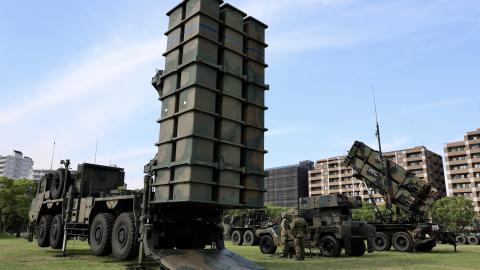
Recent conflicts in Europe and the Middle East have highlighted the changing nature of modern warfare across all domains, particularly with respect to integrated air and missile defence (IAMD). Specifically, the proliferation of low-cost drone and missile capabilities among a range of state and non-state actors has challenged traditional notions of Russia-Ukraine and US-Iran conflicts, which have highlighted both the rapid nature of technological development and the importance of industrial capacity to sustaining and prevailing in this domain.
These trends have clear implications for Australia, Japan and the United States (AJUS). Indeed, it is no coincidence that the three countries are already advancing their IAMD cooperation, creating a bespoke trilateral data-sharing arrangement and planning to hold a trilateral demonstration activity at Exercise Talisman Sabre 2027. This cooperation is being driven by a shared perception of the threat posed by China’s burgeoning arsenal of short-, medium- and long-range missiles, unmanned aerial vehicles, stealthy submarines and long-range bomber aircraft.
However, further progress on this agenda is complicated by a global shortage of missile interceptors and precision missiles; the challenge of adapting to rapid technological change; limited industrial capacity and available funding; incremental progress on missile supply chain integration; force structure weakness across the three countries; and moving from bilateral to trilateral approaches to operational planning for regional air defence.
Therefore, AJUS IAMD will require attention across multiple avenues of the trilateral defence cooperation agenda. This report presents the views of four policy thinkers and professionals from across the three countries on the current state of AJUS IAMD cooperation, identifying points of consensus between the three countries as well as a range of next steps for advancing collaboration. These include:
- Pursuing greater trilateral operational planning to establish effective divisions of labour between the partners’ short- and long-range air defence capabilities across a range of scenarios.
- Prioritising greater coordination on defence supply chains for missiles and interceptors, including harmonising and coordinating bilateral initiatives and finding an acceptable division of labour between the partners’ industrial bases.
- Exploring options for trilateral cooperative programs for new or upgraded missile interceptors and drones to minimise commercial and political barriers to industrial base cooperation.
- Including industrial and production requirements for IAMD capabilities into trilateral simulation and wargaming activities.