














Executive Summary
- Battlefield assessment. Moscow sustained pressure on Ukraine through missile and drone warfare, while Kyiv expanded strikes on Russian logistics hubs.
- North Korean assistance. North Korea is preparing to deploy large troop contingents to Russia as the two countries deepen missile and logistics cooperation.
- Ukraine’s air-defense challenges. Larger Russian missile salvos could overwhelm Ukraine’s air defenses, which are already strained by depleted stocks of interceptors.
1. Battlefield Assessment
Last week, long-range drone and missile warfare continued to shape the war’s attritional character beyond the front lines.
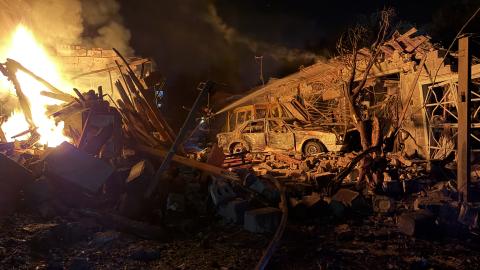
Russian forces launched a mixed-strike package against Ukraine overnight on August 10–11. The attack included Zircon hypersonic anti-ship missiles targeting Kyiv and Zaporizhzhia. Russia also launched Iskander-M and North Korean KN-23 tactical ballistic missiles from Kursk, Rostov, and Voronezh regions.
Moscow’s strike package also involved 120 unmanned aerial vehicles (UAVs), including Gerbera attack drones, Parodiya decoys, and Shahed one-way attack drones, some of which were reportedly jet-powered. Russian forces launched UAVs from Kursk, Millerovo, Oryol, and Primorsko-Akhtarsk, as well as from occupied Donetsk and occupied Crimea. Ukrainian air defenses reportedly intercepted, electronically suppressed, or otherwise neutralized 98 of the 120 drones launched by Russia.
That same night, Ukrainian drones struck logistics infrastructure operated by Wildberries, Russia’s largest e-commerce platform, in Voronezh Oblast. The attack triggered fires across a large area. Wildberries confirmed that it had evacuated its personnel from an affected facility.
In this strike, Ukrainian forces targeted a major distribution hub in Aleksandrovka, Novousmansky District, Voronezh Oblast. Since July 18, Ukrainian forces have reportedly targeted around 20 Wildberries facilities across Russia, including warehouses in Elektrostal, Krasnodar, Nevinnomyssk, Yekaterinburg, and St. Petersburg. Ukrainian strikes have reportedly burned at least 14 Wildberries warehouses, damaging approximately 27 percent of the company’s nationwide warehousing capacity.
Last week brought no significant changes in the ground war, except on the Sloviansk front. Visuals from the battleground showcased an increase in Russian first-person view (FPV) drone strikes. Some attacks took the form of “human safaris,” in which Russia forces deliberately target civilians.
The recent increase in FPV drone activity in urban areas suggests that Russia is mounting a push deeper into Ukraine’s defenses. Apart from the Sloviansk sector, increased combat activity and a heightened operational tempo characterized the overall battlespace. Pokrovsk and the Kostiantynivka sector remained the conflict’s most active flashpoints.
New trends in drone warfare continued to emerge. Visuals from tactical engagements between Russia and Ukraine increasingly show UAVs operating from naval drones, highlighting the cross-domain character of robotic warfare. This report will continue to detail important innovations in drone warfare concepts of employment (CONEMP).
2. North Korea Prepares for Large-Scale Intervention in Ukraine and Deeper Integration with Russia
North Korea’s contribution to Russia’s war effort is evolving from arms transfers and geographically contained combat deployments into direct force integration. Open-source intelligence and Ukrainian military-intelligence reporting indicate that Russia began preparations in June to absorb an additional North Korean contingent in Voronezh Oblast. The region in western Russia is emerging as a principal Russian reception and integration node for the next phase of North Korean deployments.
Initially, Kyiv estimated that Moscow was seeking 30,000 additional personnel from Pyongyang but revised this assessment to a range between 30,000 and 50,000 troops. In parallel, North Korea is deploying a missile detachment comprising roughly 90 personnel to the region for attachment to the Russian 112th Missile Brigade. This formation may operate six launchers supported by as many as 120 KN-23 and KN-24 ballistic missiles.
Russia has likely received combat-deployable missiles assigned to the 112th Missile Brigade, two of which it has already employed against Ukrainian targets. This deployment would place North Korean personnel directly inside Russia’s operational command-and-strike architecture. Such a dynamic could allow Pyongyang’s troops to gain combat experience while supporting sustained missile pressure on Ukraine.
A North Korean deployment on the scale now under consideration could allow the Kremlin to free Russian formations for frontline service while using North Korean troops in more demanding roles. Such a deployment would mark a fuller and more integrated phase of Pyongyang’s participation in the war, which could soon extend beyond Kursk Oblast into occupied Ukrainian territory, and potentially include offensive operations at critical flashpoints across the line of contact. Amid mounting Russian losses and Russian President Vladimir Putin’s determination to sustain high-tempo combat operations, a large North Korean contingent could impose additional attrition on an already strained Ukrainian military across an overstretched battlefield. Pyongyang’s tolerance for heavy casualties could further intensify pressure on Ukraine’s forces.
North Korea already transferred thousands of troops to Russia’s invasion forces in 2024. These soldiers helped Russian units repel the strategic Ukrainian salient in Kursk Oblast. A North Korean contingent roughly the size of one division may have remained in Kursk, although experts do not believe these troops are currently participating directly in combat operations. North Korea assigned a separate contingent of sappers and other military laborers to mine-clearance and reconstruction work in Kursk.
These personnel deployments rely on extensive logistical connections between Moscow and Pyongyang. North Korea has transferred millions of artillery and mortar rounds to Russia, along with 170mm-class Koksan heavy artillery, KN-23 and KN-24 tactical ballistic missiles, and multiple-launch rocket systems (MLRS). Additionally, four Russian cargo vessels conducted 64 voyages to North Korean ports between September 2023 and March 2025, moving nearly 16,000 ammunition containers to Russia.
Officials assess that North Korean deliveries provide roughly half of the ammunition Russian forces consume along some segments of the front lines in Ukraine. The supply lines connecting Moscow and Pyongyang have become a key structural enabler of Russia’s attritional war. For the Kremlin, North Korean assistance is increasingly more than a temporary expedient to cover isolated shortages.
North Korea’s emerging missile deployment to Russia represents a further escalation of this relationship. Russia first launched a North Korean ballistic missile against the Ukrainian city of Kharkiv in early 2024. Embedding a North Korean missile unit in Russia now would allow Pyongyang to observe launch operations, assess battlefield performance, refine targeting procedures, and use combat data to modify its weapons. Additional KN-23 and KN-24 salvos would increase pressure on Ukraine’s limited inventory of Patriot surface-to-air missile (SAM) interceptors and strengthen Russia’s capacity for sustained ballistic missile attacks against Ukrainian cities and critical infrastructure.
Analysis of open-source imagery further suggests that the Kremlin has accelerated road and customs infrastructure construction for the new bridge between Russia and North Korea. Open-source satellite imagery shows extensive concrete paving around the entrance to a new customs facility as well as roadwork advancing along the pavement between the customs complex and the bridge. The North Korean customs facility had appeared largely complete ahead of its originally scheduled June opening, but delays on the Russian side pushed the projected opening to September. Large stores of construction material and unfinished sections of the facility indicate that significant work remains.
The bridge carries strategic and symbolic significance. Once operational, the road connection between the two allies will add a more flexible overland channel to their existing rail and maritime network and facilitate the movement of personnel, military equipment, and ammunition.
The hostile nexus connecting Russia and North Korea also implicates the European and Indo-Pacific security theaters. Every North Korean weapon tested over Ukraine can provide Pyongyang with lessons applicable to future contingencies involving South Korea, Japan, the Philippines, or the United States. Pyongyang, therefore, is no longer merely replenishing Russian stocks but also using the war in Ukraine as a combat laboratory. At the same time, Moscow is using its North Korean connection as an increasingly important source of ammunition, missiles, specialist personnel, and potentially massed ground forces.
3. What to Look for in the Coming Weeks
As Ukraine confronts a critical shortage of air-defense interceptors, it will be important to track the size and composition of Russia’s missile salvos. Robert “Magyar” Brovdi, the commander of Ukraine’s Unmanned Systems Forces, assesses that Russia can now launch simultaneous salvos of up to 77 ballistic and cruise missiles and is seeking to increase the capacity to 200. Even partial progress toward that objective would significantly increase Russia’s ability to saturate Ukrainian air defenses, deplete Kyiv’s already limited interceptor stocks, and expose major Ukrainian cities to increasingly destructive ballistic missile attacks.