















Executive Summary
- Battlefield assessment. Russian forces continued to pressure Ukraine, while pro-Kremlin sources claimed that Russian drones now possess artificial intelligence–enabled capabilities that can recognize and target combat uniforms.
- Two assassination attempts. A reported attempt on the life of Russian General Alexander Chayko in Moscow followed a suspected Russian operation targeting a Ukrainian brigade commander, signaling a potentially escalating intelligence-led shadow war.
- Russian air raids. Russia escalated its air campaign, striking Kyiv with more than 30 ballistic missiles on August 5. In July, Russian forces also launched roughly 5,000 Shahed-type drones and more than 8,300 glide bombs.
1. Battlefield Assessment
Russian offensive operations remained persistent over the past week, driving the war’s operational tempo to an exceptionally high level. Ukrainian military reporting recorded more than 270 tactical engagements on some days. The principal flashpoints remained unchanged.
Kostiantynivka continued to serve as the focal point of Russian combat operations, while the Pokrovsk and Huliaipole sectors also saw heavy fighting. Pro-Kremlin news outlets claimed that Russian forces are attacking Ukraine with AI-enabled drones that can recognize military uniforms. Frequent drone-on-drone warfare continued to dominate the battlespace.
Newsworthy events also unfolded hundreds of miles from the front lines. According to Ukrainian sources, an explosion at Moscow’s Balzi Rossi restaurant on August 1 reportedly targeted Russian Aerospace Forces Commander General Alexander Chayko. The blast killed five people and injured 21 others, although Chayko’s condition—and whether he was wounded in the explosion or even present at the restaurant—remained unclear. The general’s daughter, Maria Chayko, was reportedly among those injured.
The Russian opposition news outlet Astra reported that the restaurant had been closed to the public for a private gathering on the evening of the blast. Witnesses also observed vehicles bearing black license plates, commonly associated with the Russian military and security services, outside the restaurant. These open-source indicators suggest that the event may have included senior members of Russia’s defense establishment.
According to initial accounts of the incident, a woman attempted to enter the restaurant carrying a box described as a gift. A security guard intercepted her and began inspecting the parcel, at which point it exploded. The Russian newspaper Kommersant reported that the device was detonated remotely.
The incident followed a suspected Russian assassination attempt against Ihor Obolienskyi, the commander of the 2nd Khartiia Corps of Ukraine’s National Guard, in Kharkiv in late July. No evidence has publicly established a connection between the two incidents. Nonetheless, the timing of the two attacks raises the possibility of an expanding campaign of intelligence-enabled operations against senior military personnel inside Russia and Ukraine.
2. Russia Ramps Up Its Air and Missile Raids
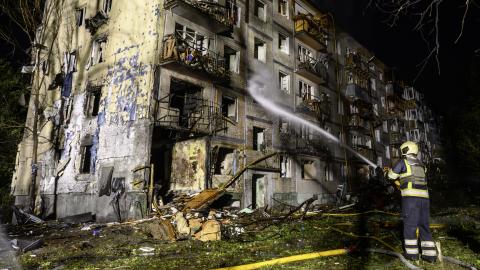
Kyiv came under a heavy Russian ballistic missile assault early on August 5. Preliminary Ukrainian reporting indicates that Russian forces launched more than 30 ballistic missiles toward the Ukrainian capital, prompting the activation of air defenses across the area. In Kyiv’s Holosiivskyi district, strikes destroyed a private residence, possibly trapping survivors beneath the rubble.
A strike on non-residential buildings in the same district reportedly caused an ammonia leak. At the site of another strike, secondary explosions damaged an ambulance and injured its driver.
Moscow has increased the frequency of its air raids this summer. In July, Russia launched roughly 5,000 Shahed-type one-way attack drones against Ukraine, according to open-source tracking estimates based on Ukrainian Air Force reporting. Ukrainian forces claim to have intercepted around 4,300 of these drones, an estimated interception rate of approximately 87 percent.
Nonetheless, more than 650 Russian drones penetrated Ukraine’s defensive screen. Of these, 479 reportedly struck their targets or adjacent impact areas. The median Russian attack this summer has involved 134 drones, highlighting Moscow’s continued reliance on large-scale saturation strikes.
Russian glide-bomb operations also reached a new wartime high in July. During the month, Russian combat aircraft released more than 8,300 guided aerial bombs against Ukraine, according to figures published by Ukraine’s Defense Ministry on August 4. This total surpasses the previous record of 8,266 bombs released in June 2026.
This trend underscores Moscow’s growing reliance on inexpensive standoff airpower to support its ground campaign. Commonly described as KAB aerial-bomb variants, many of these munitions are Soviet-era free-fall bombs retrofitted with wing and guidance kits. Russian Su-34 aircraft can release the bombs from tens of miles away, frequently beyond the effective engagement envelope of Ukraine’s frontline air defenses. Depending on the variant, the bombs can carry payloads ranging from several hundred kilograms to approximately three metric tons.
Operationally, Moscow employs glide bombs against bridges, command posts, cities, fortified positions, and Ukrainian drone teams identified by Russia reconnaissance assets. The larger significance of these munitions, however, lies in their ability to help Russia prepare the battlefield. Sustained bombardment with glide bombs can systematically demolish frontline settlements before Russian ground forces reach them.
The Ukrainian city of Dobropillya illustrates this dynamic. The city’s degradation demonstrates that Kyiv possesses no consistently reliable or economical countermeasure to Russia’s use of glide bombs. The bombs remain less accurate than advanced precision-guided munitions but possess sufficient explosive power that makes them devastating in urban terrain even when they miss their intented targets. Russia’s growing use of glide bombs against Sloviansk, Kramatorsk, Kharkiv, Zaporizhzhia, and other populated areas of Ukraine is producing mounting civilian casualties and accelerating the destruction of Ukraine’s defensive urban belt.
3. What to Look for in the Coming Weeks
Russian ballistic-missile pressure on Ukraine is rapidly gaining momentum and straining Kyiv’s limited inventory of high-end air defenses. The coming weeks could therefore bring significant developments in Ukraine’s efforts to develop and field domestically produced interceptor systems capable of providing a more scalable response to Russia’s expanding ballistic-missile threat.