















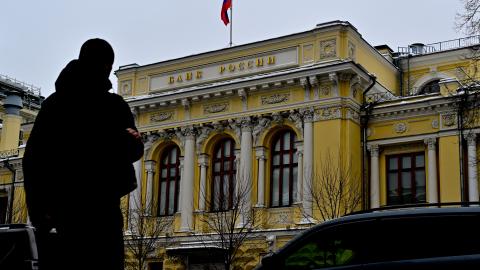
No one knows how the war in Ukraine will end, but it appears to be pushing the Russian economy toward crisis. Bloomberg reported recently that senior Russian officials have warned Vladimir Putin that wartime spending is becoming unsustainable. Mr. Putin acknowledged in April that “the trajectory of macroeconomic indicators is currently below expectations.” In May, Valery Gartung, a longtime member of the State Duma, voiced his alarm during a plenary session: “What are we going to do about it? Print money? Like in ’92, when prices were rising by 30% every week?”
Russia’s currency-printing presses are running at full speed. In the first four months of 2026, the budget deficit reached 5.87 trillion rubles ($81 billion), exceeding the government’s full-year target of 3.79 trillion rubles. Cut off from international capital markets, Russia depends on domestic bonds to fund its shortfall. Several bond auctions in 2024 and one in 2026 failed due to weak demand. Since then, the banking sector—responding to incentives from the Bank of Russia—has become the primary buyer of government debt, purchasing bonds at elevated yields. As Iwona Wiśniewska of the Warsaw-based Center for Eastern Studies argues, this structure increasingly resembles a self-reinforcing finance cycle in which the state relies on the domestic banking system, supported by central-bank liquidity, to sustain rising budget deficits at growing fiscal cost.