













Last week, Russia launched the largest airstrikes of the war so far, using hundreds of drones and dozens of missiles to strike targets across Ukraine. Civilian targets seem to be Moscow’s preference. Sometimes, Russians will even strike a residential building, wait a few hours for first responders to arrive, and then purposely strike the same location again.
This savage way of war, first perfected by Russia against the people of Grozny in the 1990s, and later refined with its atrocities in Bucha, is now being delivered from the skies against Ukrainian civilians.
Surprisingly, the large number of drones is not the main problem. Ukrainian innovation and creativity have allowed it to develop counter-drone systems unmatched globally. Even the U.S. military is now relying on Ukrainian technology to defend against Iranian drones in the Middle East. And when it comes to Russia’s slower but still deadly cruise missiles, the F-16s provided by Ukraine’s partners can get the job done.
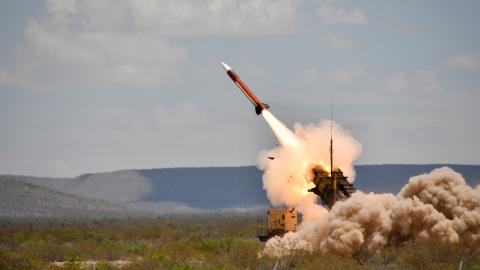
The bigger threat comes from ballistic and hypersonic missiles, against which there is only one combat-proven defense: the PAC-3 interceptor missile fired from the MIM-104 Patriot air defense system.
I have just returned from Odesa, a city under daily attack. Speaking to me on the condition of anonymity, senior officials suggested that Ukraine’s stockpiles of PAC-3 interceptors are critically low. Reading between the lines: Ukraine is out. This means Russia’s stocks of ballistic, aeroballistic, and hypersonic missiles such as the Iskander-M, Kinzhal, and Zircon, respectively, can be used with impunity. If the situation seems bad now, wait until next winter when electrical grids and heating systems are under constant attack in freezing temperatures.
But the situation does not have to be this way. While there is an immediate need for these interceptors by the United States and its partners in the Persian Gulf to counter the Iranian threat, there are still meaningful steps that can be taken to help Ukraine.
First, Europe needs to empty its warehouses. There are multiple countries across Europe that face no immediate air threat and have different variants of PAC-3 interceptors collecting dust. These weapons are of no use to the overall security of the trans-Atlantic community sitting in storage. Instead, they should be transferred to Ukraine immediately.
For some countries, especially in Eastern Europe, such a move will be politically difficult. But for any country seriously worried about the air threat posed by Russia, surely the best place to counter it is over the skies of Ukraine now, not over Western European Skies later.
Second, some European countries have ordered PAC-3 interceptors and are waiting to take delivery. These countries should allow Ukraine to take their spot in the order queue. Spain is a good example. Considering the current threat environment, waiting a little longer for Patriot interceptors is a reasonable sacrifice for Madrid to make. With Ukrainians fighting for their survival now, they do not enjoy the same luxury of time.
Third, the U.S. and Europe need to work together to crack down on Western-made components that keep finding their way into the manufacturing of Russian ballistic missiles. It is estimated that Russia can produce three ballistic missiles a day, which helps explain why Russian President Vladimir Putin can carry out a large-scale attack about every seven to 10 days.
More than four years into this conflict, it is inexcusable that Russia can still evade sanctions and Western parts are still found in the debris of Russian missiles.
Finally, the U.S. should license Ukraine to manufacture the PAC-3 interceptor in-country. The Ukrainians asked the Biden administration for permission but were refused. Ukrainian President Volodymyr Zelensky recently asked the Trump administration for the same thing, and the president should say yes.
Today, the U.S. can only produce roughly 50 PAC-3 interceptors per month. That is nowhere near enough to meet the demands of America, Ukraine, and allies around the world.
Ukraine’s defense industry has shown enormous capacity, even under wartime conditions. Allowing Ukrainians to manufacture these interceptors would scale up production, give Ukraine what it needs to defend its skies, and make more interceptors available to the U.S. and its allies.
For the first time in almost two years, Ukraine is on the front foot on the battlefield. Its long-range strikes are crippling Russia’s oil production. Its medium-range strikes are crippling Russian logistics. Slowly but surely, Ukraine has been taking back territory. But in response, Russia is striking Ukraine where it is most vulnerable: its civilian population.
Now is the time for Ukraine’s partners to be decisive and demonstrate political courage, creativity, and action. They can make a major difference — and possibly even make history — by giving Ukraine a critical capability it needs at one of the most crucial points in the conflict.