















Chinese leader Xi Jinping isn’t dawdling when it comes to science. He has directed his country to build a network of enormous fusion-energy facilities that could strengthen its ability to design and validate nuclear weapons without explosive testing. The United States has no comparable program, but it does possess a unique advantage: Private companies are already financing and building essential next-generation fusion technologies.
Beijing doesn’t benefit from such an ecosystem, and Washington still leads across much of nuclear-weapons science and development. The Lawrence Livermore National Laboratory in California, for example, is still the only facility in the world to achieve fusion ignition. But scientific leadership doesn’t guarantee the experimental capacity, industrial base or construction speed that the U.S. will need for effective deterrence. The U.S. National Nuclear Security Administration, or NNSA, knows that well. It faces the increasingly difficult mission of modernizing the nuclear stockpile, producing more warheads and keeping pace with China’s rapid buildup, all with limited resources.
The private sector offers the agency a way to stretch its resources further. Rather than try to build every new fusion capability itself, the NNSA could create a competitive, milestone-based partnership with private firms, while reserving certain highly sensitive functions for the government-run national laboratories.
The model has already proved effective before. In 2006, NASA selected two companies to create systems capable of delivering cargo to the International Space Station. One was a four-year-old start-up named SpaceX. In choosing it, NASA’s Commercial Orbital Transportation Services program departed from the usual contracting model. The agency paid the companies only as they achieved technical milestones. The firms put their own capital at risk but retained ownership of what they built, allowing the same systems to serve customers beyond NASA.
The results were catalytic. NASA invested about $788 million in the program, a fraction of the billions that the agency estimated traditional procurement might have cost. The partnership helped produce two cargo-delivery systems and gave SpaceX the patient capital and demanding customer it needed to develop capabilities that later served both government and commercial markets.
The NNSA now faces a comparable opportunity in what’s known as inertial confinement fusion (ICF). The process uses lasers, pulsed electricity or other so-called drivers to compress tiny fuel targets — usually hydrogen-filled capsules smaller than a grain of rice — and create fusion conditions. The resulting temperatures, pressures and radiation environments allow scientists to study weapons materials and validate stockpile models without explosive nuclear tests. Though these capabilities have traditionally resided at NNSA-run national labs a new generation of companies is pursuing similar technologies to produce commercial fusion energy. Such ventures are primed to help support the country’s weapons-science mission.
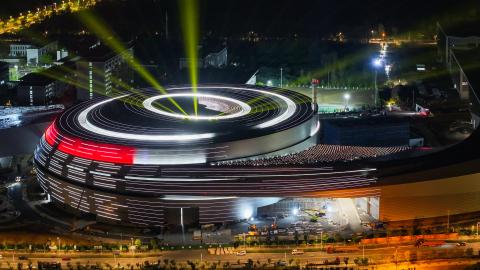
China recognizes this dual-use potential. It is investing roughly $10 billion in new laser and pulsed-power projects across at least five major ICF facilities, three of them already under construction, that will support military and commercial energy ambitions. The U.S., meantime, remains heavily dependent on aging facilities inside national labs, with major improvements years away and no settled plan for next-generation successors. China is thus poised to gain an edge in nuclear designs, weapons simulations and testing the effects of nuclear weapons on military systems, while building a springboard into commercial fusion energy.
Congress could direct and fund the NNSA to establish a five-year, dual-use ICF capabilities program on the NASA-SpaceX model. The agency and its labs would specify the necessary physical environments and security protections, then award competing companies as they successfully deliver. Industry would contribute the capital, engineering talent and construction capacity.
This would complement, not duplicate, the Energy Department’s existing milestone program for commercial fusion. That effort focuses on pilot plants capable of generating electricity. Their products are essential but unfit for security purposes. A NASA-style program investing in distinctly weapons-related capabilities would ensure that private facilities are designed from the outset to pursue multiple objectives — civilian and military — with appropriate government access and security.
Nor would this privatize stockpile stewardship or replace the national labs. Classified weapons designs, simulation tools and effects data must remain tightly controlled. Many experiments should occur only at government sites. Commercial approaches might fail, change direction or prove poorly matched to NNSA requirements. That’s why the agency should support multiple technologies, pay for demonstrated results and preserve core government nuclear-weapons science capacity.
Keeping industry at arm’s length, however, would deprive our nuclear-weapons enterprise of vital American ingenuity and capital. It could leave the NNSA trying to retrofit privately financed facilities after their designs have hardened, while watching valuable capabilities develop without any connection to the nuclear-weapons mission. Early partnership would be cheaper, safer and more useful. The choice is between an integrated American system that combines public missions with private capital and a fragmented one facing off against China’s coordinated buildup.
Twenty years ago, NASA understood that preserving U.S. leadership required changing how government worked with industry. The NNSA can make the same leap. China is building, but American companies are, too. Washington can unite the national labs and private fusion firms before the next generation of facilities is built without national security needs in mind. As SpaceX showed, commercial partnerships created to meet certain government needs can help unlock entire industries and strategic advantages.