







In this week’s episode of China Insider, Miles Yu reviews the recent threat intelligence report released by Anthropic (the developers of Claude) that details how several Chinese foreign actors used the artificial intelligence platform for military and security activities. Next, he covers the recent BRICS summit in New Delhi and highlights the concerns that participating countries raised concerning Middle East security and unilateral sanctions. Finally, Miles looks into an emerging trend in which workers at Chinese companies’ foreign divisions are using new tactics to address unfair labor practices and violations.
China Insider is a weekly podcast project from Hudson Institute’s China Center, hosted by China Center Director and Senior Fellow, Dr. Miles Yu, who provides weekly news that mainstream American outlets often miss, as well as in-depth commentary and analysis on the China challenge and the free world’s future.
Episode Transcript
This transcription is automatically generated and edited lightly for accuracy. Please excuse any errors.
Miles Yu:
Welcome to China Insider, a podcast from the Hudson Institute's China Center. I am Miles Yu, senior fellow and director of the China Center. Join me each week for our analysis of the major events concerning China, China threat, and their implications to the US and beyond.
Colin Tessier-Kay:
It's Tuesday, September 15th, and we have three topics this week. First, we look into the threat intelligence report released by Anthropic, developers of Claude AI, detailing the use of the platform by several foreign actors for security activities and how China fits into the landscape. Next, we cover the BRIC Summit held in New Delhi and highlight the concerns raised among the participating countries over ongoing Middle East security and unilateral sanctions. Finally, we look into an emerging trend among the Chinese labor force involving new labor rights advocacy tactics exercised by the workforce aimed at Chinese companies' foreign endeavors to address unfair labor practices and violations. Miles, great to be with you again. How are you doing this week?
Miles Yu:
This week is very good and glad to be with you again, Colin.
Colin Tessier-Kay:
Great to hear. So up first today, some AI news, Anthropic creators of Claude AI said in a threat intelligence report on Thursday that several actors, including Chinese-based intelligence actors, had used its models for activities ranging from weapons development and cyber operations to surveillance and fraud. Specifically, some of the searches detailed in the report involve things like Taiwanese air defense systems, research into microwave weapons, Chinese domestic cyber operations, as well as religious and political surveillance intel, so we'll look further into some of the specific use cases that Anthropic identified here. But before we get too far, Miles, can you give us an overview of the threat intelligence report issued by Anthropic and the extent to which China is involved?
Miles Yu:
Well, Anthropic's threat intelligence report last week was like an atomic bomb dropped onto the Earth. And it was a shock both inside and outside of China. Let's just say outside of China. So Anthropic obviously aimed at China, but also it adds some minor figures— Iran, Russia— but the 90% other than that is about China. The Chinese... Basically, they have their AIs. They say they're good, even better than American AIs, but that's not the case because Anthropic basically indicates that Chinese AI companies, particularly Alibaba, Z.ai, all those major companies, their capabilities were basically heavily dependent upon Anthropic and OpenAI, American companies. So what it did was that, the Chinese customers, they were bound to ask only China-developed AI companies for answers. So the Chinese military, Chinese intelligence, Chinese weapons designers, they all ask, say, Alibaba for answers. Alibaba could not answer them, so they basically forwarded those questions from Alibaba's customers— those Chinese intelligence people, the weapons people, to Claude, to Anthropic's AI. So Anthropic's answers were given to Alibaba's customers as if it's from Alibaba. So this is basically distilling, right? And the interesting thing is that the scale of such practice is mind-boggling. Anthropic's threat intelligence indicated that in the six months this year since February alone, Alibaba has done such cheating transactions through Claude over 150 million times. In other words, Chinese customers, all the state actors ask Alibaba to do things, pretty much over a hundred million times— and they use Claude answers as their own. Now, what really is important is that the Claude threat intelligence indicates that the type of questions that Alibaba asked Claude to answer include some mind-boggling details, including: how to capture and target Taiwan, how to defeat American electronic warfare; and also indicate in minute and mind-boggling details of China's repression system: how State Security can enhance surveillance and do transnational repression by identifying overseas dissidents.
For example, they have 12 targets in Taiwan and they have 16 software modules for electronic warfare for the PLA. They have something to investigate about American directed energy weapons, so lasers, for example. They want to know how to break and defeat America's efforts. They also conducted enormous research, so-called "Stability Maintenance," 維穩 ("wei wen"), and transnational repression 跨國鎮壓 ("kua guo zhenya"). For example, they ask Anthropic's AI model, AI program, to analyze politically sensitive incidents, monitor overseas dissidents, the Uyghurs, the Tibetans... particularly Uyghur targets in Syria where there is a Uyghur brigade. And also they want to monitor Hong Kong democratic activists. The really interesting thing is, this is a big shock for the overseas community that Anthropic is basically throwing in the open. The scale and the content of Chinese AI development is just mind-boggling. Now inside China, Anthropic's threat intelligence also caused a political earthquake because this is probably the biggest intelligence leak in the PRC's history.
You've got virtually every major Chinese intelligence and military agency asking Alibaba and Z.ai, those companies questions. And they're all forwarded to Anthropic because of the AI distillation opportunities practiced by these Chinese companies. That means that American intelligence is suddenly having a windfall, a windfall of this incredible treasure trove from the Chinese system. For example, they want to know how to monitor a suspect, a political dissident in China in some kind of very complicated urban terrain. To do that, one of the Chinese questions was... they have to really provide Alibaba with all the video footage and camera locations and also the control mechanisms, commands, [and] code words to Alibaba to come up with the best scenario. Alibaba instead forwarded that, asking Claude to provide answers. And that information, this footage was now in American hands. This basically freaked out the Chinese authorities. You can see immediately you have this internal spasm, top-down.
The Chinese Minister of State Security, or the MSS chief, immediately published an article saying there is a foreign threat and AI is particularly harmful. He lists six major areas where foreigners can penetrate into the Chinese state secrets system. But what he did not say, and what he clearly was responding to, was how the Chinese AI companies are leaking these state secrets on a massive scale because China's cheating method itself is very vulnerable. What I'm saying here is... I think again... there is a Chinese saying, "搬起石頭砸自己的脚" (ban qi shitou za ziji de jiao). That is, you raise a piece of a rock and drop it onto your own feet, and your own self gets hurt. That's basically what happened here. This is a very, very big deal for both Chinese and foreign entities in terms of understanding the regime, understanding how the regime works, and also understanding what they're working on.
And also, there's now a side effect on American AI. You see, immediately, the bosses at Anthropic and Grok and OpenAI, even President Donald Trump, everybody has an opinion about how to basically stop this AI monster, particularly in light of the Chinese discovery in China about Chinese activities. So Anthropic's chief, for example, he urged, "Slow down, slow down. Let's just not do any more harm." What he has failed to understand is that if we slow down, the Chinese are going to do more harm. You cannot really appeal to the Chinese system through reason and rationality. That's why President Trump responded and said, "Hey, listen, this whole idea about slowing down AI is just ridiculous." I think we better know very quickly how to manage the Chinese threat in AI. I think this is going to be a major topic between Xi Jinping and President Trump next week when the General Secretary of the Chinese Communist Party comes to town to meet with the President.
Colin Tessier-Kay:
Yeah, we'll circle back to the response by a Chinese state and then the implications for next week's summit. But before then, I wanted to highlight some of the cases identified in the report in case our listeners haven't had the chance to look through it. I encourage them to go through and take a look because it is quite interesting and specific as well. Anthropic said specifically a Chinese-based actor used Claude to help develop specifications and fire control software for an anti-torpedo system intended for the Chinese Navy. The actor used Claude to produce a technical proposal of more than 200 pages to compare the system with US Navy technology and simulate hostile technical reviews to improve the proposal. Additionally, a Chinese-based defense intelligence actor used Claude to research foreign high power microwave weapons. This one was pretty interesting, identifying components and suppliers and trace supply chains that could help reverse engineer the weapons, develop countermeasures, draft briefings for senior Chinese Communist Party officials and military and state security officials.
They also went as far in some cases as far as cybersecurity operations as well as surveillance. Anthropic cited China linked actors using Claude to compile intelligence on targets, including Catholic cardinals, Taiwanese Christian leaders, Tibetan Buddhists, dissidents and activists as well. So within the scope of this use, Miles, how concerned should we be about the national security implications here? What is the efficacy of using these searches for the Chinese actors and how effective will these measures be in achieving their goals?
Miles Yu:
For those of us who have been watching China on a daily basis, nothing is surprising. We knew all along. What really is amazing is that Anthropic's threat intelligence exposed it to the wider world. Everybody's shocked because all the stuff that we know, or have been known to only a small community of China watching... and particularly this hardcore intelligence as you listed, only visible previously to CIA and NSA and FBI, all the other intelligence organizations... Now we know. One really interesting thing is that the Chinese regime is completely oblivious to international concerns on public health. One of the major discoveries by Anthropic is that there are still very active units inside the People's Liberation Army that are actively working on gain-of-function research on deadly viruses. They're weaponized. This is the PLA. These are the people who are making weapons, biological weapons, as if nobody has learned the lessons from the Wuhan abomination six years ago.
This is a regime that is determined to dominate the world through technological and military means as well as through the United Front, and trade, and economics. What we're seeing here is a regime that is much more beguiling and much more threatening and much more determined for global domination. I think that this is not only a wake-up call, but also it tells us how formidable the task is in front of all of us.
Colin Tessier-Kay:
I'm not sure if you saw this today, but China's Ministry of Foreign Affairs spokesperson, Guo Jiakun, responded to the call from the head of Anthropic here for the US to curb China's artificial intelligence capabilities saying, "Fear mongering, confrontation, and vicious competition will only disrupt the process of global AI governance, which serves no one's interest." This development comes as both President Trump and Xi, like you mentioned, Miles, are slated to meet and discuss the very issue of AI governance next week in DC. So how do we measure China's response to the report so far and how might this development impact what the leaders will eventually talk about in next week's summit?
Miles Yu:
The Chinese foreign ministry spokesperson— they're disgusting human beings. They're worse than Baghdad Bob. They're worse than the Soviet spokesperson because they can never be wrong. They say something that's so vacuous. It doesn't mean anything. I can guarantee you heads were turned within those Chinese AI companies. There's already a report about the arrest and even detention of one of the major offenders in this whole episode, that is Kimi. Kimi is one of the major players in the distillation campaign. You will see how Alibaba will be dealt with because, by relying on American AI apps to do their own work— dirty work— they are inadvertently leaking this massive treasure trove of Chinese intelligence and their inner workings.
Colin Tessier-Kay:
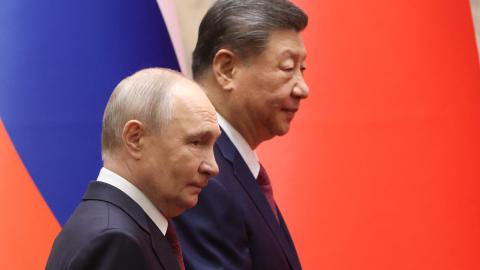
Yeah, it'll be interesting to see how this all eventually plays out in next week's conversations. But moving to our next topic for today, the BRICS group of emerging economic countries met over the weekend in New Delhi, attended by Russian president Vladimir Putin, Chinese president Xi Jinping, and counterparts from the other eight BRICS members, including Iranian President Masoud Pezeshkian. From the meeting, the leaders expressed concerns over the ongoing conflict in the Middle East and especially toward unilateral sanctions not authorized by the UN Security Council, citing in a joint statement, "We call for the elimination of such unlawful measures which undermine international law and the principles and purposes of the UN charter." So Miles, what should we know about the latest BRICS meeting here and anything of interest from the joint statement that stood out to you?
Miles Yu:
Just, like, hot baloney... when BRICS condemns unilateral tariffs without UN Security Council approval. Did the UN Security Council approve Russia's invasion of Ukraine? Did the UN Security Council approve China's aggression in the South China Sea, Taiwan Strait, and East China Sea? Did the UN Security Council ever reach a unanimous condemnation of those aggressions of its members on the permanent Security Council seats? This is just hypocrisy. What I think is that BRICS is very interesting. BRICS is an organization of contradiction. It has a common ideology of being against the American-led, the Western order, but it has very little to offer as to what it's for. You cannot build a coalition or alliance based upon what you don't like. You have to offer something. Obviously, what can you offer? The Chinese model of governance, Russian model of governance, Iranian model of governance? It is really hard to say.
What I think, there is also... there is a very different understanding of what the purpose of BRICS is among these members. You mentioned about India and China. I will say China definitely wants to use BRICS as an anti-US alliance. There's very little doubt about that. China wants to use BRICS as an anti-American alliance. I'm not sure that China really has the right judgment because not every member of BRICS is anti-American. They want to promote the Global South. They want to increase the influence and status of non-Western countries in the old tradition of Indian led non-aliance during the Cold War.
But countries inside BRICS, like India and Brazil, are not necessarily anti-American. They're not really so interested in de-dollarization, for example. They're not interested in putting every agenda as anti-America. India wants to have a good relationship with the West, particularly the United States, because these countries are increasingly dependent upon the US market and US technology. And also, they don't necessarily go along with the Chinese and Russians, Iranians because those are dictatorships, right? India and Brazil... countries like India, Brazil wanted to have an expansion of their roles in organizations like the United Nations, particularly the Security Council. China is virulently against that. As a matter of fact, I think China is leading the global campaign against India... countries like India, Japan, Germany, and Brazil joining— on a more permanent basis— the UN security apparatus. So in a way, the real enemy of BRICS' mission is China, because you have the great wealth of China there in BRICS to prevent a country like India in particular [from becoming] a permanent member of the UN Security Council.
Also, about membership qualification: you also have some kind of disagreement there. Countries inside BRICS like India, Brazil, Indonesia... to some extent wanted to have a norm-based membership qualification. China, no. Whoever is anti-America can join— that's why Iran got in. That doesn't necessarily say that there are no real accomplishments of BRICS. So far, de-dollarization is going nowhere, but there is something, not significant, but it is important to point out. That is, BRICS does have a BRICS investment bank. It's there, doing nothing, but at least there's something that their people can talk about something specific about the global financial system. I don't think that's going anywhere because the US is dominating the globe. The US dollar is the de facto reserve currency for international business transactions. You look at the Renminbi, this is one of the reasons why China cannot really be the leader of the BRICS.
BRICS does also have a reserve contingency fund. That's about over a hundred or some billion dollars. It's not big, but it's sitting there. But that's the only tangible result I can think of. Within the BRICS countries, particularly India and China, there is a clash of ambitions. I mean, India now is the host. Prime Minister Modi is a superstar there. This guy is charming. He speaks English. He moved with ease, and so he attracted internal attention. Xi Jinping wants to be the de facto leader of the globe, of the universe. He is so accustomed to be this grandiose, vainglorious role as the leader, not telling the people, that can tell the world where to go, what to do, 指明方向 ("zhi ming fangxiang" = "clearly pointing the way"), and he's not used to that kind of role in the secondary position. So that's why you see that Xi Jinping looks really uncomfortable in New Delhi.
He doesn't look well physically, but his mental state is also kind of questionable. He was not met by the prime minister in the airport. He showed up in the conference and he looks really, really stern and... no smile. He probably didn't understand a word of what the heck is going on. And in the middle of his speech, Prime Minister Modi, always very ebullient and high-spirited, he looked to his left shoulder and looked at Xi Jinping, who was looking not very well. He said, "No, be okay." He asked twice, "Are you okay?" It's kind of a very, very funny moment over there. On the other hand, Xi Jinping actually skipped the banquet hosted by Modi at the end of this BRICS Summit. He just left town early. I mean, that's not very nice. But nevertheless, he feel uncomfortable there. And, there was nothing substantial at all, either during the official meeting or on the sidelines, about this ongoing India-China border clash.
There was not even a talk, I don't think... India, China have this terrible border clash, the intensity of which really rivals some of the other border clashes China had with say, for example, Japan or with the Philippines. It turned deadly. Six years ago, 24 Indian border guards were bludgeoned to death by the Chinese agents over there. This is an ongoing issue. I don't think there's anything substantial here. What really is interesting is that Xi Jinping, I think he went to India reluctantly. He wasn't given the spotlight, and he wants to be the one who tells the world what's going on, so his ego, his feelings were hurt. So that's why he went home very quietly without much glory. The Chinese media... Chinese citizen journalism is having a field day mocking him; every single move here looks very awkward.
Colin Tessier-Kay:
Yeah. Those are some really interesting points to pick on here because the UN Security Council apparatus, and at least just the UN in general seemed to be a focal point of this meeting. And Xi, with the limited visibility that he had at this summit in particular, did issue statements or at least spoke at the summit saying, "China will work with BRICS members in playing its due role to forge peace in the Middle East and that BRICS countries should serve as vanguards for maintaining peace and stability and oppose violations of other countries' sovereignty." Nothing terribly new here, at least in terms of scope and intention by Xi to increase China's global footprint. But given what you detailed, Miles, is there anything between the lines that stands out to you? More broadly, how has China's role within BRICS evolved over the past couple decades here?
Miles Yu:
This is just the height of hypocrisy. You got the three of the most aggressive, most revanchist states in BRICS: Russia, China, and Iran. They invaded people left and right. And then they were saying, "Hey, listen, we are urging the world to show respect for sovereignty and national dignity." This is just absolutely bizarre. I mean... BRICS... you cannot have any convincing power when you have members like that joining the statement urging mutual respect and non-aggression. It's a farce, in a way.
Colin Tessier-Kay:
Turning to our final topic today, we track an emerging development within the Chinese labor force that aims to secure leverage and ongoing labor disputes and advocate for increased worker rights. Several researchers have been following a labor dispute at Xingyu Automotive Lighting, a publicly traded car lamp maker in Changzhou in Jiangsu province, where highly skilled workers have complained not only to domestic authorities, but to the Hong Kong Stock Exchange and other avenues where Xingyu is seeking another public listing, as well as to customers of vehicle manufacturers that source their lighting components, including Volkswagen, Mercedes-Benz, and BMW, which have since prompted responses from each of the major manufacturers. But before we get too far into the story, Miles, what exactly is this new tactic? And walk us through the chronology here with the Xingyu dispute.
Miles Yu:
China is the world's workshop. That means it's the world's sweatshop. The prevailing work hours are 996. 996 means that every worker must work every day from nine o'clock in the morning to nine o'clock in the evening, six days a week. That's 996. All the major companies in China, every one of them treats this as if this is the golden rule. The government backed [this] up. This is a severe violation of international labor law. That's why you have China as the world's sweatshop. Right now, of course, the Chinese economy is tanking. You got massive unemployment among the youth.
This Xingyu Lighting Company is a major provider of all the light fixtures for automobile makers, particularly in Europe. You mentioned Volkswagen, Mercedes, and BMW in particular. So they're making very good ones, but they are based upon the sweat work of the workers.
This particular case: Xingyu is a company based in Changzhou, Jiangsu province, and they recruited highly educated graduates for research and development positions and technical, very technical; they're well trained. Those were graduates of major universities with degrees like a bachelor's of science, and your master's, and a few PhDs, actually. They were hired there, but within three months they were told: "you got to go."
Or, you have to really go to the plant to tighten the screws, doing manual work. There is no labor dispute mechanism in the real sense, in Chinese organizations, Chinese companies, in the Chinese system. Chinese HR is a joke. These graduates, these highly educated people who are facing this dilemma, decided: the Chinese system doesn't work. So they appealed to the customers of this Xingyu company, and they sent complaints to Volkswagen, to BMW, to Mercedes. And this company actually is on the verge of being listed on the Hong Kong Stock Exchange. There's got to be some kind of reputational cost there. They also sent their complaint to the Hong Kong Stock Exchange. Those companies, particularly Volkswagen, BMW, Mercedes, had their own problems in the past. For example, Volkswagen famously, infamously fixed its emissions meter in the US market, so it was fined billions of dollars for the violation.
So they are very sensitive to these kinds of labor violations, because the US has very strong slave labor enforcement laws in its exports and imports mechanism. They responded, they launched immediate investigation into potential labor, ESG, and reputational exposure. So these companies acted very quickly. When these major customers took this complaint very seriously and Xingyu got scared, they immediately rehired those people and improved their conditions. This is actually one of the rare cases that Chinese company bosses, Chinese capitalists actually proactively reacted. This is all because of complaining abroad. This is called 告洋状 ("gao yang zhuang" = "petitioning abroad") which is very important. This actually is very interesting. For those people, millions of petitioners in China, because there's a lot of injustice at every societal level in China, they learn something. You go to the White House, you go to the White House petitions office, you see on some items, for example, restriction on travel abroad and religious persecution, you get a lot of Chinese petitioners to the White House to solve their problems.
This actually is a huge embarrassment to the Chinese government because the Chinese government is not for the people, of the people, and by the people. This is a problem, and I think this is a trend. It shows that globalization has created external enforcement mechanisms that Chinese civil society lacks internally. The system is collapsing because the system does not really work according to international law. In this case, it is the workers themselves that forced the Chinese company to comply with international law. Hopefully, this will become a major trend.
Colin Tessier-Kay:
Yeah. The domestic reactions have been rather varied and interesting to track, to say the least, compared to other cases of workers' rights movements in recent years, some of which we've covered on previous episodes of China Insider. The sympathy here is rather split, specifically related to the tactic of complaining abroad. There was one case the researchers highlighted where a legal advocate called for the state, the Chinese state, to stamp out the supposed disorder, arguing that workers who reported employers to foreign companies or overseas capital markets were inviting long-arm jurisdiction and urged, even, legislation to be passed to ban cross-border complaints. There have since been several instances of outrage over advocating for external interference. But the context of this is really what makes it so interesting to me because you touched upon this, Miles. China does not have independent trade union movement outside of the state-sanctioned All-China Federation of Trade Unions, which is a centralized body and really doesn't do all that much.
So employers face much less organized resistance than they do in capitalist countries. Given this new tactic in your assessment, how, at least in this case with Xingyu, how impactful has the new tactic been in leveling this playing field? And what can we expect from the Chinese state to respond going forward? Because I'm sure there will be other disputes similar to this, and this tactic will be reused in other areas, right?
Miles Yu:
The Chinese state can always blame foreign governments for insidious conspiracies to overthrow the Communist Party's regime. However, China also is economically so intrinsically connected with the rest of the world. You can condemn, you can lambast foreign governments, but this is companies. These are the Chinese customers without which you cannot really do any business. You'll hurt yourself. This is why for major companies, a compliance policy imposed on China is so effective. Chinese companies have no other choice but to comply. That's why external pressure works much, much more efficiently and meaningfully in this case. I think it is impossible for China not to pay attention to this kind of complaint by its own people. Plus, the reputational cost is just enormous. Then it shows how impotent, how incompetent the Chinese Communist Party is. It does not take the interest of its own people into account. Rather, it is foreigners who do this kind of stuff.
This is one of the major controversies about Tesla, for example. Elon Musk has a huge Megaplant in Shanghai. He treats his workers very well. To be able to work for Tesla in China is considered one of the hardest, most confident jobs because you follow American labor law, you follow international law. Even if you are leaving the company, you get very good severance pay. So those working conditions... workers' rights were protected. This is such a big embarrassment to China. This is one of the reasons that the Chinese government really doesn't like these kinds of foreign companies that enforce international norms. And that's one reason they want to kick them out. I think Tesla is facing a similar problem. There are also some kinds of lawsuits, very ironically, against some foreign companies for treating workers so well, so above the Chinese norm. This is a tragic comedy of the highest kind.
Colin Tessier-Kay:
Well, it'd be interesting to track where this new tactic goes from here and how it develops. I know we're getting close to our time today, but before we wrap the conversation, Miles, you mentioned offline that there is a particularly unique common thread tying together the three topics we covered today. So to close out, what exactly do the three stories today have in common that might otherwise be overlooked?
Miles Yu:
Well, I want to talk about the three topics today because it shows that the Chinese government, even though they want to create a political, economic, and technological ecosystem of its own, it's impossible. It shows how interdependent our world is. Anthropic's story: it shows that the Chinese, obviously, they want to act separately, independently to enrich and empower itself, but they have to rely upon international technological ecosystems to survive because they simply do not have the capabilities. They cannot really reproduce internally, so they have to rely upon Anthropic and OpenAI and all the other companies who are in AI, not just AI, also many other technologies too. It also shows the Chinese internal vulnerability and weakness over there because they are full of holes. It's internal impotence actually exposed on a massive scale in this case. BRICS story: Beijing reached outside the existing international order to build alternative institutions, but discovered that India and other major states refused simply to substitute Chinese leadership for American leadership.
They also hit not a brick wall... well, literally BRICS wall, I should say. This is the story that... the international order cannot be easily changed because the Chinese Communist Party and the General Secretary want to.
Chinese workers' story: individuals frustrated with weak domestic labor institutions; they reached out outside of China's political system for leverage from foreign corporations, stock exchanges, and global supply chain standards. In each case, the Chinese Communist Party confronts the same paradox. China wants the benefits of an international world, interconnected world, while controlling the political consequences of interconnection. That is a very tall order for them to do. What I'm trying to say here is that it has become much harder when globalization also allows information, institutional leverage, legal standards, and technological transparency to flow back into China. That's the problem of Chinese governance. I think that governance can no longer really, really say it's safe and long-living.
Colin Tessier-Kay:
Well, that's a perfect note to bring us to a close for today. Thank you, as always, to our listeners for joining us, and thank you, Miles, for this week's conversation. We'll check back in with you again next week.
Miles Yu:
All right. See you next week!