














This translation was generated using AI and edited lightly. Read the original in French here.
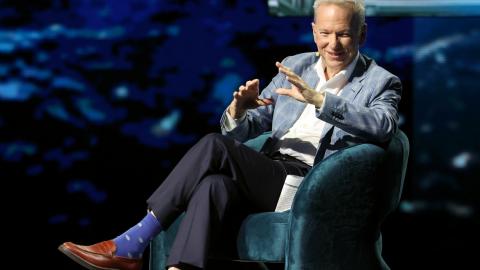
Eric Schmidt, Google’s former CEO, warns that Russia has learned to neutralize Ukrainian innovations and is now combining its industrial capacity with an innovation cycle of its own. Moscow has certainly closed part of the gap, but Kyiv’s advantage has not disappeared. As winter approaches, the most immediate threat lies less in the technological race than in a shortage of air-defense missiles.
What to Take Away
- No overall outpacing. Russia has not surpassed Ukraine in innovation. It has become much better at observing a Ukrainian innovation, neutralizing it, and adapting its own systems. But Ukraine’s advantage is now being challenged, to varying degrees depending on the sector.
- Innovation is also about doctrine. Faster Shahed drones, salvos combining drones, decoys, and missiles, and the use of RM-48U training missiles in large numbers: Moscow is innovating as much in how it employs its weapons as in the weapons themselves, with the aim of overwhelming and exhausting Ukrainian air defenses.
- The real weak point is air defense. Ukraine is mass-producing drones—four million in 2025, with more than seven million targeted for 2026. But it remains dependent on its partners for anti-ballistic missiles, particularly Patriots, whose demand has increased because of the war between the United States and Iran. A few months of insufficient deliveries could create a window of vulnerability this winter.
- Rassvet is still a program; co-production is the response. Russia’s Starlink rival constellation currently has only sixteen satellites (as of March 2026). The response advocated by Eric Schmidt, who has a direct interest in the matter through Swift Beat, is to combine Ukraine’s speed of adaptation with Western industrial capabilities.
Is Russia overtaking Ukraine in innovation, or is it mainly becoming better at copying and neutralizing?
Tsiporah Fried: We first need to consider how far Russia has come. In February 2022, Moscow launched a “special military operation” conceived as a short campaign. It is now waging a war of attrition that has entered its fifth year. In the meantime, Ukraine has helped transform the battlefield: the proliferation of reconnaissance and strike drones, combined with electronic warfare and very short development cycles, has made troop movements, force concentrations, and sometimes even the rotation of positions much more dangerous. Russia has had to learn how to fight in an environment that its adversary played a major role in creating.
I would therefore not say that Russia has broadly overtaken Ukraine in innovation. Russia has become much better at identifying Ukrainian innovations, neutralizing them, and then adapting its own systems. But Eric Schmidt’s point goes beyond imitation: Moscow is now combining its production capacity with an innovation cycle of its own. Ukraine’s advantage has not disappeared; it is much more contested. This assessment also needs to remain sector-specific: the pace and resources of the two sides differ depending on whether we are talking about tactical drones, long-range strike, electronic warfare, or air defense.
How has Russia made its military apparatus more responsive?
Tsiporah Fried: Through the forced learning process of a prolonged war. The example of Shahed drones is telling: in response to Ukrainian interceptors, Russia has developed faster variants and modified the characteristics of its drones. But its progress is also visible in the way it combines different weapons. Waves of drones, decoys, and different types of missiles place sustained pressure on Ukrainian air defenses; they complicate threat identification, force Ukraine to allocate limited resources across multiple targets, and can deplete interceptor stocks. CSIS has documented the growing use of combined drone-and-missile salvos, as well as the sustained pace of these attacks.
Innovation therefore concerns both the weapons themselves and the doctrine governing their use. A recent example is the reported use, according to Reuters citing Ukrainian data, of RM-48U missiles originally intended for training. Their use in significant numbers could allow Moscow to maintain pressure while preserving more capable strike missiles. This should be understood not simply as a technical adaptation, but also as an adaptation in the economics of the strike.
However, it would be misleading to attribute this ability to adapt solely to Russia. Ukraine is also developing new interceptors, modifying its detection methods, and devising new ways of employing drones. Both militaries are innovating in their equipment as well as their practices. The decisive difference lies in their respective ability to finance, manufacture, and sustain these adaptations over the long term.
Does Ukraine risk losing less because of a lack of innovation than because of an inability to produce at scale?
Tsiporah Fried: The answer requires a distinction. Ukraine already knows how to produce drones on a mass scale. Its Ministry of Defense says it manufactured four million in 2025 and is targeting more than seven million in 2026. It also knows how to develop and produce interceptor drones: in April, Kyiv announced, among other things, the purchase of 8,000 Octopus drones, with several manufacturers involved in the program. It would therefore be inaccurate to portray Ukraine’s defense industry as incapable of scaling up.
The difficulty is producing enough of the right interceptor quickly enough against a threat that is constantly changing. The latest versions of the Shahed and Geran combine improved guidance, speed, and range capabilities, forcing Ukrainian interceptor manufacturers to adapt their systems. It is a race between the weapon and the countermeasure.
President Volodymyr Zelensky himself has called for an acceleration in the production of fast interceptor drones and low-cost missiles. These systems could become a major factor if they are reliable, available in sufficient quantities, and integrated into the air-defense network. But an interceptor drone cannot replace a missile capable of stopping a ballistic threat. That is where the most urgent vulnerability lies. For air-defense missiles, Ukraine remains heavily dependent on deliveries from its partners. In June, NATO said that its PURL (Prioritized Ukraine Requirements List) mechanism had supplied approximately 70% of the missiles used by Ukrainian Patriot batteries and 90% of the ammunition used by other air-defense systems. But this procurement channel remains dependent on available stocks and U.S. production rates. At the same time, the war between the United States and Iran is increasing demand for these same interceptors, while new U.S. and European production capacity will take time to have an effect. The shortage of Patriot missiles in Ukraine is particularly acute.
The timing therefore matters as much as the final volume. In the short term, a few months of insufficient deliveries could create a window of vulnerability, particularly against strikes on energy infrastructure. In the longer term, increased European production and co-production with Ukraine could change the calculation. But a capability scheduled to arrive tomorrow cannot protect Ukrainian cities this winter.
Could a Russian satellite constellation competing with Starlink shift the balance of power?
Tsiporah Fried: This is a risk cited by Eric Schmidt, but it is presented as a project under development rather than an operational reality. Such a constellation could reduce a Ukrainian advantage, but it would be excessive to speak of a shift in the balance at this point. Russia is developing the Rassvet system; according to Ukrainian military intelligence, sixteen satellites had been placed into orbit by March 2026, and Moscow is aiming for a much larger constellation. These figures describe a program and its objectives, not yet a capability equivalent to Starlink under combat conditions.
If Russia succeeds in providing its units with reliable, accessible satellite connectivity that is resistant to disruption, it will gain greater autonomy for communications and certain drone operations. This would not automatically cut Ukraine’s access to Starlink. The military impact will depend on actual coverage, the availability of terminals, integration with military units, and the system’s resistance to countermeasures.
Should Ukraine’s defense industry be integrated into the Western defense ecosystem?
Tsiporah Fried: Yes — and in both directions. Ukraine’s partners should help it secure critical components, finance procurement, and scale up the production of missiles, munitions, and air-defense systems. At the same time, Western defense companies and armed forces need to integrate Ukrainian technologies and battlefield lessons more rapidly. This is at the heart of Eric Schmidt’s recommendation: combine Ukraine’s speed of adaptation with Western industrial resources, rather than treating military assistance as a succession of one-off deliveries.
It is also important to put Eric Schmidt’s recommendation into context. He is not simply an outside observer of this evolution. As CEO of Swift Beat, he signed a memorandum of understanding with Ukraine’s Ministry of Defense in July 2025 covering, among other things, the large-scale production of interceptor and strike drones. That does not invalidate his analysis; it provides important context about his direct experience of the model of co-production and industrial integration he is advocating.