











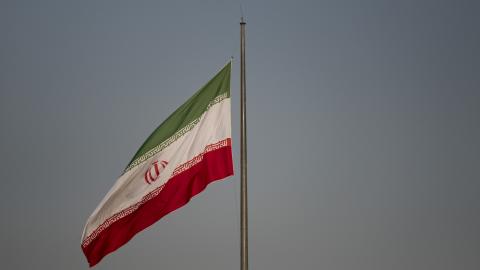
On Monday, Treasury Secretary Scott Bessent unveiled the Trump administration’s planned “economic D-Day” for Iran: a patient campaign to financially strangle the regime in Tehran. The plan calls for full-throttle enforcement of U.S. sanctions and discreet yet hard-nosed diplomatic engagement with Beijing and other actors who facilitate illicit trade and cash flows with Iran. “Our objective is to sever every economic lifeline that sustains this tyrannical regime,” Bessent declared.
President Donald Trump is right to resort to an intensive economic pressure campaign, backed by the implicit threat of renewed kinetic action. The regime and Iran’s economy have taken a beating, compounding the country’s preexisting woes. Moreover, talks are likely to continue to sputter.
Twenty years of experience as an American diplomat has made me realize that no amount of diplomatic ingenuity can contain Iran. The United States should keep pushing until it gets the best outcome for American interests, the region and the Iranian people: the shattering of the illegitimate regime in Tehran.
Iran’s rulers have outmaneuvered a succession of U.S. administrations. Jimmy Carter’s presidency foundered over the Iran hostage crisis; Ronald Reagan took out half of Iran’s navy in Operation Praying Mantis but his legacy was tarnished by the Iran-contra scandal; George W. Bush declared Iran part of an “axis of evil” without ever confronting it directly; and Barack Obama subordinated much of his foreign policy to a quixotic bid to negotiate the regime into moderation. At each turn, Iran’s rulers proved clever opponents willing to suffer military losses and risk economic catastrophe in order to maintain their grip on power.
I was sent to Kuwait for my first State Department assignment, arriving in 2007 at the peak of Iraq’s bloody civil war and the onset of Gen. David H. Petraeus’s “surge.” The Islamic Revolutionary Guard Corps drove much of the violence, building death squads and militias and arming them with IEDs that killed and injured hundreds of U.S. servicemembers. The U.S. ambassador to Iraq, Ryan Crocker, engaged Iranian officials in the first public, formal talks since 1979, but Tehran stalled and kept killing.
My subsequent tour in Bahrain coincided with the onset of the Arab Spring protests in 2010. Popular grievances fueled the demonstrations, but Iran exploited the situation, pouring fuel on sectarian tensions that reverberated through the region. Gulf rulers seized on fears of Iranian interference to justify the Saudi-led intervention that put an end to the protests.
From 2011-13, I coordinated State Department policy for Lebanon — a country hollowed out by decades of Iranian meddling and hostage to Tehran’s shadow war against Israel. Billions of dollars of IRGC backing meant Hezbollah outgunned Lebanon’s national army and possessed an arsenal of about 60,000 rockets and missiles aimed at Israeli towns and cities. As President Bashar al-Assad’s murderous repression led to civil war in neighboring Syria, Iran in 2013 dispatched Hezbollah and other regional militias to shore up the Assad regime — fueling a conflict that led to over half a million deaths.
During my next assignment as the “Iran watcher” in Paris, I was privy to the Obama administration’s determined — and at times desperate — effort to sign a nuclear accord with Tehran. Iran’s negotiators were (and remain) savvy and cunning interlocutors who extracted U.S. concessions that concerned our French counterparts. My experiences in Paris and the Persian Gulf made me see the logic of Trump’s exit from the nuclear agreement and, during postings in Qatar and in the White House on the staff of Vice President Mike Pence, I witnessed the benefits of the president’s “maximum pressure” campaign. However, a variety of diplomatic considerations tempered the efficacy of the campaign and the policy failed to yield to new talks, let alone a comprehensive deal. Uranium enrichment and missile production carried on.
Iran continued to sow havoc in the region. The mullahs might not have orchestrated Hamas’s Oct. 7, 2023, attacks, but IRGC know-how and hundreds of millions of dollars of funding over two decades enabled the rampage across southern Israel that killed more than 1,200 people, including 46 Americans. The Hamas attack marked an inflection point in the Middle East’s evolution: It ended tentative moves by Saudi Arabia, Turkey and others to improve relations with Israel, and it transformed long-standing tensions in the Levant and Persian Gulf into inexorable and overlapping cycles of violence.
Earlier in my career, in 2008, Saudi Arabia’s King Abdullah urged U.S. officials to “cut off the head of the snake” by attacking Iran’s nuclear program. The more I learned about the region, the more I agreed with the king’s characterization: The regime in Tehran bears overwhelming responsibility for the mayhem and misery in the Middle East since 1979, and its hold on power is a dire threat to regional stability.
The current showdown in the region is an inevitable result of the Iranian regime’s efforts to dominate the region through bullying, blackmail and terror. Iran’s rulers have shown time and again they will not accede to an arrangement that constrains their hegemonic aspirations.
The best outcome for the region — and for core U.S. interests — is the regime’s collapse. The Islamic republic is in terminal decline: Iran’s economy is in free fall, its leadership is in disarray, and the government does not have legitimacy with the people. A patient, sustained campaign of economic and military pressure, coupled with hard-nosed diplomacy supported by our regional partners, can strike a mortal blow to a regime that grows more brittle with each passing day.