









Introduction
Over the last thirty-five years, there has been a remarkable growth in the partnership between the world’s oldest and largest democracies. The U.S.–India ties, long marked by episodic cooperation and recurring strains, have been institutionalized across different spheres. Commercial engagement matured from irregular exchanges into structured dialogues and regulatory coordination that pushed total two-way trade toward the $200-billion threshold.[2] Suspicion in the military realm gave way to sustained cooperation, culminating in foundational agreements, advanced technology transfers, and regular joint exercises. Converging views on the Indo-Pacific architecture, shared concerns about the rise of China, and deeper alignment in the broader great-power competition have reinforced this progress.
Against this backdrop, it was reasonable for New Delhi to expect continuity and perhaps acceleration when President Donald J. Trump returned to office in January 2025. Personal rapport between Prime Minister Narendra Modi and President Trump in the first term further reinforced this expectation. Instead, the first year of the new administration has suggested otherwise: not only is a global partnership unlikely, but the gains of the past thirty-five years are at risk.
The paper proceeds in three parts. It opens with the history of U.S.–India relations during the Cold War. It illustrates that the relationship was shaped by dissimilar assessments and at times competing geopolitical priorities. These divergences were structural in nature rather than adversarial, oppositional, or antithetical. The second part examines how this changed after the end of the Cold War. As systemic conditions shifted, avenues for economic, commercial, and military cooperation expanded. While certain structural constraints persisted, the progress over the past thirty-five years has been steady and balanced. The final section assesses the first year of President Trump’s second term and cautions that recent developments in Washington risk undermining those gains. Marked by short-term, transactional decision-making and a limited appreciation of India’s strategic autonomy, the administration’s approach may undo the hard-won gains that have brought the relationship close to becoming the “defining partnership of the twenty-first century.”
Structural Divergence: U.S.–India Relations after 1947
For two multi-ethnic, pluralist, and democratic countries, the history of U.S.–India relations has never followed a straightforward trajectory. As two nations, in different geographies and with divergent histories, they have had different visions of the global order. India’s preference for strategic autonomy, inward oriented economic model, regional security outlook, perception of the Soviet Union and later Russia, and evolving assessment of the threat posed by China have contributed to this rocky relationship.
Non-Alignment Abroad, State Planning at Home
American interest in India dates to the 1930s and the Indian national movement. American historian Will Durant wrote a book titled “The Case for India” and in 1931 Time magazine named Mahatma Gandhi as “Man of the Year.” Many in the U.S. supported India’s fight against colonial rule and President Franklin Delano Roosevelt appointed his personal representatives to India, starting in 1941. Roosevelt and Churchill disagreed vehemently on the issue of Indian independence, and FDR only eased his pressure after Churchill threatened to leave the Atlantic Alliance. Throughout this period, American officials supported the idea of a united India and were against partition of the country.[3]
At India’s independence, many American officials hoped that India would join the Western bloc and were disappointed when New Delhi chose the policy of nonalignment. India’s first Prime Minister and external affairs Minister, Jawaharlal Nehru insisted that independent India would chart its own course, preserving its policy autonomy on the domestic and international stage. As a newly independent country, India was keen to stabilize its polity, grow economy, and deal with internal and external security challenges. New Delhi was equally wary of international commitments that would entangle the country in wars and conflicts. Seeing military alliances as limiting its freedom of geopolitical maneuver, India consistently kept its distance from them.[4]
American officials often expressed frustration with India’s nonaligned policies. Secretary of State John Foster Dulles referred to nonalignment as immoral neutrality.[5] Most American Presidents, however, accepted India’s position and were keen to work with it, even if New Delhi did not join the American bloc. In his tenure as a senator, John F. Kennedy captured this logic clearly. Arguing that “India contains nearly 40 percent of all the free people of the uncommitted world,” he urged Washington not to be “confused by talk of Indian neutrality.”[6] Keeping India nonaligned was far preferable to risking its drift toward the Soviet camp.
India, for its part, became a leading voice of the nonaligned world, creating room to maneuver outside the rigid constraints of the Cold War. As a founding member of the United Nations, India has made multilateralism a key pillar of its foreign policy. New Delhi has long viewed the UN as essential for ensuring that smaller and middle powers retain leverage in a system dominated by global powers. India often disagreed with the United States in the UN, particularly on questions of Korea and Vietnam. New Delhi has also long believed it deserves to be on the UN Security Council as a veto-holding power, and it is only in the last few decades that the United States has supported this claim.[7]
National leaders held that economic self-reliance was inseparable from strategic autonomy. Nehru’s development model centered on state-led industrialization and import substitution, intended to build indigenous capacity and shield a fragile economy. High tariffs, licensing regimes, and foreign ownership restrictions were designed to prevent external dependence in capital, technology, or industrial control. For American policymakers, Indianized Fabian socialist model was contrary to what they advocated for post-colonial countries. However, for a state that had endured two hundred years of colonial rule and seen its nascent industry wiped out, Indian statesmen believed in the need to protect domestic industries and markets from American companies. This economic insularity persisted through the 1960s and 1970s, but slow growth, balance-of-payments pressures, food shortages, and technological stagnation forced gradual adjustment. Instead of discarding state-led development, the Indian government selectively permitted foreign cooperation where it served national objectives without compromising autonomy.[8] Nevertheless, the market remained almost impenetrable for the U.S. firms.
The collapse of the Soviet Union and the end of the Cold War led to a geoeconomic and geopolitical uncertainty for India. The 1991 balance-of-payments crisis forced structural changes. India reduced tariffs, dismantled industrial licensing, and opened multiple sectors to foreign investment. This transformation restructured the economic dimension of bilateral relations, enabling commercial engagement that were impossible earlier. Liberalization, however, did not erase strategic instincts. Reforms were extensive but selective. Defense production, nuclear energy, telecommunications, space, and digital infrastructure remained heavily regulated. India liberalized where growth demanded it but maintained protection where dependence threatened vulnerability.[9]
The Pakistan Factor
From the very outset, Washington’s relationship with Islamabad created problems for New Delhi. Although South Asia was never a primary theater in the Cold War, Pakistan’s readiness to align with the United States, its location on the Soviet Union’s southern flank, and its ties to the Middle East made it strategically valuable. In the words of then President Eisenhower, Pakistan was “the most allied of allies” as it joined almost every American military alliance. These included the Southeast Asia Treaty Organization and the Central Treaty Organization, originally the Baghdad Pact, in the 1950s.[10]
As the largest country on the subcontinent, and the only one that borders all others in South Asia, India believes that its neighbors are the first layer of security. Modern India has always resented the involvement of external powers in its backyard unless those powers acknowledge its pre-eminence. While the U.S. understood that India was the largest power in South Asia, American military and security assistance to Pakistan created security challenges in the region. U.S. support strengthened Pakistan’s military capabilities, enabling a state far smaller in population and economic size to pursue a posture of parity with India. The Mutual Defense Assistance Agreement of 1954 brought substantial transfers of equipment, training, and advanced, altering regional military calculations. Indian policymakers watched as this support emboldened Islamabad’s belief that it could compete with India militarily. This false confidence pushed Pakistan into initiating the 1965 war. Even though Washington suspended military supplies to both countries during the conflict, the damage had already occurred.
The 1971 Bangladesh crisis and the American tilt towards Pakistan further damaged relations with India. The Nixon administration’s support for West Pakistan and frictions with India, including the deployment of the USS Enterprise to the Bay of Bengal, were remembered by Indians for decades to come. New Delhi interpreted these actions not as a Cold War necessity but as antithetical to strategic interests. The pattern recurred a decade later. After the Soviet invasion of Afghanistan, the Reagan administration made Pakistan central to its strategy, providing advanced military technologies as part of its effort to support Afghan resistance. This surge in military aid and capabilities, however, intensified regional insecurity and further destabilized South Asia’s strategic environment.[11]
Washington’s handling of Pakistan’s nuclear program compounded these frustrations. Throughout the 1970s and 1980s, successive American administrations were aware of Pakistan’s nuclear program but were unwilling to publicly pressure an ally that was critical to the anti-Soviet war in Afghanistan.[12] This reinforced Indian perceptions that American non-proliferation enforcement was subordinate to the strategic priority of the day and thus applied selectively.
India has long faced insurgencies and terrorism across the country. The Kashmir and the Khalistani insurgencies, while having a domestic element, have had strong links to Pakistan-based groups and support from Pakistan’s military-intelligence establishment. During the Cold War, the U.S. was reluctant to callout Pakistan for its support to these terror outfits, even though American intelligence agencies were aware of the Pakistani military’s involvement. Since the 1990s, as relations with India improved, the U.S. has periodically called on Pakistan to act against terror groups that target India and Afghanistan. However, from India’s point of view, the U.S. has rarely applied enough leverage that would force Pakistan to completely wipeout the terrorist infrastructure inside the country. This reluctance stems from Pakistan’s recurring importance to various regional or global objectives of the United States. The U.S.–Pakistan relationship has remained one of the most durable constraints on closer U.S.–India ties for nearly eight decades.
India’s Soviet/Russian Ties
India’s perception of Soviet Russia differed fundamentally from the American perspective and has continued to differ over the decades. Founding elite viewed both the U.S. and the USSR as the two main global powers and was keen to have good relations with both. Indian leaders criticized Soviet domestic repression and rejected the communist ideology, but since the Soviet Union lacked a colonial history in Asia and was believed to have neither the capacity nor the intention to dominate the subcontinent, Indian elites never viewed it as a threat to its security.[13] Second, the Soviet Russia, and later Russia, became India’s continental balancer against China. Finally, the economic factor brought New Delhi and Moscow closer as India needed assistance to build its domestic industrial base, and Russia was more willing to help with that than the Americans.[14]
From the 1950s, the Soviet Union demonstrated willingness to help India built the large state-owned enterprises central to its industrialization strategy. While overall trade with the United States remained larger, the USSR became a key provider of technical assistance, heavy industrial equipment, and engineering expertise. Soviet specialists assisted with petroleum exploration and development and partnered on major industrial projects, including steel and transportation infrastructure. By the 1960s, the Soviet Union had become India’s most important defense partner. Arms supply relationships expanded from aircraft and armored vehicles to sophisticated platforms, gradually embedding Soviet equipment across Indian operational doctrine, maintenance systems, and training pipelines.[15]
From 1952 onward, the Soviet Union supported India by vetoing Kashmir-related resolutions at the UN Security Council.[16] This, along with statements by Soviet leaders reinforced Indian perceptions that Moscow, unlike Washington, understood India’s territorial concerns and would shield it in multilateral forums. India, in turn, often practiced geopolitical silence, tempering its criticism of Soviet interventions in Hungary and Czechoslovakia so as not to jeopardize this crucial support.[17]
The Soviet Union’s collapse in 1991 created immediate economic and strategic disruptions for India. The loss of a major trading partner contributed to the 1991–92 balance-of-payments crisis and created challenges in supply chains, replacement components, and military readiness. The relationship adapted rather than dissolved. Both countries shifted to pragmatic cooperation, especially in defense. Weapons transactions continued throughout the 1990s, nuclear cooperation persisted, and both sides negotiated agreements to sustain long-term military-technical ties. By the 2010s, Russian systems were embedded across India’s defense ecosystem.[18] Major acquisitions, licensed production, and joint ventures—the Su-30 MKI program, T-90 tanks, BrahMos missile development—created long-term interdependence. Even as India diversified toward the U.S., France, and Israel, Russian-origin equipment remained the backbone of its inventory. Spare parts, maintenance cycles, and ammunition supplies reinforced this structural reliance, evident in the 2018 S-400 air-defense purchase despite U.S. objections and potential CAATSA sanctions.
Russia extended its influence beyond the defense sector. Cooperation in nuclear energy, fertilizers, and more recently discounted crude oil underscore Moscow’s continued importance to India’s economic security. India’s decision not to condemn Russia after the 2022 Ukraine invasion reflects these material dependencies and the assessment that isolating Moscow might push it further toward China. For New Delhi, sustaining ties with Russia remains part of a broader strategy of preserving autonomy.
China: From Postcolonial Partner to Strategic Rival
As ancient civilizations and neighbors, India and China had long histories of cultural exchange and trans-Himalayan trade. However, as modern states, the two have had a conflict-ridden relationship for seven decades. The early Indian political leadership expected that, as Asian countries, the two could maintain stable and constructive relations. The 1954 Agreement on Trade and Intercourse with the Tibet Region, which enshrined the principles of peaceful coexistence, symbolized the high point of this early cordiality. For New Delhi, the agreement reflected the belief that mutual respect for sovereignty and non-interference could stabilize relations with a newly assertive China; for Beijing, it marked India’s formal recognition of Chinese authority over Tibet. Thus, from the start, the two viewed things through different lenses, and this has continued to the present day.[19]
The cooperation soon showed its first cracks as Tibet became the first major fault line. The 1954 Agreement left unresolved the status of the Northeast Frontier Agency (today’s Arunachal Pradesh) and Aksai Chin in Ladakh. Legacies of colonial cartography and divergent interpretations of the McMahon Line generated competing territorial claims throughout the 1950s and sowed early mistrust. The situation deteriorated sharply after the 1959 Tibetan uprising. Beijing viewed India’s decision to grant asylum to the Fourteenth Dalai Lama as interference in its internal affairs. Both countries increased military deployments along the frontier, resulting in several clashes that year. The creeping militarization of the region prompted Mao Zedong to launch coordinated attacks across both the western and eastern sectors in October 1962, advancing deep into Indian-held territory.[20]
After India suffered a severe military defeat and China ultimately pulled back, both states were left with a de facto Line of Actual Control (LAC) rather than a clearly demarcated border. This stood in sharp contrast to Beijing’s readiness to resolve boundary issues with Nepal and Pakistan, even as it adopted far more rigid positions toward India and toward Bhutan, which had backed India in 1959.[21] The resulting uncertainty added a widening security challenge to the already delicate issue of Tibet.
Even though diplomatic relations were restored and economic cooperation expanded in the next decades, the unresolved frontier has remained central to India’s security calculus. The Sumdorong Chu standoff in 1986–87, the Daulat Beg Oldi incident in 2013, the Doklam crisis in 2017, and the deadly 2020 clashes in the Galwan Valley illustrate the persistent fragility of the LAC. Both sides remain cautious about infrastructure development along the frontier, as new roads or military posts can quickly alter the local balance. Additionally, China employs cartographic pressure, most recently issuing maps that claim parts of Arunachal Pradesh as Chinese territory.[22] Its posture is even more assertive toward Bhutan, where Beijing has advanced claims in the Jakarlung Valley and the Doklam plateau, with the latter carrying clear strategic implications for India’s Siliguri Corridor.
Rapid expansion of China’s economy led to a parallel expansion of its strategic interests in South Asia. Over the last three decades, Beijing has consolidated its commercial presence: it has been Bangladesh’s largest trading partner for fifteen years and Pakistan’s for over a decade, while also emerging as a significant economic partner for Sri Lanka, Nepal, and the Maldives. Added to this are Belt and Road Initiative projects, like the China–Pakistan Economic Corridor, which place financial pressure on already debt-laden economies and increase their dependence on Beijing. China has also become a major supplier of arms to India’s neighbors, most notably Pakistan and Bangladesh. Through this combination of trade, investment, and defense ties, Beijing has penetrated a regional sphere, which New Delhi has historically regarded as its own, and has secured access to maritime infrastructure with both commercial and potential military uses in Sri Lanka, Pakistan, and Bangladesh, complementing a wider network of ports in Southeast Asia and Africa.
Recognizing the growing encirclement by China, India seeks to maintain its role as the principal regional actor. It does so by providing economic assistance, technical expertise, and security support to its neighbors. New Delhi built strong political and commercial relations with Bangladesh under the Awami League government, provided sustained economic relief to the Maldives during the Covid-19 pandemic, and extended $4 billion in immediate credit assistance to Sri Lanka during its 2022 crisis. Despite political turbulence in Bangladesh and the Maldives, India continues its economic outreach there.
Thirty-Five Years of Recalibration
Over the last thirty-five years, U.S.–India relations have acquired a different character. The end of the Cold War forced New Delhi to rethink its geopolitical calculus and confront structural vulnerabilities at home, above all in the economic and defense sectors. Liberalization and a gradual opening to global markets created space for deeper commercial ties with the United States, while the erosion of Soviet support pushed India to diversify its defense partnerships. In parallel, Washington started to view India less as a difficult outlier and more as a potential strategic partner in a changing Asian balance.
India’s Economic Potential vs Reality
By 2025, India is expected to surpass $4 trillion, ranking fifth among the world’s largest economies. It will be within striking distance of Japan and Germany, though still far behind the U.S. and China. Following the 1991 reforms, India’s nominal GDP has grown at a modest rate of 6.3%, rising from $270 billion. On a purchasing-power-parity basis, its GDP has expanded from $990 billion in 1991 to an estimated $17.7 trillion in 2025.[23] This places India behind only China and the U.S. but ahead of Russia, Japan, and Germany.
This growth is a result of the liberalization policies. Even before yielding results, these policies generated two broad expectations for the Indian economy. For one, liberalization was expected to deliver sustained socio-economic upliftment and ultimately contribute to the global consumer market. At independence, at least half of India’s 340 million citizens lived below the poverty line. By 1993, this ratio had not changed; 442 million people were classified as poor under the World Bank’s $3.00-per-day standard. Although the number initially rose to 531 million in 2004, it fell to 427 million in 2009 and declined sharply to 75 million by 2022.[24]
Liberalization also led to gains in purchasing power. Per-capita PPP income is expected to reach $12,100 by 2025, up from $1,100 in 1991. Nominal GDP per capita is similarly projected to increase from $300 in 1991 to $2,800 in 2025.[25] Put differently, India has witnessed rising consumption capacity alongside the emergence of a middle class. When compared globally, however, the picture is less reassuring. Its nominal per-capita GDP remains low, on par with Zimbabwe and Ghana at $2,650 and $2,400 respectively, and far below China’s $13,300.[26]
This comparison reveals a structural problem. While India has lifted hundreds of millions out of poverty and created a sizeable middle class, its domestic market is not yet as lucrative in terms of consumption capacity as China’s, contrary to early expectations. Sluggish manufacturing growth, episodes of elevated food inflation, weak job creation, and soft urban consumption, combined with external constraints, have limited India’s ability to generate broad-based demand.[27]
For the second, India was anticipated to match its economic profile with its global ambitions by joining the international supply chain and attracting foreign investment. This expectation persisted as nineteen years after the start of liberalization, U.S. President Barack Obama remarked in his address to the Indian Parliament that “by opening markets and reducing barriers to foreign investment, India can realize its full economic potential.”[28]
Despite being the world’s fifth-largest economy and the second-largest among emerging economies, India remains a modest participant in international merchandise trade today. Its trade-to-GDP ratio stands at 45 percent. By comparison, Mexico and Turkey—also emerging economies—with GDPs of $1.86 trillion and $1.57 trillion in 2025, have these ratios of 75 percent and 56 percent.[29] India’s participation in Global Value Chains (GVC) is similarly limited: its GVC integration rate is 36.4 percent, whereas Mexico and Turkey stand at 46.4 percent and 39.8 percent respectively.[30] This illustrates that the Indian economy, even after liberalization, remains largely inward-oriented, and its cross-border goods trade is disproportionately low relative to the size of its economy.[31]
At both ideational and practical levels, the Indian state has been protectionist in nature, but the emphasis and extent have waxed and waned over the decades. It was at its lowest in the decade following the 1991 crisis but has resurfaced over the last ten years. Concerned about the place of developing countries in the international economy, New Delhi, nevertheless, reversed its earlier opposition to the Uruguay Round under the General Agreement on Tariffs and Trade and became a founding member of the World Trade Organization. During the same period, India expanded its regional engagement, supporting the South Asian Free Trade Agreement and negotiating trade arrangements with ASEAN, South Korea, Japan, and members of the Gulf Cooperation Council. Economic reasoning gradually became overshadowed by strategic considerations that guided FTAs with Afghanistan, Bhutan, Nepal, and Sri Lanka in the 2000s and engagement with Asia-Pacific and Western economies in the early 2010s.[32]
It is puzzling that just as global interest in India has grown over the past decade, New Delhi has moved in a more protectionist direction. Many in the U.S. expected that India’s economic weight, global ambitions, and limited participation in trade arrangements would make more interested in deeper integration.[33] This expectation seemed reasonable given India’s own commitment to multilateralism and clear economic gains that greater openness would bring. Contrary to these assumptions, however, successive Indian governments have opted for a more inward-oriented policies.
Liberalization also raised expectations that with its resources, human capital, and expanding market, the country would attract substantial foreign investment. A decade after its start, restrictive regulations, unclear sectoral policies, high tariffs on labor-intensive manufacturing, centralized reforms, limited export-processing capacity, rigid labor laws, a state-dominated banking system, and high corporate taxes still constrained foreign direct investment (FDI).[34] While some of these areas have seen gradual improvement, India’s overall FDI inflows have remained comparatively modest. During Prime Minister Narendra Modi’s first term, it rose from $34.5 billion in 2014 to $64.3 billion in 2020 but then declined to $44.7 billion in 2021 and further to $27.1 billion in 2024.[35] This drop reflects several persistent constraints, including the emphasis on indigenization, lack of market access, unpredictability of regulatory and tax policy structures, weak investment multipliers from public-sector–driven infrastructure spending, the maturing of venture-capital and private-equity cycles, and restrictions on Chinese FDI.[36]
U.S.–India Trade & Commerce
President William Jefferson “Bill” Clinton entered office in 1993 with a strong desire to improve bilateral relations. The geopolitical climate created the opportunity for both countries to move forward, especially in the economic arena. Early reforms created space for an expansion of two-way trade even as the relationship continued to carry the weight of Cold War mistrust and India’s longstanding protectionism.[37] Clinton’s tenure also saw the first formal institutional mechanisms for commercial engagement. The creation of the U.S.–India Commercial Dialogue aimed to bring regulators, business leaders, and policymakers into direct contact after decades of episodic engagement. Although American sanctions imposed after India’s 1998 nuclear tests briefly stalled progress, Clinton’s landmark 2000 visit re-centered the relationship on technology, aviation, and IT-enabled industries, signaling to U.S. companies that India was becoming a viable commercial market rather than an aid-dependent economy.[38]
Under the Clinton administration, bilateral trade nearly doubled—from $7.3 billion in 1993 to $13.4 billion by 2001. Most of this growth came from Indian imports from the United States, which increased from $4.5 billion to $9.7 billion, while U.S. imports from India rose more modestly, from $2.8 billion to $3.7 billion.[39] This imbalance is also reflected in the structure of exports. Although India’s exports nearly doubled, the U.S. share in India’s overall export basket remained broadly unchanged at about 18–22 percent, similar to its share in 1988 before liberalization.[40] For the United States, India accounted for only 0.4–0.6 percent of total exports over this period.[41] Thus, even as bilateral trade expanded and India’s reliance on the U.S. market persisted, India remained a minor destination for American exports. This asymmetry would shape the future trajectory of the bilateral relationship.
The late 1990s saw a wave of bilateral institutional cooperation that paved the way for the more transformative engagement under George W. Bush. Trade accelerated during the Bush administration, which viewed India as a rising strategic partner and linked commercial liberalization to expanded high-technology cooperation. The 2004 Next Steps in Strategic Partnership marked the most important shift: it expanded India’s access to dual-use technologies in civilian spaceflight, missile-related items, and advanced industrial equipment that had been restricted for decades.[42] This initiative had immediate commercial consequences, especially in aviation and high-tech manufacturing, and reinforced the perception that India was emerging from its post-1998 isolation. This partnership was complemented by the creation of the U.S.–India CEO Forum in 2005, which institutionalized private-sector influence on policymaking and aimed at catalyzing reforms in investment regulation.[43] The 2005 U.S.–India Civil Nuclear Cooperation Agreement, although strategic in design, further normalized India’s access to advanced technology and opened commercial opportunities for U.S. firms in nuclear energy and reactor components.[44]
By 2008, two-way trade was expanding rapidly, with annual growth approaching 20 percent.[45] U.S. exports to India benefited from sustained economic growth, with the largest increases coming from chemicals, fertilizers, minerals, metals, and energy-related products. These gains were partly offset by a decline in transportation equipment exports as aircraft deliveries to Indian airlines slowed.[46] India’s dependence on the U.S. market remained pronounced: 22–23 percent of its exports went to the United States, while the U.S. share of exports to India rose only gradually, from roughly 0.85 percent in 2001 to 1.37 percent by 2008.[47]
Under Barack Obama, the economic relationship expanded further but continued to be shaped by structural constraints.[48] Obama’s presidency saw the creation of the U.S.–India Economic and Financial Partnership in 2010, which elevated macroeconomic coordination, financial regulation, and investment climate discussions to the Treasury–Finance Ministry level.[49] The Strategic and Commercial Dialogue launched in 2015 marked another attempt to integrate commercial policy with strategic cooperation, with an emphasis on infrastructure financing, clean energy, and defense offsets.[50] These initiatives produced real sectoral gains, particularly in renewable energy, yet American exporters continued to face high tariffs, complex regulatory barriers, and weak enforcement of intellectual-property rights.[51] Between 2009 and 2015, bilateral trade grew by nearly 90 percent but India’s share of total U.S. export hardly changed.[52]
Starting with the first Trump administration, long-standing trade and commercial frictions occupied center stage. The embrace of “America First” led to public airing of disputes and social media rhetoric. The first Trump administration imposed Section 232 tariffs on steel and aluminum, followed by broader tariff threats under Section 301, which prompted Indian retaliation on U.S. agricultural and industrial products. More consequentially, this administration revoked India’s preferential access to the American market under the Generalized System of Preferences in 2019, affecting billions in Indian exports. Even though both sides pursued negotiations on a limited trade deal, talks ultimately stalled over agriculture, pharmaceuticals, and digital services.[53] However, overall trade between the two countries was sustained by structural drivers, including American demand for pharmaceuticals and IT services, India’s reliance on U.S. capital goods, and the expansion of global digital value chains.[54]
The presidency of Joseph Biden brought stability and a long-term technological focus to the economic relationship. While this administration retained most of the Trump-era tariffs, Biden revived cooperative platforms that had atrophied during the previous four years. The Trade Policy Forum was restored in 2021, allowing negotiators to reengage long-standing disputes on agriculture, medical-device pricing, and digital taxation. The most significant innovation is the U.S.–India Initiative on Critical and Emerging Technologies (iCET), launched in 2023, which links trade policy to cooperation in semiconductors, space, emerging technologies, and defense co-production. iCET has begun reshaping patterns of investment and supply-chain diversification, particularly in electronics manufacturing and aerospace.[55] India’s participation in the supply-chain and clean-energy pillars of the Indo-Pacific Economic Framework (IPEF) has further aligned standards, investment incentives, and regulatory approaches across key sectors, even though IPEF is not a traditional tariff-lowering arrangement.[56] During the Biden administration, two-way goods trade ranged between $110 billion and $130 billion annually, placing India among America’s top ten trading partners.[57]
Defense and Security Cooperation
Since the end of the Cold War, U.S.–India defense relations have evolved gradually from mutual suspicion to pragmatic cooperation. The collapse of the Soviet Union prompted India to reassess long-standing reliance on Moscow for diplomatic cover and defense supplies.[58] Meanwhile, Washington reassessed India’s place in its broader Asia strategy, recognizing that India’s size, geography, and democratic system made it indispensable in the emerging post-Cold War order. These parallel shifts created the conditions for a slow but continuous improvement in bilateral defense relations.
The first major turning point came in the aftermath of India’s 1998 nuclear tests. Although Washington responded with sanctions, the crisis unexpectedly generated a channel for sustained dialogue. Deputy Secretary of State Strobe Talbott and India’s External Affairs Minister Jaswant Singh conducted eight rounds of negotiations between 1998 and 1999. What began as an effort to manage nuclear disagreements soon expanded to wider strategic discussions on terrorism, regional stability, and the nature of the international system. Most importantly, the dialogue underscored that Washington and New Delhi shared overlapping security interests, even if they differed sharply on specific methods.[59]
During the George W. Bush administration, defense cooperation entered a period of gradual institutionalization. The two governments signed the General Security of Military Information Agreement and the Master Information Exchange Agreement to facilitate information sharing and lay the groundwork for future collaboration.[60] Divergencies in strategic worldviews nevertheless persisted. While India supported the American-led international intervention in Afghanistan, it refused to send troops and instead provided developmental assistance to the war-torn country. Even as U.S.–India defense and security ties deepened, Washington simultaneously resumed security cooperation with Pakistan after 9/11. Pakistan was designated a Major Non-NATO Ally in 2004 for its support of U.S. counterterrorism operations and, over the next two decades, received billions of dollars in military and economic assistance.[61]
Even though India was not a formal American security ally, defense ties expanded. In 2005, the two countries signed the “New Framework for the U.S.–India Defense Relationship,” a ten-year plan that outlined priorities for defense cooperation.[62] The framework was renewed in 2015 and again in 2025. It facilitated cooperation across multiple areas, including joint military exercises, missile defense collaboration, co-production and research initiatives, and the lifting of export controls on sensitive military technologies.
Major arms sales, such as the U.S. transfer of the amphibious vessel USS Trenton to India in 2007, signaled growing trust.[63] The two militaries increased joint exercises, including the Malabar naval drills, and deepened counterterrorism cooperation. By the second Obama term, these patterns had matured into a broader strategic understanding.[64] President Obama’s 2015 visit to India produced a Joint Strategic Vision for the Asia-Pacific and the Indian Ocean Region, explicitly aligning the two countries’ maritime interests at a time of China’s expanding naval presence.[65] Between 2006 and 2016, bilateral defense trade increased from $1billion to more than $15 billion, and the growing technological and military-to-military cooperation led officials to describe the relationship as a “strategic handshake.”[66] Soon after, Washington designated India a “Major Defense Partner,” offering New Delhi access to advanced military technologies that provided to U.S. treaty allies.[67]
Still, limitations persisted. India remained unwilling to enter any formal alliance or commit to a defense framework that entailed mutual security obligations. Its preference for strategic autonomy, combined with long-standing defense ties with Russia and a cautious approach to military entanglements, slowed deeper integration. The Obama administration nonetheless pushed forward foundational agreements, enhanced maritime cooperation, and broadened technology cooperation, while accepting India’s reluctance to move beyond flexible partnership.[68]
The first Trump administration continued many of these trends but recast them within the “Indo-Pacific” framework. In 2018, the United States renamed the Pacific Command as the Indo-Pacific Command. In doing so, the U.S. elevated India’s strategic importance in the region.[69] At the bilateral level, Washington also completed key “enabling agreements” with India: the Logistics Exchange Memorandum of Agreement, the Communications Compatibility and Security Agreement, and later the Basic Exchange and Cooperation Agreement for geospatial cooperation.[70] The United States approved the sale of 22 Sea Guardian drones to India, making it the first non-NATO recipient, and intensified naval coordination. At the minilateral level, the Trump administration leaned heavily on small-group diplomacy, viewing it as a more agile mechanism for managing regional challenges. Under this approach, the Quadrilateral Security Dialogue (Quad) was institutionalized as a mechanism to “further strengthen the rules-based order in the Indo-Pacific region.”[71]
Under Biden, the defense partnership moved into a more structured and technologically driven phase. The administration treated India’s rise as central to Indo-Pacific strategy and used the 2023 state visit to lock in concrete steps: procurement of MQ-9B drones, the jet-engine co-production initiative, and a broader defense industrial roadmap. INDUS-X created direct links between defense firms, research institutions, and government labs to speed joint innovation. Biden also tied defense cooperation to the high-technology agenda under iCET, pressing forward on export controls and technology transfer so India could access systems once limited to U.S. treaty allies. For Washington, these moves aimed to build India’s long-term capacity while reducing its reliance on Russia; for New Delhi, they offered access to advanced systems and production opportunities without entering a formal alliance.[72]
The Second Trump Administration
Ushering in the second Trump administration, New Delhi held high but reasonable expectations. For more than three decades, bilateral relations, buoyed by bipartisan support, had expanded in trade, deepened in defense cooperation, and increasingly converged in strategic assessments. The fact that the Biden administration had largely preserved Trump’s earlier approach to China and had broadened cooperation with India confirmed these expectations. While some friction on trade and immigration was anticipated, a stable strategic partnership rooted in shared concerns about Beijing and sustained by the personal rapport between Modi and Trump seemed assured. Trump’s relaxed attitude toward India’s relationship with Russia added to the belief that major disruptions were unlikely.
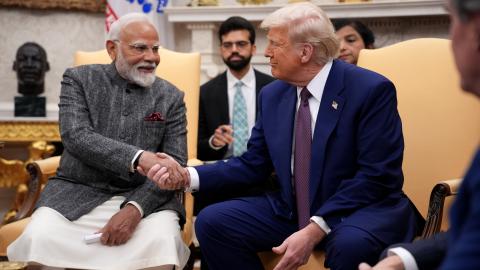
These expectations appeared validated in the administration’s opening weeks. On February 13, Prime Minister Modi met President Trump at the White House. Modi spoke confidently of working “with twice the speed,” while Trump listed prospective areas for cooperation, including defense, trade and investment, energy security, technology and innovation, multilateral coordination, and people-to-people ties.[73] This gave New Delhi confidence that the accumulated goodwill would finally translate into a more equal global partnership that would outgrow the largely regional character of earlier decades.
Soon, however, it became clear that the second Trump administration would combine the transactional impulses of the first term with a more mercurial, semi-isolationist, and short-sighted approach. The first sign appeared on the economic front. India was swept into the first round of reciprocal tariff hikes imposed on more than seventy countries and was assigned a 25 percent rate. The tariff hit directly at Indian consumer goods, making them uncompetitive against Chinese and Vietnamese products, and threatened high-value sectors such as diamonds and jewelry.[74] Negotiations proceeded slowly. New Delhi proposed zero tariffs on steel, auto components, and pharmaceuticals on a reciprocal basis for limited volumes, but Washington did not agree.[75]
Entangled in the Russia–Ukraine peace negotiations, Trump decided to pressure Moscow by targeting one of Russia’s largest remaining energy markets. The administration imposed an additional 25 percent tariff on all imports from India on the grounds that New Delhi continued to import Russian crude oil.[76] The Ministry of External Affairs called the measures “unfair, unjustified and unreasonable,” stressing India’s need to safeguard its energy security,[77] and External Affairs Minister Subrahmanyam Jaishankar remarked that “it is ironic for a pro-business American administration to accuse others of doing business.”[78]
The tariff decision created two immediate problems for the bilateral relationship. The imposition of initial duties was poorly calibrated: sweeping rather than sector-specific, lacking any economic rationale, and imposed in a manner that is already facing legal challenge in U.S. courts.[79] For India, this stood in stark contrast to what a strategic partner might reasonably expect: targeted negotiations, sectoral arrangements, or at minimum a one-on-one framework befitting two states that have spent decades building trust. The tariffs also sat uneasily with the strong personal ties between Modi and Trump.
The additional 25 percent tariff cut far deeper. It demonstrated that, in Washington’s calculus, India can be subordinated to immediate tactical objectives, treated less as a partner with its own strategic priorities and more as an instrument in a broader geopolitical negotiation. The logic behind tariffs is particularly perplexing for New Delhi. While Europe views this war as an existential and strongly supports Ukraine, and China benefits from Russia’s growing dependence, India, by contrast, has no ideological or geopolitical stake in the conflict’s outcome. Its purchases of Russian crude are driven by energy security needs. New Delhi stated this from the outset of the war, but the administration chose to ignore it. A concurring push for India to offset Russian imports by buying U.S. liquefied petroleum gas only reinforced the perception that Washington discounted India’s long-standing commitment to strategic autonomy.
The short-sightedness of the second Trump administration became clearer when it moved quickly toward rapprochement with Pakistan. India had tolerated residual U.S.–Pakistan military cooperation, but it had also grown used to Washington’s acknowledgment of Pakistan’s role in cross-border terrorism. Given the Biden administration’s minimal diplomatic engagement with Islamabad, Pakistan’s deep alignment with China, and the depth of U.S.–India coordination in the broader great-power competition,[80] New Delhi expected Pakistan to remain, if not marginal, at least peripheral to Washington’s strategic calculus.
Instead, Trump revived U.S.–Pakistan economic diplomacy, expanded counterterrorism coordination, and showcased ties with military establishment. The administration did not fully support India in its counterterror response in April, intervened during the India–Pakistan crisis in May, and fast-tracked tariff negotiations with Islamabad. Pakistan, for its part, moved quickly to satisfy Trump: handing over Mohammad Sharifullah, responsible for the 2021 Kabul airport bombing, publicly praising Trump’s involvement in the peace process, offering cooperation on critical minerals and energy exploration, and signaling openness to new defense-related projects. To Delhi, this amounted to a transactional revival that overlooked Pakistan’s long record of unreliability, economic fragility, political volatility, and a military establishment with a well-known history of duplicity in counterterrorism.
China policy produced the deepest disappointment. New Delhi had expected the second Trump administration to preserve the trajectory established during Trump’s first term and consolidated under Biden: economic pressure, strategic decoupling, and a minilateral architecture centered on the Quad. Given its limited military cooperation and constrained economic capacity, the Quad had not evolved into a hard-power instrument by the start of the second Trump term and therefore could not answer the questions that now dominate Trump’s foreign policy: “Does it make America safer? Does it make America stronger? And does it make America more prosperous?” Its structural dependence on strong bilateral ties made it even more vulnerable.[81] In this context, Washington’s renewed outreach to Pakistan and the tariff pressure placed on India undercut the very logic of the Quad, signaling to New Delhi that the administration was willing to sideline long-term Indo-Pacific strategy in favor of short-term, transactional choices.
Conclusion
Over the last thirty-five years, India and the United States have built a partnership grounded in steady institutional cooperation, shared concerns about the rise of China, and a growing alignment of strategic interests. This progress emerged despite historical differences, and it reflected a bipartisan consensus in Washington that India’s rise strengthens the wider Indo-Pacific order. New Delhi, for its part, expanded economic openness, diversified its defense links, and invested in regular high-level coordination. By 2024, the relationship had acquired a depth that previous decades lacked.
The first year of President Trump’s second term has endangered this progress. Inconsistent trade duties, pressure on India’s energy security, and an abrupt revival of U.S.–Pakistan engagement signal a shift toward short-term, transactional choices. These actions overlook the foundation of the modern partnership. India cooperates closely with the United States but guards its strategic autonomy. It expects consultation, predictability, and policy coordination, not decisions that treat it as an expendable variable in other geopolitical negotiations.
If the United States seeks a stable Indo-Pacific balance and an effective response to China’s assertiveness, India remains essential. Preserving this partnership requires consistency rather than improvisation, respect for India’s strategic priorities, and a clear understanding that durable cooperation cannot be built on economic coercion or episodic overtures. The next three years will determine whether the relationship continues its long-term consolidation or reverts to the cycle of mistrust that defined much of the Cold War period. The opportunity for progress remains, but so does the risk of losing the gains accumulated over a generation.
The original appeared in the Indian Journal of Asian Affairs.
Endnotes
- Aparna Pande is Research Fellow at Washington DC based Hudson Institute and has written extensively on India and Pakistan. Kirill Shabalin holds an M.A. in South Asian Studies from Columbia University and is a Research Intern at Hudson Institute.↑
- U.S. Trade Representative. “India,” https://ustr.gov/countries-regions/south-central-asia/india ↑
- Stephen Cohen, India: Emerging Power (Washington, DC: Brookings Institution Press, 2001), 269. ↑
- Ashley J. Tellis, “US–India Relations: The Struggle for an Enduring Partnership,” in The Oxford Handbook of Indian Foreign Policy, ed. David M. Malone, C. Raja Mohan, and Srinath Raghavan (Oxford: Oxford University Press, 2015), 484–85, https://doi.org/10.1093/oxfordhb/9780198743538.001.0001 ↑
- Frederick B. Chary, Nonaligned Movement Meets, Research Starters (EBSCO, 2023), https://www.ebsco.com/research-starters/history/nonaligned-movement-meets ↑
- John F. Kennedy, “Remarks in the Senate, Washington, D.C., March 25, 1958, ‘The Choice in Asia – Democratic Development in India,’” John F. Kennedy Presidential Library and Museum, https://www.jfklibrary.org/archives/other-resources/john-f-kennedy-speeches/washington-dc-19580325 ↑
- Tellis, “US–India Relations,” 490. ↑
- Teresita C. Schaffer and Howard B. Schaffer, India at the Global High Table: The Quest for Regional Primacy and Strategic Autonomy (Washington, DC: Brookings Institution Press, 2016), 185–88. ↑
- See: Vanita Shastri, “The Politics of Economic Liberalization in India,” Contemporary South Asia 6, no. 1 (1997): 27–56, https://doi-org.ezproxy.cul.columbia.edu/10.1080/09584939708719804 ↑
- Aparna Pande, Explaining Pakistan’s Foreign Policy: Escaping India, 1st ed. (London: Routledge, 2011), 36. ↑
- Husain Haqqani, Magnificent Delusions: Pakistan, the United States, and an Epic History of Misunderstanding, 1st ed. (New York: PublicAffairs, 2013), 1–2. ↑
- Ibid., 267–268. ↑
- Cohen, India: Emerging Power, 271–72. ↑
- Surjit Mansingh, “Indo-Soviet Relations in the Nehru Years: The View from New Delhi,” Parallel History Project on Cooperative Security (2000): 9. https://phpisn.ethz.ch/lory1.ethz.ch/collections/coll_india/documents/Mansingh_Essay_Final_000.pdf ↑
- Ramesh Thakur, “The Impact of the Soviet Collapse on Military Relations with India,” Europe-Asia Studies 45, no. 5 (1993): 831–33. ↑
- Mansingh, “Indo-Soviet Relations in the Nehru Years,” 3. ↑
- Ramesh Thakur, “India and the Soviet Union: Conjunctions and Disjunctions of Interests,” Asian Survey 31, no. 9 (1991): 839, https://doi.org/10.2307/2645298 ↑
- Vojtech Mastny, “The Soviet Union’s Partnership with India,” Journal of Cold War Studies 12, no. 3 (2010): 86–87, https://www.jstor.org/stable/26923380 ↑
- Lorenz Lüthi, “Sino-Indian Relations, 1954–1962,” Eurasia Border Review 3, no. Special Issue (2012): 109, https://eprints.lib.hokudai.ac.jp/dspace/bitstream/2115/50965/1/EBR3-S_009.pdf ↑
- Ibid., 116–17. ↑
- Ibid., 117. ↑
- Tenzin Pema, “China names 30 places in India-controlled Arunachal Pradesh,” Radio Free Asia, 2024, https://www.rfa.org/english/news/tibet/arunachal-pradesh-04022024161146.html ↑
- International Monetary Fund, “IMF DataMapper: India Country Profile,” https://www.imf.org/external/datamapper/profile/IND ↑
- World Bank, “India Country Profile,” https://pip.worldbank.org/country-profiles/IND ↑
- IMF, “IMF DataMapper: India Country Profile.” ↑
- World Bank, “GDP per capita (current US$),” https://data.worldbank.org/indicator/NY.GDP.PCAP.CD ↑
- Jayati Ghosh, “Growth and Emergent Constraints in the Indian Economy in the Context of Global Uncertainty,” in Industrialization of China and India, ed. Nobuharu Yokokawa, Jayati Ghosh, and Bob Rowthorn (New York: Routledge, 2013), 180–82. ↑
- Embassy of India, “Remarks by U.S. President Mr. Barack Obama to Members of Both Houses of Parliament in the Central Hall,” accessed December 1, 2025. https://www.indianembassyusa.gov.in/ArchivesDetails?id=135 ↑
- World Bank, “Trade (% of GDP),” https://data.worldbank.org/indicator/NE.TRD.GNFS.ZS ↑
- World Trade Organization, “Trade in Value-Added and Global Value Chains: Statistical Profiles,” https://www.wto.org/english/res_e/statis_e/miwi_e/countryprofiles_e.htm ↑
- Amitendu Palit, “Will India’s Disengaging Trade Policy Restrict It from Playing a Greater Global Role?” World Trade Review 20, no. 2 (2021): 204–5, https://doi.org/10.1017/S1474745620000518 ↑
- Palit, “Will India’s Disengaging Trade Policy,” 212. ↑
- Alyssa Ayres, “Economic Relations with India,” Council on Foreign Relations, 2016, 5–6, http://www.jstor.org/stable/resrep30001 ↑
- Nirupam Bajpai and Jeffrey D. Sachs, “Foreign Direct Investment in India,” Development Discussion Paper No. 759 (March 2000): 6–8. ↑
- World Bank, “Foreign direct investment, net inflows (BoP, current US$) – India,” https://data.worldbank.org/indicator/BX.KLT.DINV.CD.WD?locations=IN ↑
- Subhash Chandra Garg, “Why FDI Investors Are Turning Away From India,” Tribune, May 13, 2025, https://www.tribuneindia.com/news/comment/why-fdi-investors-are-turning-away-from-india/ ↑
- Aparna Pande, “Natural Allies? The India–US Relations from the Clinton Administration to the Trump Era,” Asie. Visions, no. 104 (Ifri, December 2018): 10–11. ↑
- Cohen, India: Emerging Power, 297. ↑
- U.S. Census Bureau, “Trade in Goods with India,” https://www.census.gov/foreign-trade/balance/c5330.html ↑
- World Integrated Trade Solution, “Export Partner Share (%),” https://wits.worldbank.org/CountryProfile/en/Country/IND/StartYear/1988/EndYear/2023/TradeFlow/Export/Partner/USA/Indicator/XPRT-PRTNR-SHR ↑
- WITS, “Export Partner Share (%),” https://wits.worldbank.org/CountryProfile/en/Country/USA/StartYear/1991/EndYear/2023/TradeFlow/Export/Partner/IND/Indicator/XPRT-PRTNR-SHR ↑
- Ashley J. Tellis, Opportunities Unbound: Sustaining the Transformation in U.S.–Indian Relations (Washington, DC: Carnegie Endowment for International Peace, 2013), 5, https://carnegie-production-assets.s3.amazonaws.com/static/files/opportunities_unbound.pdf ↑
- Alan Kronstadt, U.S.–India Bilateral Agreements in 2005, CRS Report for Congress (Washington, DC: Congressional Research Service, 2005), 13–14. ↑
- Tellis, Opportunities Unbound, 6. ↑
- U.S. Census Bureau, “Trade in Goods with India.” ↑
- United States International Trade Commission, “India: Exports, Imports, and Trade Balance,” 2008, https://www.usitc.gov/research_and_analysis/tradeshifts/2008/india.htm ↑
- WITS, “Export Partner Share (%).” ↑
- Pande, “Natural Allies?” 22. ↑
- The White House, Office of the Press Secretary, “The U.S.–India Partnership: The Fact Sheets,” 2010, https://obamawhitehouse.archives.gov/the-press-office/2010/11/08/us-india-partnership-fact-sheets ↑
- U.S. Department of State, Office of the Spokesperson, “Joint Statement on the First U.S.–India Strategic and Commercial Dialogue,” 2015, https://2009-2017.state.gov/r/pa/prs/ps/2015/09/247192.htm ↑
- Pande, “Natural Allies?” 21–22. ↑
- U.S. Census Bureau, “Trade in Goods with India.” ↑
- Surupa Gupta, “Economic Nationalism and India–US Trade Relations During the Modi–Trump Years,” India Review 22, no. 2 (2023): 128–33, https://doi.org/10.1080/14736489.2023.2180912 ↑
- Raj Verma, “Trump and Modi and the Ideological, Political and Economic Underpinnings of the India–United States Trade Dispute,” International Area Studies Review 26, no. 4 (2023): 428–30, https://doi.org/10.1177/22338659231178907 ↑
- Rudra Chaudhuri and Konark Bhandari, 2024, The U.S.–India Initiative on Critical and Emerging Technology (iCET) from 2022 to 2025: Assessment, Learnings, and the Way Forward, https://carnegieendowment.org/research/2024/10/the-us-india-initiative-on-critical-and-emerging-technology-icet-from-2022-to-2025-assessment-learnings-and-the-way-forward?lang=en ↑
- Inu Manak, “Unpacking the IPEF: Biden’s Indo-Pacific Play,” Council on Foreign Relations, 2023, https://www.cfr.org/article/unpacking-ipef-bidens-indo-pacific-trade-play ↑
- U.S. Census Bureau, “Trade in Goods with India.” ↑
- Tellis, “US–India Relations,” 488–89. ↑
- Cohen, India: Emerging Power, 285. ↑
- Deepa Ollapally, U.S.–India Relations: Ties That Bind? (Washington, DC: The Sigur Center for Asian Studies, 2005), 10. ↑
- Husain Haqqani and Lisa Curtis, “A New U.S. Approach to Pakistan: Enforcing Aid Conditions without Cutting Ties,” Hudson Institute, 2017, https://www.hudson.org/national-security-defense/a-new-u-s-approach-to-pakistan-enforcing-aid-conditions-without-cutting-ties ↑
- U.S. Census Bureau, “Trade in Goods with India.” ↑
- Karl F. Inderfurth and Bruce Riedel, Breaking New Ground with India: Build a Valuable Indo–U.S. Strategic Partnership, Opportunity 08 project report (Washington, DC: Brookings Institution, 2008), 7–8. ↑
- U.S. Department of State, Office of the Spokesperson, “U.S.–India Security Partnership,” 2014, https://2009-2017.state.gov/r/pa/prs/ps/2014/09/232330.htm ↑
- Pande, “Natural Allies?” 32. ↑
- U.S. Embassy & Consulate in India, “U.S.–India Defense Relations Fact Sheet, December 8, 2016,” 2016, https://in.usembassy.gov/u-s-india-defense-relations-fact-sheet-december-8-2016/ ↑
- Alan Kronstadt, “India–U.S.: Major Arms Transfers and Military Exercises,” Congressional Research Service, 2025, https://www.congress.gov/crs-product/IF12438 ↑
- Pande, “Natural Allies?” 22. ↑
- Indrees Ali, “In Symbolic Nod to India, U.S. Pacific Command Changes Name,” Reuters, 2018, https://www.reuters.com/article/us-usa-defense-india/in-symbolic-nod-to-india-u-s-pacific-command-changes-name-idUSKCN1IV2Q2/ ↑
- Pande, “Natural Allies?” 26–27. ↑
- Heather Nauert, “Australia–India–Japan–U.S. Consultations on the Indo-Pacific,” Press Statement, U.S. Department of State, 2017, https://2017-2021.state.gov/australia-india-japan-u-s-consultations-on-the-indo-pacific/ ↑
- Aparna Pande, “Biden Committed to India’s Rise as a Major Global Player: Aparna Pande,” India Writes, 2023, https://www.hudson.org/foreign-policy/biden-committed-india-rise-major-global-player-aparna-pande ↑
- The White House, “United States–India Joint Leaders’ Statement,” 2025, https://www.whitehouse.gov/briefings-statements/2025/02/united-states-india-joint-leaders-statement/ ↑
- Reuters, “India Reacts to Trump’s 25% Tariff on Exports to US,” 2025, https://www.reuters.com/world/india/view-india-reacts-trumps-25-tariff-exports-us-2025-07-30/ ↑
- Shruti Srivastava and Mihir Mishra, “India Offers Zero-for-Zero Tariffs on Auto Parts, Steel from US,” Bloomberg, 2025, https://www.bloomberg.com/news/articles/2025-05-05/india-offers-zero-for-zero-tariffs-on-auto-parts-steel-from-us?embedded-checkout=true ↑
- The White House, “Fact Sheet: President Donald J. Trump Addresses Threats to the United States by the Government of the Russian Federation,” 2025, https://www.whitehouse.gov/fact-sheets/2025/08/fact-sheet-president-donald-j-trump-addresses-threats-to-the-united-states-by-the-government-of-the-russian-federation/ ↑
- Ministry of External Affairs, Government of India, “Statement by Official Spokesperson,” 2025, https://www.mea.gov.in/Speeches-Statements.htm?dtl/39945/Statement_by_Official_Spokesperson ↑
- Times of India, “‘Addressing Threats to US by Russia’: Trump Admin Notifies India of Additional Tariffs; Deadline Tomorrow,” 2025, https://timesofindia.indiatimes.com/business/india-business/addressing-threats-to-us-by-russia-trump-admin-notifies-india-of-additional-tariffs-deadline-due-tomorrow/articleshow/123514240.cms ↑
- Erica York and Alex Durante, “What You Should Know About the Trump Tariffs Being Challenged at the Supreme Court,” Tax Foundation, 2025, https://taxfoundation.org/blog/trump-tariffs-supreme-court-decision/ ↑
- Madiha Afzal, “The Biden Administration’s Two-Track Pakistan Policy Misses the Mark,” Brookings, 2023, https://www.brookings.edu/articles/the-biden-administrations-two-track-pakistan-policy-misses-the-mark/ ↑
- Aparna Pande, “The Quad in an ‘America First’ World,” The Diplomat, 2025, https://thediplomat.com/2025/07/the-quad-in-an-america-first-world/ ↑