





When future historians try to pinpoint the high-water mark of the second Trump administration’s Latin America policy, they may very well settle on March 7, 2026, and the inaugural Shield of the Americas summit.
That Saturday, at his golf resort in Doral, Florida, President Donald Trump addressed a dozen leaders from Latin America and the Caribbean. On hand were old friends like Javier Milei, the Argentine firebrand whose ardent support Trump could always count on, and El Salvador’s Nayib Bukele, one of the administration’s most enthusiastic partners on immigration enforcement.
Promising new allies were present too, like Bolivia’s Rodrigo Paz and Chile’s José Antonio Kast. Even once-prickly partners like Panama’s José Raúl Mulino had come more fully into the fold.
The heads of the assembled countries were open to partnering with Washington, and it wasn’t hard to understand why. Trump was riding high on the spectacular success of Operation Absolute Resolve, the January raid that had captured Venezuela’s Nicolás Maduro and wiped out 32 of his Cuban bodyguards without losing a single American life. True, Venezuela had not democratized overnight, and some allies were uneasy about the new role of interim president Delcy Rodríguez. But the raid had demonstrated that Washington was serious about prioritizing the region, a shift that held tantalizing prospects of greater investment and security assistance.
It could pay to be America’s friend, and it could be exceptionally painful to be its enemy. Cuba had been starved of oil for almost three months and was resorting to putting state workers on a four-day workweek to save fuel. On the day of the summit, about two-thirds of the island was without power, and the regime’s total collapse was treated almost as a foregone conclusion. In Nicaragua, Daniel Ortega and Rosario Murillo’s dictatorship had hurriedly scrapped its visa-free policy for Cubans shortly after the Maduro raid, in an apparent attempt to avoid drawing American ire. Nonstate actors were also feeling the weight of the new American commitment to the region: The U.S. had carried out 34 strikes on suspected drug boats to that point, and showed no signs of slowing down.
Relations with Mexico had been transformed too. Under the Biden administration, the border had served as a leverage point for Mexico. But now Claudia Sheinbaum’s government was cooperating with the United States on border enforcement, and border encounter numbers had plunged to record lows. American pressure also had led Sheinbaum’s government to halt oil shipments to Cuba, and it had extradited 92 cartel figures to American custody. Perhaps wary of the Trump administration’s undisguised appetite for unilateral military operations on its soil, Mexico had also just worked with U.S. intelligence to carry out its most ambitious operation against a drug kingpin in years.
The United States seemed capable of squeezing friend and foe alike to get what it wanted, and no one could say with certainty what it might do next, or whether there were limits to what it could achieve. Almost eight months later, some of those limits are beginning to crystallize. The Iran war has become a counterexample to the decisive outcome of Operation Absolute Resolve, Trump’s attention has been diverted by domestic political issues, and developments in the region have taken a few surprising turns.
Right-wing momentum stalls.
A string of right-wing political victories in the region has buoyed the Trump administration’s strategy. From January 2025 to July 2026, conservative candidates won all seven presidential elections in Latin America. Trump ally Flávio Bolsonaro’s lead in the first round of Brazil’s election raised hopes that South America’s largest country would soon throw its considerable weight behind the administration’s regional efforts.
Instead, Bolsonaro lost in a surprise upset to leftist incumbent Luiz Inácio Lula da Silva and found himself going from being the president-in-waiting to having to flee the country for the United States for fear of being arrested by Lula’s government.
Bolsonaro’s loss is not the only complication for the administration’s hemispheric strategy. The region’s right has seen a drop in popularity: Seven of the 11 right-of-center presidents in Latin America have negative approval ratings, and only Bukele and Costa Rica’s Laura Fernández command the support of comfortable majorities.
Some are also hedging by strengthening ties with China. Ecuador’s Daniel Noboa made his first state visit to China in August, Chile has reaffirmed the one-China policy, Kast is meeting with Xi Jinping at the APEC summit in Shenzhen next month, and Peru’s Keiko Fujimori has reportedly assured China that Peru attaches great importance to its ties with the nation.
Progress in Venezuela, site of the administration’s crowning foreign policy achievement, has been rocky. A devastating set of earthquakes in June set back the country’s recovery efforts. Impatient with the private sector’s unwillingness to commit to revitalizing Venezuela’s oil industry, the White House directly facilitated and joined an oil deal some of its usual supporters have been critical of.
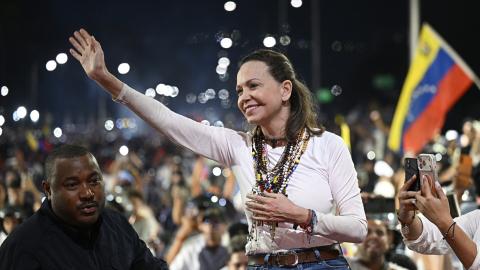
The return of María Corina Machado, Venezuela’s leading opposition figure, also introduces an element of turbulence into the stability the administration has thus far enjoyed in Venezuela. Calls for elections are growing in strength, and the political situation threatens to begin taking on a life of its own.
Far from collapsing or acquiescing, Cuba and Nicaragua have only grown more brazen in their hostility toward the United States. At the U.N. this week, a Cuban diplomat tried to interrupt Ambassador Mike Waltz’s remarks on the embargo and made physical contact with an American diplomat. Cuban President Miguel Díaz-Canel later swore that Cuba “will not back down … in the face of Yankee pressures and orders.”
The Nicaraguan regime has gone even further, shamelessly consolidating its grip on power through an announcement that the country would cease to hold elections, a declaration later converted to a formal constitutional reform process that would see Ortega and Murillo functionally installed as dictators for life.
Out of focus.
What happened? Rightly or wrongly, many actors in the region have determined that the American approach to the region is not going to be the one Washington seemed to be taking in March, for three broad reasons.
First, in his own rhetoric, Trump has repeatedly stated that the U.S. will deal with Cuba after it finishes with Iran. This may be honest and even prudent, but the lessons the Cubans (and the Nicaraguans, who are sometimes mentioned as being next on the administration’s to-do list after Cuba) have taken from it are that they are safe as long as the U.S. remains mired in war with Iran. They have evidently decided that they can hold out until the midterm elections, when they expect Republican losses will weaken the president and potentially restrain his Western Hemisphere policy further.
Second, the administration’s priorities have sometimes come across as inconsistent. The crux of current American regional strategy, as outlined at the Doral summit, is that the U.S. will not “allow hostile foreign influence to gain a foothold in this hemisphere.” This was clearly aimed at China and Russia, but since then, Trump has made a state visit to China, hosted Xi Jinping at the White House, and generally taken a more conciliatory approach to U.S.-China relations than expected.
A military pact with Nicaragua that Russia ratified in April was not met with a dramatic response, and Trump has recently sought to bargain with Russia as well. These developments have made it more difficult for Latin American leaders to discern exactly where the administration’s lines are when it comes to engaging with China and Russia.
Third, the United States has not always treated its friends in a friendly manner. Nine of the 12 governments in the Shield of the Americas coalition in March were hit by the forced-labor tariffs that Washington announced in July. These tariffs were particularly harsh for Chile, whose strategic importance and friendly president couldn’t save it from being placed in the highest tariff tier of 12.5 percent. The message actions such as these have conveyed is that spending political capital to align with Washington doesn’t necessarily buy protection or preferential treatment.
None of this means that Washington has walked away from the region, that it has neglected its partners, or that it has given up on Cuba and Nicaragua. The U.S. has announced plans for $1 billion in security assistance to Colombia, continues to signal forthcoming action in Cuba, and is increasing its scrutiny of the Ortega-Murillo regime.
But compared with how things stood in March, the regional order that Operation Absolute Resolve seemed to be ushering in now appears far less certain.
Running out the clock.
Next week’s midterms could further complicate the administration’s hemispheric strategy. If Democrats win the Senate and the House, they will likely use their subpoena power to investigate a number of the administration’s actions in the region, from the drug-boat strikes to the terms of the Venezuelan oil deal to the State Department’s role in the Brazilian election. They could also use spending bills to limit the tools at the White House’s disposal. This could include barring funds for unauthorized military actions against Cuba or restricting the Pentagon office that holds Washington’s stake in the Venezuelan oil deal.
However, it seems unlikely that Democrats will gain the supermajorities necessary to override a White House veto, and paradoxically a political environment that limits Trump’s ability to pass his agenda in Congress could lead him to focus more on foreign policy, where the executive branch enjoys its broadest remit.
Regardless of the midterms’ outcome, the administration will have its hands full in the region. Bolsonaro’s flight to the U.S. will create another recurring issue in relations with Brazil, and consequential trade talks with Mexico are ongoing.
A military operation in Cuba could also be in the cards. Despite Trump’s professed confidence that a deal with the island’s communist leaders will come together, diplomacy appears to have stalled. While tensions with the Cuban government have been simmering for months, given Trump’s particular loathing for being defied or insulted publicly, Cuban behavior at the U.N. this week could prove to be a tipping point.
While Cuba has rightly become a core issue in the administration’s regional strategy, the U.S. might have an easier time reestablishing deterrence and credibility in the region by mounting a swift response to the growing problems in Nicaragua. The region is united in its view that Nicaragua has become a destabilizing presence, and the Nicaraguan regime has never faced the kind of pressure campaign the United States could bring to bear upon it. Taking decisive action against the Nicaraguan dictatorship would send a message to both the Cuban regime and remaining Chavista figures in Venezuela that Operation Absolute Resolve was not a one-off but rather the opening move toward establishing a safer, more prosperous democratic order.
The stability of that order will require the U.S. to demonstrate a willingness to make trade-offs that benefit its friends, such as conditional tariff relief for countries that continue to align with Washington. Perhaps most important, it will also require the U.S. to see the return of democracy to Venezuela through to the end. If the U.S. can prove that it is capable not only of destroying things that are evil but also of building things that are good, American power will seem like something to follow rather than to fear.