










The Memorandum of Understanding between the United States and the Islamic Republic of Iran has been signed remotely and is in effect. By now, analysts have already aired the most troubling aspects of it: The MOU requires the United States to lift its naval blockade in the Strait of Hormuz as well as its sanctions on Iranian oil as a trade for the Iranians no longer firing missiles and drones at shipping in the strait. As a result, Iran, which just a day ago was suffering from the very effective American blockade, will now receive billions of dollars from oil exports over the next 60 days, at which point there is expected to be another negotiated agreement that lays out the details about the fate of the Iranian nuclear program. The United States will also refrain from “meddling” in Iranian domestic affairs (no more American support and advocacy for the Iranian people).
The MOU doesn’t say much about the Iranian nuclear program. It says that Iran’s nuclear program must “maintain the status quo,” a status that nobody really knows the details of since there have been no inspections since Operations Midnight Hammer and Epic Fury badly damaged Iran’s nuclear infrastructure and eliminated its top nuclear scientists. It says Iran “reaffirms that it shall not procure or develop nuclear weapons” and agrees to hold nuclear talks, including on the down-blending of its highly enriched uranium that is near weapons-grade. But down-blending is easily reversible, much like the direction of the wind and Iranian commitments. And, if the MOU relieves the pressure President Trump created and imposed on Iran, the United States’ leverage to implement aspirational plans to dismantle Iran’s nuclear program will be diminished, if not entirely evaporated.
There are numerous other offensive aspects of the deal, like the $300 billion investment fund that the United States will facilitate but will not fund (this is an important distinction because supporters of the deal will accuse those who have a problem with this as being confused about whose money it is). The source of the money matters, but it also matters that the mighty United States has now committed to help secure those investments for a state that is run by an apocalyptic Islamist theocracy. The only good news here is that the fund is almost certainly not going to happen; putting money into a terrorist state which conducts industrial-scale executions of its citizens is not a particularly attractive pitch for investors.
None of this is good, and most commentary has rightly concluded that the president is fixated, above all, on getting oil flowing through the strait to avoid a global catastrophe with oil reserves. The myriad other problems that remain with Iran, including Trump’s demand for the permanent shuttering of its illicit nuclear program, have simply been punted for the United States to solve on a later date. Its defenders believe that getting oil flowing freely is worth enriching the regime, at least through the midterm elections.
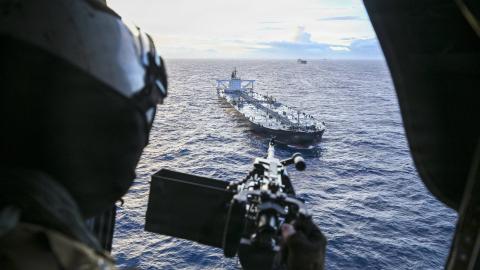
This view underappreciates what all is at stake. While the United States and Israel won the war, there were significant conditions required to achieve a victorious peace. The most obvious and geopolitically significant of these was ensuring Iran is not — and cannot — hold global shipping hostage any longer. In other words, the United States — and its allies — should ensure safe and free passage throughout the Strait of Hormuz, an international waterway. That is not what the MOU states.
Instead, it states that the “Islamic Republic of Iran will conduct dialogue with the Sultanate of Oman to define the future administration and maritime services in the Strait of Hormuz.” That means that, once Iran clears Hormuz of the mines (does anyone trust the IRGC to clear the mines it laid to hit the ships it is now claiming to protect?), it might gain internationally recognized governance over the strait. The details have not yet been resolved, and therefore the fight over the strait continues, but it is leaning towards Iran — and not the United States — claiming the strait as the biggest prize of the war.
There is evidence that President Trump knows that Iran should not be permitted to so much as threaten to close this key chokepoint. One only needs to take stock of his public remarks, which demonstrate that Trump has warned against permitting Iran to threaten the strait for over a decade.
Trump has made it clear he understands that not only must the strait be safe for shipping traffic — it must also be free and open with no tolls. This is a vital American interest. In his remarks during the Tanker War, on May 29, 1987, President Ronald Reagan declared: “The use of the vital sea lanes of the Persian Gulf will not be allowed to come under the control of the Soviet Union. The Persian Gulf will remain open to navigation by the nations of the world.” He went on: “I will not permit the Middle East to become a chokepoint for freedom or tinderbox of international conflict. Freedom of navigation is not an empty cliché of international law. It is essential to the health and safety of America and the strength of the alliance.” Reagan’s aim, like Trump’s, was peace. And he got it through grit, political resolve, and military force supported by U.S. allies — the U.K., France, Italy, and Saudi Arabia. Trump could do the same thing. Europeans have said they are ready and willing to help, but on the condition that Iran, Oman, and the United States ask for help. Trump would be wise to take their help but insist there can be no waiting on Iran for the green light.
Ceding authority over the strait to Iran gives it more leverage and international stature than it had before Operations Midnight Hammer and Epic Fury began. Before, warships sailed through without the permission of any nation. Now, Iran seems poised to collect tolls by calling them “fees.” This would set what should be an intolerable precedent for other major chokepoints, especially in Asia. Administration officials undoubtedly tried to remove this provision from the MOU but seem to have concluded that they could capitulate to Iran because the Gulf states would ensure it couldn’t collect tolls. That is a risky gambit considering that the Gulf states were risk averse for fear of Iran hitting their infrastructure.
At best, the fate of the strait remains unresolved as shipping ticks back up. The battle over the strait may have a 60-day reprieve, but it is not over. However, after the MOU, the momentum is with Iran — at least for now.